BIA Remands Bond Determination for Further Flight-Risk Findings
BIA bond determination spotlights flight-risk proof. See which residence, sponsor, and status records matter, then request a free evaluation today.
Published on October 28, 2026· Updated October 28, 2026
Talk to an immigration attorney
Free call. A clear plan for your case.
Free & confidential · Se habla espanol · Mon-Fri 8am-7pm, Sat 9am-2pm (ET)

Have questions? Talk to an attorney - free evaluation.
Call 1-844-967-3536Worried how the latest immigration news affects you?
Schedule a confidential case review with an immigration attorney - know exactly where you stand.
USCIS Case Status
Check your USCIS case status
Enter your receipt number and get the official status. Free, no registration.
BIA Remands Bond Determination for Further Flight-Risk Findings
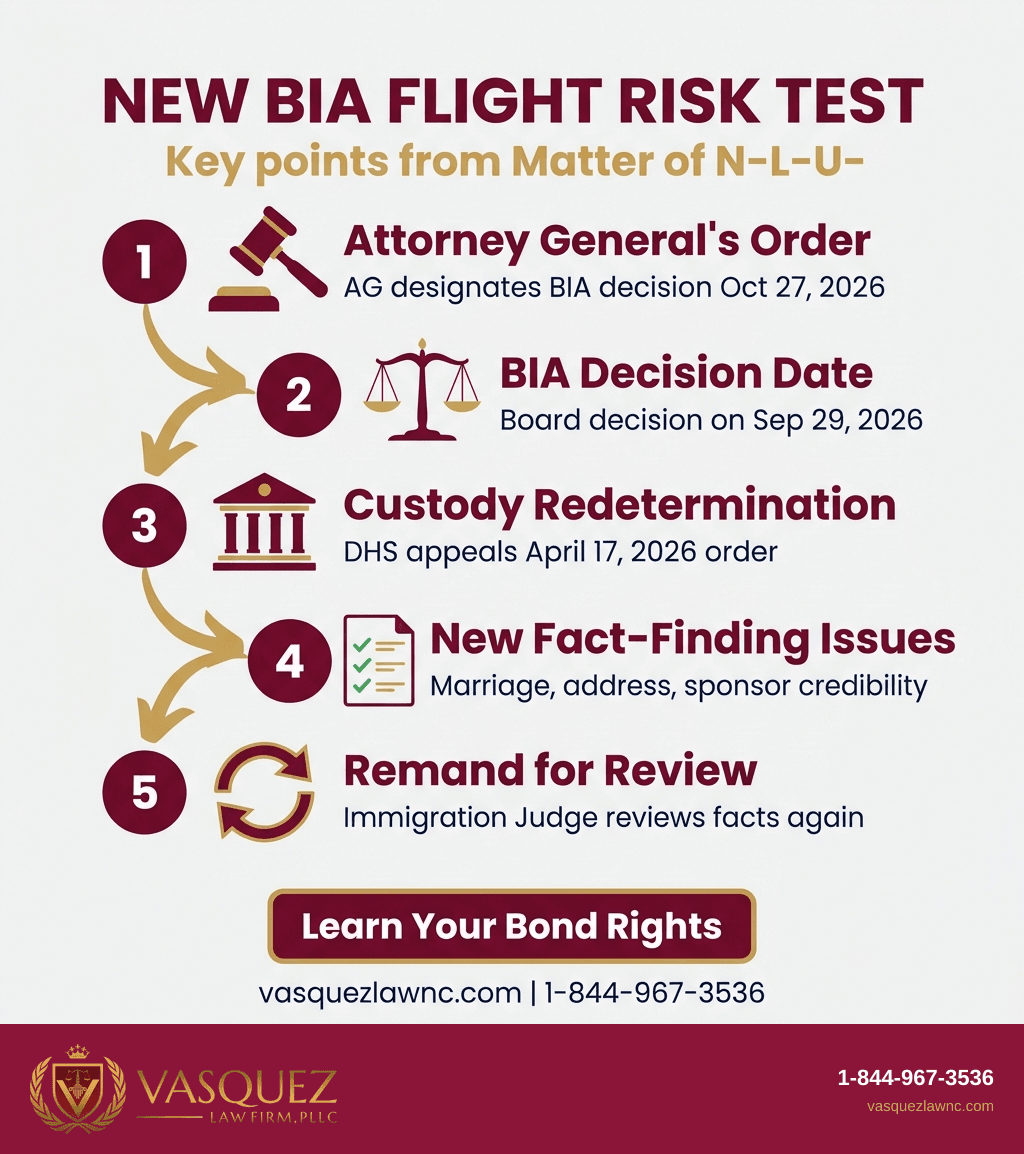
Pursuant to Order No. 7270-2026, dated October 27, 2026, the Attorney General designated the Board’s decision in Matter of N-L-U- (BIA Sep. 29, 2026), as precedent in all proceedings involving the same issue or issues. This decision remanded a detained respondent's case to an Immigration Judge for further fact-finding regarding marriage evidence, a claimed address, a proposed sponsor, and the likelihood of lawful status.
For a person seeking release from immigration detention, these details can affect the bond record. A bond record is the evidence used to decide whether release is safe and appropriate. It should show dependable reasons to return to court. Our immigration attorneys regularly review how documents support a bond request before a hearing occurs.
Legal disclaimer: This article provides general legal information, not legal advice for any person or case. Immigration custody decisions depend on the facts in each person's record. Speak with qualified counsel about your circumstances.
What happened in Matter of N-L-U-?
The Board of Immigration Appeals issued its decision on September 29, 2026. DHS had appealed an Immigration Judge's April 17, 2026 custody redetermination order. A custody redetermination is a new review of whether a detained person should be released. That order set bond at $20,000. The Immigration Judge later issued a bond memorandum on May 20, 2026.
The respondent is a native and citizen of India. DHS argued that the Immigration Judge had not fully reviewed evidence about whether the respondent would appear at later removal proceedings.
Pursuant to Order No. 7270-2026, dated October 27, 2026, the Attorney General designated the Board’s decision in Matter of N-L-U- (BIA Sep. 29, 2026), as precedent in all proceedings involving the same issue or issues.
In Matter of N-L-U-, the Board found that the record needed more fact-finding. Fact-finding means deciding what the evidence shows. The Board told the Immigration Judge to examine several issues. These included whether the respondent's marriage was genuine and workable. They also included whether he had a timely path to lawful status.
The Immigration Judge must also review whether the respondent's claimed residence is reliable. The judge must examine the credibility and financial ability of a friend proposed as a sponsor. A sponsor is a person who offers housing, money, or other support to help a detained person follow release conditions.
The decision did not decide whether this respondent should receive bond. Instead, it sent the record back for a new decision after a fuller review. This return is called a remand. A remand requires renewed consideration of the evidence.
The Board also stressed that an Immigration Judge must make findings based on the record. Findings are the judge's decisions about important facts. The concern was whether bond could mitigate, or adequately reduce, the respondent's risk of failing to appear.
Who may this BIA bond determination affect?
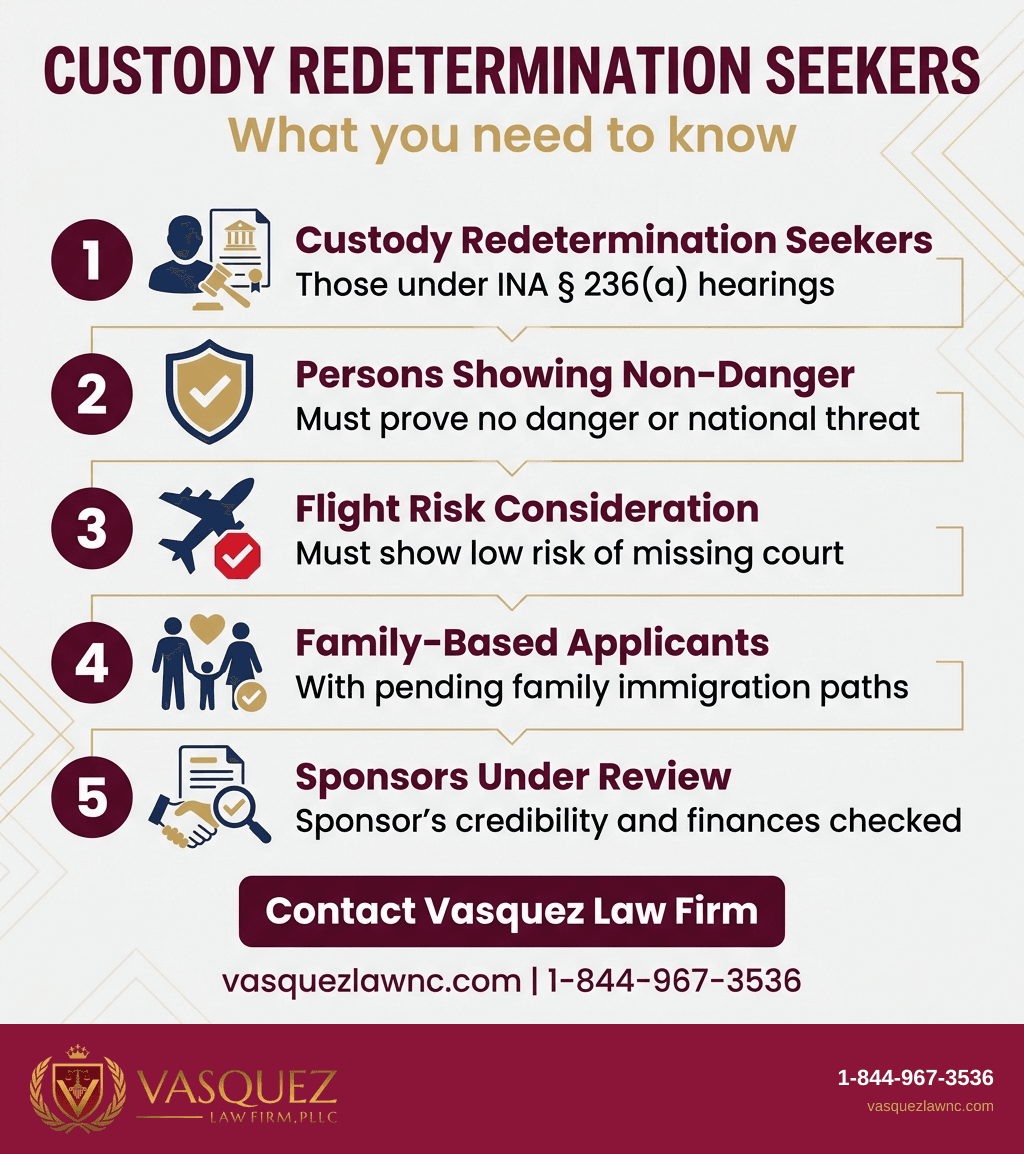
The BIA bond determination concerns people seeking custody redetermination under INA § 236(a), codified at 8 U.S.C. § 1226(a). In these discretionary custody proceedings, the person seeking release has the burden of proof.
The person must show that they do not present a danger to people or property. They also must show that they do not pose a national-security threat or a risk of flight. Risk of flight means a concern that the person may not appear for future court hearings.
The decision's reasoning is especially important when a person relies on a pending family-based immigration path. The respondent in Matter of N-L-U- had married a U.S. citizen before removal proceedings began. Yet the record did not contain a Form I-130, Petition for Alien Relative, filed by the spouse. It also did not contain a support letter from the spouse.
The Board identified evidence that DHS had raised about the marriage. The evidence included testimony and documents. They suggested that the respondent had not spoken with his wife for 20 days. They also suggested that he planned to live with a family friend rather than his wife if released.
The record also suggested that he did not know where her children lived. It showed address differences between his records and his wife's records. These facts did not decide the case by themselves. They required the Immigration Judge to examine the marriage and the proposed release plan more closely.
A pending asylum application also received focused treatment. The Board held that filing asylum alone does not sufficiently reduce flight risk. This does not decide the merits of an asylum claim. The merits are the facts and legal grounds that determine whether the claim should be approved.
The decision states that a pending asylum application on its own is insufficient to mitigate flight risk.
While the Immigration Judge found, in the alternative, that the respondent has a strong incentive to appear at future hearings because he filed an application for asylum, a pending asylum application on its own is insufficient to mitigate flight risk.
The decision also applies to bond records that rely on housing or a third-party sponsor. Here, DHS pointed to several Indiana addresses. Those addresses appeared on a marriage certificate, tax returns, and other documents.
The Board called for an assessment of whether the respondent had a fixed address. A fixed address is a stable place where the person will live and can be located. The Board also required review of the proposed sponsor's means, credibility, and relationship with the respondent.
In our experience, bond cases are strongest when the hearing record connects each claimed tie to reliable documents. The record should also include a clear plan for appearing at every hearing. A claimed tie can include a home, family relationship, job, or other community connection.
What law governs an immigration bond hearing?
Section 236(a) of the Immigration and Nationality Act, 8 U.S.C. § 1226(a), authorizes custody decisions during removal proceedings. A custody redetermination is the process in which an Immigration Judge reconsiders whether release on bond is appropriate for a person detained under that provision.
Matter of N-L-U- relies on Matter of E-Y-F-G-, 29 I&N Dec. 103 (BIA 2025), for the burden in these determinations. The person requesting release must establish that they do not pose danger, a national-security threat, or flight risk.
Flight risk involves more than a person's statement that they intend to appear. The Board's analysis draws on Matter of Guerra, 24 I&N Dec. 37 (BIA 2006). That case includes a fixed address among the relevant considerations.
The Board also cites Matter of R-A-V-P-, 27 I&N Dec. 803 (BIA 2020). That case concerns the likelihood that relief will be approved. It also concerns whether a sponsor can actually provide financial support.
For appellate review, 8 C.F.R. § 1003.1(d)(3)(i) limits the Board's review of factual findings to clear error. Clear error means a clear mistake in the judge's factual decision. This rule explains why the Board sought fuller factual findings from the Immigration Judge.
The Board must be able to review a complete record and legal analysis. Legal analysis explains how the facts apply to the law. Without enough factual findings, the Board may not be able to perform that review.
A family petition can remain important evidence. However, a marriage certificate alone is not the same as an approved immigration petition.
The Board stated that the Immigration Judge should provide complete findings of fact and legal analysis as to whether the respondent has a sufficiently probable and timely path to lawful status in the United States.
For broader context on agency guidance, readers can review the USCIS Policy Manual.
What evidence should you prepare for a bond hearing?
A bond request should begin with documents that can be checked. A person claiming a fixed residence should gather records that consistently show where they will live if released.
Depending on the facts, useful records can include a lease, utility records, mail, and a detailed letter from the household member offering housing. The records should use consistent names and addresses. Any differences should be explained clearly.
How can you document a family-based immigration path?
If a person relies on a marriage to support a bond request, they should organize the actual immigration filings and supporting evidence. A filed Form I-130, receipts, correspondence, shared records, and a credible statement from the spouse may help counsel explain the current status of that path.
The evidence must match the facts presented at the hearing. Documents that conflict with testimony can raise questions. Missing documents can also make the claimed immigration path harder to evaluate.
What should a proposed bond sponsor bring?
A proposed sponsor should be ready to show willingness and financial ability to help. Supporting materials may include a written statement, proof of lawful status where relevant, employment records, and financial documents.
The Board stressed that willingness alone is not enough when the record lacks independent proof of the ability to provide support. Independent proof comes from records other than the sponsor's own statement. Those records can help show that the release plan is realistic.
How should you handle conflicting information?
Address discrepancies directly. A discrepancy is a difference between two records or statements. If different addresses appear in past filings or records, identify the reason. Then provide documents that clarify the timeline.
Leaving an inconsistency unexplained can make it harder for an Immigration Judge to find that a release plan is reliable. A short, accurate explanation is usually better than ignoring the issue.
Matter of N-L-U- reiterated, citing Matter of Z-N-L-, that a pending asylum application on its own is insufficient to mitigate flight risk.
Build a record that covers residence, family connections, financial support, immigration relief, and a realistic plan to attend proceedings. Immigration relief means a legal benefit that may allow a person to remain in the United States. The record should connect each item to documents and testimony.
Need help preparing for an immigration custody hearing? Vasquez Law Firm offers a free evaluation for immigration matters nationwide, with in-person consultations in Raleigh, NC and Orlando, FL. Se Habla Español.
What should you watch after a bond remand?
The next step in Matter of N-L-U- is further proceedings before the Immigration Judge. The judge must enter a new decision that follows the Board's opinion. The Board expressly stated that it was not deciding the final result of the respondent's custody case.
People with similar hearings should watch how Immigration Judges apply the decision's focus on evidence. The central question is whether the record reliably supports a residence, sponsor, and sufficiently probable path to lawful status.
The judge will consider whether these factors together reduce flight risk. It is not yet settled whether a particular person's own records will meet that standard. The answer depends on the evidence presented in that custody proceeding.
The published Matter of N-L-U-, 30 I&N Dec. 195 (BIA 2026) identifies the record issues that Immigration Judges must examine on remand.
Frequently Asked Questions
What did the BIA decide in Matter of N-L-U-?
The Board remanded a custody redetermination for additional fact-finding. It found that the Immigration Judge had not adequately addressed evidence concerning the respondent's marriage, potential lawful status, claimed residence, and proposed financial sponsor. It required a new decision after fuller factual findings and legal analysis.
Can a pending asylum application reduce flight risk by itself?
No. Matter of N-L-U- states that a pending asylum application on its own is insufficient to mitigate flight risk. This does not resolve the asylum application. It means that, for a bond hearing, the person should also present reliable evidence about residence, community or family ties, financial support, and reasons they will attend future proceedings.
Why does a Form I-130 matter at a bond hearing?
A Form I-130 can be relevant when a person argues that a family-based immigration path gives them a strong reason to appear in court. In this case, the Board noted that there was no evidence the respondent's spouse had filed an I-130. The decision requires a realistic, sufficiently probable, and timely path to lawful status, supported by the record.
Why can address records affect an immigration bond decision?
A fixed address is a factor in evaluating flight risk under Matter of Guerra. The Board directed further consideration because the record contained several Indiana addresses on the respondent's marriage certificate, tax returns, and other materials. Consistent housing evidence can help an Immigration Judge evaluate whether a release plan is stable and credible.
What must a financial sponsor show for a bond request?
The decision says an Immigration Judge should examine the sponsor's credibility, reliability, relationship with the respondent, and financial means. The Board cited Matter of R-A-V-P-, under which a friend's willingness to provide financial support, without independent evidence of the friend's ability to do so, is insufficient to adequately ensure appearance at removal proceedings. Documentary proof can make the proposed support more concrete.
Does a BIA remand mean immigration bond will be granted?
No. A remand returns the case for additional proceedings and a new decision. In Matter of N-L-U-, the Board expressly gave no opinion on the ultimate outcome. The Immigration Judge must reassess flight risk using complete findings grounded in the record, and may take other action appropriate to resolve the proceedings.
Sources
Immigration detention can move quickly, but a careful record can give an Immigration Judge the information needed to assess release. Contact Vasquez Law Firm for a free evaluation tailored to your circumstances. This is general information, not individualized legal advice.
Reviewed by Attorney Vasquez, Managing Attorney
Need legal help?
Immigration in NC and FL. Personal injury and workers compensation across NC. Criminal defense in Johnston, Harnett and Pitt counties, and traffic tickets in 10 NC counties. Tell us your county and we will tell you exactly what we can do.
Keep Reading


William Vasquez
Founder & CEO, Vasquez Law Firm, PLLC
William Vasquez is the founder and CEO of Vasquez Law Firm, PLLC, a results-driven firm specializing in immigration, criminal defense, personal injury, and workers' compensation. A U.S. Air Force veteran and recipient of the Joint Service Achievement Medal, William is dedicated to fiercely fighting for his clients' rights.
Related Legal Services
Need legal help? Learn more about learn about our immigration practice, or contact us for a free evaluation.
You can also visit NC immigration legal help for more information.