BIA Dismisses Appeal After Hearing Notice Was Returned from the Only Address in the Record
BIA due process notice requirements explain when returned hearing mail can support removal in absentia. Know your rights, request a free evaluation.
Published on October 28, 2026· Updated October 28, 2026
Talk to an immigration attorney
Free call. A clear plan for your case.
Free & confidential · Se habla espanol · Mon-Fri 8am-7pm, Sat 9am-2pm (ET)

Have questions? Talk to an attorney - free evaluation.
Call 1-844-967-3536Worried how the latest immigration news affects you?
Schedule a confidential case review with an immigration attorney - know exactly where you stand.
USCIS Case Status
Check your USCIS case status
Enter your receipt number and get the official status. Free, no registration.
On October 22, 2026, the Board of Immigration Appeals held that an Immigration Court does not need to take more steps after hearing mail is returned. This rule applies when the court used the only address in its record. The ruling in the respondent’s case, 30 I&N Dec. 170 (BIA 2026), examines BIA due process notice requirements. These requirements can affect whether a missed hearing leads to a removal order in absentia.
For a person in removal proceedings, an envelope marked undeliverable can separate appearing before a judge from learning later that an order was entered. Our immigration attorneys help clients understand address records, hearing notices, and motions to reopen. These issues can affect an immigration case.
Legal disclaimer: This article provides general legal information. It does not provide advice for any person’s case. Removal proceedings depend on the specific record. That record includes every address filed with the Immigration Court and the reason a hearing was missed.
What did the BIA decide about due process notice requirements?
The BIA dismissed the respondent’s appeal. The case followed a long procedural path. That path began with removal proceedings on February 22, 2019. The Department of Homeland Security filed a Notice to Appear. This document starts removal proceedings. DHS then filed an ICE Form I-830 four days later. It did so after the respondent’s release from detention. The form listed a Richland, Washington address and a telephone number.
On September 9, 2019, the Immigration Court mailed a hearing notice to that address. The mail came back marked return to sender, not deliverable as addressed, and unable to forward. The respondent missed the January 8, 2020 hearing. The Immigration Judge then entered a removal order in absentia. This means an order entered after the person did not appear.
The respondent later filed a motion to reopen. A motion to reopen asks the court to reconsider a completed matter. He asserted that he never received the notice. His filings confirmed that the address was correct. A postal employee’s letter stated that the mailbox became full. Mail was held at the post office for 10 days. The notice was then returned as unclaimed.
The Immigration Judge denied reopening on April 7, 2020. The BIA affirmed that decision on October 21, 2020. The Ninth Circuit later returned the case to the BIA. It directed the BIA to apply the court’s intervening decision in United States v. Rivera-Valdes.
“Where the Government learns that its notice efforts have not succeeded, that knowledge triggers an obligation on the Government’s part to take additional reasonable steps to effect notice, if it is practicable to do so.”
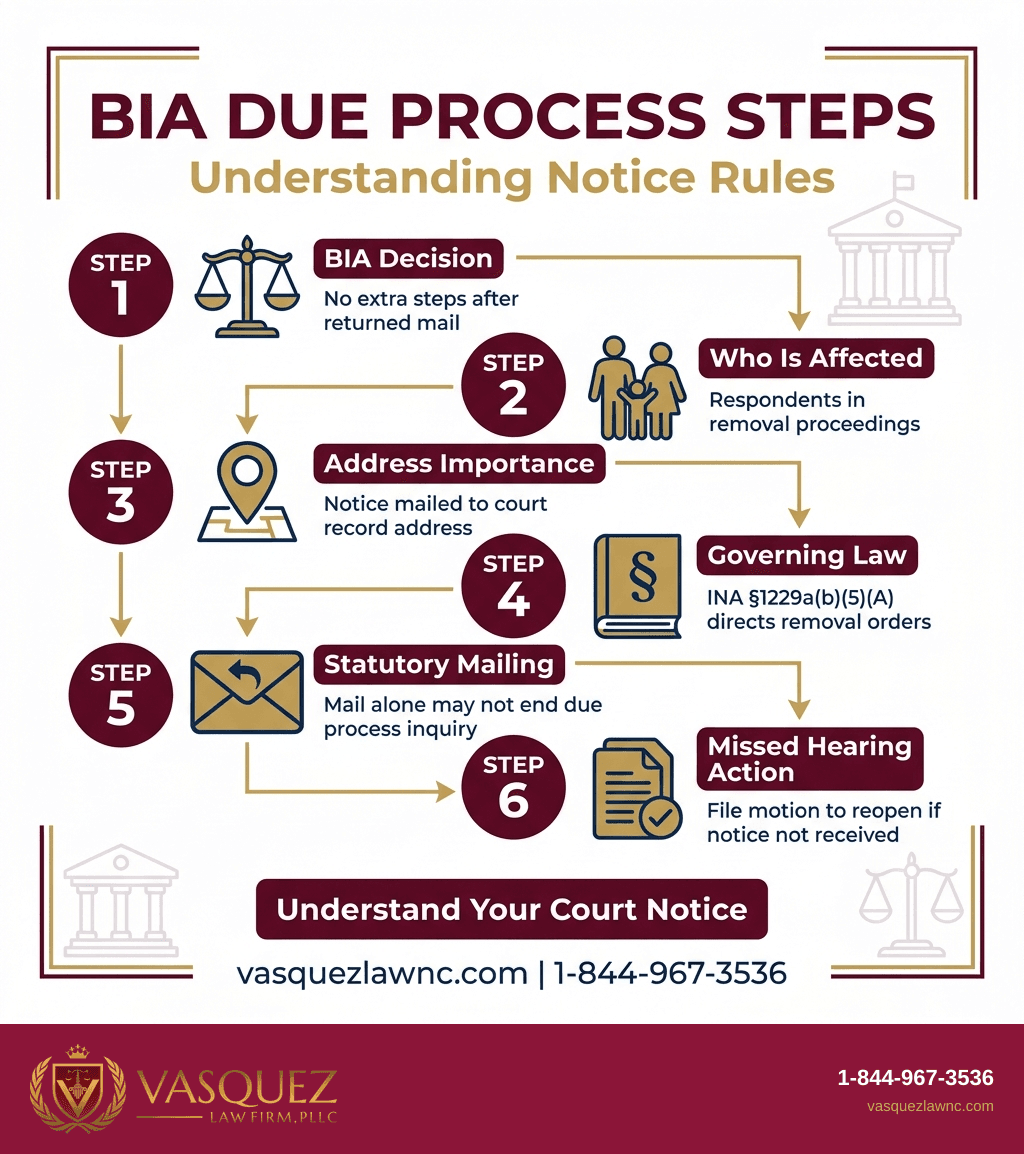
The BIA concluded that the Ninth Circuit’s due process framework applies in civil removal proceedings. Still, the BIA found that the Court had used the correct and only address in the record. It therefore found no further reasonably available or practicable step. The Immigration Court or BIA did not need to take another step.
Who can be affected by the BIA due process notice requirements?
The decision directly concerns respondents in removal proceedings. The agency relies on the address provided by the parties when serving notice by mail. The decision is especially relevant when mail is returned. It also matters when a person later challenges an in absentia removal order. The person may claim that the person did not receive notice.
The result depends on the record. In this case, the BIA emphasized that the hearing notice went to the respondent’s correct address. No other mailing address appeared in the record. In other cases cited by the BIA, the notice was sent to an invalid address or to an address provided by a third party instead of the respondent’s address.
That distinction matters. A returned notice does not automatically answer every due process question. Due process means basic fairness required by the Constitution. Under the Ninth Circuit framework discussed by the BIA, the government’s knowledge can matter. If a notice attempt failed, the government may need to take more reasonable steps. Those steps must be practicable, meaning reasonably possible in the circumstances. The BIA concluded that no such step was available here. The court had no alternative address.
The decision also draws a line between DHS and EOIR. DHS prosecutes removal proceedings and handles enforcement functions. EOIR means the Executive Office for Immigration Review. It includes Immigration Courts and the BIA. EOIR performs an adjudicatory role. The BIA reasoned that courts should not independently investigate a respondent’s location. The Board noted that it does not conduct site visits to verify an address or online research to reach a respondent, and it held that making Immigration Courts generally responsible for calling a phone number in the file is not reasonable.
The BIA raised practical and institutional concerns. A telephone call could create risks involving ex parte communication. Ex parte communication means contact with one side without the other side’s participation. A call could also create problems with identity verification and confidential information. The BIA also reasoned that locating respondents could harm the neutral role of Immigration Judges and the Board.
Why does the address record matter so much?
Federal regulations place responsibility on the respondent. The respondent must correct an address or report an address change through Form EOIR-33. The rule applies during proceedings before the Immigration Court. Where applicable, it also applies before the BIA. A written address record is not a minor administrative detail. It is the channel for a hearing date, time, and location. The notice may reach the respondent through that channel.
We typically see address problems become clear only after a hearing has been missed. At that point, the record and mail history become central. People facing removal proceedings should preserve copies of address filings. They should also preserve returned envelopes, postal records, and every notice received from the court. These documents may show what happened before and after the hearing date.
What law governs due process and immigration hearing notice?
Section 240(b)(5)(A) of the Immigration and Nationality Act, codified at 8 U.S.C. § 1229a(b)(5)(A), directs an Immigration Judge to enter an in absentia order. The judge must do so if the statutory requirements are met and the respondent does not appear. This consequence makes proper notice a central due process issue. It is an important issue in immigration proceedings.
INA § 239(c), 8 U.S.C. § 1229(c), addresses service by mail. The mail goes to the last address provided by the respondent. The BIA decision also discusses INA § 239(a)(2), 8 U.S.C. § 1229(a)(2). That section concerns notice of changes or postponements. The changes may involve the hearing time or place.
Background law separates statutory notice from constitutional due process. Statutory notice means notice required by a law passed by Congress. Constitutional due process means the fairness required by the Constitution. The BIA relied on the Ninth Circuit’s reading of Mullane v. Central Hanover Bank & Trust Co. and Jones v. Flowers. Under that framework, notice must be reasonably calculated to inform a person about pending removal proceedings. It must also provide an opportunity to attend and participate.
“When mail sent to the only address in the record provided for a respondent is returned as undeliverable, there are no additional reasonably available or practicable steps the Board or an Immigration Court can take to effect notice.”
The address-update regulations are equally important. Respondents are required to inform the Immigration Court or the Board, as applicable, of any necessary corrections to the address listed on the notice to appear and any change of address through the filing of a Form EOIR-33. DHS is required to inform the Immigration Court of any change in a respondent’s custody location, and if released, the respondent’s address, through the filing of an ICE Form I-830.
Does statutory mailing end the due process inquiry?
Not always. The BIA explained that the Ninth Circuit rejected a particular position. That position said compliance with INA notice provisions automatically defeats a due process claim. The question is whether the notice method was reasonably calculated to reach the respondent under the circumstances. In this case, two facts drove the outcome. The address was correct. There was no alternative address.
What should you do if you miss an immigration court hearing?
Start by obtaining and organizing the record. Obtain means get the documents kept in the case file. Keep your Notice to Appear and hearing notices. Keep Form EOIR-33 filings and Form I-830 paperwork if available. Also keep mailing receipts, returned envelopes, and postal documentation. These records can show which address was filed. They can show where the court sent notice and what happened during delivery.
Next, verify your current address with the Immigration Court handling the case. File the required address-change form when needed. Do not rely only on an address change made with another agency. The BIA’s decision emphasizes an important point. The Immigration Court relies on the address in its own proceedings record.
Then review whether a motion to reopen may be available. A motion to reopen asks the Immigration Judge or BIA to revisit a completed matter. A claim based on lack of notice may require close review. The review may include the mailing address and the notice record. It may also include whether another practicable means of notice was available in the case.
Do not ignore a returned envelope. Do not ignore an unexpected absence of hearing notices. Ask for a copy of the case record. Confirm hearing information directly with the Immigration Court. The official USCIS Policy Manual is also a useful government reference for many benefit matters. Immigration Court proceedings and USCIS benefit applications are different systems, however.
What documents should a family keep?
Keep a dated file with each court notice. Include copies of every address form, proof of mailing, identity documents, and immigration receipts. Include postal tracking and any employee statement. If a household moves, keep evidence of the former and new addresses. These materials may help establish a timeline. They may become important if notice is disputed later.
Concerned about a missed hearing or removal order? Vasquez Law Firm offers a free immigration evaluation to review the documents that matter. Se Habla Español.
What should you watch for after this BIA notice decision?
The immediate rule from the respondent’s case, 30 I&N Dec. 170 (BIA 2026), is tied to a specific record. That record had one correct address and no alternative address. Future disputes will likely focus on the addresses available to the government. They will also focus on whether another practical step existed after returned mail.
Readers should watch decisions from federal courts of appeals and the BIA. Those decisions may apply Rivera-Valdes and Meza Medina v. Blanche to different notice records. These cases matter because they examine the practical details of notice. They do not treat a mailed envelope as the end of every inquiry.
It is not yet settled whether a particular respondent’s records show another practical way to provide notice after mail is returned. That answer requires the actual court file. It also requires the address history and procedural posture. Procedural posture means the stage and history of the case.
For dependable updates about individual hearings, use the Immigration Court’s case information tools. Also review notices issued in the case. For broader immigration-benefit updates, consult the USCIS Policy Manual. People should also keep a current address on file. They should not wait for a hearing problem to emerge.
Frequently Asked Questions
Can an Immigration Judge order removal if I miss my hearing?
Yes, INA § 240(b)(5)(A), 8 U.S.C. § 1229a(b)(5)(A), authorizes an in absentia removal order when statutory requirements are met and the respondent does not appear. Whether notice was legally sufficient can be a critical question. The answer depends on the notice record and the circumstances of the individual proceeding.
Does returned mail always mean notice was inadequate?
No. In the respondent’s case, the hearing notice was returned, but the BIA found that it had been mailed to the correct and only address in the record. It concluded that the Immigration Court and BIA had no additional reasonably available or practicable method to effect notice in that case.
What is Form EOIR-33?
Form EOIR-33 is the form used to notify the Immigration Court or BIA of a respondent’s address correction or address change. Keeping a copy and proof of filing is prudent.
Can the Immigration Court call me if hearing mail is returned?
The BIA concluded that calling was not a reasonably practicable obligation for the Immigration Court or BIA in the case before it. The decision cited concerns about court workload, ex parte communications, confirming identity, confidentiality, and the court’s neutral adjudicatory role. A different record can raise different factual issues.
What is constructive notice in removal proceedings?
Constructive notice generally refers to legal notice based on compliance with required mailing procedures, even when a person asserts they did not actually receive the mail. The BIA explained that statutory compliance does not necessarily resolve a separate due process analysis under the Ninth Circuit’s framework.
What should I preserve if I did not receive a hearing notice?
Preserve your Notices to Appear, hearing notices, address forms, mail receipts, returned envelopes, postal tracking, and records showing where you lived. In this case, the correct address, the returned mail, and the postal employee letter were all part of the procedural record considered by the Immigration Judge, BIA, and Ninth Circuit.
Sources
Legal disclaimer: This information is general and may not fit your facts. For guidance about a removal hearing, address record, or possible motion to reopen, contact Vasquez Law Firm’s immigration legal team for a free evaluation. We meet immigration clients in Raleigh, NC and Orlando, FL, and assist clients nationwide.
A missed hearing deserves prompt, careful review. Speak with Vasquez Law Firm about your immigration record and available options.
Reviewed by Attorney Vasquez, Managing Attorney
Facing Deportation?
Time is critical. Our deportation defense attorneys are available 24/7 for emergency cases.
Keep Reading



William Vasquez
Founder & CEO, Vasquez Law Firm, PLLC
William Vasquez is the founder and CEO of Vasquez Law Firm, PLLC, a results-driven firm specializing in immigration, criminal defense, personal injury, and workers' compensation. A U.S. Air Force veteran and recipient of the Joint Service Achievement Medal, William is dedicated to fiercely fighting for his clients' rights.
Related Legal Services
Need legal help? Learn more about NC immigration legal team, or contact us for a free evaluation.
You can also visit statewide immigration attorneys for more information.