Visa Applicants Social Media Screening Reported for 2026
Will visa applicants face expanded social media screening in October 2026? Understand DS-160 disclosures and protect your case. Request an evaluation.
Published on September 27, 2026
Talk to an immigration attorney
Free call. A clear plan for your case.
Free & confidential · Se habla espanol · Mon-Fri 8am-7pm, Sat 9am-2pm (ET)

Have questions? Talk to an attorney - free evaluation.
Call 1-844-967-3536Worried how the latest immigration news affects you?
Schedule a confidential case review with an immigration attorney - know exactly where you stand.
USCIS Case Status
Check your USCIS case status
Enter your receipt number and get the official status. Free, no registration.
Federal reporting has raised questions about broader social-media screening for visa applicants beginning in October 2026. The available news summary does not identify a published federal notice, the visa classes involved, or the standards officers would use. This gap matters. Applicants should not change a DS-160 or delete an account because of an unverified headline.
This is general legal information. It is not advice for any person’s case. Visa processing is federal. It applies wherever an applicant lives, including Raleigh, NC and Orlando, FL. Our immigration attorneys can review the records and application history that matter to a specific visa case.
Need a Work Visa or Permit?
H-1B, TN, L-1, and more. We help workers and employers navigate the visa process.
Social-media identifiers have already appeared on many nonimmigrant and immigrant visa forms for years. The practical question is not whether every post looks perfect. The important question is whether the information given to the government is complete, consistent, and truthful.
What has actually been announced about visa applicants social media screening?
The only supplied report says that the United States will review social media for more visa applicants beginning in October. It does not name the agency that issued the report. It gives no date for an announcement. It does not quote an official statement or link to a government notice. It also does not say whether the report concerns consular officers abroad, USCIS benefits adjudicators, or both.
That difference is central. The Department of State decides whether to issue a visa at a U.S. embassy or consulate. USCIS decides many immigration benefits inside the United States. These benefits include adjustment of status and certain petitions. A report that uses the words “visa applicants” should not be treated as a new rule for every USCIS filing.
Visa applicants social media screening is therefore a reported development. It is not a confirmed rule change based on the materials provided here. Readers should look for a dated State Department announcement, revised form instructions, or a Federal Register notice. Each source would identify the legal authority, start date, covered forms, and any exception.
Social-media disclosure itself is not new. Some Department of State visa forms have required applicants to provide identifiers used on listed platforms during a defined period. An identifier is a handle or username. It is not a password. The supplied report does not say that officers will request passwords, private messages, browsing history, or every deleted account.
Federal agencies may collect information that relates to eligibility and security review. Applicants still deserve clear notice about what a form requires. Until an official instruction changes, answer the version of the form used in your application process. Do not rely on social-media rumors. This includes advice shared through Reddit threads. Such advice cannot replace the actual form and its instructions.
Why the missing details matter
A broad review and a new disclosure requirement are different things. A broad review may change an agency’s internal screening. A disclosure requirement changes what an applicant must provide. The news summary does not prove either point with an official document.
Who could the reported screening reach?
The report uses the broad words “more visa applicants,” but it names no visa category. It does not say whether social media vetting for B1/B2 visa applicants, social media vetting F1 visa applicants, exchange visitors, workers, or immigrant visa applicants would be included. It also does not list any exclusions.
A visitor planning a B1/B2 trip should not assume that student visa rules apply to that person. An F1 applicant should not assume that a report about consular screening changes the requirements for a pending USCIS petition. Each person must identify the form, agency, and stage of the case.
The usual consular process starts with a visa application. It may also include an interview. A consular officer may ask follow-up questions. The officer can place a case into administrative processing when more review is needed. Administrative processing is extra review before a final decision. The report gives no expected processing time. It gives no number of affected applications. It also gives no evidence that every applicant will receive the same level of review.
For families in Raleigh, NC and Orlando, FL, the federal nature of this issue matters. A relative abroad may apply through a consulate. At the same time, a U.S. petitioner may have a separate USCIS family petition. The petition does not itself guarantee visa issuance. Families can review this difference through our resource on family immigration petitions in 2026.
People already in the United States should not assume that a consular report controls every immigration benefit. USCIS uses its own forms and decision procedures. The agency’s USCIS Policy Manual is a reliable starting point for USCIS policy. A visa applicant should check the instructions for the specific consular form instead.
What the report does not establish
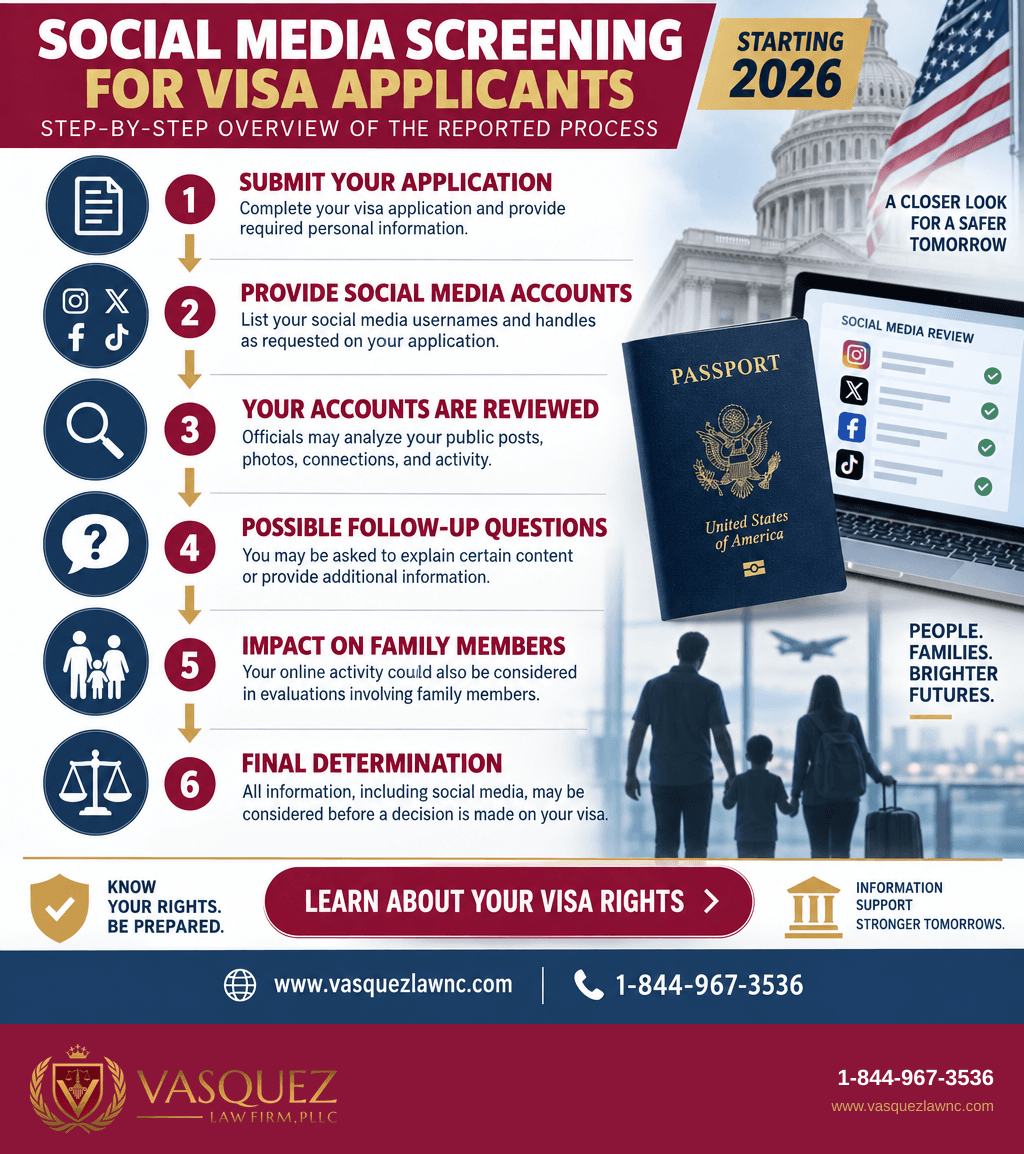
The supplied material does not say that accounts must be public. It does not say that a U.S. visa social media public setting is mandatory. It also does not say that a US visa social media deleted account creates automatic denial. Those claims require an official source and facts about the individual case.
What law governs social-media questions in visa cases?
Section 221 of the Immigration and Nationality Act, codified at 8 U.S.C. § 1201, governs visa issuance and authorizes the visa application process. Section 222, 8 U.S.C. § 1202, addresses visa application requirements. These statutes create the framework for collecting information needed to decide eligibility.
A visa applicant must also understand the grounds of inadmissibility in INA § 212(a), 8 U.S.C. § 1182. Inadmissibility means a legal reason that a person may not receive a visa or enter the United States. The applicable ground depends on the facts. A person’s use of social media does not, by itself, create a ground of inadmissibility.
For many temporary visa applicants, INA § 214(b), 8 U.S.C. § 1184(b), creates a presumption that the person intends to immigrate. The applicant must establish eligibility for the temporary classification. A refusal under that provision is different from a fraud finding. It should not be confused with a social-media review.
Truthfulness remains the key legal issue. INA § 212(a)(6)(C)(i), 8 U.S.C. § 1182(a)(6)(C)(i), can make a person inadmissible for fraud or willful misrepresentation of a material fact to obtain an immigration benefit. “Material” generally means that the statement could affect the decision. An omission on a DS-160 social media list can become serious when the form asks for the information and the omission is deliberate and relevant.
The regulations also address visa applications and decisions. See 22 C.F.R. § 41.103 for nonimmigrant visa application requirements and 22 C.F.R. § 42.63 for immigrant visa applications. These rules provide legal background. They do not confirm the reported October expansion.
Do not confuse access with disclosure
Disclosing a username does not mean that the government can automatically see all private content or a person’s full browsing history. The wording of the form controls. Keep the form confirmation page. Also keep any written request for more information.
What should a visa applicant do now?
Start with the exact application you plan to submit. Read every question slowly. This includes the social-media identifier section. Make a private list of accounts, handles, former usernames, and platforms used during the period named on the form. Check the spelling against the application before you submit it.
Second, do not delete an account simply because a headline says screening may expand. Deleting information can cause confusion if an application asks about past accounts. If an account was already closed, record the platform, identifier, approximate dates of use, and reason it closed. Answer only what the form asks.
Third, compare important statements across your immigration record. Names, employment, school history, travel, marital history, addresses, and prior applications should be accurate and consistent. If a prior filing contains an error, get a copy of that filing. Identify the correction before the interview.
Fourth, keep evidence organized. Save DS-160 confirmation pages, appointment notices, passport biographic pages, prior visas, refusal sheets, and written communications. For a USCIS case, check the agency’s processing-times tool. Do not rely on a social-media post for timing.
In our experience, the first question in these cases is often whether an old username must be disclosed. The next concern is whether a small inconsistency will decide the entire case. A careful review separates a required correction from an assumption about what an officer may see.
Finally, get legal advice before submitting a form if past statements, arrests, prior refusals, account changes, or public posts may create a material inconsistency. A review is especially useful when a family petition is pending. It can also help when a prior immigration decision affects the visa strategy.
What is still unknown before October?
The key unanswered question is whether an official agency will publish an expanded-screening policy at all. The supplied report gives no official document, date, form number, transition period, or definition of the applicants it describes. It also provides no instructions for cases that are already pending.
No stated answer explains whether officers would review only publicly available material. There is also no answer about whether officers would request more identifiers. The report does not say whether procedures would differ by visa class. It also does not identify a court challenge, proposed legislation, or deadline for public comment.
What's Your Immigration Situation?
Answer 3 questions - we'll tell you your options
Question 1 / 3
What best describes your situation?
Keep Reading
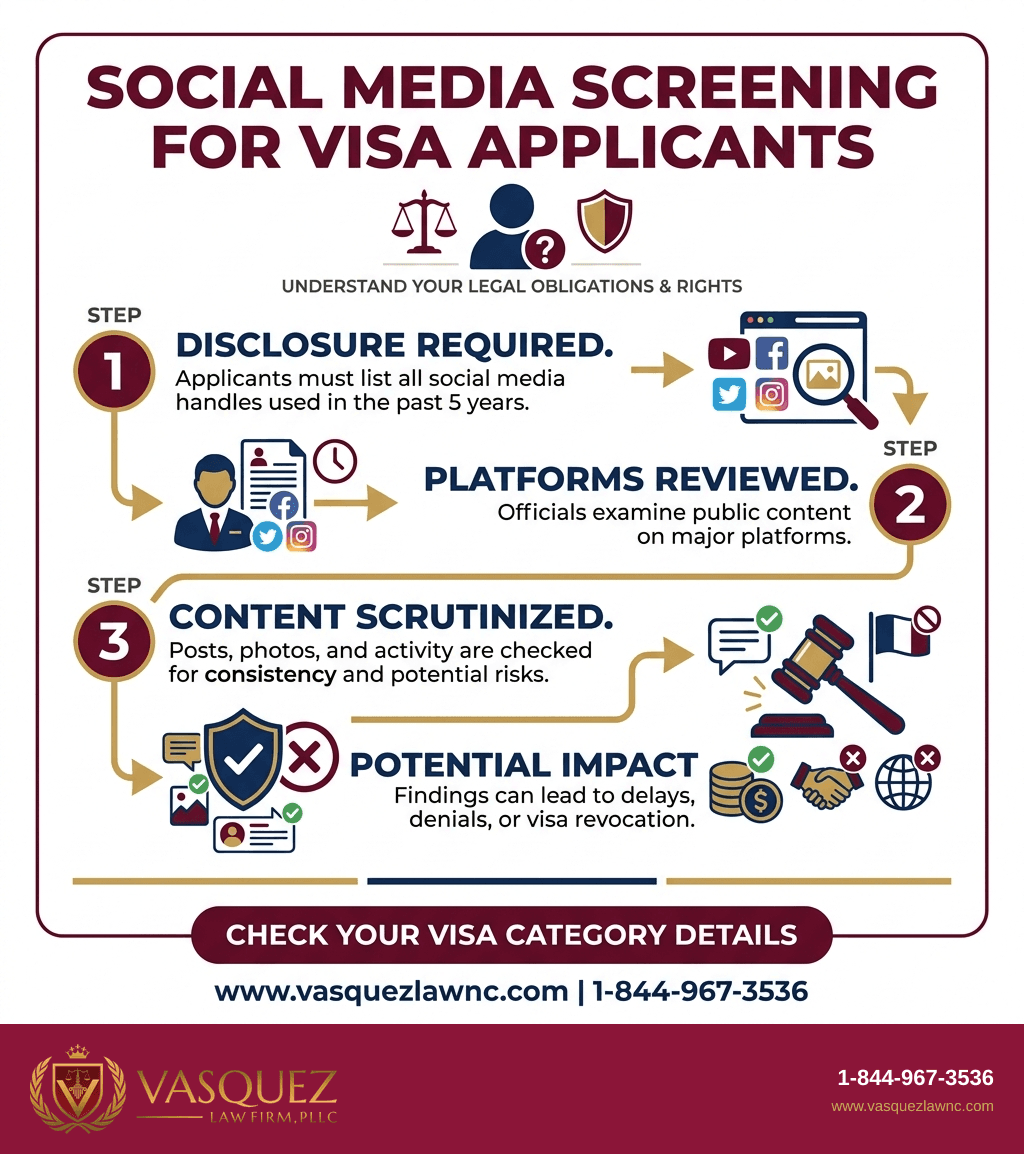
Applicants can reduce uncertainty by following the agency handling the matter. Keep copies of every form version and submission receipt. Do not treat a viral claim that USCIS sees browsing history as proven fact. USCIS cases and consular visa cases use different systems and records.
Watch for an official notice that names an agency, provides a date, and describes the scope. If a new question appears in your application, read its exact wording before answering. That is when visa applicants social media screening moves from a reported possibility to a concrete filing issue.

Frequently Asked Questions
Do they check your social media when applying for a visa?
Some visa forms have asked applicants to disclose social-media identifiers, and consular officers may review information relevant to eligibility. The supplied report suggests broader review may begin in October 2026, but it does not provide a verified official policy. Follow the actual form instructions for your visa class and preserve a copy of what you submit.
What do officers check in social-media screening for a U.S. visa?
The supplied report does not define review criteria. In general, immigration applications are evaluated for eligibility, admissibility, and credibility. A social-media post should not be viewed in isolation from the form, interview, and supporting evidence. A contradiction about employment, relationship history, travel, or intent can require explanation.
Do I have to list a deleted social-media account on the DS-160?
Answer the DS-160 exactly as it is presented when you apply. If the question asks for identifiers used during a stated period, a deleted account may still fall within that period. Do not guess. Write down the identifier and dates you remember, then seek case-specific advice if prior answers or account history create uncertainty.
Must my social-media accounts be public?
The supplied news summary does not say that applicants must make accounts public. A request for a username is different from a mandate to change privacy settings. Do not change settings solely because of online speculation. Check the current form instructions and any written request issued in your own case.
Can USCIS see my browsing history?
This report does not state that USCIS can see browsing history, and a social-media identifier is not the same as browser history. USCIS handles many domestic immigration benefits, while consular officers decide visas abroad. Do not make legal decisions based on generalized online claims about government access to personal data.
Do I have to pay $250 to enter the United States?
The report about visa applicants social media screening does not establish a $250 entry payment. Visa fees, reciprocity fees, and other charges depend on visa class and nationality, and they are separate from social-media questions. Verify fees through the official instructions for your application rather than a social-media post or third-party claim.
Can an old social-media mistake cause visa denial?
An old post or username does not automatically decide a visa case. The legal risk rises when information on a required form is knowingly false or omits a fact that could affect eligibility. Gather the facts, identify any mismatch with prior applications, and obtain advice before submitting a response or attending an interview.
Reviewed by Attorney Vasquez, Managing Attorney
William Vasquez
Founder & CEO, Vasquez Law Firm, PLLC
William Vasquez is the founder and CEO of Vasquez Law Firm, PLLC, a results-driven firm specializing in immigration, criminal defense, personal injury, and workers' compensation. A U.S. Air Force veteran and recipient of the Joint Service Achievement Medal, William is dedicated to fiercely fighting for his clients' rights.
Related Legal Services
Need legal help? Learn more about get immigration legal help today, or contact us for a free evaluation.
You can also visit our NC immigration team for more information.


