BIA Bars Equitable Tolling of Appeal Deadline
By William J. Vásquez · Updated November 24, 2026
The BIA rejected equitable tolling on Nov. 23, 2026. The appeal deadline must be enforced if properly invoked. Request a free evaluation.
Published on November 23, 2026· Updated November 24, 2026
Talk to an immigration attorney
Free call. A clear plan for your case.
Free & confidential · Se habla espanol · Mon-Fri 8am-7pm, Sat 9am-2pm (ET)
Have questions? Talk to an attorney - free evaluation.
Call 1-844-967-3536Worried how the latest immigration news affects you?
Schedule a confidential case review with an immigration attorney - know exactly where you stand.
USCIS Case Status
Check your USCIS case status
Enter your receipt number and get the official status. Free, no registration.
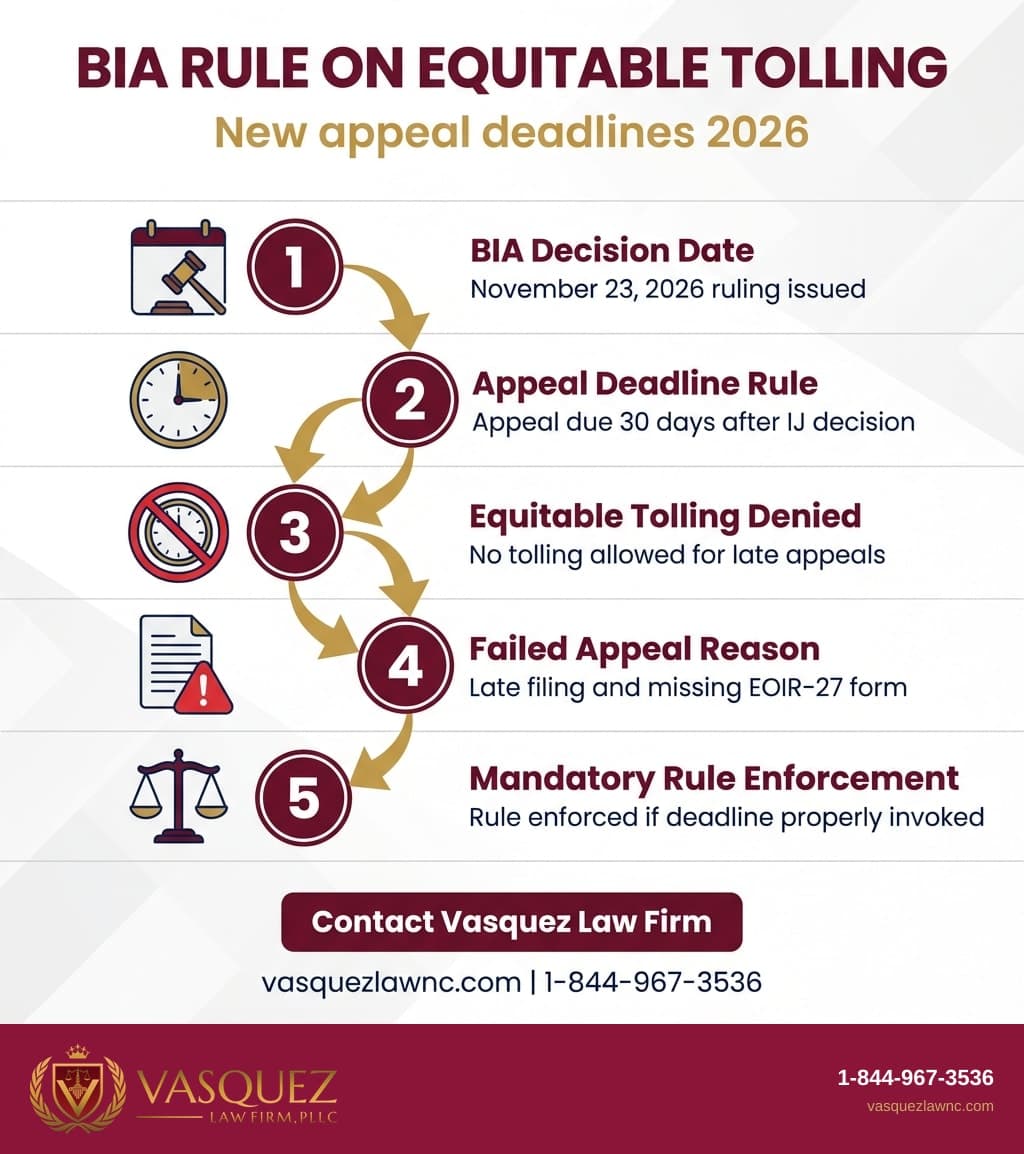
Thirty-nine days after the appeal deadline, a Honduran respondent tried to challenge an Immigration Judge’s decision. The attempt ended in summary dismissal. Summary dismissal means the appeal ended without a full review of its issues. On November 23, 2026, the Board of Immigration Appeals issued its decision in the respondent’s case, published at 30 I&N Dec. 249 (BIA 2026), Interim Decision #4276. The Board held that BIA equitable tolling is unavailable for the regulatory deadline to appeal.
The decision changes the risks for people who seek Board review after an Immigration Judge ruling. The Board held that the thirty-day filing period in 8 C.F.R. § 1003.38(b) is a nonjurisdictional but mandatory claims-processing rule. A claims-processing rule sets the steps and time limits for making a claim. Nonjurisdictional means the deadline does not define the Board’s basic power over the case. In practical terms, the deadline must be enforced when the opposing party properly raises it. Our immigration attorneys help clients assess procedural options before a removal-case deadline closes.
Need legal help?
Immigration in NC and FL. Personal injury and workers compensation across NC. Criminal defense in select NC counties depending on the charge (DWI in 12 counties), and traffic tickets in 20 NC counties. Tell us your county and we will tell you exactly what we can do.
Legal information only: This article is general information, not legal advice for any person’s case. Appeal rules can turn on the filing date, the case record, service history, and the procedural posture. Procedural posture means the case’s position in the legal process. For individual guidance, an immigration legal team can review the actual order and filing record.
What did the BIA equitable tolling ruling decide?
In this case, the Board summarily dismissed the respondent's appeal as untimely and denied his motion to accept a late-filed appeal. The respondent had sought review of a February 20, 2026, denial of his motion to reopen and rescind an in absentia removal order entered on June 15, 2017.
A motion to reopen asks the agency to consider new facts or circumstances. To rescind means to cancel or set aside. An in absentia removal order is an order entered when a person does not appear for a removal hearing, if the statutory requirements are met.
Under the Board’s timeline, the appeal was due Monday, March 23, 2026. The thirtieth day fell on a Sunday. The notice of appeal arrived May 1, 2026. The Board described that filing as thirty-nine days late.
The deadline for filing an appeal to the Board in 8 C.F.R. § 1003.38(b) is a nonjurisdictional, but mandatory, claims-processing rule and thus must be enforced if the opposing party properly invokes it.
The respondent’s counsel argued that equitable tolling should excuse the delay. Equitable tolling generally refers to pausing a deadline when a person pursued rights diligently but extraordinary circumstances prevented a timely filing. Diligently means making a serious and timely effort. Extraordinary circumstances are unusual events outside the person’s reasonable control. The Board concluded that Immigration Judges and the Board lack inherent authority to apply that remedy in administrative removal proceedings.
The ruling expressly overruled Matter of Morales-Morales, 28 I&N Dec. 714 (BIA 2023). To overrule means to reject an earlier legal decision. That earlier decision had treated the appeal deadline as subject to equitable tolling. The Board also stated that it would not apply prior circuit decisions on this issue. It said those decisions did not present, consider, or decide the later question of a mandatory claims-processing rule.
Why did this particular appeal fail?
The Board found conflicting statements about the filing history. Counsel said the Immigration Judge’s decision arrived on March 9, 2026. The Board noted that the claimed receipt date was still within the appeal period. Counsel also claimed that he had filed an earlier appeal and that the Board had rejected it because it lacked Form EOIR-27, the Notice of Appearance form for an attorney or representative before the Board. The Board described counsel’s account as inconsistent and unsupported by evidence.
The Board noted that no evidence supported the inconsistent explanations. DHS invoked the deadline. DHS means the Department of Homeland Security, the opposing government party in this matter. The Board denied the motion to accept the late-filed appeal and summarily dismissed the appeal as untimely under 8 C.F.R. § 1003.1(d)(2)(i)(G).
Who does the BIA equitable tolling decision reach?
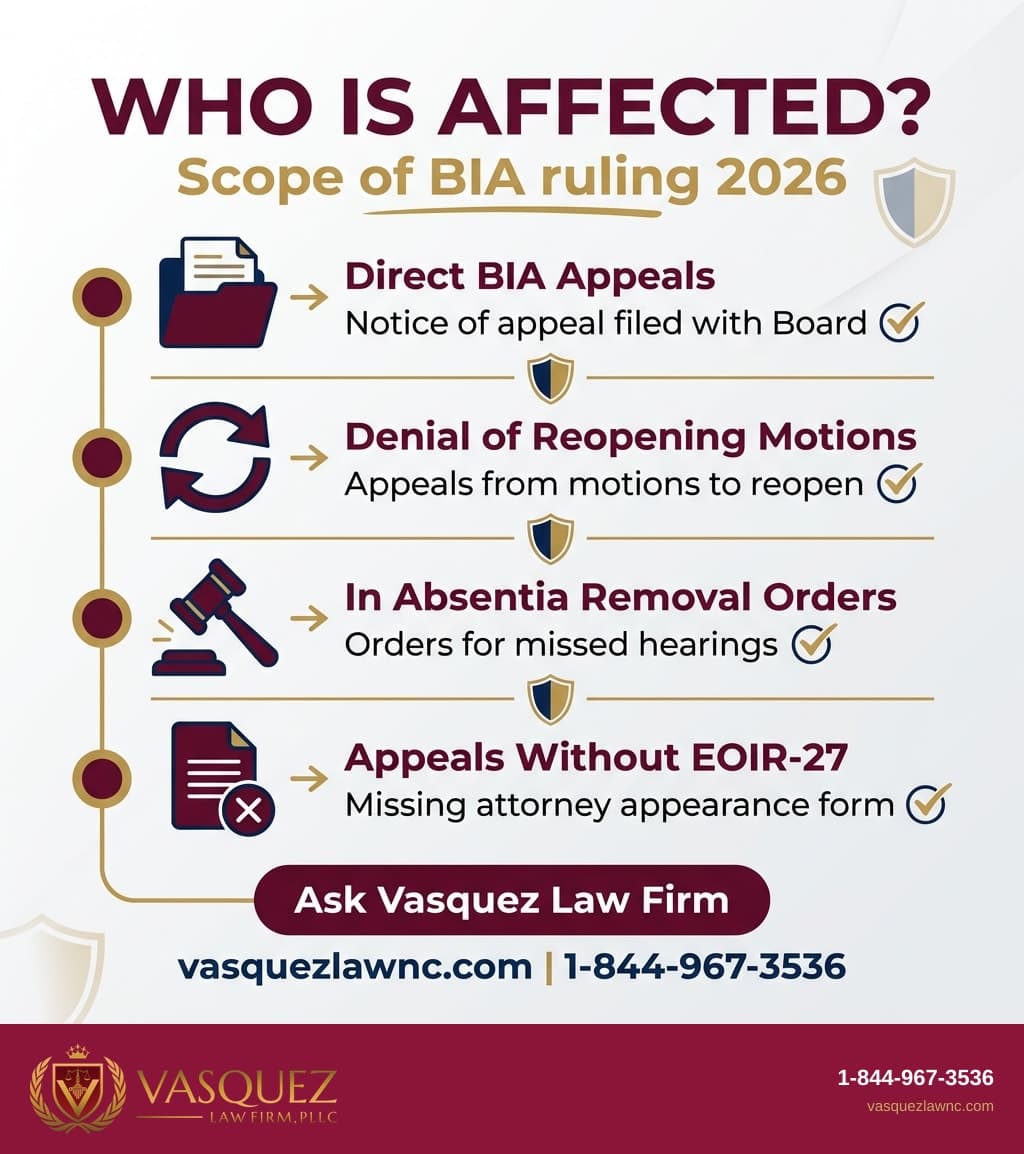
The decision concerns a person filing a notice of appeal directly with the Board after an Immigration Judge decision. A notice of appeal is the document that asks the Board to review that decision. Section 1003.38(b) says the notice of appeal shall be filed with the Board within thirty calendar days of the Immigration Judge’s decision.
That rule can include appeals from a denial of a motion to reopen. It did so in the respondent’s case. A motion to reopen asks the Immigration Judge or Board to consider new facts or circumstances under the applicable rules. The rule can also include other Immigration Judge decisions for which Board appeal procedures apply.
An in absentia order is entered when a person does not appear at a removal hearing and the statutory requirements are met. Here, the respondent alleged he never received notice of the hearing. The Board decided the appeal based on lateness instead.
We therefore cannot equitably toll the appeal deadline at 8 C.F.R. § 1003.38(b).
There remains an important distinction between the deadline and the Board’s subject-matter authority. Subject-matter authority means the legal power to decide a type of case. The Board called the rule nonjurisdictional. Yet it also held that the rule is mandatory. It must be enforced if the opposing party properly invokes it. This distinction matters because a filing may be late even when the Board has authority over the category of appeal.
In our experience, the first question after an Immigration Judge ruling is often whether the order date, service date, and Board receipt date all appear in the client’s records. The service date is the date the decision was delivered under the applicable service rules. The receipt date is the date the Board received the filing. This review should happen promptly. A disagreement about dates can become the central issue before anyone considers the merits of a removal case.
What did not change?
The ruling addresses the Board appeal deadline. It also does not erase regulatory procedures for motions to reconsider, motions to reopen, or Board certification. A motion to reconsider asks the agency to review a decision for a claimed legal or factual error. Board certification is a procedure that brings a matter to the Board for review under the governing rules. Each procedure has its own authority and requirements.
For separate USCIS benefit matters, readers can consult the agency’s USCIS Policy Manual. USCIS benefit procedures are different from a Board appeal of an Immigration Judge decision. A person should not assume that a deadline or remedy in one system applies in the other system.
What law governs a BIA equitable tolling appeal?
The core regulation is 8 C.F.R. § 1003.38(b). It requires a notice of appeal to be filed directly with the Board within thirty calendar days of an Immigration Judge’s decision. The Board relied on the regulation’s wording and structure. It called the deadline a mandatory claims-processing rule.
Another provision, 8 C.F.R. § 1003.38(d), requires the notice of appeal to include the appropriate fee or a fee-waiver request within the same filing period. A fee waiver is a request to avoid paying the required filing fee because the person meets the applicable requirements. If that requirement is not met, the appeal is not deemed properly filed. The Immigration Judge’s decision becomes final as if no appeal had been taken.
The Board recognized one defined extension in the electronic-filing rules. Under 8 C.F.R. § 1003.3(g)(2), in an electronically filed case, the deadline is extended if an unplanned system outage makes EOIR’s electronic filing application unavailable on that case’s final filing day. The new deadline is the first accessible day that is not a weekend or legal holiday.
Why did the Board reject equitable tolling?
The Board described itself as an administrative entity. Its authority comes through statutes and regulations. It is not a court with inherent equitable power. Inherent equitable power means a court’s traditional power to provide a fair remedy when strict rules would cause an unfair result.
The Board reasoned that its power to reconsider decisions under 8 C.F.R. § 1003.2(a) and (b) does not create general authority to extend deadlines through equitable remedies. The Board also cited the rule governing summary dismissal of an untimely appeal, 8 C.F.R. § 1003.1(d)(2)(i)(G).
Its conclusion was narrow but consequential. BIA equitable tolling cannot extend the appeal period in § 1003.38(b). The deadline must be enforced when the opposing party properly invokes it. This means a person should treat the filing deadline as firm unless a specific rule provides a different result.
What should I do after an Immigration Judge decision?
Start by preserving the paperwork on the day an Immigration Judge decision arrives. Keep the written order, envelope or electronic service record, hearing notice, filing receipts, fee materials, and every prior motion. Record the date the decision was issued. Also record the date it was received.
Next, identify the procedural step you may be considering. An appeal challenges an Immigration Judge decision before the Board. A motion to reopen asks for further proceedings based on new facts or circumstances. A motion to reconsider challenges a prior decision based on a claimed legal or factual error. The correct procedure affects the governing rule.
For a Board appeal, the general rule is thirty calendar days under 8 C.F.R. § 1003.38(b). Do not assume that a late filing can be accepted through BIA equitable tolling. Check that the notice, fee or fee-waiver request, and Form EOIR-27 when counsel appears are complete before filing.
Exceptions that change the deadline
The Board identified a limited electronic-filing exception. If EOIR’s electronic filing application has an unplanned system outage on the last filing day in a specific electronically filed case, 8 C.F.R. § 1003.3(g)(2) extends the deadline. The extension lasts until the first day the application becomes accessible that is not a weekend or legal holiday.
Document the outage and preserve any system notices. Save screenshots, messages, receipts, and other records that show what happened. This guide covers the general appeal rule and the electronic-outage exception addressed in the Board’s November 23, 2026, decision. Other deadlines can apply in some cases. Ask a lawyer about yours.
Facing an Immigration Judge deadline? Vasquez Law Firm offers a free evaluation to review the procedural record and available options. Se Habla Español.
What should I watch after the BIA equitable tolling ruling?
What's Your Immigration Situation?
Answer 3 questions - we'll tell you your options
Question 1 / 3
What best describes your situation?
Keep Reading
Watch for Board decisions applying the ruling published at 30 I&N Dec. 249 (BIA 2026) to other late appeals. The decision states that DHS properly invoked the deadline in the respondent’s case. That point was decisive under the Board’s analysis.
Readers should also monitor the Board’s published precedent decisions and EOIR filing information. A precedent decision is a published decision that guides later cases under the applicable rules. The Board’s decision published at 30 I&N Dec. 249 (BIA 2026) is the starting point for the ruling’s precise language, citations, and procedural history.
One material question may arise in individual cases. The question is whether the opposing party has properly invoked the filing deadline. That question depends on the record in the specific appeal. The settled rule today is that a timely, complete filing is the safest course.

Frequently Asked Questions
Can I appeal an Immigration Judge decision?
Yes, Board appeal procedures apply to Immigration Judge decisions that are appealable under the regulations. Under 8 C.F.R. § 1003.38(b), the notice of appeal generally must be filed directly with the Board within thirty calendar days. The respondent’s case shows why the order, receipt, and filing records should be reviewed immediately.
Does BIA equitable tolling still apply to an appeal deadline?
In this case, the Board held that it cannot equitably toll the deadline in 8 C.F.R. § 1003.38(b). It overruled Matter of Morales-Morales. The Board described the deadline as nonjurisdictional but mandatory, requiring enforcement when the opposing party properly invokes it.
What happens if my notice of appeal is late?
An untimely appeal may be summarily dismissed under 8 C.F.R. § 1003.1(d)(2)(i)(G). In the respondent’s case, the Board denied a motion to accept the late appeal after DHS invoked the deadline. A late filing also can prevent the Board from reaching the merits of the underlying immigration claim.
Does an electronic filing outage affect the deadline?
It can. Under 8 C.F.R. § 1003.3(g)(2), an unplanned EOIR electronic-filing outage on the final filing day in a specific electronically filed case extends the deadline to the first accessible day that is not a weekend or legal holiday. Preserve records connected to the outage.
Can a missing fee or fee-waiver request affect my appeal?
Yes. Section 1003.38(d) requires the notice of appeal to be accompanied by the appropriate fee or fee-waiver request within the filing period. The regulation states that an appeal failing that requirement is not properly filed, and the Immigration Judge decision becomes final as though no appeal was taken.
Should I file a motion to reopen instead of an appeal?
A motion to reopen and an appeal serve different functions. The respondent’s case involved an appeal from a denied motion to reopen and rescind an in absentia removal order. The appropriate option depends on the order, the procedural history, and the facts available. Have the decision and record reviewed before choosing a filing path.
Do not rely on general information for a deadline decision. Contact Vasquez Law Firm for a free evaluation. We meet immigration clients in Raleigh, NC and Orlando, FL, and serve immigration matters nationwide.
Disclaimer: This article is not legal advice and does not create an attorney-client relationship. A consultation does not guarantee any outcome.
Sources
Reviewed by Attorney Vasquez, Managing Attorney

William Vasquez
Founder & CEO, Vasquez Law Firm, PLLC
William Vasquez is the founder and CEO of Vasquez Law Firm, PLLC, a results-driven firm specializing in immigration, criminal defense, personal injury, and workers' compensation. A U.S. Air Force veteran and recipient of the Joint Service Achievement Medal, William is dedicated to fiercely fighting for his clients' rights.
Related Legal Services
Need legal help? Learn more about get immigration legal help today, or contact us for a free evaluation.
You can also visit North Carolina immigration lawyers for more information.