BIA Vacates CAT Protection and Orders Removal to El Salvador
Facing removal after a BIA CAT protection decision? See why personal evidence and relocation proof matter, then request a free evaluation today for help.
Published on October 29, 2026· Updated October 29, 2026
Talk to an immigration attorney
Free call. A clear plan for your case.
Free & confidential · Se habla espanol · Mon-Fri 8am-7pm, Sat 9am-2pm (ET)

Have questions? Talk to an attorney - free evaluation.
Call 1-844-967-3536Worried how the latest immigration news affects you?
Schedule a confidential case review with an immigration attorney - know exactly where you stand.
USCIS Case Status
Check your USCIS case status
Enter your receipt number and get the official status. Free, no registration.
BIA Vacates CAT Protection and Orders Removal to El Salvador
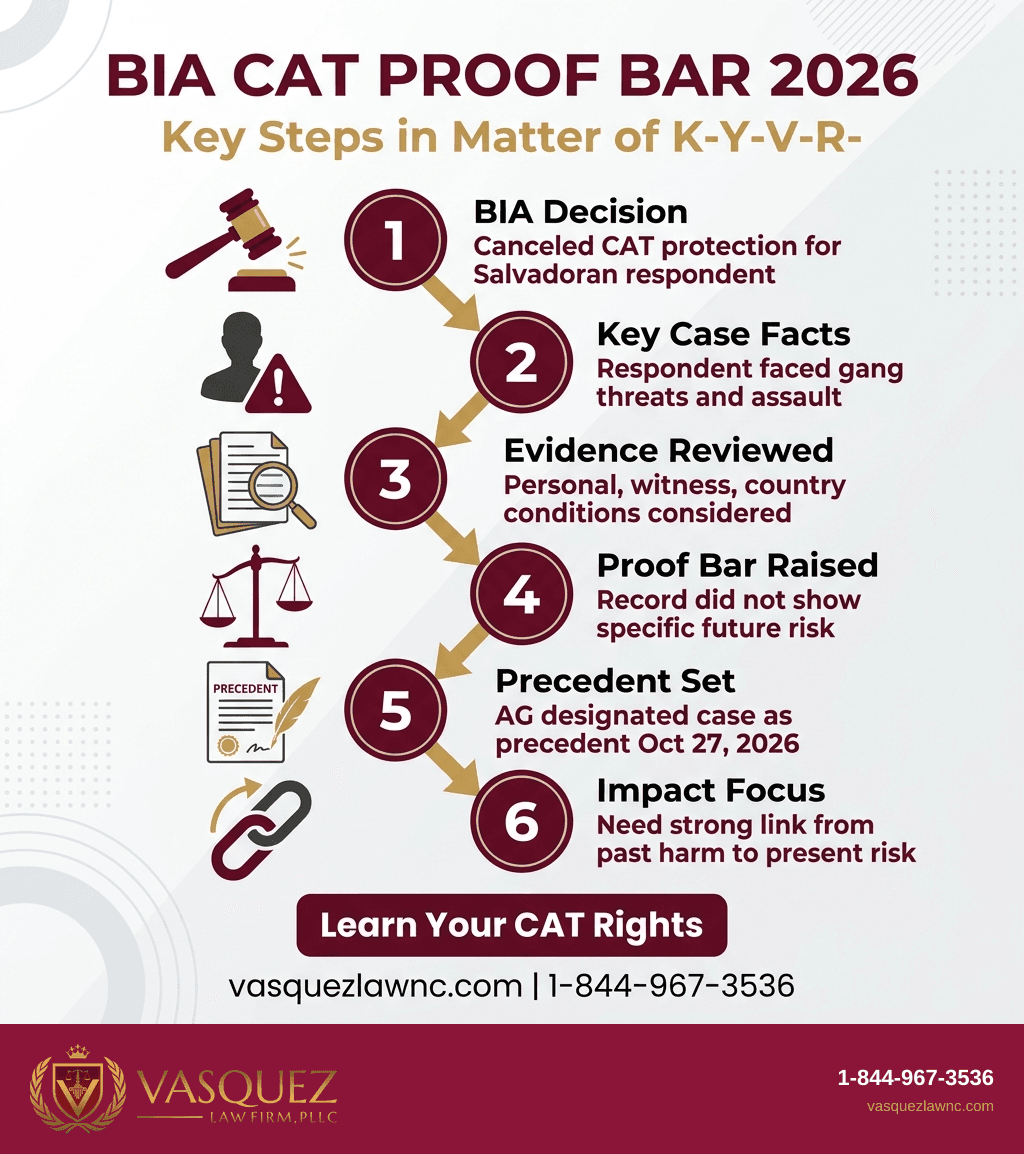
The Board of Immigration Appeals vacated the grant of CAT protection for a Salvadoran respondent. A respondent is a person in a removal case. The Board ordered removal to El Salvador. It found that the evidence did not show a specific future risk to that person. The ruling, Matter of K-Y-V-R- , 30 I&N Dec. 203 (BIA 2026), focuses on evidence that links past harm to present danger.
For a person in removal proceedings, the difference can be immediate. A record that describes widespread violence may matter. However, this BIA CAT protection decision found that general conditions alone did not show that this respondent would more likely than not face torture after return. Our immigration attorneys review personal records, witness statements, and country evidence. We assess how those materials fit together in removal-defense cases.
The Attorney General designated the decision as precedent on October 27, 2026, through Order No. 7272-2026. Readers seeking a case-specific review may speak with our immigration legal team about a free evaluation.
Legal disclaimer: This article provides general legal information, not legal advice for any individual. CAT claims depend on the evidence, procedural history, and law that apply to each case.
What happened in Matter of K-Y-V-R-?
The Board of Immigration Appeals vacated the Immigration Judge’s January 21, 2020, decision granting protection under the Convention Against Torture regulations and ordered the respondent removed to El Salvador.
The respondent testified that gang members tried to recruit him from childhood until he left El Salvador at age 17. He described threats and rocks thrown at his home. He also described a physical assault at school after he refused to join. The Immigration Judge found that these events supported a likelihood of future torture. The judge also relied on country-conditions material about gang violence.
The Board reached a different conclusion. It held that the prediction of future torture rested on unsupported inferences. An inference is a conclusion drawn from other facts. The decision stressed that the record did not show that the people who threatened the respondent as a minor had looked for him after he left El Salvador in 2015. It also found no evidence that relatives or people close to him had been questioned or targeted after his departure.
The Immigration Judge’s determination as to the likelihood of the respondent’s future torture upon his return to El Salvador is speculative and unsupported by the record.
This BIA CAT protection decision did not decide whether Salvadoran authorities would acquiesce in torture. Acquiescence means that an official knows about the harm and allows it, including by willful blindness. Willful blindness means deliberately ignoring a known risk. The Board explained that the respondent did not meet his burden of proof for protection under the CAT. That conclusion resolved the appeal. The Board therefore did not reach the separate government-acquiescence issue.
Why precedent status matters
Order No. 7272-2026 designated Matter of K-Y-V-R- as precedent in proceedings involving the same issues. The published citation is 30 I&N Dec. 203. Practitioners reviewing EOIR BIA decisions, BIA cases, or a BIA precedent chart can now find the decision under that citation. EOIR is the Executive Office for Immigration Review.
Who must pay attention to this BIA CAT protection decision?
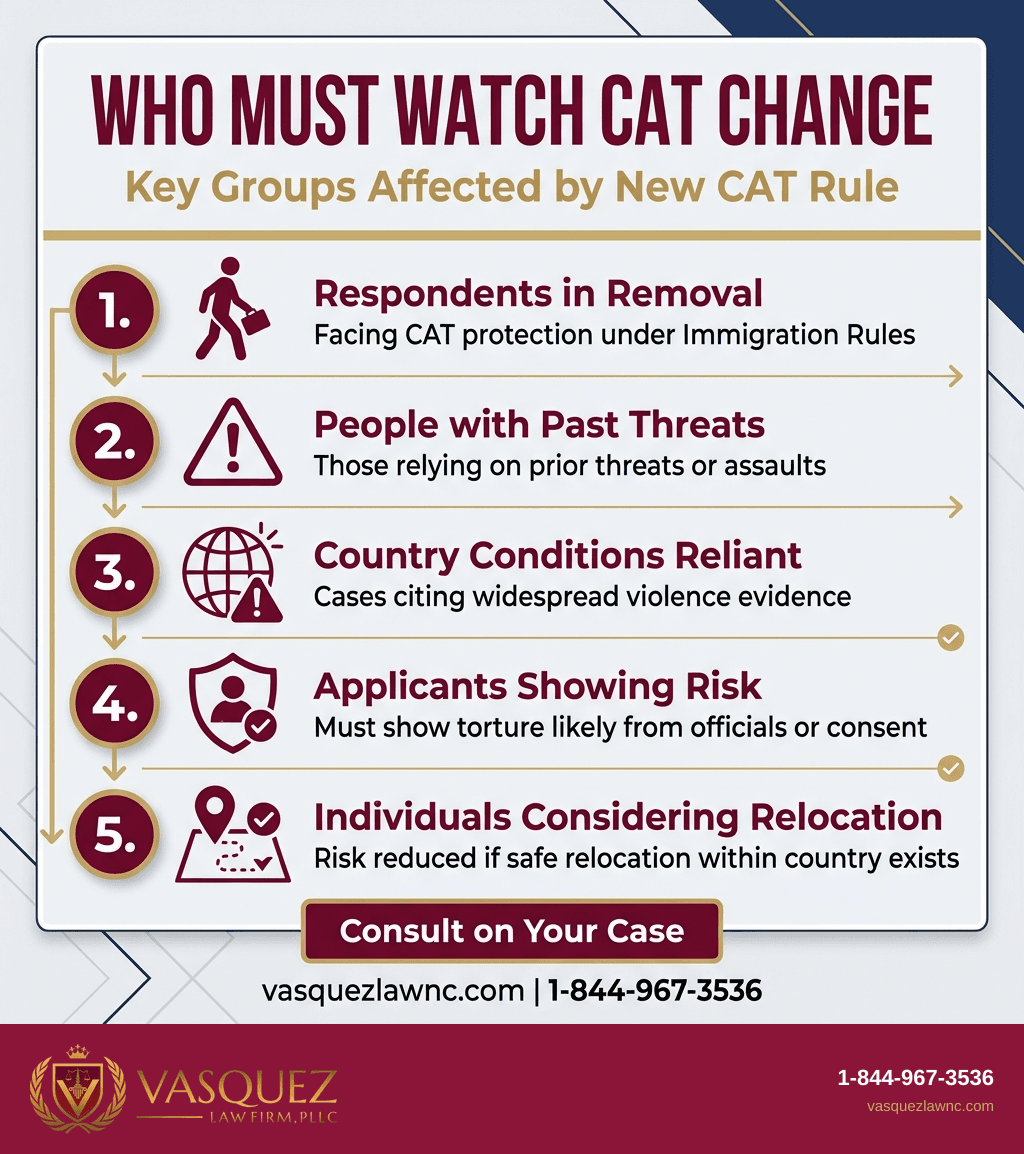
The ruling concerns respondents seeking protection under the CAT regulations. It especially concerns people who rely on prior threats, past assaults, and evidence of broad violence in their home country. It does not eliminate CAT protection for people facing real danger. Instead, it explains the proof that the Board found missing in this record.
CAT protection requires a person to show that torture will more likely than not occur in the home country. The expected torture must be committed by a public official or another person acting in an official role. It may also occur with that official’s consent or acquiescence, including willful blindness. Those requirements appear in 8 C.F.R. §§ 1208.16(c) through 1208.18(a).
Here, the Board found that general country evidence did not establish an ongoing, personal risk from unknown gang members. It separated evidence about violence in El Salvador from evidence showing that this particular respondent remained a target. The ruling also examined whether moving within El Salvador could reduce the feared risk.
The respondent had not previously attempted to relocate within El Salvador to avoid the feared harm. The Board noted that he was then an able-bodied adult. It noted that he had uncles who worked as police officers in El Salvador. The record did not show that he could not leave his hometown and find work elsewhere.
The generalized country conditions evidence cited in the decision further does not support the Immigration Judge’s predictive finding that the respondent would be unable to relocate within El Salvador to avoid any future torture.
In our experience, the cases we handle often turn on the connection between past threats and current personal risk. A record that only describes dangerous conditions may not make that connection. For related removal-defense information, review our discussion of a deportation defense case review and our asylum and humanitarian protection guidance.
What the decision does not erase
A BIA CAT protection decision rests on the evidence and issues before the Board. A person with recent threats may have different facts. The same may be true if people tried to locate that person, harmed relatives, involved officials, or supplied reliable relocation evidence. The legal burden remains specific to the respondent.
What does CAT law require before removal can be withheld?
The Convention Against Torture is carried out through the immigration regulations at 8 C.F.R. §§ 1208.16(c), 1208.17, and 1208.18(a). In plain terms, torture is an especially severe form of harm. A CAT applicant must prove that torture is more likely than not. The applicant must also show that officials would inflict it, consent to it, allow it, or deliberately ignore it.
The Board cited the Third Circuit’s framework in Myrie v. Attorney General U.S.: an Immigration Judge must examine what is likely to happen to the respondent if he is removed, and determine whether what is likely to happen amounts to the legal definition of torture. The question of what will happen to a respondent is a factual finding for the Immigration Judge to make that the Board reviews for clear error. Whether such harm amounts to torture is a legal determination that the Board reviews de novo.
The Board reviewed the respondent’s ability to relocate within El Salvador when considering the evidence about future risk. The decision found that the Immigration Judge’s conclusion about relocation lacked support in this record.
CAT protection differs from asylum under INA § 208, 8 U.S.C. § 1158, and statutory withholding under INA § 241(b)(3), 8 U.S.C. § 1231(b)(3). Statutory withholding is a separate form of protection that can block removal when its requirements are met. In this case, the respondent did not challenge the denial of asylum or statutory withholding on appeal. The Board therefore treated those challenges as waived. Waived means the person gave up the issue by not properly pursuing it.
Why personal proof carries weight
Country reports can provide essential background. Yet the Board cited earlier BIA decisions. Those decisions explain that evidence of widespread violence does not necessarily mean a respondent could show that there is a clear probability he faces a particularized risk of torture. The Board considered what is likely to happen to the individual respondent.
What evidence should a person with a CAT claim prepare?
A person preparing a CAT claim should begin with a precise timeline. Record each threat, assault, attempted recruitment, report to authorities, move within the country, and contact from the feared person or group. Dates, locations, names, messages, photographs, medical records, and police documents can help support testimony.
Next, preserve evidence showing current interest in the person. Communications seeking the person’s location may help. So may threats to family members, inquiries at a former home or workplace, and affidavits from people with direct knowledge. These items may show that the danger did not end when the person left. Translate each item when required. Also connect it clearly to the applicant’s testimony.
Then address relocation directly. Explain any earlier effort to move. Discuss family support, housing, employment prospects, medical needs, and language barriers. Explain why a feared actor could still find the person. The Board’s analysis in this BIA CAT protection decision shows why an unexplained relocation question can create a serious evidence problem.
Finally, organize country evidence around the individual facts. Do not submit material only to show high violence levels. Identify information that explains the feared actor’s reach. Also address local officials and the realistic results of seeking protection.
Facing removal or preparing protection evidence? Vasquez Law Firm offers free immigration evaluations for people nationwide. We meet immigration clients in Raleigh, NC and Orlando, FL. Se Habla Español.
What should people watch after this BIA CAT protection decision?
The Attorney General’s October 27, 2026 precedent designation makes Matter of K-Y-V-R-, 30 I&N Dec. 203, relevant when future risk and internal relocation are disputed.
The rule today requires proof of a more-likely-than-not risk of torture. That risk must connect to the individual applicant. The applicant must also show official involvement or acquiescence. A person should monitor the immigration court record for filing instructions and hearing notices. Evidence must be presented in the proper proceeding.
Whether a particular set of past threats will establish a present likelihood of torture after a lengthy absence depends on the proof in each record. The published Matter of K-Y-V-R- decision is the official text to review with current filings and case-specific evidence.
Frequently Asked Questions
What did the Board decide in Matter of K-Y-V-R-?
The Board sustained DHS’s appeal, vacated the Immigration Judge’s grant of CAT protection, and ordered removal to El Salvador. It found the prediction of future torture speculative because general country evidence did not show that the respondent personally remained a target. The Board also found insufficient support for the conclusion that he could not relocate within El Salvador.
Does country-conditions evidence still matter in a CAT case?
Yes. Country evidence can explain conditions, risks, and official conduct in the country of return. This BIA CAT protection decision held that generalized evidence alone did not establish a particularized risk for this respondent. Strong CAT records connect country evidence to personal threats, recent developments, feared actors, and the applicant’s actual ability to avoid harm.
What is internal relocation?
Internal relocation means moving to another area within the country of removal. In this decision, the Board found the record did not show that the respondent would be prevented from leaving his hometown, finding work, and avoiding the people who threatened him as a minor. Relocation evidence may affect the assessment of future risk. Relocation evidence may affect the assessment of future risk.
What must an applicant prove for CAT protection?
An applicant must show that torture is more likely than not in the home country. The expected torture must be inflicted by, or occur with the consent or acquiescence, including willful blindness, of a public official or person acting in an official capacity. The governing regulations include 8 C.F.R. §§ 1208.16(c) through 1208.18(a).
Did the Board decide whether officials would acquiesce in torture?
No. The Board found that the respondent had not carried the burden on the likelihood of future torture. Because that finding resolved the appeal, it did not reach the Immigration Judge’s conclusion on government acquiescence. This illustrates that CAT claims require proof on each necessary element, even when one issue becomes dispositive.
What records can support a particularized CAT claim?
Relevant evidence may include detailed testimony, recent threats, messages, witness affidavits, records of harm to relatives, police materials, medical documentation, and country evidence tied to the person’s facts. The practical goal is to show why the feared harm remains likely for that individual, rather than relying only on evidence of dangerous general conditions.
Do not make evidence decisions without understanding the legal standard. Contact Vasquez Law Firm for a free evaluation focused on your immigration situation. This is general information and not individualized legal advice.
Sources
Reviewed by Attorney Vasquez, Managing Attorney
Facing Deportation?
Time is critical. Our deportation defense attorneys are available 24/7 for emergency cases.
Keep Reading


William Vasquez
Founder & CEO, Vasquez Law Firm, PLLC
William Vasquez is the founder and CEO of Vasquez Law Firm, PLLC, a results-driven firm specializing in immigration, criminal defense, personal injury, and workers' compensation. A U.S. Air Force veteran and recipient of the Joint Service Achievement Medal, William is dedicated to fiercely fighting for his clients' rights.
Related Legal Services
Need legal help? Learn more about speak with an immigration lawyer, or contact us for a free evaluation.
You can also visit immigration lawyers serving all of North Carolina for more information.