How Workers' Compensation Approval Works in North Carolina
How does workers compensation approval work in North Carolina? See Forms 18 and 33, notice rules, and claim steps. Call for a free evaluation today.
Published on October 29, 2026· Updated October 29, 2026
Hurt on the job?
Free review of your workers' comp claim.
Free & confidential · Se habla espanol · Mon-Fri 8am-7pm, Sat 9am-2pm (ET)
Have questions? Talk to an attorney - free evaluation.
Call 1-844-967-3536Hurt on the Job? Claim What You Are Owed
A review of your workers' comp claim - we handle the fight.
How Workers' Compensation Approval Works in North Carolina
A workplace injury claim can start with a report to an employer. Approval is not automatic. How does workers' compensation approval work in North Carolina? The process depends on written notice, the worker's own claim filing, medical proof, and the employer or carrier's response. A Form 19 from an employer does not file the worker's claim. This guide explains the North Carolina Industrial Commission process. It also explains the important forms and steps that can protect a claim.
Need help with a North Carolina workplace injury claim? William J. Vasquez and the firm can review the process with you. Se Habla Español.
Call 1-844-967-3536 for a free case evaluation.
Quick Answer
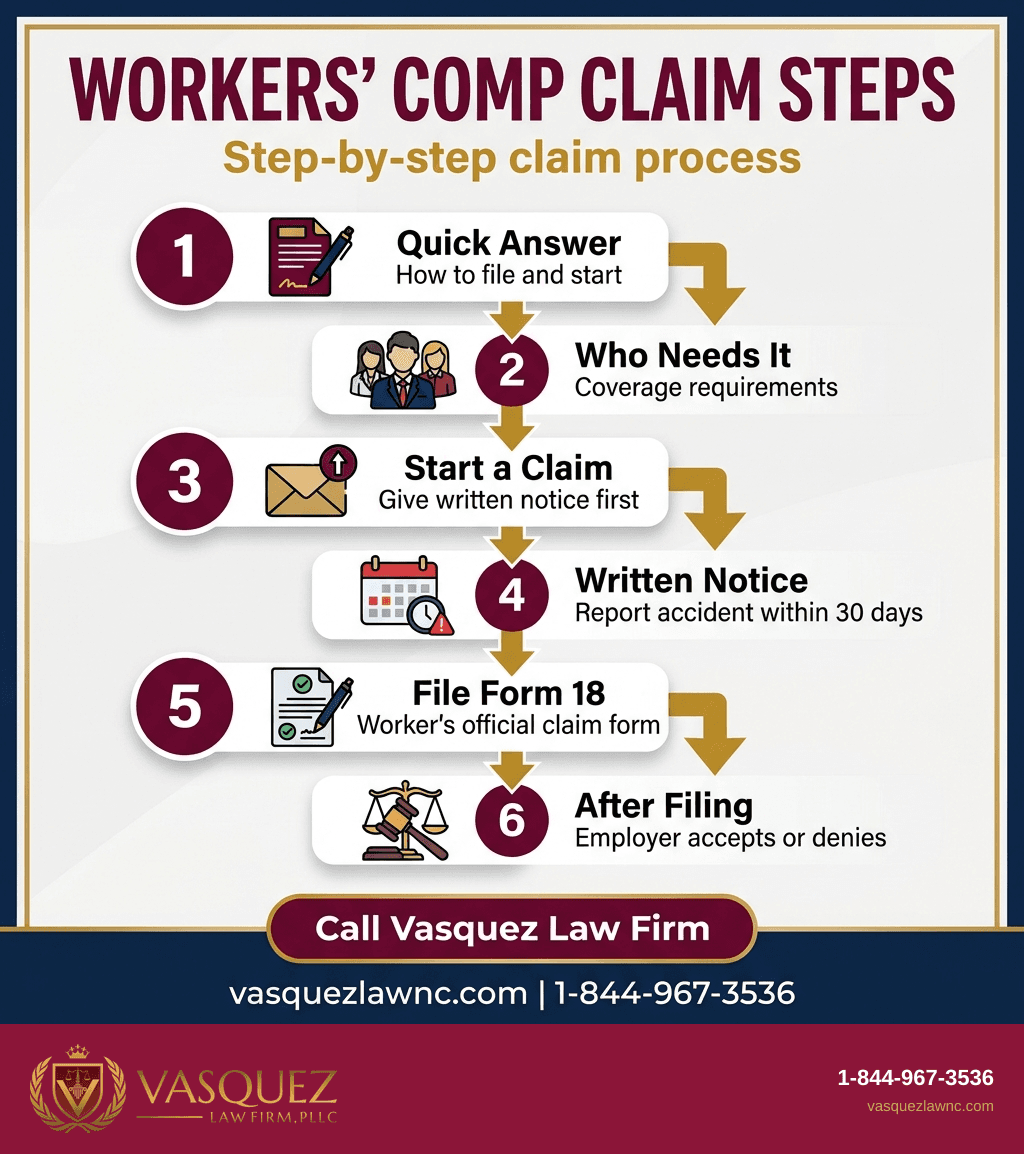
An employee can file a workers’ compensation claim by completing and filing an Industrial Commission Form 18. The employer or insurance carrier may accept or deny the claim. If your claim is denied by the employer or carrier and you want to pursue obtaining workers’ compensation benefits, you may request a hearing before a Deputy Commissioner by filing a Form 33.
- Give written notice promptly.
- File your own Form 18.
- Keep medical and work records.
- Read every Industrial Commission form.
- Act quickly if benefits stop or a claim is denied.
Who needs workers' compensation coverage in North Carolina?
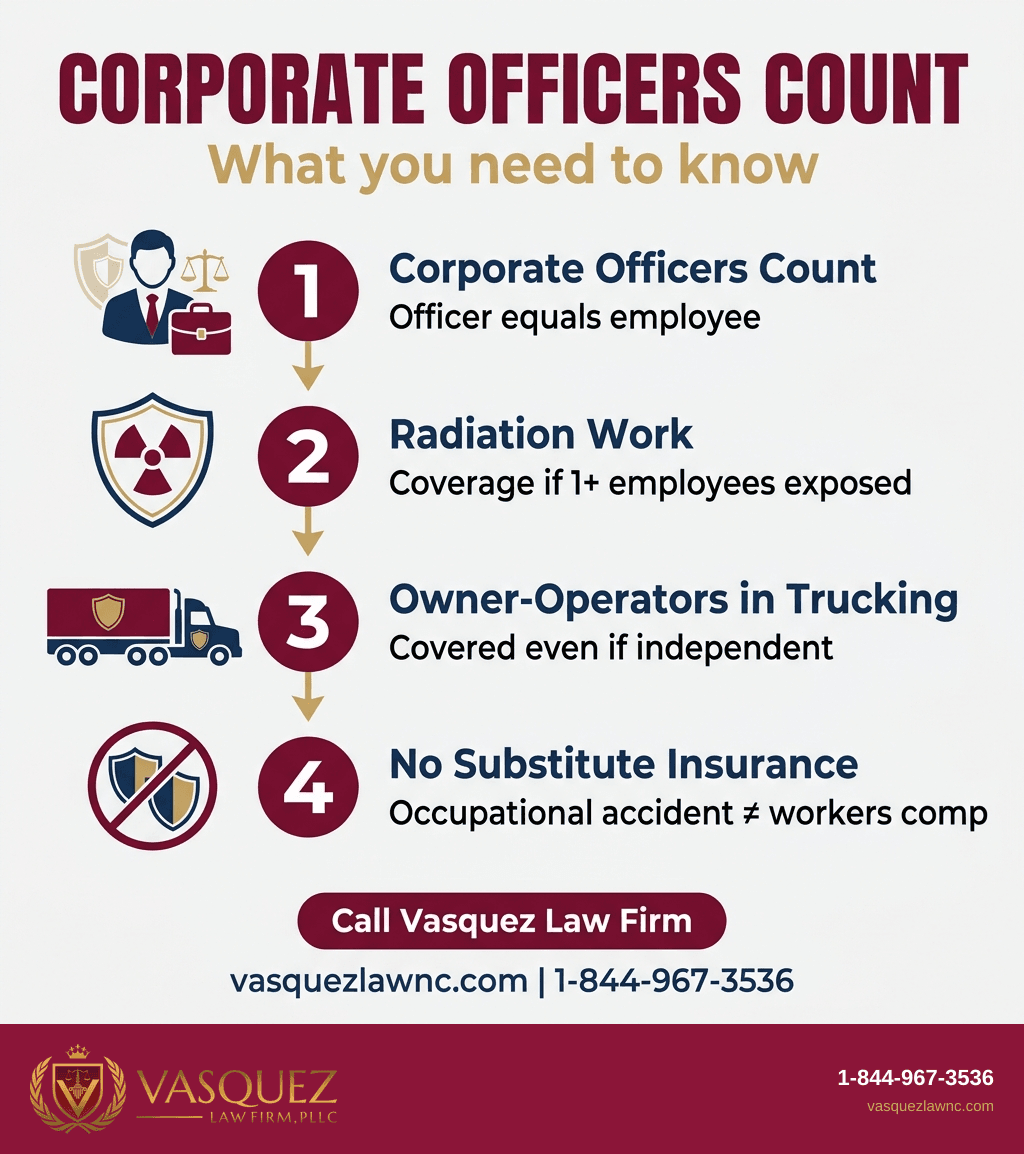
A corporation with two officers and one employee generally reaches the coverage threshold. The North Carolina Industrial Commission says an employer with three or more employees generally must carry workers' compensation insurance. The employer may instead qualify as self-insured. Corporate executive officers count as employees for this purpose.
In general, any employer who employs three or more employees must have workers' compensation insurance coverage or qualify as a self-insured employer.
A separate rule applies to work involving radiation. Coverage is required if one or more employees perform activities involving its use or presence. North Carolina law requires that workers’ compensation coverage be in place to cover certain trucking owner/operators, even if the operator is deemed to be an independent contractor. If the owner-operator does not have workers’ compensation insurance coverage, the motor carrier must provide the workers’ compensation coverage, regardless of whether the principal contractor, intermediate contractor, or subcontractor regularly employs three or more employees. However, a motor carrier employer is not liable for workplace injuries suffered by an independent contractor who is individually licensed by the U.S. Department of Transportation and personally operates the vehicle.
Occupational accident insurance differs from workers' compensation coverage. The Industrial Commission says it is not a lawful substitute under the North Carolina Workers' Compensation Act. It may cover only certain injuries. It may also provide limited contract benefits.
For help with a work injury claim, review the firm's North Carolina workers' compensation services. This article addresses North Carolina claims only.
How do you start a workers' compensation claim?
A worker who slips, gets struck by equipment, or develops a covered occupational disease should create a clear written record. An occupational disease is an illness caused by workplace exposure or conditions. Under N.C. Gen. Stat. § 97-22, the worker should give written notice immediately or as soon as practicable. Notice given later than thirty days after the accident may put compensation at risk.
Written notice comes first
Written notice should identify the workplace accident. It should preserve the date, place, and basic facts. The report and notice requirements set forth in N.C. Gen. Stat. §97-22 also apply in occupational disease claims (except for cases of asbestosis, silicosis, or lead poisoning), and the 30 days for giving written notice in an occupational disease claim begins to run on the date the employee was advised by competent medical authority that the employee has the occupational disease.
Form 18 is the worker's claim
After giving notice, an employee may file Industrial Commission Form 18 for an injury by accident. There is a two-year statute of limitations that applies to workers’ compensation claims, and employees should carefully review N.C. Gen. Stat. § 97-24(a) regarding this two-year statute of limitations. For an occupational disease that does not involve lung disease, an employee can file an Industrial Commission Form 18. For an occupational disease involving lung disease, an employee should file a Form 18B instead of a Form 18. The two-year statute of limitations that applies to occupational diseases is set forth in N.C. Gen. Stat. § 97-58(c).
The practical lesson is simple. Do not assume the employer's paperwork protects your claim. The Industrial Commission says a Form 19 report does not constitute a workers' compensation claim for the employee. See the firm's guide on how to file a North Carolina workers' compensation claim for related filing information.
What happens after a workers' compensation claim is filed?
The employer or carrier may accept the claim; if it denies the claim, the worker may pursue benefits by requesting a hearing before a Deputy Commissioner. Compensable means the injury qualifies for workers' compensation benefits. The record may include the accident report, medical records, wage information, and work restrictions. If the carrier denies the claim, it should file Form 61 with the Industrial Commission under N.C. Gen. Stat. § 97-18(c) and (d), send a copy to the employee or the employee’s attorney of record, if any, and send copies to all known medical service providers.
If your claim is denied by the employer or carrier and you want to pursue obtaining workers’ compensation benefits, you may request a hearing before a Deputy Commissioner by filing a Form 33.
If your claim is denied by the employer or carrier and you want to pursue obtaining workers’ compensation benefits, you may request a hearing before a Deputy Commissioner by filing a Form 33.
Medical care after a denial
The employer or its insurance company provides and directs medical treatment pursuant to N.C. Gen. Stat. § 97-25, subject to any Industrial Commission orders. If your claim has been denied, you may go to any health care provider of your choice. However, even in a denied claim, the employer or carrier is entitled to request that you submit to independent medical examination pursuant to N.C. Gen. Stat. § 97-27(a).
Cases we handle often involve missing written notice. Some involve a Form 19 mistaken for the worker's own claim. Others involve incomplete medical restrictions. These details can affect how a carrier evaluates a claim. Preserve documents before memories and records become harder to find.
How are workers' compensation benefits calculated and paid?
The weekly compensation rate for total disability benefits under the Workers’ Compensation Act is two-thirds of the employee’s “average weekly wage,” as defined in N.C. Gen. Stat. § 97-2(5), subject to a cap. The cap is called the “maximum weekly compensation rate.” Pursuant to N.C. Gen. Stat. § 97-29(a) and N.C. Gen. Stat. §97-29)(i), the maximum weekly compensation rate is calculated annually and the new annual rate is effective as of January 1 each year. The applicable cap on an employee’s weekly benefits for the entirety of the employee’s claim is the maximum weekly compensation rate for the year in which the employee’s injury occurred.
Pursuant to N.C. Gen. Stat. § 97-28, no compensation is due for the first seven days of lost time from work, unless the disability exceeds 21 days. Therefore, the first workers’ compensation disability payment issued to the employee by the employer or carrier will not include any workers’ compensation disability payments for days 1-7. Payment for days 1-7 will be due only if the employee’s disability has continued beyond 21 days.
Late payments and travel costs
After calling the representative of the carrier/administrator to attempt to resolve the issue, you may file a motion or written request pursuant to N.C. Gen. Stat. § 97-18(e) and (g) with the Executive Secretary’s Office for an Order compelling payment of the unpaid benefits and a 10% late payment penalty. You should attach supporting documentation to your filing.
An employee who travels 20 miles or more round trip for authorized medical treatment in a workers’ compensation case is entitled to mileage reimbursement to be paid by the employer or carrier at the IRS standard mileage rate for the year or other time period in which the travel occurred pursuant to Rule 11 NCAC 23J .0101(h). The employee should submit the request for mileage reimbursement to the employer or carrier/administrator on a Form 25T.
A denial, unpaid benefits, or a request to stop checks can require prompt attention. Vasquez Law Firm helps injured North Carolina workers understand their options. Se Habla Español.
Call 1-844-967-3536.
What should you do if weekly benefits are stopped?
A Form 24 Application to Terminate or Suspend Payment of Compensation should not be ignored. A worker who disagrees may complete Section B as a Form 24 Response. The worker must file it with the Executive Secretary's Office within seventeen days of the date the application was mailed to the worker and simultaneously send a copy to the attorney listed in Section A of the application. The response should explain the objection. It should also include supporting records.
Permission can be sought by filing a Form 24 Application to Terminate or Suspend Payment of Compensation pursuant to N.C. Gen. Stat. § 97-18.1 and Rule 11 NCAC 23A .0404. It should be noted that only an attorney can file a Form 24 on behalf of an employer or carrier because it is a legal filing. Adjusters and other employer or insurer representatives who are non-attorneys are not permitted to file a Form 24. A copy of the Form 24 must be sent contemporaneously to the employee or the employee’s attorney of record, if any. When Commission permission is required, payments may be stopped only if the Commission approves the application. Permission is not required after 500 weeks from the first date of disability without an award of extended compensation, upon a return to work subject to the trial-return-to-work provisions, or when a claim paid without prejudice is timely contested.
Which workers' compensation mistakes can hurt approval?
One common mistake is waiting to give written notice. Another is treating a Form 19 as the employee's claim. Both mistakes can create avoidable disputes. The dispute may concern whether the claim was properly preserved.
- Mistake: Reporting only by memory or verbally. Fix: Give written notice and retain a copy.
- Mistake: Skipping Form 18. Fix: File the employee claim within the applicable statute of limitations.
- Mistake: Ignoring a Form 61 denial. Fix: Consider Form 33 to request a hearing.
- Mistake: Ignoring Form 24. Fix: File a supported response within seventeen days.
- Mistake: Losing mileage records. Fix: Track authorized trips and submit Form 25T.
- Mistake: Assuming occupational accident coverage is workers' compensation. Fix: Confirm the coverage type.
If you remember one thing: how does workers' compensation approval work in North Carolina is often answered by the documents filed, the notice given, and the medical evidence preserved.
How does the North Carolina Industrial Commission process apply?
North Carolina notes
For more information, see the injured workers information and workers' compensation claims page of the North Carolina Industrial Commission.
A worker can also report a non-insured employer to the Industrial Commission Criminal Investigations & Employee Classification Division. The agency lists fraudcomplaints@ic.nc.gov and 888-891-4895 for reports.
When should you call about a workers' compensation dispute?
Consider a free case evaluation if written notice was delayed. You should also consider one if Form 18 has not been filed. The same applies if a Form 61 denied the claim or a Form 24 seeks to suspend checks. Seek help if medical treatment is disputed. Also seek help if weekly payments are late, an occupational disease is involved, or mileage reimbursement is unpaid.
How does workers' compensation approval work in North Carolina in a particular case? A review of the actual forms, medical records, wage information, and deadlines can provide a more reliable answer than a general article.
About Vasquez Law Firm
Vasquez Law Firm represents people with North Carolina workers' compensation matters by phone throughout the state. The firm combines compassionate communication with determined representation. Its Yo Peleo® commitment reflects a focus on protecting people facing legal problems.
William J. Vasquez leads the firm. Bilingual support staff help clients communicate in English or Spanish. The firm also handles immigration, personal injury, criminal defense, and traffic matters within its service scope. Se Habla Español.
Frequently Asked Questions
Does my employer's Form 19 file my claim?
No. The Industrial Commission explains that a Form 19 submitted by an employer or carrier does not constitute the employee's workers' compensation claim. An employee seeking benefits must file the employee claim with the Industrial Commission within the applicable statute of limitations. For an injury by accident, Form 18 is the form identified by the agency.
How quickly must I notify my employer?
N.C. Gen. Stat. § 97-22 calls for written notice immediately or as soon as practicable after a workplace accident. Notice must be given no later than thirty days after the accident, or compensation may not be payable. Preserve a copy of the notice and the information used to describe the accident.
Which form starts an injury claim?
An employee may file Industrial Commission Form 18 for an injury by accident. Form 18 also applies to an occupational disease that does not involve lung disease. The Industrial Commission identifies Form 18B for an occupational disease involving lung disease. The filing form is separate from an employer's Form 19 report.
What can I do after a claim denial?
A worker who wants to pursue benefits after a denial may request a hearing before a Deputy Commissioner by filing Form 33. To deny a claim under N.C. Gen. Stat. § 97-18(c) and (d), the carrier should file Form 61 with the Industrial Commission and send copies to the employee or the employee’s attorney of record, if any, and all known medical service providers. Keep the denial notice, medical records, and work records with the hearing paperwork.
Who selects medical treatment in an accepted claim?
In an accepted or compensable claim, the employer or insurance company provides and directs medical treatment under N.C. Gen. Stat. § 97-25, subject to Industrial Commission orders. A worker dissatisfied with treatment may file a medical motion. If the claim is denied, the worker may choose a provider, while the carrier may request an independent medical examination.
Can weekly benefits stop without permission?
They can in specific circumstances described by the Industrial Commission. These include a return to work subject to the trial-return-to-work provisions, a timely contest of a claim paid without prejudice, and the passage of five hundred weeks from the first date of disability without an award of extended compensation. Otherwise, the employer or carrier must obtain Commission permission before stopping weekly temporary total disability benefits and may seek that permission through Form 24 under N.C. Gen. Stat. § 97-18.1 and Rule 11 NCAC 23A .0404.
Are the first seven lost workdays paid?
N.C. Gen. Stat. § 97-28 generally does not require compensation for the first seven days of lost time. Those days become payable if disability continues beyond twenty-one days. The weekly compensation rate for total disability is two-thirds of the average weekly wage, subject to the maximum rate applicable in the injury year.
Can I get mileage reimbursement for medical trips?
An employee who travels 20 miles or more round trip for authorized medical treatment in a workers’ compensation case is entitled to mileage reimbursement to be paid by the employer or carrier at the IRS standard mileage rate for the year or other time period in which the travel occurred pursuant to Rule 11 NCAC 23J .0101(h). The employee should submit the request for mileage reimbursement to the employer or carrier/administrator on a Form 25T.
Sources and References
- North Carolina Industrial Commission FAQs
- North Carolina Industrial Commission Workers' Compensation Claims
- North Carolina Industrial Commission Injured Workers
Contact Vasquez Law Firm for a free case evaluation if you need help understanding how workers' compensation approval works in North Carolina. Se Habla Español.
Call 1-844-967-3536.
Hurt at work? You have rights.
NC workers' comp covers medical bills and lost wages — even for undocumented workers. 15-min call to see what you qualify for.
Keep Reading

Reviewed by Attorney Vasquez, Managing Attorney

William Vasquez
Founder & CEO, Vasquez Law Firm, PLLC
William Vasquez is the founder and CEO of Vasquez Law Firm, PLLC, a results-driven firm specializing in immigration, criminal defense, personal injury, and workers' compensation. A U.S. Air Force veteran and recipient of the Joint Service Achievement Medal, William is dedicated to fiercely fighting for his clients' rights.
Related Legal Services
Need legal help? Learn more about workers compensation case consultation, or contact us for a free evaluation.
You can also visit statewide workers compensation attorneys for more information.