How North Carolina Protects Workers From Workplace Injury
How does North Carolina protect workers from workplace injuries? See coverage, medical care, benefit rules, and call for a free case evaluation today.
Published on October 26, 2026· Updated October 26, 2026
Hurt on the job?
Free review of your workers' comp claim.
Free & confidential · Se habla espanol · Mon-Fri 8am-7pm, Sat 9am-2pm (ET)
Have questions? Talk to an attorney - free evaluation.
Call 1-844-967-3536Hurt on the Job? Claim What You Are Owed
A review of your workers' comp claim - we handle the fight.
How North Carolina Protects Workers From Workplace Injury
A workplace injury can leave a worker needing medical care. It can also cause missed paychecks. The worker may not know who controls the next step. The question, how does North Carolina protect workers from workplace injuries, has practical answers under the Workers' Compensation Act. This Act is the North Carolina law that provides benefits for certain work injuries. Coverage rules can protect an eligible worker. So can injury reports, medical treatment rules, and disability payments. This guide explains the process. It uses information from the N.C. Industrial Commission Employers page and Chapter 97 of the North Carolina General Statutes.
Need help with a North Carolina workplace injury claim? Vasquez Law Firm offers a free case evaluation. Se Habla Español.
Call 1-844-967-3536.
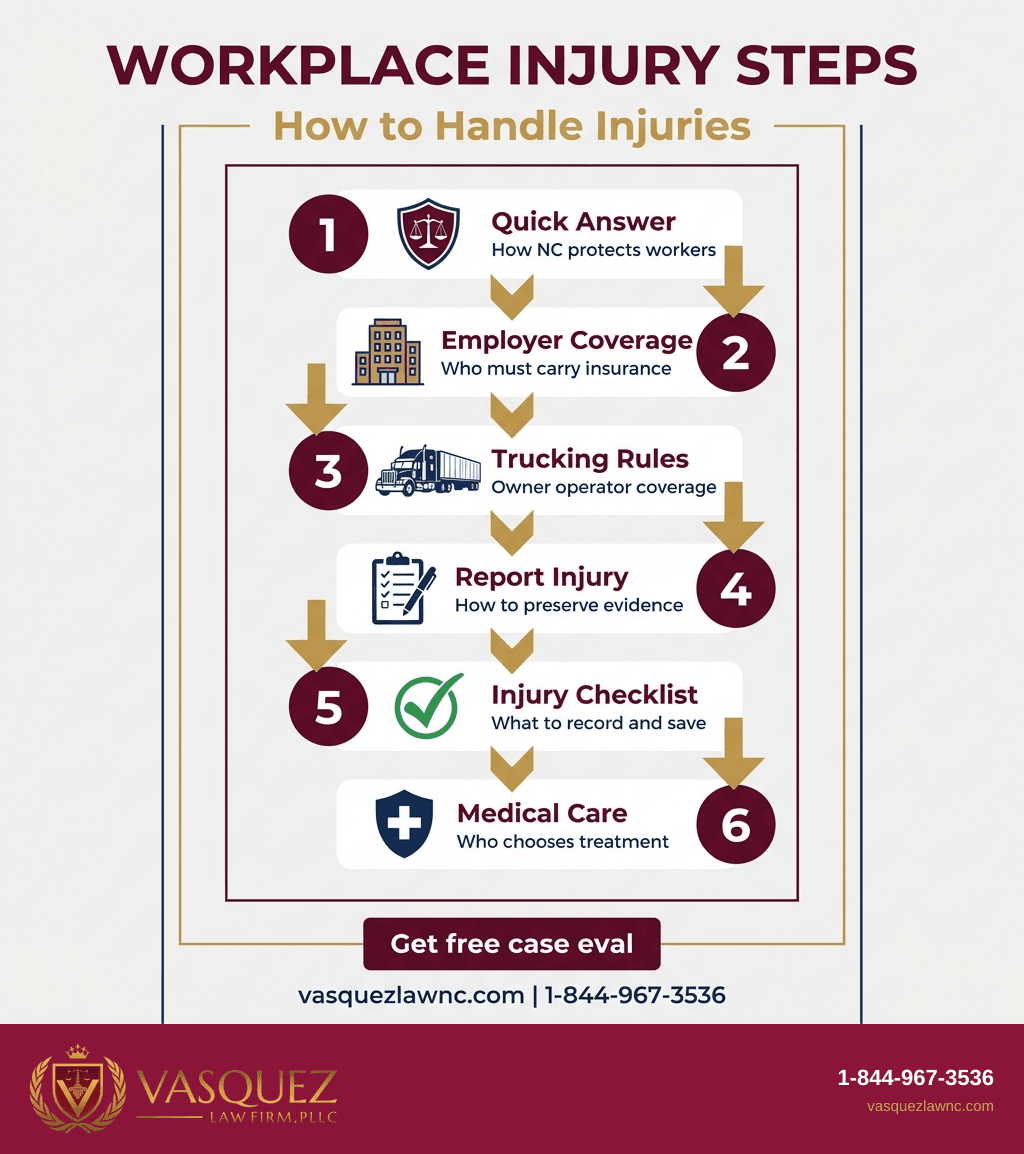
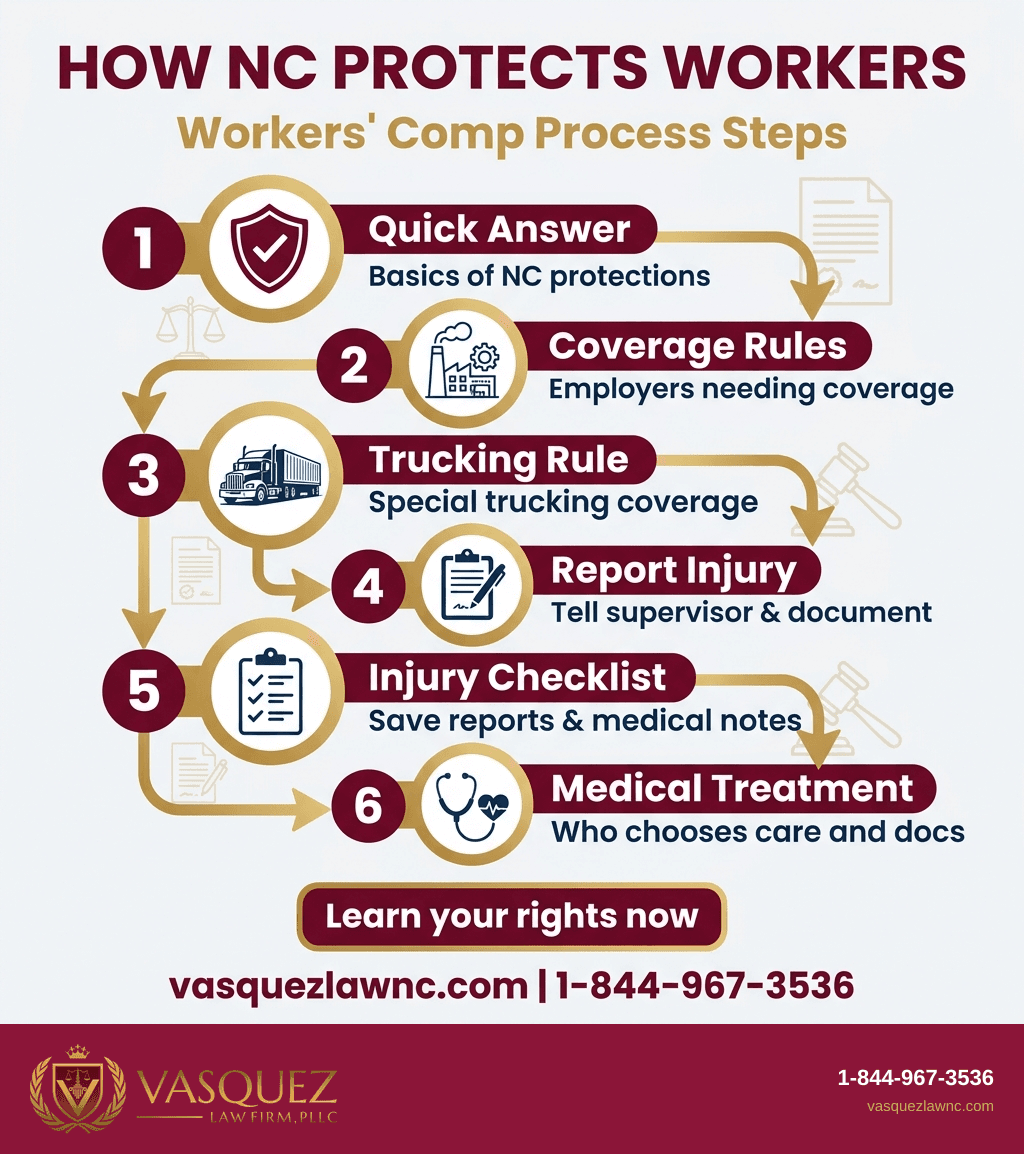
Quick Answer
North Carolina protects eligible workers in several ways. It requires workers' compensation coverage for many employers. It sets rules for medical treatment. It provides wage-loss benefits. It also gives the Industrial Commission procedures for claim disputes. The law may impose penalties for late payment. Protection depends on the employment relationship, the injury, and the claim status.
- Many employers with three or more regular employees need coverage.
- Temporary total disability benefits are generally two-thirds of average weekly wage.
- The employer or carrier generally directs authorized medical treatment.
- Industrial Commission procedures can address unpaid benefits and treatment disputes.
Which employers must carry workers compensation coverage?
A business's employee count may not be simple. Consider a corporation with two officers and one employee. The N.C. Industrial Commission explains that corporate officers count when deciding whether the business has three or more employees. An officer may still elect exclusion from the policy.
In general, all businesses employing three or more employees on a regular basis are covered by the Act.
A business covered by the North Carolina Workers' Compensation Act is required by law to obtain workers’ compensation insurance or qualify as a self-insured employer. Certain groups are exempt from the provisions of the Act, and these exemptions are set forth in N.C. Gen. Stat. §97-13.
Radiation work has a separate coverage rule. An employer with one or more employees performing work involving the use or presence of radiation needs coverage. Sole proprietors, partners, and limited liability company members are not automatically employees. They may elect coverage for themselves.
Workers asking how North Carolina protects workers from workplace injuries should begin by preserving basic information. Save the employer's name, job title, work location, and injury details. Review the firm's North Carolina workers' compensation representation page for a focused overview of claim issues.
What is different for trucking owner operators?
Trucking coverage can apply even when an operator is treated as an independent contractor. An independent contractor is a person who works under a business arrangement instead of being treated as a regular employee. N.C. Gen. Stat. § 97-19.1 addresses certain owner operators and motor carriers. A company that merely arranges transportation is not necessarily a motor carrier. The Industrial Commission explains that a motor carrier must provide coverage if the owner operator lacks it.
A motor carrier employer is not liable for the workplace injuries suffered by an independent contractor who is individually licensed by the U.S. Department of Transportation and personally operates the vehicle. (N.C. Gen. Stat. § 97-19.1)
How should you report a workplace injury and preserve evidence?
A worker may tell a supervisor about an injury but keep no personal record. That worker may later have trouble showing what was reported. Write down the incident facts as soon as possible. Record who received the report. Note symptoms, medical visits, and work restrictions. Keep copies of every document you receive.
Employers use Form 19, the Employer's Report of Employee's Injury or Occupational Disease to the Industrial Commission. The agency also lists Form 22. Form 22 is a statement of days worked and earnings. Those records can help with wage calculations. They can also become part of the claim file.
Workplace injury checklist
- Record the date, place, task, and mechanism of injury.
- Keep messages, incident reports, and names of people who observed the event.
- Save medical instructions, appointment records, and work restrictions.
- Keep wage records and any benefit notices.
- Track trips for authorized treatment that reach the mileage standard.
An employee who travels 20 miles or more round trip for authorized medical treatment in a workers’ compensation case is entitled to mileage reimbursement to be paid by the employer or carrier at the IRS standard mileage rate for the year or other time period in which the travel occurred pursuant to Rule 11 NCAC 23J .0101(h). The employee should submit the request for mileage reimbursement to the employer or carrier/administrator on a Form 25T.
Safety handouts for workplace training may help show what occurred. Incident reports may also help. Neither replaces medical records. If your injury may be work related, a free case evaluation can help identify documents worth preserving. Early organization can make the claim history easier to understand.
Who chooses medical treatment after an accepted claim?
In an accepted or compensable workers' compensation claim, the employer or insurance company generally provides and directs medical treatment, subject to Industrial Commission orders. A compensable claim is a claim for an injury that qualifies for workers' compensation benefits. The employer or its insurance company provides and directs medical treatment pursuant to N.C. Gen. Stat. § 97-25, subject to any Industrial Commission orders. A worker should not assume that every provider change will be paid without approval.
The employer or its insurance company provides and directs medical treatment pursuant to N.C. Gen. Stat. § 97-25, subject to any Industrial Commission orders.
If an employee is dissatisfied with the medical treatment provided by the employer or carrier, the employee may file a medical motion with the Industrial Commission pursuant to N.C. Gen. Stat. § 97-25 and Rule 11 NCAC 23A .0609A.
What about emergency treatment?
An emergency creates a narrower choice rule. Under N.C. Gen. Stat. § 97-25(e), a worker may obtain emergency treatment from a provider of the worker's choice. This rule applies if the employer fails to provide emergency treatment. The employer must pay the reasonable cost if the Industrial Commission orders payment.
Cases we handle often involve a missing paper trail after treatment begins. Workers may have appointment papers but no saved work restriction. They may also lack a mileage record. Collect those materials early. Then review medical care in a workers' compensation claim for more discussion of treatment issues.
Medical treatment or benefits should not be handled with guesswork. Call Vasquez Law Firm for a free case evaluation. Se Habla Español.
Call 1-844-967-3536.
How are temporary disability payments calculated and protected?
A worker who cannot earn wages because of a disability may receive temporary total disability compensation. This is payment for a temporary period when the worker cannot earn wages because of the injury. The weekly compensation rate for total disability benefits under the Workers’ Compensation Act is two-thirds of the employee’s “average weekly wage,” as defined in N.C. Gen. Stat. § 97-2(5), subject to a cap. The payment remains subject to the maximum weekly compensation rate.
N.C. Gen. Stat. § 97-29(a) and § 97-29(i) provide for an annually calculated maximum rate. The applicable cap is tied to the year of injury for the entire claim. A cap is the highest amount allowed under the rule. Wage records and Form 22 can therefore be important evidence. They may help show the earnings used in the calculation.
What if weekly benefits stop or arrive late?
For several weeks of unpaid temporary total disability compensation, the Industrial Commission directs workers to contact the carrier or administrator first. A carrier is usually the insurance company handling the claim. An administrator may handle the claim for the carrier or employer. After calling the representative of the carrier/administrator to attempt to resolve the issue, you may file a motion or written request pursuant to N.C. Gen. Stat. § 97-18(e) and (g) with the Executive Secretary’s Office for an Order compelling payment of the unpaid benefits and a 10% late payment penalty. Supporting documents should accompany the filing.
Weekly benefits ordinarily cannot stop without Industrial Commission permission. Defendants may terminate temporary total disability compensation without Industrial Commission permission when an employee has returned to work for the same or a different employer, subject to the trial-return-to-work provisions in N.C. Gen. Stat. § 97-32.1 and Rule 11 NCAC 23A .0404A; when they timely contest a claim in which benefits were paid pursuant to the “payment without prejudice” provision; or after 500 weeks have passed from the first date of disability if the employee has not been awarded extended compensation by the Industrial Commission. Permission can be sought by filing a Form 24 Application to Terminate or Suspend Payment of Compensation pursuant to N.C. Gen. Stat. § 97-18.1 and Rule 11 NCAC 23A .0404.
What workplace injury mistakes can weaken a claim?
A missed form can complicate a claim. A lost wage record can create another problem. An unauthorized treatment dispute can also make a valid claim harder to manage. The following checklist focuses on avoidable problems. It does not promise any outcome.
- Waiting to document the incident: Write a clear factual account while details remain fresh.
- Discarding pay information: Preserve wage and workday records that may affect average weekly wage.
- Ignoring benefit notices: Save Forms 60, 61, 62, and 63 if received.
- Assuming occupational accident coverage is workers' compensation: The Industrial Commission says it is not a lawful substitute under the Act.
- Missing mileage records: Keep travel details for authorized medical appointments.
- Stopping communication after a benefit problem: Keep written notes of contacts with the carrier or administrator.
- Trying to litigate another party's motion without legal help: Some Industrial Commission filings require attorney representation for a party or entity.
If you remember one point, remember this: How North Carolina protects workers from workplace injuries depends heavily on records. Those records should show employment, injury, treatment, earnings, and benefit activity.
What North Carolina workers compensation rules matter most?
North Carolina's Industrial Commission administers workers' compensation claims under Chapter 97. The agency lists Form 60 as an employer admission of the employee's right to compensation. It lists Form 63 as payment without prejudice or medical compensation without prejudice. Payment without prejudice means payment may begin while the claim remains unresolved.
A Form 24 application is a legal filing. A legal filing is a formal document submitted in a claim. The Industrial Commission states that an adjuster or other non-attorney representative cannot file it for an employer or carrier. A copy of the application must be sent to the worker or the worker's attorney of record, if any, at the same time it is filed. Payments may stop only if the Industrial Commission approves the request when approval is required.
The agency's Workers' Compensation Claims page lists forms and claim resources. For a claim-specific review, the firm's workplace injury legal services in North Carolina can help explain the next procedural questions. Procedural questions concern the steps, forms, and deadlines in the claim.
When should you call about a workplace injury claim now?
A denied claim is a practical reason to request a review. A stopped check is another reason. So is a dispute over treatment. Call for a free case evaluation if any of these concerns applies:
- You received a Form 61 denial.
- Weekly temporary total disability payments have not arrived.
- A carrier seeks to suspend compensation.
- You need emergency treatment after an employer failed to provide it.
- You disagree with the medical treatment being directed.
- You have wage records or mileage records that have not been considered.
- You need to understand a Form 60, Form 63, or Form 24.
About Vasquez Law Firm
Vasquez Law Firm handles workers' compensation matters for people throughout North Carolina by phone. The firm combines compassionate communication with determined advocacy. Its Yo Peleo® approach means standing up for people dealing with injury-related uncertainty.
- Bilingual support: Se Habla Español, with bilingual support staff.
- Practice focus: Immigration, personal injury, workers' compensation, criminal defense, and traffic violations.
- Experience: William J. Vasquez has practiced for more than fifteen years.
Attorney trust and experience
William J. Vasquez is admitted to the North Carolina State Bar. A claim review should focus on the documents, medical issues, wage information, and procedural status that apply to the individual worker.
Frequently Asked Questions
Do three employees trigger workers' compensation coverage?
In general, an employer with three or more employees on a regular basis must carry workers' compensation insurance or qualify as self-insured. Corporate officers count when determining the number for a corporation. Certain groups are exempt from the provisions of the Act, and these exemptions are set forth in N.C. Gen. Stat. §97-13.
Is occupational accident insurance the same as workers' compensation?
No. The Industrial Commission explains that occupational accident insurance is separate insurance and is not a lawful substitute for workers' compensation coverage under the North Carolina Workers' Compensation Act. It may cover only specified injuries and may pay limited benefits based on the policy contract. The Commission does not decide coverage disputes under those policies.
Who directs treatment in an accepted claim?
The employer or its insurance company generally provides and directs medical treatment under N.C. Gen. Stat. § 97-25, subject to Industrial Commission orders.
Can I get mileage reimbursement for medical travel?
An employee who travels 20 miles or more round trip for authorized medical treatment in a workers’ compensation case is entitled to mileage reimbursement to be paid by the employer or carrier at the IRS standard mileage rate for the year or other time period in which the travel occurred pursuant to Rule 11 NCAC 23J .0101(h). The Industrial Commission directs workers to submit the request to the employer or carrier on Form 25T.
How are temporary total disability payments calculated?
The weekly compensation rate is two-thirds of average weekly wage as defined in N.C. Gen. Stat. § 97-2(5), subject to the maximum weekly compensation rate. The applicable maximum is tied to the year of injury. Form 22, wage records, and days-worked information can matter when compensation is calculated.
What can I do if disability payments are late?
After contacting the carrier or administrator, a worker may file a motion or written request under N.C. Gen. Stat. § 97-18(e) and (g) seeking an order for unpaid benefits and a ten percent late-payment penalty. Attach supporting documentation. The proper action can depend on the procedural history of the claim.
Can an insurer stop weekly benefits without permission?
Defendants may terminate temporary total disability compensation without Industrial Commission permission when an employee has returned to work for the same or a different employer, subject to the trial-return-to-work provisions in N.C. Gen. Stat. § 97-32.1 and Rule 11 NCAC 23A .0404A; when they timely contest a claim in which benefits were paid pursuant to the “payment without prejudice” provision; or after 500 weeks have passed from the first date of disability if the employee has not been awarded extended compensation by the Industrial Commission. Outside those situations, the carrier must obtain Industrial Commission approval through Form 24 before stopping temporary total disability benefits.
How does North Carolina protect workers from workplace injuries?
Protection comes through the workers' compensation framework: coverage obligations, authorized medical care, wage-loss calculations, mileage reimbursement, agency forms, and Industrial Commission procedures. Whether those protections apply in a particular claim depends on the work relationship, injury facts, records, and claim status. A free case evaluation can help a worker organize the relevant questions.
Sources and References
- N.C. Industrial Commission, Employers
- N.C. Industrial Commission, Injured Workers
- OSHA, File a Safety and Health Complaint
How North Carolina protects workers from workplace injuries is a question that deserves careful attention to records and claim procedures. Contact Vasquez Law Firm for a free case evaluation. Se Habla Español.
Start Your Free Evaluation Now
Call 1-844-967-3536.
Hurt at work? You have rights.
NC workers' comp covers medical bills and lost wages — even for undocumented workers. 15-min call to see what you qualify for.
Keep Reading

For how Vasquez Law Firm can help, see our workplace injuries page.
Reviewed by Attorney Vasquez, Managing Attorney

William Vasquez
Founder & CEO, Vasquez Law Firm, PLLC
William Vasquez is the founder and CEO of Vasquez Law Firm, PLLC, a results-driven firm specializing in immigration, criminal defense, personal injury, and workers' compensation. A U.S. Air Force veteran and recipient of the Joint Service Achievement Medal, William is dedicated to fiercely fighting for his clients' rights.
Related Legal Services
Need legal help? Learn more about how our work injury attorneys can help, or contact us for a free evaluation.
You can also visit North Carolina workers compensation lawyers for more information.