How to File a Workers’ Compensation Claim in North Carolina
How to file a workers’ compensation claim in North Carolina: protect deadlines, Form 18, and benefits. Call for a free case evaluation today.
Published on October 11, 2026· Updated October 11, 2026
Hurt on the job?
Free review of your workers' comp claim.
Free & confidential · Se habla espanol · 24/7
Have questions? Talk to an attorney - free evaluation.
Call 1-844-967-3536Hurt on the Job? Claim What You Are Owed
A review of your workers' comp claim - we handle the fight.
How to File a Workers’ Compensation Claim in North Carolina
A worker may report an injury by speaking to a supervisor. The worker may then assume the employer’s report protects the claim. That assumption can cause a missed filing step. How to file a workers’ compensation claim in North Carolina means giving written notice. It also means filing your own Form 18 and keeping records. You must act quickly if benefits are denied. This guide explains the North Carolina Industrial Commission process for injured workers. It covers deadlines, medical care, wage benefits, and hearing requests.
Need help protecting a workplace injury claim? William J. Vasquez and Vasquez Law Firm help people anywhere in North Carolina by phone. Se Habla Español.
Call now: 1-844-967-3536
Quick Answer
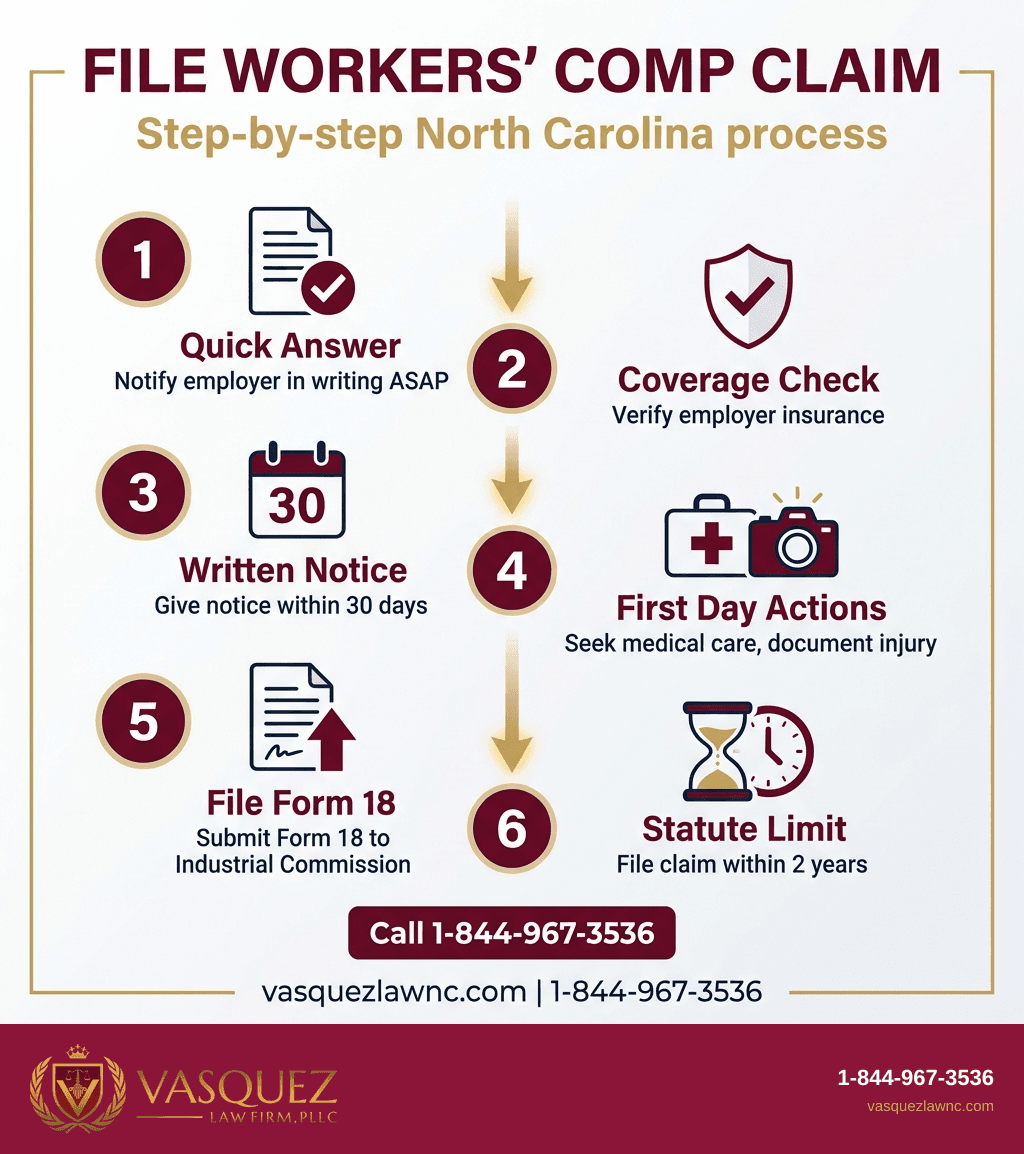
To file a workers’ compensation claim in North Carolina, notify your employer in writing as soon as practical. Then file Industrial Commission Form 18 within the applicable two-year deadline. Workers’ compensation means benefits for a work injury or work-related disease. An employer’s Form 19 is not your claim. Keep medical, wage, travel, and notice records.
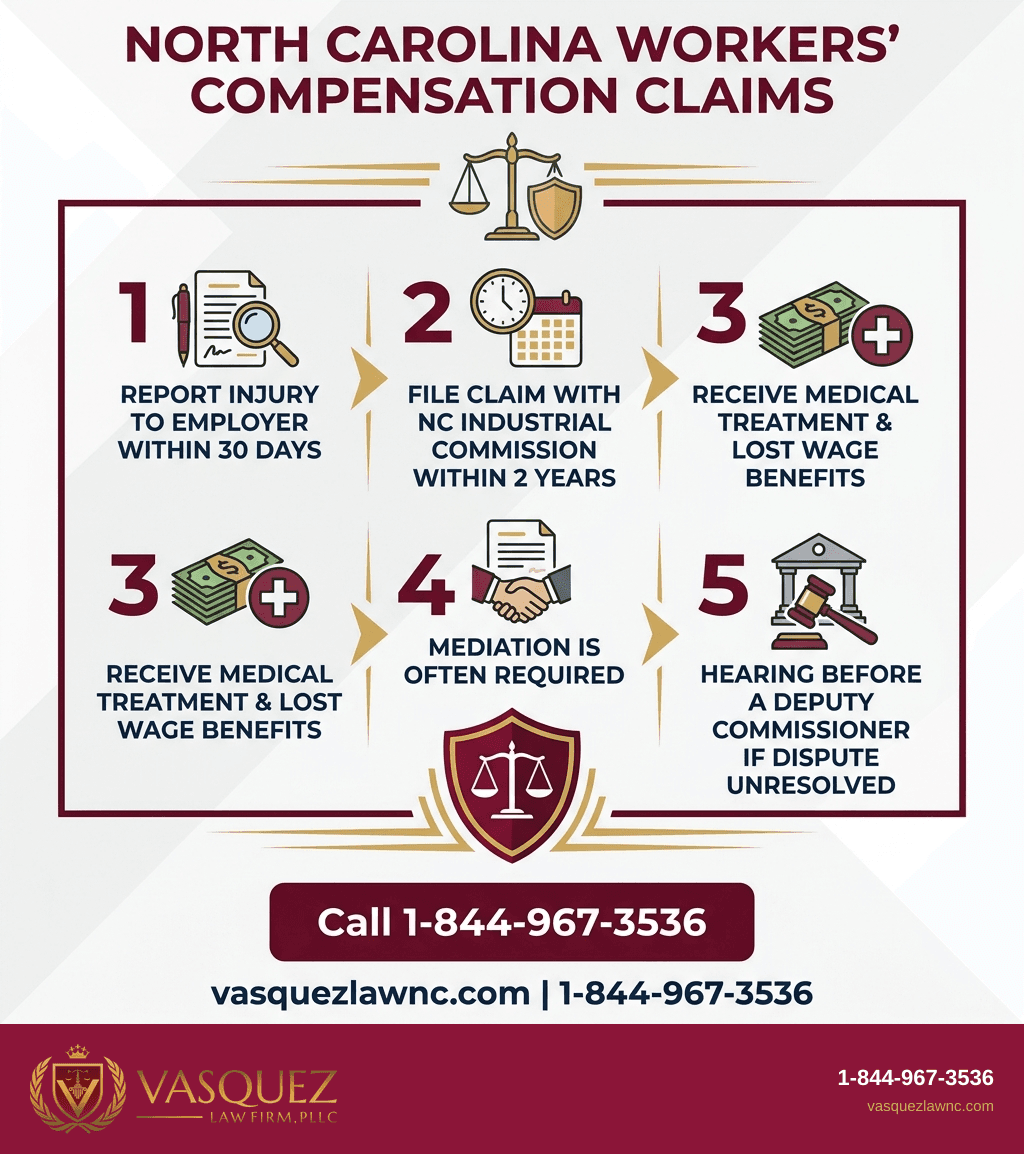
- Give written accident notice within 30 days.
- File Form 18 for an injury by accident.
- Use Form 18B for an occupational lung disease.
- File Form 33 to request a hearing after a denial.
Does North Carolina require workers’ compensation insurance?
A corporation with two officers and one employee generally reaches the three-employee coverage rule. The North Carolina Industrial Commission says an employer with three or more employees must generally carry workers’ compensation coverage. The employer may instead qualify as self-insured. A self-insured employer pays covered claims without buying an insurance policy. Corporate officers count as employees for this calculation.
The rule has exceptions. Employment involving radiation requires coverage with one or more employees performing activities involving radiation. Certain trucking owner-operators also require coverage. This applies even when they are classified as independent contractors. N.C. Gen. Stat. § 97-19.1 addresses the motor carrier rule. It also states an exception for a qualifying USDOT-licensed owner-operator who personally operates the vehicle.
Coverage is only a starting point. It does not prove that an injury is compensable. Compensable means eligible for benefits under the law. A claim still needs facts connecting the accident or occupational disease to work. People seeking help with North Carolina workers’ compensation claims should preserve job details, witness information, and medical records from the first day.
“In general, any employer who employs three or more employees must have workers' compensation insurance coverage or qualify as a self-insured employer.”
How can you check insurance coverage?
The Industrial Commission provides an insurance coverage search system. If an employer that should have coverage appears uninsured, the Commission says a report may be made to its Criminal Investigations & Employee Classification Division. You may report it by email or phone. That report does not replace filing Form 18 for your own benefits.
How soon must you give written notice after a work injury?
A worker who falls on Monday may wait until the next month to send a written report. That delay creates a deadline dispute. Under N.C. Gen. Stat. § 97-22, an injured employee must give the employer written notice “immediately... or as soon thereafter as practicable.” The notice must be given no later than 30 days after the accident. Otherwise, compensation may not be payable.
The same notice framework generally applies to occupational disease claims under N.C. Gen. Stat. § 97-58(b). An occupational disease is an illness caused by a person’s work. For these claims, the 30-day period begins when competent medical authority advises the employee about the occupational disease. Competent medical authority means a qualified medical source with authority to give that advice. The source separately identifies asbestosis, silicosis, and lead poisoning as exceptions to that described rule.
“Pursuant to N.C. Gen. Stat. §97-22, an injured employee shall give the employer written notice of a workplace accident ‘immediately. . . or as soon thereafter as practicable,’ but no later than 30 days after the accident or else compensation may not be payable.”
Give notice in a format you can later prove. Identify the date, place, body part, and basic event. Name the people who saw it. Save a copy of the notice and its delivery confirmation. The North Carolina Industrial Commission’s official resources list Form 18. They also list a Spanish Form 18 notice option.
What should you do on the first day?
- Ask for medical care if you need it. Describe how the injury happened.
- Send written notice to a supervisor, human resources contact, or other employer contact.
- Photograph the area, equipment, visible injury, or unsafe condition if it is safe to do so.
- Record witness names and their contact details.
- Keep work schedules, pay stubs, restrictions, and every medical instruction.
How do you file Form 18 for a workers comp claim?
Form 18 is the employee’s claim form for an injury by accident. An injury by accident is a specific event that causes an injury during work. The Industrial Commission’s Injured Workers page identifies Form 18 as the filing for this type of claim. File it with the Industrial Commission. Do not file it only with the employer or insurance carrier.
N.C. Gen. Stat. § 97-24(a) contains the two-year statute of limitations for an injury claim. A statute of limitations is the legal deadline for filing a claim. The source directs employees to review that statute carefully. An occupational disease that does not involve lung disease also uses Form 18. A lung disease claim uses Form 18B under the process described by the Commission.
Do not confuse an employer report with your filing. The Commission’s Injured Workers page is the primary source for this guide. It expressly says an employer or carrier’s Form 19 does not constitute the employee’s workers’ compensation claim. Filing Form 18 helps establish the claim before the statutory deadline.
What information belongs in the claim file?
Use accurate facts instead of guesses. Include the employer name, accident date, affected body parts, location, and medical providers. List the periods you missed from work. Keep a complete copy of the submitted form. Keep any confirmation as well. If you are unsure whether a condition is an injury by accident or an occupational disease, get individualized guidance. Do so before choosing a filing path.
Cases we handle often show that a worker has medical discharge papers. The worker may lack a copy of written notice or a submitted Form 18. Those missing records can create avoidable disputes. A workplace injury claim checklist can help organize documents before deadlines become urgent.
What workers’ compensation benefits can you obtain?
A worker earning $900 per week may receive a compensation rate based on two-thirds of the average weekly wage. The statutory cap still applies. A statutory cap is a legal maximum. Under N.C. Gen. Stat. § 97-2(5), average weekly wage has a defined legal meaning. The Industrial Commission explains that total disability benefits are generally two-thirds of that amount. For a $900 average weekly wage, two-thirds is $600 per week. The maximum weekly compensation rate still applies.
The applicable cap depends on the year of injury. It applies for the entire claim. The Industrial Commission says the maximum rate is calculated annually under N.C. Gen. Stat. § 97-29(a) and § 97-29(i). For injuries in 2026, the Commission lists the maximum weekly compensation rate as $1,446.00 (it was $1,380.00 for 2025).
There is also a seven-day waiting rule. N.C. Gen. Stat. § 97-28 provides no compensation for the first seven days of lost work. This changes if disability continues beyond 21 days. If it does, payment for days one through seven becomes due. Medical treatment in an accepted claim is generally provided and directed by the employer or carrier under N.C. Gen. Stat. § 97-25. Industrial Commission orders may affect that treatment.
Can you recover travel costs for treatment?
The Commission says an employee who travels 20 miles or more round trip for authorized treatment may seek mileage reimbursement. Use Form 25T. The reimbursement uses the IRS standard mileage rate for the applicable period under Rule 11 NCAC 23J .0101(h). Keep appointment notices, dates, mileage logs, and receipts.
If you disagree with authorized treatment in an accepted claim, the Industrial Commission says you may file a medical motion. A medical motion asks the Commission to decide a medical-treatment issue. The motion uses N.C. Gen. Stat. § 97-25 and Rule 11 NCAC 23A .0609A. Workers’ compensation representation in North Carolina can help a worker assess records and procedure. It cannot guarantee a particular result.
What happens if the insurance carrier denies your claim?
A denial does not end the administrative process. Administrative means handled through the agency process rather than only through court. The Industrial Commission says an employee who wants to pursue benefits after a denial may request a hearing before a Deputy Commissioner. The employee does this by filing Form 33. A hearing request needs careful factual support. That support includes medical records and proof of the work event.
After a denial, the Industrial Commission says you may choose any health care provider. The employer or carrier may still request an independent medical examination under N.C. Gen. Stat. § 97-27(a). An independent medical examination is an evaluation by a doctor chosen for that examination. Keep copies of denial letters, appointment notices, medical bills, and communications about work restrictions.
If weekly benefits are late, first contact the carrier representative. The Commission explains that a written request or motion under N.C. Gen. Stat. § 97-18(e) and (g) may seek an order compelling payment. It may also seek a 10% late-payment penalty. Attach supporting documentation. The Commission does not specify how quickly it will decide a particular request.
What if you receive a Form 24?
A Form 24 seeks permission to terminate or suspend compensation when approval is required. The Commission says you can complete Section B as a Form 24 Response. File it within 17 days of the mailing date. Send a contemporaneous copy to the listed opposing representative. Contemporaneous means sent at the same time. Attach supporting records.
Deadlines can affect a claim before medical treatment is complete. Call Vasquez Law Firm for a free case evaluation. Se Habla Español.
Call: 1-844-967-3536
What mistakes can delay a North Carolina workers comp claim?
A missed 30-day notice deadline is one of the clearest avoidable problems. The better approach is prompt written notice and a saved copy. Another frequent mistake is relying on Form 19. The Industrial Commission says Form 19 does not file the employee’s claim.
- Only reporting orally: Send written notice and retain proof.
- Waiting for a Form 19: File Form 18 yourself within the applicable limitation period.
- Ignoring an occupational diagnosis: Document the date competent medical authority gave the advice.
- Missing Form 24 response time: Calendar the 17-day period immediately.
- Discarding wage records: Preserve pay stubs because average weekly wage affects benefits.
- Failing to log medical travel: Track authorized trips of 20 miles or more round trip.
- Assuming every benefit stop is proper: Review the stated basis and relevant Commission procedure.
If you remember one thing: how to file a workers’ compensation claim in North Carolina involves your own written notice and claim filing. It does not involve only an employer report.
What North Carolina rules apply to Smithfield workers?
A workplace injury in Smithfield follows the same North Carolina Industrial Commission system described in this guide. The firm assists injured workers anywhere in North Carolina by phone. The Industrial Commission’s Information Specialist Section can answer questions about Commission forms and procedures for unrepresented claimants. Unrepresented means people who do not have a lawyer. The source cautions that Information Specialists cannot give legal advice.
Workers should distinguish occupational accident insurance from workers’ compensation insurance. Occupational accident insurance is a different type of insurance. The Industrial Commission says it is not a lawful substitute for workers’ compensation coverage under the North Carolina Workers’ Compensation Act. It also says the Industrial Commission lacks jurisdiction over disputes concerning occupational accident insurance policies. Jurisdiction means legal authority to decide a dispute.
The North Carolina workers’ compensation overview offers additional context about work injury claims. For immediate procedural questions, preserve paperwork first. Then seek legal advice tailored to your facts.
When should you call about a workplace injury claim?
Call promptly if the employer disputes the accident. Call if the carrier denies the claim. Call if medical care is delayed or weekly checks stop. Call if a Form 24 arrives. Early review is also useful when an injury may involve an occupational disease. It can help with a trucking arrangement, several employers, or disputed wage information.
- You are close to the 30-day written-notice deadline.
- You have not filed Form 18 and time has passed.
- You received a denial letter or a Form 24.
- You disagree with authorized medical treatment.
- Your work restrictions prevent return to your prior job.
- Your benefits are late or stopped.
About Vasquez Law Firm
Vasquez Law Firm combines compassionate communication with determined representation. Its “Yo Peleo®” commitment means standing up for clients while explaining each legal step clearly. The firm handles workers’ compensation, immigration, personal injury, criminal defense, and traffic matters within its service scope.
- Bilingual support: Se Habla Español, with bilingual support staff.
- Workers’ compensation service area: North Carolina.
- Approach: Clear communication, document review, and careful deadline tracking.
- Leadership: William J. Vasquez has practiced since 2011.
Experience and communication
William J. Vasquez is admitted to the North Carolina State Bar. A workplace injury can affect income, treatment, and family planning at the same time. The firm provides a direct point of contact for people who need to understand the North Carolina claim process.
Frequently Asked Questions
Do I have to file Form 18 if my employer filed Form 19?
Yes, if you wish to pursue workers’ compensation benefits. The Industrial Commission says Form 19 does not constitute the employee's claim. Form 19 is an employer or carrier report. For an injury by accident, file Form 18 with the Industrial Commission within the applicable two-year limitations period in N.C. Gen. Stat. § 97-24(a).
How long do I have to report a work injury?
Under N.C. Gen. Stat. § 97-22, written notice should be given immediately or as soon as practicable, and no later than 30 days after the accident. Waiting can place compensation at risk. Give notice in writing, identify the event and body part, and preserve a dated copy or delivery confirmation.
How long do I have to file a workers comp claim?
The Industrial Commission says there is a two-year statute of limitations for an injury-by-accident claim and directs workers to N.C. Gen. Stat. § 97-24(a). Occupational disease deadlines are addressed in N.C. Gen. Stat. § 97-58(c). Because the applicable date and claim type matter, do not assume an employer report preserves your deadline.
How much does North Carolina workers compensation pay?
Total disability benefits are generally two-thirds of the employee's average weekly wage, subject to the maximum weekly compensation rate. The relevant cap is tied to the injury year. For 2026 injuries, the maximum is $1,446.00 per week. The first seven lost-work days are generally unpaid unless disability exceeds 21 days, under N.C. Gen. Stat. § 97-28.
Can I choose my own doctor after a denial?
According to the Industrial Commission, you may go to a health care provider of your choice after the employer or carrier denies the claim. The carrier may still request an independent medical examination under N.C. Gen. Stat. § 97-27(a). Keep records from every visit and make sure each provider understands the claimed work connection.
What can I do if my weekly checks stop?
First contact the carrier or administrator to try to resolve the issue. The Commission says a worker may then file a motion or written request under N.C. Gen. Stat. § 97-18(e) and (g) seeking payment and a 10% late-payment penalty. Attach proof of unpaid benefits and communications. Different rules may apply if a Form 24 or return-to-work issue exists.
Can I get mileage reimbursement for medical appointments?
Yes. The Industrial Commission says authorized medical travel of 20 miles or more round trip may qualify for mileage reimbursement. Use Form 25T and request payment from the employer or carrier. The rate follows the IRS standard mileage rate for the relevant period under Rule 11 NCAC 23J .0101(h). Keep a dated mileage log and appointment proof.
What happens after a workers comp denial?
You may request a hearing before a Deputy Commissioner by filing Form 33 if you want to continue pursuing benefits. Gather the denial notice, Form 18 confirmation, medical records, witness information, wage records, and written notice to the employer. A hearing request is a procedural step, not a guarantee that benefits will be awarded.
Sources and References
- North Carolina Industrial Commission, Injured Workers information and forms.
- Occupational Safety and Health Administration, workplace safety resources.
- NC Industrial Commission, Maximum Weekly Compensation Rates.
How to file a workers’ compensation claim in North Carolina can turn on prompt notice, Form 18, and proof you kept from the start. Contact Vasquez Law Firm for a free case evaluation and discuss your situation. Se Habla Español.
Start Your Free Evaluation Now
Call: 1-844-967-3536
Hurt at work? You have rights.
NC workers' comp covers medical bills and lost wages — even for undocumented workers. 15-min call to see what you qualify for.
Keep Reading

Reviewed by Attorney Vasquez, Managing Attorney
For how Vasquez Law Firm can help, see our North Carolina workers' compensation page.

William Vasquez
Founder & CEO, Vasquez Law Firm, PLLC
William Vasquez is the founder and CEO of Vasquez Law Firm, PLLC, a results-driven firm specializing in immigration, criminal defense, personal injury, and workers' compensation. A U.S. Air Force veteran and recipient of the Joint Service Achievement Medal, William is dedicated to fiercely fighting for his clients' rights.
Related Legal Services
Need legal help? Learn more about workers comp lawyers in North Carolina, or contact us for a free evaluation.
You can also visit statewide workers comp services for more information.