NC Workers’ Comp: Trial Returns and Benefit Suspension Rules
Returning to work after a NC workers comp injury? Understand suitable employment and compensation suspension under G.S. 97-32. Call for a free case evaluation today.
Published on October 27, 2026· Updated October 28, 2026
Hurt on the job?
Free review of your workers' comp claim.
Free & confidential · Se habla espanol · Mon-Fri 8am-7pm, Sat 9am-2pm (ET)
Have questions? Talk to an attorney - free evaluation.
Call 1-844-967-3536Hurt on the Job? Claim What You Are Owed
A review of your workers' comp claim - we handle the fight.
NC Workers’ Comp: Trial Returns and Benefit Suspension Rules
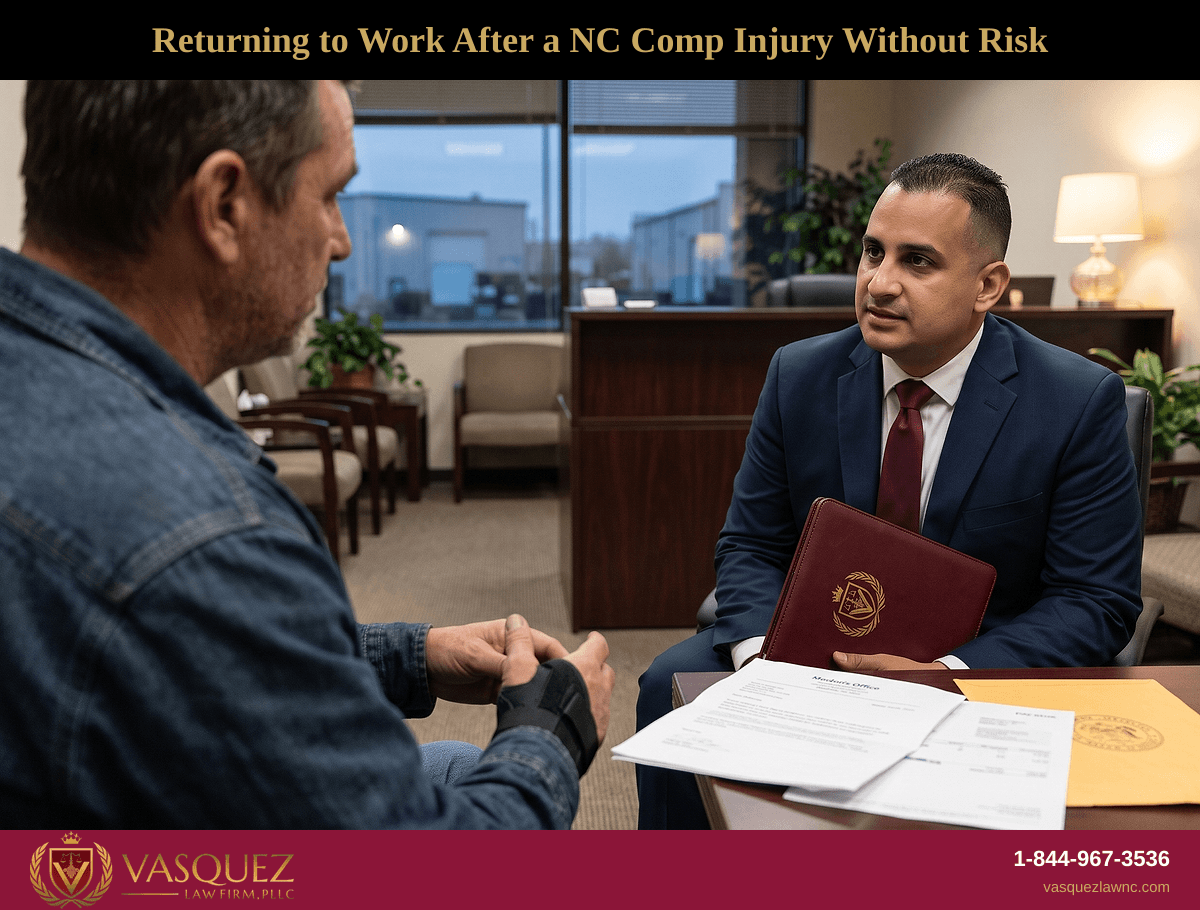
Returning to work after a North Carolina workers' comp injury can affect wage replacement benefits, medical recovery, and the path of a claim. North Carolina law covers suitable employment, a trial return to work, and partial disability benefits. This guide explains these rules in plain language. It can help an injured employee understand choices that may affect compensation.
Questions about returning to work after a North Carolina workers' comp injury? Vasquez Law Firm offers free case evaluations for North Carolina workers. Se Habla Español.
Schedule a Free Case Evaluation
Call 1-844-967-3536.
Quick Answer
A return-to-work offer can matter because an unjustified refusal of suitable employment may suspend compensation. Suitable employment means work that meets the legal requirements for the employee's situation. A worker may also attempt a trial return to work. A trial return is a temporary effort to test whether the employee can do the work. If that effort fails, the worker's continuing compensation rights remain unimpaired unless they are later terminated or suspended under the Workers' Compensation Act.
- Read the work offer carefully.
- Compare duties with current medical restrictions.
- Keep records of wages and work performed.
- Ask questions before refusing an offer.
- Document problems during a trial return.
How does suitable employment affect NC workers' comp?
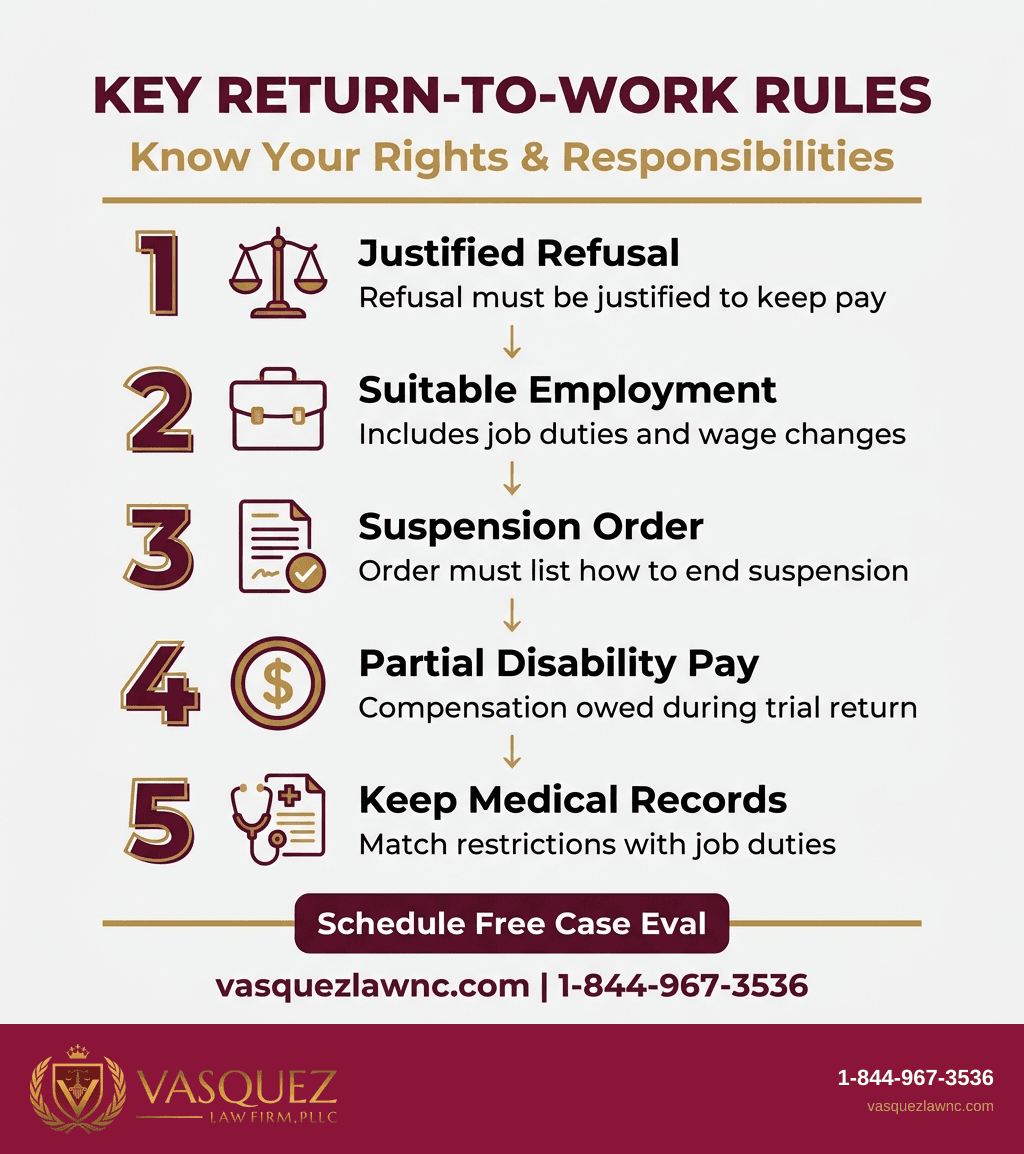
An injured worker may receive an offer to return in a different role. The offer may include changed duties or a different wage. If an injured employee refuses suitable employment as defined by G.S. 97-2(22), the employee shall not be entitled to any compensation at any time during the continuance of such refusal, unless in the opinion of the Industrial Commission such refusal was justified. The Industrial Commission decides whether the refusal was justified.
If an injured employee refuses suitable employment as defined by G.S. 97-2(22), the employee shall not be entitled to any compensation at any time during the continuance of such refusal, unless in the opinion of the Industrial Commission such refusal was justified.
The question is not simply whether an employer uses the words light duty. The legal issue is suitable employment. Before deciding how to respond, save the written offer. Also save the job description, schedule, pay information, and messages about the expected duties. These materials help show what the employer offered. They also show what the employee understood.
Workers who need help with a work-related injury can review the firm's North Carolina workers' compensation representation. Returning to work after a North Carolina workers' comp injury deserves careful review. An informal response may later be described as a refusal.
Can an employer contact an injured employee directly?
Nothing in this Article prohibits an employer from contacting the employee directly about returning to suitable employment with contemporaneous notice to the employee's counsel, if any. Contemporaneous notice means notice given at the same time. Save the date, method, and content of each contact.
What should a suspension order include?
A Commission order suspending compensation under N.C. Gen. Stat. § 97-18.1 for an unjustified refusal of an offer of suitable employment must list the actions the employee should take. Those actions must end the suspension and reinstate compensation. Read any order line by line. Keep a copy with the claim records.
Can a trial return to work protect compensation?
A worker may not know whether a job will remain physically possible after an injury. Notwithstanding the provisions of G.S. 97-32, an employee may attempt a trial return to work for a period not to exceed nine months. A trial return is a temporary work effort that tests whether the employee can return. This option recognizes that an employee can test a return without automatically losing continuing compensation if the effort does not succeed.
If the trial return to work is unsuccessful, the employee's right to continuing compensation under G.S. 97-29 shall be unimpaired unless terminated or suspended thereafter pursuant to the provisions of this Article.
A trial return is not a reason to ignore symptoms. It is also not a reason to ignore changed duties or wage records. Keep copies of schedules, pay records, work instructions, and messages about the effort. A clear record can show the difference between a failed trial return and a disagreement about whether the employee worked.
We often see workers focus on the first day back. They may miss the written description of their assigned duties and later wage information. Those records often become important when the employee must explain why the work was not sustainable. This is a general pattern, not a prediction about any individual claim.
Can partial disability compensation be owed during a trial return?
During a trial return to work period, the employee shall be paid any compensation which may be owed for partial disability pursuant to G.S. 97-30. Partial disability compensation is payment for a work-related loss that reduces, but does not completely prevent, the ability to work. A return to some work therefore does not automatically answer every compensation question.
The role of authorized medical care in a workers' comp claim can also matter when people discuss job duties and physical ability. Keep medical restrictions with the employment documents.
How does partial disability pay work after return?
Partial incapacity means the work injury causes a partial inability to work. Except as otherwise provided in G.S. 97-31, partial incapacity resulting from the injury generally entitles the employee to weekly compensation of sixty-six and two-thirds percent (66 2/3%) of the difference between pre-injury average weekly wages and the average weekly wages the employee is able to earn afterward, subject to the annual weekly maximum effective January 1 under G.S. 97-29 and a limit of 500 weeks under this section. However, a State Highway Patrol officer or member who remains in that position during incapacity from an accidental injury arising out of and in the course of official duties cannot receive weekly compensation under G.S. 97-30 for the first two years of that incapacity, but remains entitled to any other benefits available under the Article. Any weeks of payments made pursuant to G.S. 97-29 shall be deducted from the 500 weeks of payments available under this section.
The calculation depends on wage information from before and after the injury. Keep pay stubs, time records, and records showing any wage change. Do not assume that accepting work ends every issue involving partial disability compensation.
Which wage records should be preserved?
Save documents that show average weekly wages before the injury. Also save documents that show wages earned after returning. Records of missed time, reduced hours, and assigned duties can help organize a discussion of partial incapacity. The calculation comes from the statute. Accurate records therefore matter.
For an overview of claim issues, see the firm's North Carolina workers' compensation guide. That resource can help a worker identify questions to raise while returning to work after a North Carolina workers' comp injury.
What steps should an injured worker take before returning to work?
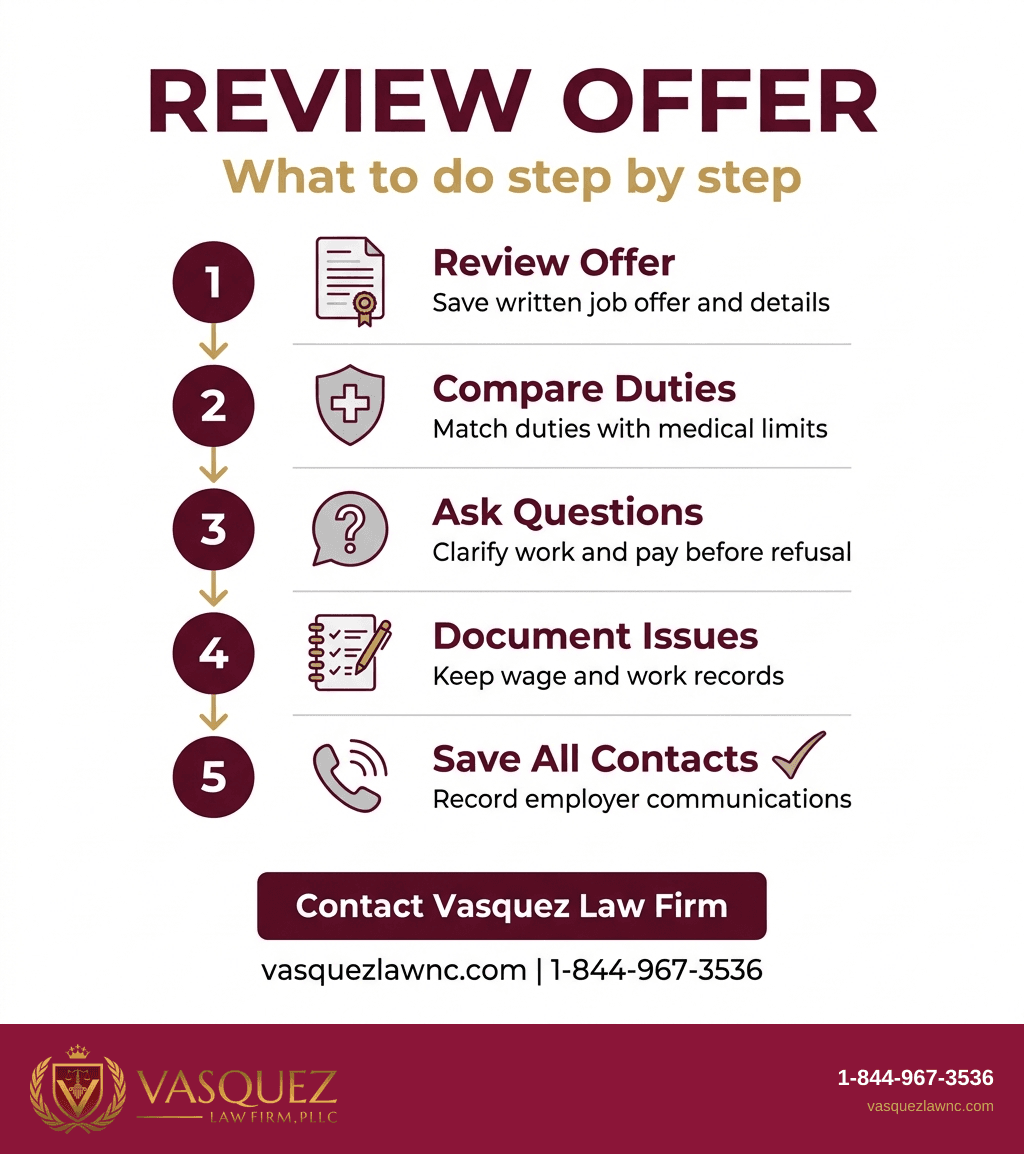
A written job offer can arrive before an employee feels ready. Start by collecting the paperwork. Do not make a quick verbal decision. The following process helps organize information about suitable employment, a trial return, and partial disability.
- Save the offer and every message about the proposed job.
- Identify the duties, schedule, pay, and expected start date shown in the materials.
- Compare the proposed duties with current medical restrictions and treatment records.
- Keep a written log of contacts, completed work, symptoms, and wage changes.
- Retain pay records before and after the return.
- Read any Industrial Commission order for the actions required to reinstate suspended compensation.
Use the North Carolina Industrial Commission information for injured workers as an official starting point for claim information. A workplace safety concern may also be reported through OSHA's safety and health complaint process.
Before responding to a return-to-work offer, request a free case evaluation from Vasquez Law Firm. Se Habla Español.
Call 1-844-967-3536.
What return-to-work mistakes can affect benefits?
A brief text message can create confusion. It may be unclear whether an employee refused work or attempted a return. Clear communication helps protect the record. These mistakes are practical risks, not automatic outcomes.
- Ignoring an offer: Save it and respond in a documented way.
- Relying on a verbal job description: Request written duties and pay details.
- Discarding wage records: Keep pre-injury and post-return pay documentation.
- Calling a trial return permanent: Keep records showing it was a trial effort.
- Failing to track assigned work: Record duties actually performed.
- Ignoring a Commission order: Review the actions required for reinstatement.
- Assuming reduced earnings do not matter: Preserve evidence relevant to N.C. Gen. Stat. § 97-30.
If you remember one point: do not treat suitable employment, a trial return, and partial disability as the same issue. Each has a separate statutory role in returning to work after a North Carolina workers' comp injury.
What North Carolina rules govern the decision?
North Carolina workers' compensation rules
N.C. Gen. Stat. § 97-32 addresses refusal of suitable employment and suspension of compensation. N.C. Gen. Stat. § 97-32.1 addresses a trial return to work. N.C. Gen. Stat. § 97-30 addresses partial incapacity and weekly compensation.
The North Carolina Industrial Commission workers' compensation claims page provides official claim information. The firm assists workers anywhere in North Carolina by phone. A discussion of an individual claim should account for the actual offer, work performed, wage records, and Commission documents.
When should you call about a return-to-work offer?
Call promptly if an offer is presented as suitable employment. Call if compensation has been suspended. Also call if a trial return has become unsuccessful. A timely review can help a worker understand the documents before responding.
- You received a written or verbal return-to-work offer.
- You believe proposed duties conflict with medical restrictions.
- You are returning at lower earnings.
- You need to document an unsuccessful trial return.
- You received an Industrial Commission suspension order.
- Your employer contacted you about work while you have counsel.
About Vasquez Law Firm
Vasquez Law Firm handles immigration, personal injury, workers' compensation, criminal defense, and traffic matters. For North Carolina workers' compensation matters, the firm provides caring communication and a determined approach reflected in its Yo Peleo® message.
William J. Vasquez leads the firm, and bilingual support staff assist clients who prefer Spanish. The firm helps people anywhere in North Carolina by phone and offers a free case evaluation for workers' compensation matters.
Frequently Asked Questions
Can refusing suitable employment stop compensation?
It can. If an injured employee refuses suitable employment as defined by G.S. 97-2(22), the employee shall not be entitled to any compensation at any time during the continuance of such refusal, unless in the opinion of the Industrial Commission such refusal was justified. The Industrial Commission decides whether the refusal was justified. Keep the offer, duty description, and communications so the issue can be evaluated using the actual terms of the proposed work.
Can I try returning to work without giving up benefits?
Notwithstanding the provisions of G.S. 97-32, an employee may attempt a trial return to work for a period not to exceed nine months. If the trial return to work is unsuccessful, the employee's right to continuing compensation under G.S. 97-29 shall be unimpaired unless terminated or suspended thereafter pursuant to the provisions of this Article. Keep records showing the work attempted and the result.
Can partial disability compensation be owed while I work?
During a trial return to work period, the employee shall be paid any compensation which may be owed for partial disability pursuant to G.S. 97-30. G.S. 97-30 provides for compensation for partial incapacity. Wage documents are important to that statutory comparison.
What if the Industrial Commission suspends compensation?
A suspension order issued under N.C. Gen. Stat. § 97-18.1 for an unjustified refusal of an offer of suitable employment must specify the actions the employee should take to end the suspension and reinstate compensation. Preserve the order and review each listed action. The wording of the order matters to the next step.
May an employer contact me directly about returning to work?
Nothing in this Article prohibits an employer from contacting the employee directly about returning to suitable employment with contemporaneous notice to the employee's counsel, if any. Record the contact and retain messages, letters, and notes about what was discussed.
Why should I keep pay stubs after returning to work?
Pay stubs can show the wages earned after a return to work. G.S. 97-30 provides for compensation for partial incapacity. Accurate wage records help organize that comparison.
What records matter during a trial return?
Keep the written job offer, assigned duties, schedule, wage records, medical restrictions, and communications about the return. Also maintain a dated log of the work performed and problems encountered. These records can help explain whether the effort was a trial return and whether it was unsuccessful.
Where can I find official North Carolina claim information?
The North Carolina Industrial Commission provides workers' compensation claim and injured-worker information through its official website. That material can help a worker locate general claim resources. For advice about a particular return-to-work offer, compensation suspension, or wage issue, obtain a review based on the actual documents.
Sources and References
- North Carolina Industrial Commission, Workers' Compensation Claims
- North Carolina Industrial Commission, Injured Workers
- OSHA, File a Safety and Health Complaint
Returning to work after a North Carolina workers' comp injury can involve suitable employment, trial work, wages, and Commission orders. Contact Vasquez Law Firm for a free, confidential case evaluation. Se Habla Español.
Start Your Free Evaluation Now
Call 1-844-967-3536.
Need legal help?
Immigration in NC and FL. Personal injury and workers compensation across NC. Criminal defense in select NC counties depending on the charge (DWI in 12 counties), and traffic tickets in 20 NC counties. Tell us your county and we will tell you exactly what we can do.
Keep Reading

For how Vasquez Law Firm can help, see our workplace injuries page.
Reviewed by Attorney Vasquez, Managing Attorney

William Vasquez
Founder & CEO, Vasquez Law Firm, PLLC
William Vasquez is the founder and CEO of Vasquez Law Firm, PLLC, a results-driven firm specializing in immigration, criminal defense, personal injury, and workers' compensation. A U.S. Air Force veteran and recipient of the Joint Service Achievement Medal, William is dedicated to fiercely fighting for his clients' rights.
Related Legal Services
Need legal help? Learn more about our workers comp law practice, or contact us for a free evaluation.
You can also visit work injury attorneys serving all of North Carolina for more information.