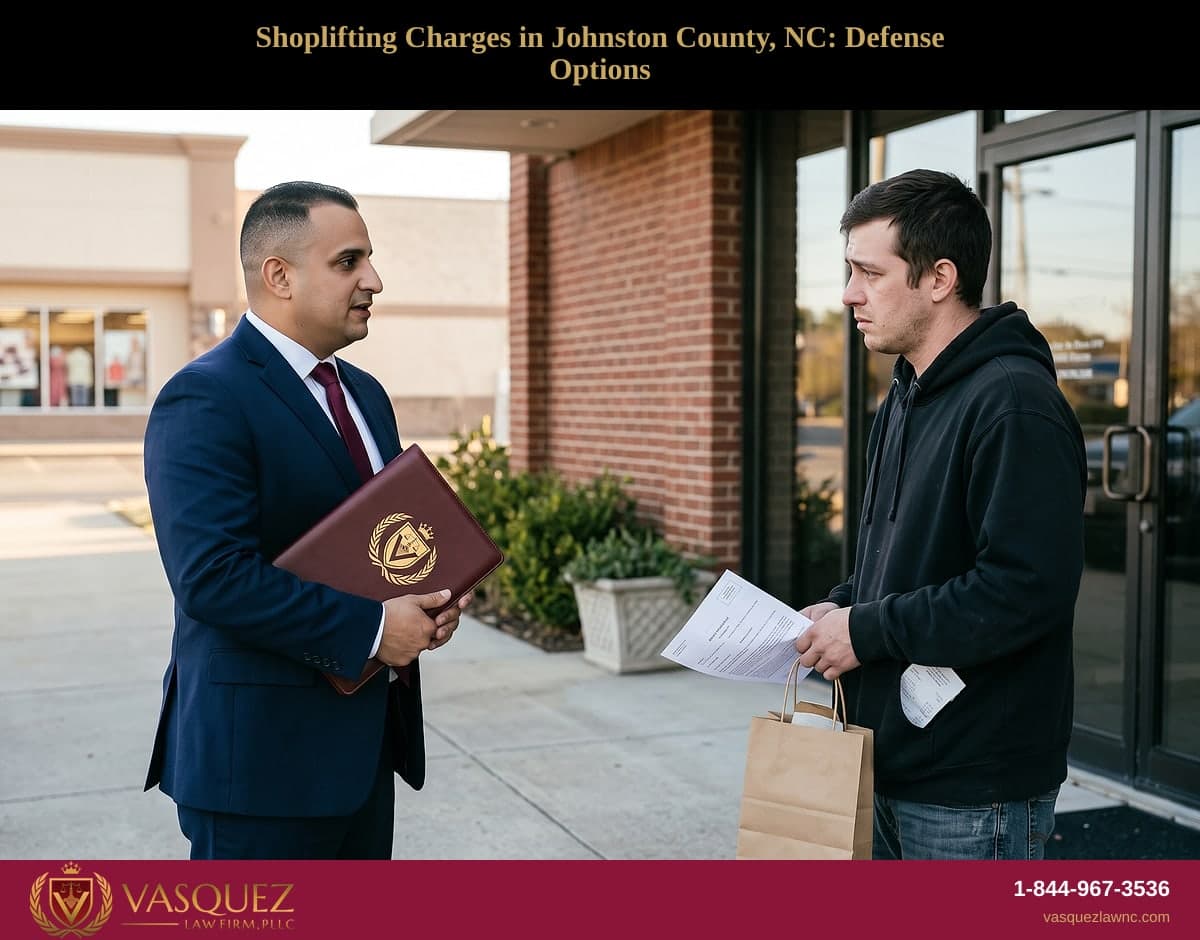
Shoplifting Charges in Johnston County, NC: Defense Options
By William J. Vásquez · Updated November 6, 2026
Facing shoplifting charges in Johnston County, NC? Learn penalties and defense steps. Contact Vasquez Law Firm for a free case review today.
Published on November 6, 2026· Updated November 6, 2026
Protect your record and your freedom
Free, confidential review.
Free & confidential · Se habla espanol · Mon-Fri 8am-7pm, Sat 9am-2pm (ET)
Have questions? Talk to an attorney - free evaluation.
Call 1-844-967-3536Protect Your Record and Your Freedom
A confidential case review. Call Mon-Fri 8am-7pm, Sat 9am-2pm ET.
Shoplifting Charges in Johnston County, NC: Defense Options
Shoplifting charges in Johnston County, NC may result from hiding unpaid merchandise. They may also result from changing a price mechanism. Using a device meant to defeat a store alarm may also lead to charges. N.C. Gen. Stat. § 14-72.1 describes offenses related to concealment of merchandise, price tag transfers, and use of certain devices. A charge is not a conviction. The facts, evidence, and case history matter. This guide explains the statute in plain language. It also lists practical steps that may help protect your rights.
If you face shoplifting charges in Johnston County, NC, request a consultation with Vasquez Law Firm. William J. Vasquez can review the allegation, paperwork, and court concerns. Se Habla Español.
Call 1-844-967-3536.
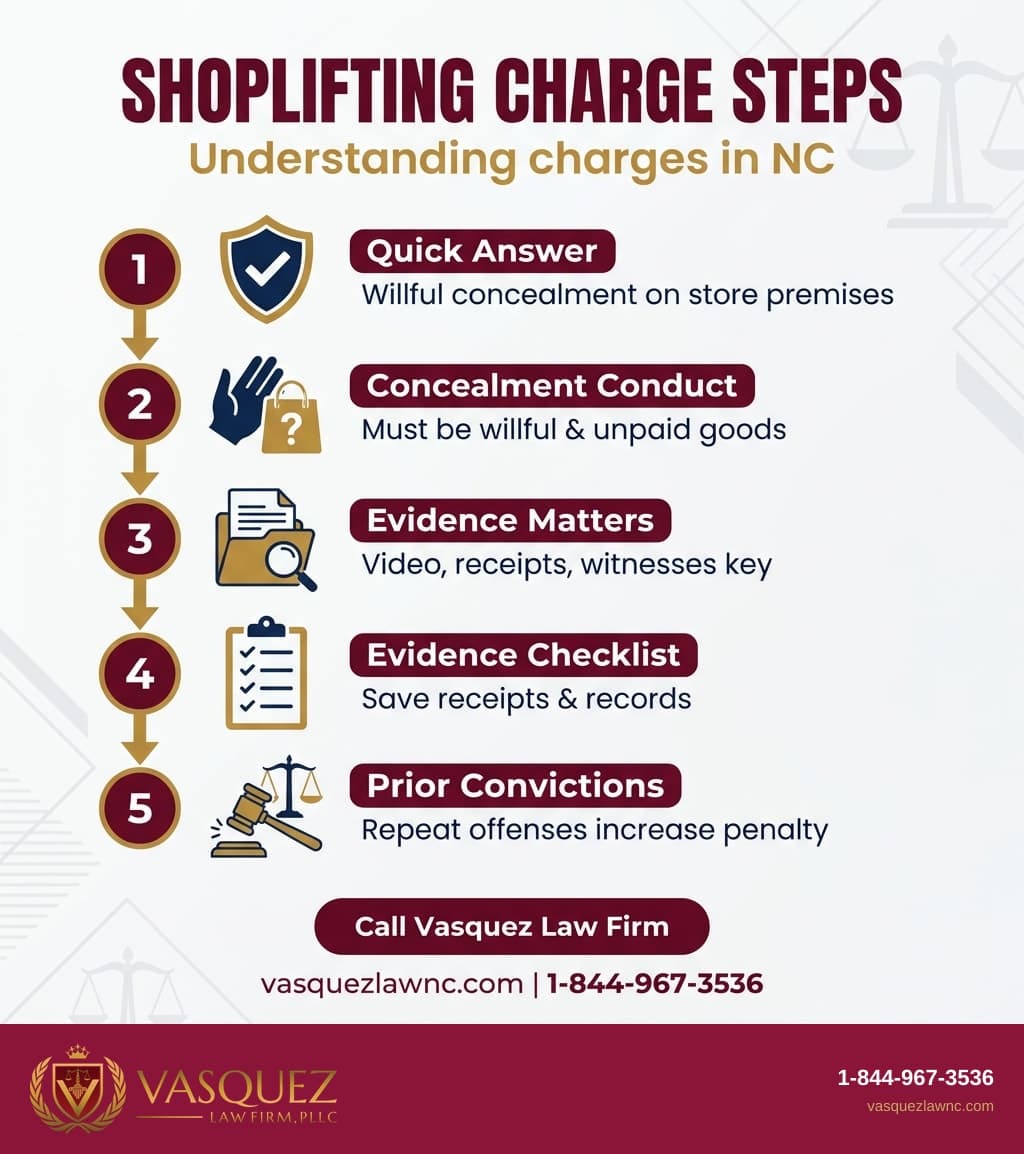
Quick Answer
Under N.C. Gen. Stat. § 14-72.1, willfully concealing goods or merchandise of any store, not theretofore purchased, while still upon the premises of such store, is addressed by the statute. A price-tag allegation may also be addressed. Class H felonies include violating subsection (a) by using a lead-lined or aluminum-lined bag, similarly lined clothing, or a similar device to prevent activation of an antishoplifting or inventory control device. They also include willfully and without authority transferring a price mechanism to merchandise whose selling price is more than $200 higher than the transferred price and then presenting that merchandise for purchase. The result depends on the specific conduct and circumstances.
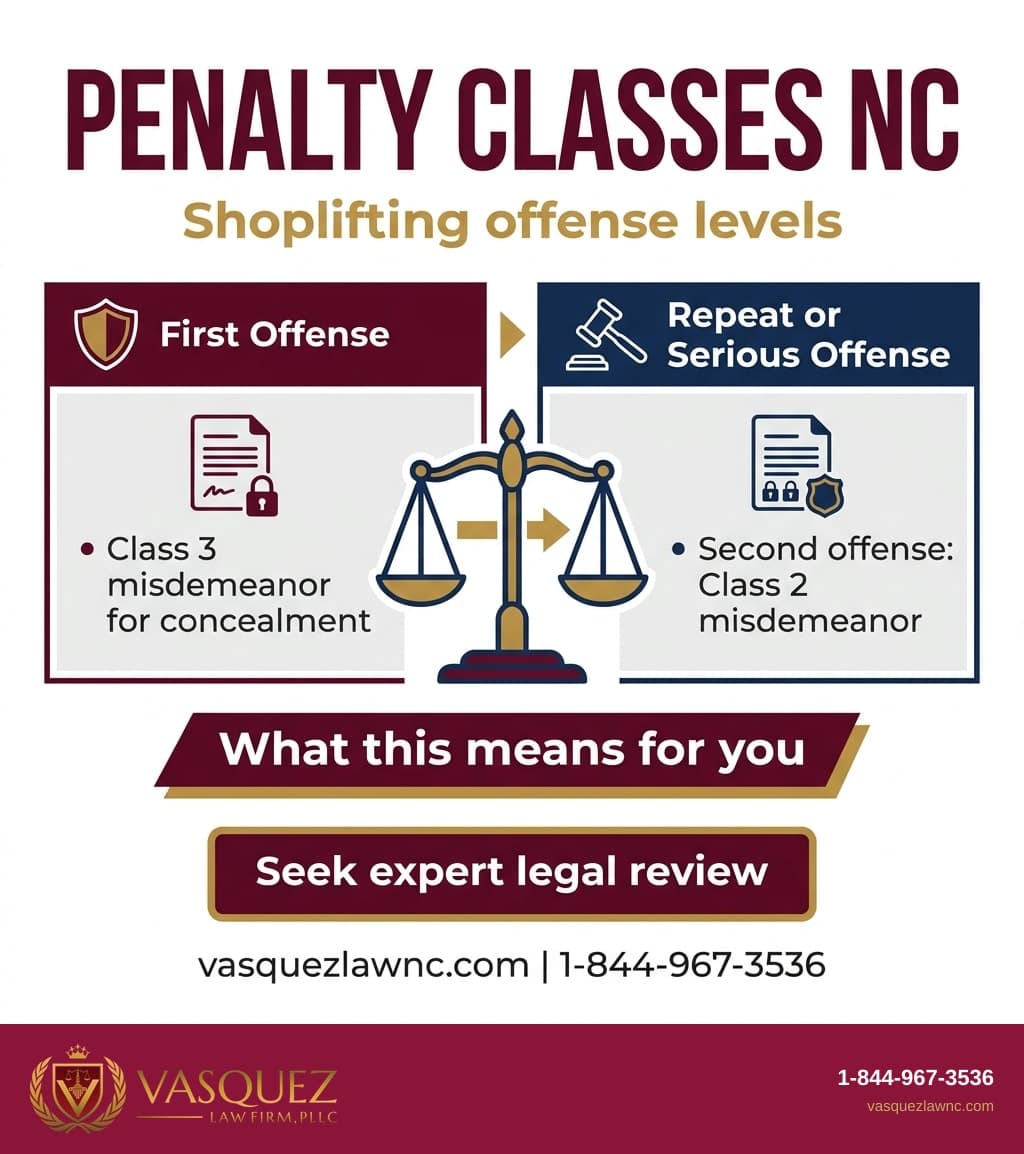
- A first covered conviction is generally a Class 3 misdemeanor.
- Repeat convictions can increase the misdemeanor class.
- Certain conduct is charged as a Class H felony.
- Preserve documents and seek legal advice promptly.
What conduct can lead to a shoplifting concealment charge?
For example, a person who puts unpaid store merchandise in a bag while still in the store may face this charge. N.C. Gen. Stat. § 14-72.1(a) states that whoever, without authority, willfully conceals the goods or merchandise of any store, not theretofore purchased by such person, while still upon the premises of such store, may be found to have committed an offense under this section. The statute focuses on two points. The hiding must be willful. The goods must remain unpaid.
Whoever, without authority, willfully conceals the goods or merchandise of any store, not theretofore purchased by such person, while still upon the premises of such store, shall be guilty of a misdemeanor and, upon conviction, shall be punished as provided in subsection (e).
The statute also says that hidden, unpurchased goods found on or about a person are prima facie evidence of willful concealment. Prima facie evidence means evidence that may support an inference unless someone rebuts or explains it. It does not remove the prosecution’s duty to prove the charge in court.
Shoplifting charges in Johnston County, NC may require a close review of events before, during, and after the claimed concealment. Relevant material may include store video, receipts, item descriptions, witness accounts, and written reports. Read about related larceny and theft charges in Johnston County for distinctions that may matter in a criminal case.
Why does evidence matter?
The difference between possessing an item, placing it somewhere by accident, and willfully hiding it can matter. Do not change receipts, messages, packaging, or recordings. Preserve the information. Discuss the facts privately with legal counsel.
Can changing a price tag result in a felony shoplifting charge?
A shopper may present merchandise with a lower price. The shopper may have transferred a tag or product code from other goods. N.C. Gen. Stat. § 14-72.1(d) addresses willfully and without authority transferring any price tag, product code, or other price mechanism from goods or merchandise to other goods or merchandise having a higher selling price or marking said goods at a lower price or substituting or superimposing thereon a false price tag and then presenting said goods or merchandise for purchase. The statute expressly separates this allegation from simply possessing the goods or presenting them at checkout.
Nothing herein shall be construed to provide that the mere possession of goods or the production by shoppers of improperly priced merchandise for checkout shall constitute prima facie evidence of guilt.
N.C. Gen. Stat. § 14-72.1(d2) states that whoever, without authority, willfully transfers any price tag, product code, or other price mechanism, from goods or merchandise to other goods or merchandise having a selling price in excess of two hundred dollars ($200.00) higher than the price tag, product code, or other price mechanism from which the price tag, product code, or other pricing mechanism was transferred and then presents said goods or merchandise for purchase shall be guilty of a Class H felony. The alleged price difference is central to this provision.
N.C. Gen. Stat. § 14-72.1(d1) provides that any person who violates subsection (a) by using a lead-lined or aluminum-lined bag, a lead-lined or aluminum-lined article of clothing, or a similar device to prevent the activation of any antishoplifting or inventory control device is guilty of a Class H felony. The exact item, claimed purpose, and available evidence should be reviewed carefully.
For broader information about charge levels, see misdemeanor and felony charge differences. The firm’s criminal defense representation in Johnston County focuses on the facts, records, and court process that apply to the particular accusation.
Evidence checklist after a price allegation
- Keep any receipt or transaction record.
- Write down the store location, date, and item descriptions.
- Save messages that may provide relevant context.
- Do not contact store personnel to argue facts.
- Bring charging papers and release conditions to a consultation.
How do prior shoplifting convictions affect misdemeanor penalties?
A first conviction under subsection (a) or (d) is a Class 3 misdemeanor. This result remains subject to the statute’s stated rules. If imprisonment is suspended, the statute generally requires at least twenty-four hours of community service. However, the judge may impose another appropriate sentence upon finding that mental or physical infirmity prevents the defendant from performing the required service and recording the reasons in the judgment. That condition comes from the statutory punishment provision.
A second offense committed within three years after conviction of an offense under the section is a Class 2 misdemeanor. If imprisonment is suspended, the statute requires at least seventy-two hours of imprisonment as a condition of special probation, at least seventy-two hours of community service, or both. The judge may impose another appropriate sentence if mental or physical infirmity prevents the defendant from performing the required service and the reasons for that finding are recorded in the judgment.
A third or later offense committed within five years after conviction of two other offenses under the section is a Class 1 misdemeanor. The statute permits suspension only when special probation requires at least eleven days of imprisonment. Section 14-72.1(g) provides that for active terms of imprisonment imposed under this section, the judge may not give credit for the first 24 hours of time spent in incarceration pending trial, the defendant must serve the mandatory minimum period of imprisonment, and the defendant may not be released or paroled unless otherwise eligible and has served the mandatory minimum period.
Why should prior records be reviewed carefully?
Timing and the type of prior convictions affect how subsection (e) applies. A person should not assume that a prior charge has the same effect as a prior conviction. Court records, judgment dates, and the charged subsection are important documents to examine.
Cases we handle often begin with a missing copy of the citation, magistrate paperwork, or prior judgment. Bringing every available document helps identify the allegation. It also helps identify the statutory provision involved. For information about post-case issues, review Johnston County misdemeanor expungement information.
What rules apply when a merchant detains a shopper?
A store employee may detain a person on store property or nearby. This may happen after the employee believes an offense occurred. N.C. Gen. Stat. § 14-72.1(c) states that a merchant, or the merchant's agent or employee, or a peace officer who detains or causes the arrest of any person shall not be held civilly liable for detention, malicious prosecution, false imprisonment, or false arrest of the person detained or arrested, where such detention is upon the premises of the store or in a reasonable proximity thereto, is in a reasonable manner for a reasonable length of time, and, if in detaining or in causing the arrest of such person, the merchant, or the merchant's agent or employee, or the peace officer had at the time of the detention or arrest probable cause to believe that the person committed the offense created by this section.
Probable cause means facts that would lead a reasonable person to believe an offense occurred. For a detained minor, the statute directs a merchant, agent, or employee to call or notify a parent or guardian during detention. The statute also allows a reasonable effort to call or notify the parent or guardian. It addresses civil liability when that reasonable effort is made.
This part of the statute does not decide every factual dispute in a criminal case. A defense review can assess reports, video, witness statements, and whether the evidence supports the charged offense. Avoid making statements about facts without first understanding the allegation and your rights.
Practical steps after a detention
- Keep all papers given by the store or law enforcement.
- Record your own recollection while it remains fresh.
- Identify possible receipts, witnesses, and video locations.
- Follow every release condition and court instruction.
- Request a criminal defense consultation before making avoidable decisions.
What should you do about shoplifting charges in Johnston County, NC?
Shoplifting charges in Johnston County, NC should be evaluated under the actual subsection alleged. Do not rely only on a label used in conversation.
Call promptly if any of these issues apply:
- You received a citation, summons, or arrest paperwork.
- The allegation involves a lined bag, clothing, or device.
- The allegation involves a transferred price mechanism.
- You have a prior conviction under this statute.
- You are unsure which court date applies.
- You have video, receipts, or witnesses that may be relevant.
- You have been told not to return to a store.
Vasquez Law Firm accepts criminal defense matters involving theft allegations in Johnston County. Request a consultation through our criminal defense contact page to discuss the charge and available records. Se Habla Español.
How are Johnston County shoplifting cases handled locally?
N.C. Gen. Stat. § 14-72.1 describes offenses related to concealment of merchandise, price tag transfers, and use of certain devices. For misdemeanor enhancement, it also depends on the conviction history and timing described in subsection (e). The court record and charging document are the starting point for understanding the case.
At our Smithfield office, a common first question is whether a store report alone decides the case. It does not end the legal analysis. The charging language deserves review. So do the evidence, procedural history, and applicable statute.
Do not treat online descriptions of shoplifting charges as a substitute for advice about your own papers. A consultation can help identify the specific statutory issue. It can also identify the records that need attention.
Frequently Asked Questions
Is concealing unpaid merchandise a misdemeanor in North Carolina?
N.C. Gen. Stat. § 14-72.1(a) states: "Whoever, without authority, willfully conceals the goods or merchandise of any store, not theretofore purchased by such person, while still upon the premises of such store, shall be guilty of a misdemeanor and, upon conviction, shall be punished as provided in subsection (e)." The evidence and the exact conduct alleged remain important in any individual case.
What is the penalty for a first shoplifting conviction?
For a first conviction under subsection (a) or (d), the defendant shall be guilty of a Class 3 misdemeanor. Suspension of imprisonment generally requires at least 24 hours of community service. However, the judge may impose another appropriate sentence upon finding that mental or physical infirmity prevents the defendant from performing the required service and recording the reasons in the judgment. The court record and charged subsection should be reviewed closely.
Can a price-tag allegation be charged as a felony?
Yes. N.C. Gen. Stat. § 14-72.1(d2) states: "Whoever, without authority, willfully transfers any price tag, product code, or other price mechanism, from goods or merchandise to other goods or merchandise having a selling price in excess of two hundred dollars ($200.00) higher than the price tag, product code, or other price mechanism from which the price tag, product code, or other pricing mechanism was transferred and then presents said goods or merchandise for purchase shall be guilty of a Class H felony." The statute distinguishes this allegation from merely possessing or presenting improperly priced goods.
Can a lined bag lead to a felony charge?
N.C. Gen. Stat. § 14-72.1(d1) states: "Notwithstanding subsection (e) of this section, any person who violates subsection (a) of this section by using a lead-lined or aluminum-lined bag, a lead-lined or aluminum-lined article of clothing, or a similar device to prevent the activation of any antishoplifting or inventory control device is guilty of a Class H felony." The actual item and alleged use are important factual questions.
Do prior convictions change a shoplifting charge?
For a second offense committed within three years after the date the defendant was convicted of an offense under this section, the defendant shall be guilty of a Class 2 misdemeanor. For a third or subsequent offense committed within five years after the date the defendant was convicted of two other offenses under this section, the defendant shall be guilty of a Class 1 misdemeanor. Those provisions also contain specific conditions tied to suspended imprisonment and prior conviction timing.
May a store detain someone for suspected shoplifting?
N.C. Gen. Stat. § 14-72.1(c) states that a merchant, or the merchant's agent or employee, or a peace officer who detains or causes the arrest of any person shall not be held civilly liable for detention, malicious prosecution, false imprisonment, or false arrest of the person detained or arrested, where such detention is upon the premises of the store or in a reasonable proximity thereto, is in a reasonable manner for a reasonable length of time, and, if in detaining or in causing the arrest of such person, the merchant, or the merchant's agent or employee, or the peace officer had at the time of the detention or arrest probable cause to believe that the person committed the offense created by this section. Whether those elements apply depends on the facts of the event.
What should I bring to a shoplifting consultation?
Bring the citation, summons, arrest papers, bond or release conditions, receipts, and any notices from the store. Write down names of witnesses and the location of possible video. These materials can help identify the charged subsection, evaluate available evidence, and prepare for the next required court step.
Should I miss court if I think the allegation is mistaken?
No. A disagreement with the allegation does not remove an obligation to follow a court instruction or appearance requirement. Keep the paperwork, confirm the setting shown on it, and request legal advice promptly. A criminal defense consultation can help you understand the charge and organize relevant records.
About Vasquez Law Firm
Vasquez Law Firm provides criminal defense services for eligible matters in Johnston County. William J. Vasquez leads the firm with a direct, respectful approach. The firm’s motto, Yo Peleo®, reflects a commitment to protecting clients’ rights. It also reflects a commitment to treating people with care.
Our bilingual support staff assists English and Spanish speaking clients. The firm also handles immigration, personal injury, workers’ compensation, and traffic matters within its applicable service areas. For shoplifting charges in Johnston County, NC, the firm can review your documents. It can also explain the next practical step.
Do not let uncertainty about a criminal charge control your next decision. Request a consultation with Vasquez Law Firm. Se Habla Español.
Call 1-844-967-3536.
Sources and References
Shoplifting charges in Johnston County, NC deserve a careful review. That review should include the statute, charging papers, and evidence. Contact Vasquez Law Firm to request a confidential consultation. Se Habla Español.
Call 1-844-967-3536.
Accused of Theft in Johnston County?
Theft charges can follow you for life. We fight for reduced charges or dismissal.
Keep Reading

For how Vasquez Law Firm can help, see our theft page.
Reviewed by Attorney Vasquez, Managing Attorney

William Vasquez
Founder & CEO, Vasquez Law Firm, PLLC
William Vasquez is the founder and CEO of Vasquez Law Firm, PLLC, a results-driven firm specializing in immigration, criminal defense, personal injury, and workers' compensation. A U.S. Air Force veteran and recipient of the Joint Service Achievement Medal, William is dedicated to fiercely fighting for his clients' rights.
Related Legal Services
Need legal help? Learn more about how our defense attorneys can help, or contact us for a free evaluation.
You can also visit our North Carolina defense practice for more information.