North Carolina Law Sets Rules for DWI Checkpoints in Johnston County
Stopped at DWI checkpoints in Johnston County? See how stop patterns, screening requests, and reasonable suspicion work. Request a consultation today.
Published on October 23, 2026· Updated October 24, 2026
Protect your record and your freedom
Free, confidential review.
Free & confidential · Se habla espanol · Mon-Fri 8am-7pm, Sat 9am-2pm (ET)
Have questions? Talk to an attorney - free evaluation.
Call 1-844-967-3536Protect Your Record and Your Freedom
A confidential case review. Call Mon-Fri 8am-7pm, Sat 9am-2pm ET.
North Carolina Law Sets Rules for DWI Checkpoints in Johnston County
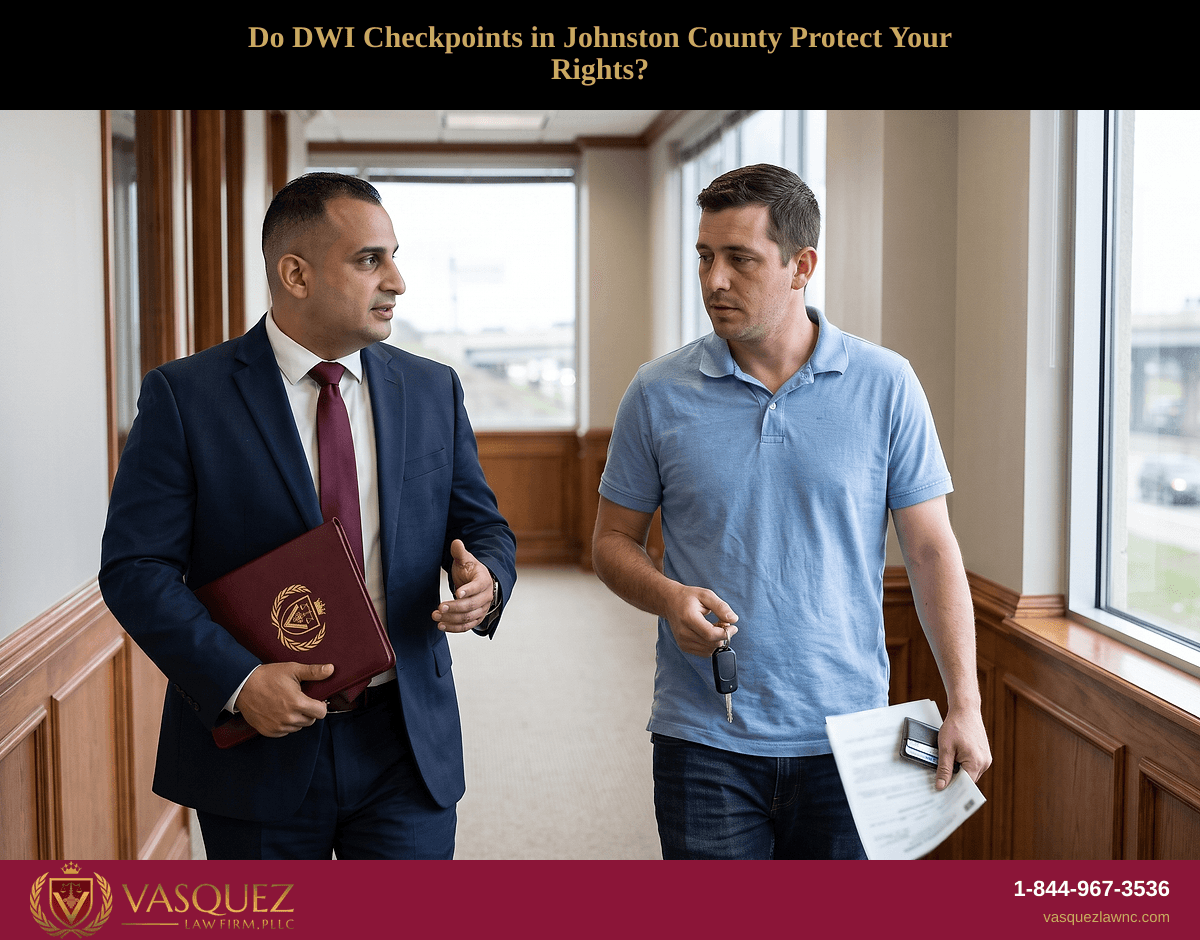
A blue light, a line of vehicles, and a request for a license can cause immediate stress. DWI checkpoints in Johnston County must follow North Carolina rules. These rules limit officer choice and require an advance plan for stopping vehicles. This guide explains the requirements in G.S. 20-16.3A. It also explains what an officer may request and when a short stop may become a longer investigation.
If a DWI checkpoint stop led to a charge in Johnston or Harnett County, request a confidential consultation with William J. Vasquez. Se Habla Español.
Quick Answer
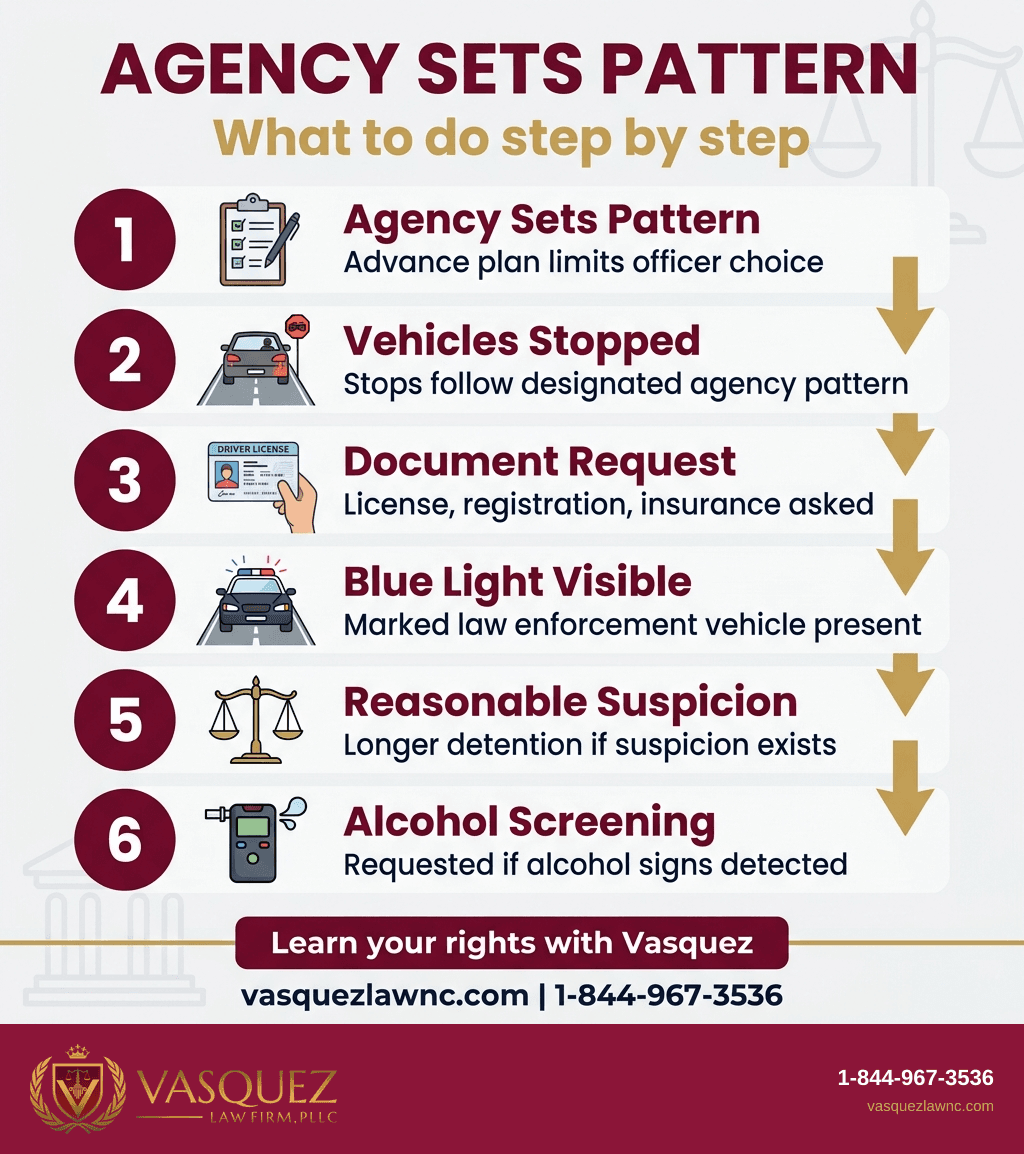
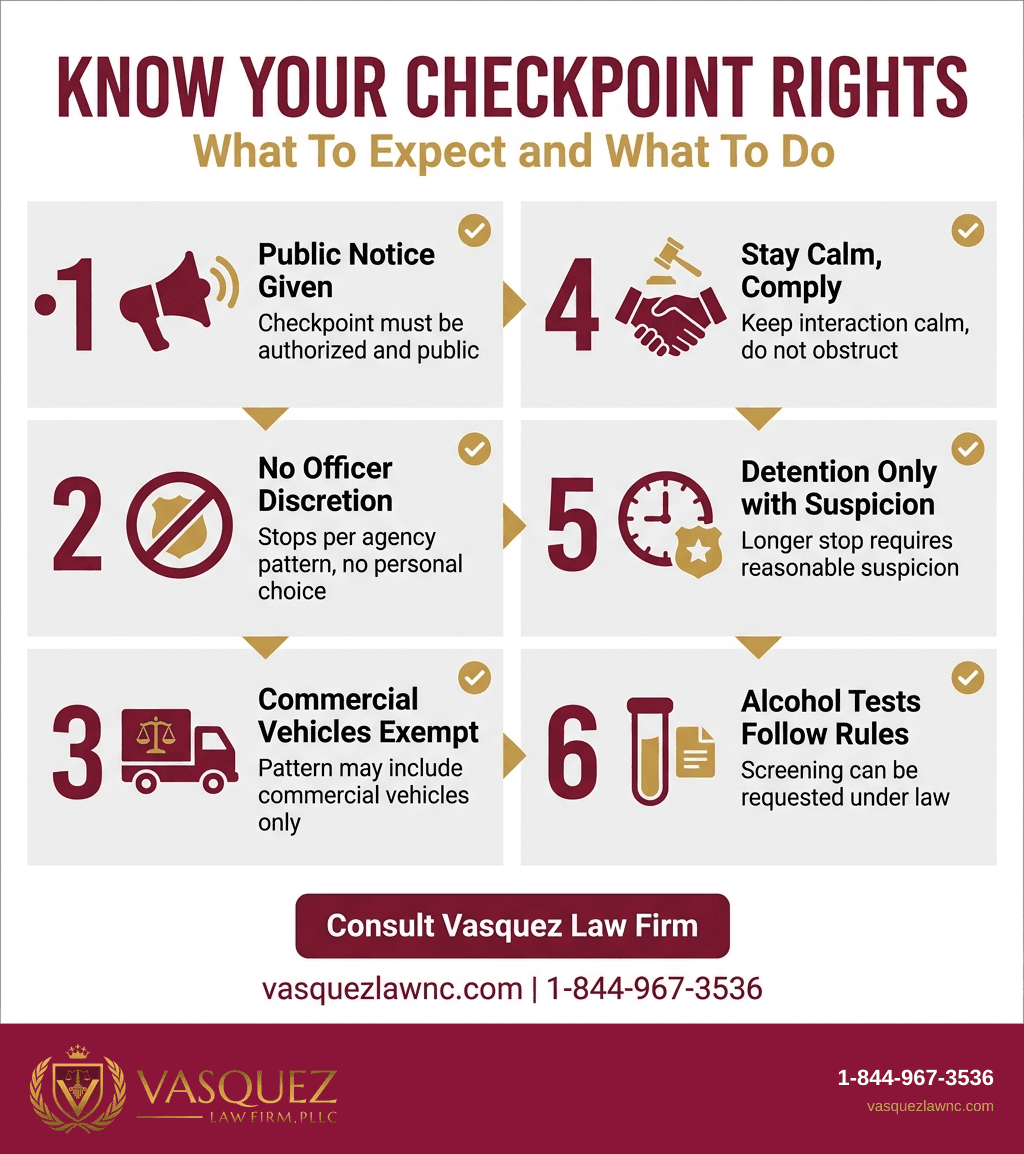
G.S. 20-16.3A sets requirements for checking stations. An agency must designate in advance the pattern for stopping vehicles and for requesting drivers to produce license, registration, or insurance information. The agency must operate under a written policy that provides guidelines for the pattern. At least one law enforcement vehicle with its blue light in operation must be present during the checking station. No individual officer may be given discretion as to which vehicle is stopped or, of the vehicles stopped, which driver is requested to produce documentation. An officer may detain a driver for further investigation if there is reasonable suspicion of a violation.
- The initial stop follows a designated pattern.
- Officers may request license, registration, or insurance information.
- Further investigation depends on reasonable suspicion.
- An alcohol screening request has specific statutory conditions.
How do DWI checkpoint rules limit officer discretion?
Picture a driver approaching a line where vehicles are stopped. Under G.S. 20-16.3A, an agency must designate in advance the pattern for stopping vehicles and for requesting drivers to produce license, registration, or insurance information. A checking station is a location where officers stop vehicles to determine compliance with the provisions of Chapter 20. The statute also requires a written policy that provides guidelines for the pattern.
Designate in advance the pattern both for stopping vehicles and for requesting drivers that are stopped to produce drivers license, registration, or insurance information.
The policy may include contingency provisions for traffic conditions. These are backup rules for changing traffic conditions. Even so, the statute says that no individual officer may decide which vehicle gets stopped. An individual officer also may not decide which stopped driver must produce license, registration, or insurance information. This difference matters. The stop must result from an agency pattern, not from an officer's personal choice.
Under G.S. 20-16.3A(a1), a pattern designated under subsection (a) for checking compliance with Chapter 20 shall not be based on a particular vehicle type, except that it may designate any type of commercial motor vehicle as defined in G.S. 20-4.01(3d). This restriction does not extend to other lawful checkpoints or roadblocks that meet subsection (c). Law enforcement agencies may conduct any type of checking station or roadblock as long as it is established and operated in accordance with the United States Constitution and the Constitution of North Carolina.
For help evaluating a charge from a checkpoint stop, review the firm's criminal defense representation for Johnston County cases. The legal question is not simply whether a checkpoint felt intimidating. The question is whether the agency and officers followed the governing rules. The question also includes whether they stayed within constitutional limits.
What happens during a DWI checkpoint stop?
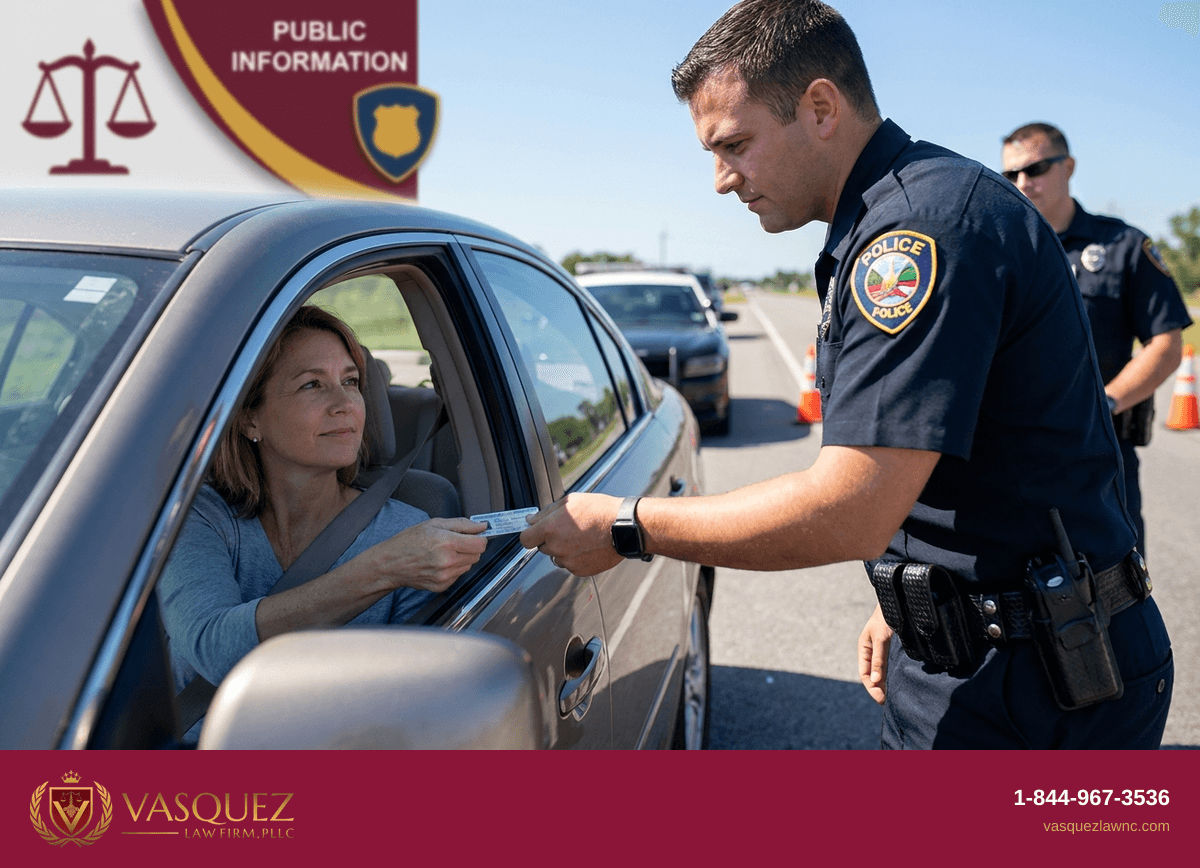
After a vehicle is stopped under the designated pattern, an officer may ask for a driver's license, registration, or proof of insurance. G.S. 20-16.3A(a) specifically describes this request. Keep the interaction calm. Do not obstruct the stop. Safety should remain the first concern while the officer performs the initial check.
Initial contact at the checking station
The statute requires public notice of an authorized checking station. At least one law-enforcement vehicle must operate its blue light during the station. This is one visible detail a person may remember after the encounter. Write down your observations later. Do not try to document events in a way that creates danger during the stop.
When a brief stop can become a longer detention
Under G.S. 20-16.3A(b), an officer who determines there is a reasonable suspicion that an occupant has violated a provision of this Chapter, or any other provision of law, may detain the driver to further investigate in accordance with law.
That separation is central to DWI checkpoints in Johnston County. The checkpoint pattern explains why the vehicle was first stopped. The officer's observations may then affect whether the detention continues. Other legally relevant information may also affect that decision. The initial stop and the later detention are separate parts of the legal analysis.
Alcohol screening requests
The statute permits a request for an alcohol screening test in certain situations. During the stop, the officer must determine that the driver previously consumed alcohol or that an open alcoholic beverage container is in the vehicle. The officer must consider the result of any screening test. The officer must also consider a refusal. That result or refusal must be considered when deciding whether reasonable suspicion exists for further investigation.
Questions about testing can have serious license consequences. The North Carolina warrantless blood draw guide discusses a related testing issue that may arise in impaired-driving investigations. It addresses a separate topic. It does not decide whether a particular checkpoint was lawful.
What should you do at a Johnston County DWI checkpoint?
A short, controlled interaction usually creates a clearer record than an argument at the roadside. DWI checkpoints in Johnston County may involve a routine request for documents. An officer may detain the driver for further investigation upon reasonable suspicion that an occupant violated the law. An alcohol screening request requires the officer to determine during the stop that the driver previously consumed alcohol or has an open container of alcoholic beverage in the vehicle. Focus on safety and identification. Also preserve facts for later review.
- Stop safely when directed by the checkpoint pattern.
- Provide the documents requested by the officer.
- Listen carefully and answer without volunteering unrelated details.
- Do not interfere with the checking station.
- After the encounter, write down the location, visible signs, blue lights, traffic pattern, timing, and statements you recall.
- Preserve notices, charging papers, receipts, and any paperwork given to you.
Do not assume that the initial checkpoint stop resolves every legal issue. A later detention may depend on what the officer observed. It may also depend on what the officer requested and what happened after the initial contact. A prompt review helps preserve details. Memories of a stressful event can fade quickly.
Cases we handle often involve a missing account of the early roadside minutes. People may remember the eventual charge but not the stopping sequence. They may also forget the document request, visible patrol vehicle, or screening request. Those details can be useful when William J. Vasquez reviews a Johnston or Harnett County DWI matter. A careful account may help the lawyer compare your memory with the available records.
A checkpoint-related DWI allegation deserves a careful review of the stop and the records. Se Habla Español.
What evidence should you preserve after a checkpoint stop?
A written timeline made soon after the stop may capture facts that become difficult to rebuild later. Preserve facts, not conclusions. For example, note whether you saw a blue light. Note where officers directed vehicles. Also note whether vehicles appeared to stop in a recurring sequence. These observations can help a lawyer understand the event without relying only on a general impression.
- Charging documents and release paperwork.
- Your driver's license, registration, and insurance records.
- A personal timeline of the encounter.
- Names and contact details for passengers or witnesses.
- Photos, messages, or location records created independently of the stop.
- Information about any alcohol screening request and your recollection of it.
- Information about any license action from the North Carolina Division of Motor Vehicles.
The North Carolina DMV provides general information about license suspension procedures. DMV issues and criminal charges can involve separate processes. Do not discard any notice connected with either matter. Keep copies when possible, and note when you received each document.
Use the checklist to organize a consultation. Do not use it to decide your own legal claim. A lawyer needs the exact documents and facts. This includes information that may not appear on a citation. The firm's Johnston and Harnett County criminal defense services include review of DWI and alcohol-related charges within those counties.
What checkpoint mistakes can affect a DWI defense?
A common mistake is treating the entire encounter as one event. The order of events may matter when the stop is reviewed. Write down the sequence. Do not rely only on a general impression that the stop was unfair.
- Arguing at the roadside: Keep the encounter safe and save legal objections for counsel.
- Forgetting the stop pattern: Note whether cars appeared to be stopped consistently.
- Ignoring visible details: Record blue lights, markings, signs, and vehicle placement.
- Discarding papers: Keep every notice, citation, and DMV document.
- Waiting until memories fade: Make a factual timeline promptly.
- Assuming a refusal ends the inquiry: The statute directs an officer to consider a refusal in the reasonable-suspicion decision.
- Assuming every checkpoint is identical: Agency policy and actual events must be reviewed in the individual matter.
If you remember one point: distinguish the initial pattern-based stop from any later detention. That is the structure used by G.S. 20-16.3A.
How do Johnston County DWI checkpoint cases fit North Carolina law?
G.S. 20-16.3A is a North Carolina statute governing checking stations and roadblocks. Subsection (c) permits a law-enforcement agency to conduct a checking station or roadblock. The station or roadblock must be established and operated consistently with the United States Constitution and the Constitution of North Carolina.
Law enforcement agencies may conduct any type of checking station or roadblock as long as it is established and operated in accordance with the provisions of the United States Constitution and the Constitution of North Carolina.
County-focused representation
For DWI and other alcohol-related criminal charges, Vasquez Law Firm handles matters in Johnston and Harnett counties. The firm can discuss a Johnston County checkpoint allegation and the documents connected with it. This article does not determine whether any individual stop, detention, test request, or charge was lawful.
Subsection (d) says checkpoint placement should be random or statistically indicated. It also says agencies shall avoid repeated placement in the same location or proximity. The same subsection says that this is not a ground for a motion to suppress or a defense to an offense arising from a checking station. A motion to suppress is a request asking a court to exclude certain evidence. This statutory limitation makes a detailed review of all relevant facts important.
When should you request a consultation after a DWI checkpoint?
Request a consultation promptly if a checkpoint stop resulted in a DWI charge. You may also want a consultation after an allegation involving alcohol. The same applies after a request for an alcohol screening test or a notice affecting your driving privilege. Early review can help identify documents. It can also help preserve a clear account of what occurred.
- You received a citation or charging paperwork after the stop.
- An officer extended the encounter beyond the document request.
- You were asked to take an alcohol screening test.
- You received paperwork concerning your driving privilege.
- You have questions about the vehicle-stopping pattern.
- You need help organizing the facts and documents for a defense review.
About Vasquez Law Firm
Vasquez Law Firm handles immigration, personal injury, workers' compensation, criminal defense, and traffic matters within the firm's service scope. For Johnston and Harnett County DWI and alcohol-related criminal matters, William J. Vasquez offers focused case review and bilingual support staff assistance.
The firm's motto, Yo Peleo® means I Fight. It reflects a commitment to careful preparation, direct communication, and respectful advocacy. In-person criminal defense meetings for Johnston and Harnett County matters are available in Smithfield, NC. Se Habla Español.
Attorney trust and experience
William J. Vasquez is admitted to the North Carolina State Bar. A consultation is a chance to discuss the specific record, paperwork, and concerns in a checkpoint-related matter. You do not have to rely only on general online information.
Frequently Asked Questions
Can an officer choose which cars to stop at a DWI checkpoint?
Under G.S. 20-16.3A, an agency must designate in advance the pattern for stopping vehicles and for requesting drivers to produce license, registration, or insurance information. The agency must operate under a written policy that provides guidelines for the pattern. The statute says no individual officer may be given discretion as to which vehicle is stopped or, of the vehicles stopped, which driver is requested to produce documentation. A case review may examine the actual stop sequence and the relevant records.
What documents can an officer request at a checking station?
The statute refers to requests for a driver's license, registration, or insurance information from drivers who are stopped. The request must be part of the pattern designated in advance by the agency. A driver should preserve any paperwork received and write down what occurred after the interaction ends safely.
Does a blue light matter at a DWI checkpoint?
Under G.S. 20-16.3A, the agency must advise the public that an authorized checking station is being operated by having, at a minimum, one law enforcement vehicle with its blue light in operation during the conducting of the checking station. Note what you observed, but avoid creating a roadside safety risk while doing so.
Can a checkpoint stop become a longer investigation?
Under G.S. 20-16.3A(b), an officer who determines there is a reasonable suspicion that an occupant has violated a provision of this Chapter, or any other provision of law, may detain the driver to further investigate in accordance with law. The initial pattern-based stop and a later detention are separate parts of the legal analysis. Exact facts and records matter in each case.
When can an officer request an alcohol screening test?
The statute permits a request when, during the stop, the officer determines that the driver had previously consumed alcohol or has an open alcoholic beverage container in the vehicle. The officer must consider a screening result or refusal in deciding whether reasonable suspicion exists for further investigation.
Can a checkpoint target a certain vehicle type?
Under G.S. 20-16.3A(a1), a pattern designated under subsection (a) for checking compliance with Chapter 20 shall not be based on a particular vehicle type, except that it may designate any type of commercial motor vehicle as defined in G.S. 20-4.01(3d). This restriction does not extend to other lawful checkpoints or roadblocks that meet subsection (c). A question about a specific stop should be evaluated with the actual checkpoint policy and circumstances.
Does repeated checkpoint placement automatically dismiss a charge?
No. Subsection (d) says checkpoint placement should be random or statistically indicated, and agencies shall avoid repeated placement in the same location or proximity. It also states that this subsection is not grounds for a motion to suppress or a defense to an offense arising from a checking station.
Who handles DWI checkpoint charges for Johnston County?
Vasquez Law Firm handles DWI and alcohol-related criminal charges in Johnston and Harnett counties. A consultation can focus on the charging papers, your recollection of the stop, any screening request, and driving-privilege notices. General online information cannot replace advice based on the actual record in your matter.
Sources and References
Facing a DWI checkpoint charge in Johnston or Harnett County? Contact Vasquez Law Firm to request a confidential consultation with William J. Vasquez. Se Habla Español.
Facing a DUI/DWI charge in NC?
Every DUI case is different. We've handled hundreds in North Carolina. 15-min call to walk through your specifics — no fee.
Keep Reading
William Vasquez
Founder & CEO, Vasquez Law Firm, PLLC
William Vasquez is the founder and CEO of Vasquez Law Firm, PLLC, a results-driven firm specializing in immigration, criminal defense, personal injury, and workers' compensation. A U.S. Air Force veteran and recipient of the Joint Service Achievement Medal, William is dedicated to fiercely fighting for his clients' rights.
Related Legal Services
Need legal help? Learn more about criminal defense lawyers in North Carolina, or contact us for a free evaluation.
You can also visit criminal defense services in Johnston and Harnett counties for more information.