DWI Level 2 in Johnston County NC Can Mean Jail
Facing a DWI Level 2 in Johnston County, NC? See jail, fines, aggravating factors, and defense steps. Request a consultation today.
Published on October 27, 2026· Updated October 27, 2026
Protect your record and your freedom
Free, confidential review.
Free & confidential · Se habla espanol · Mon-Fri 8am-7pm, Sat 9am-2pm (ET)
Have questions? Talk to an attorney - free evaluation.
Call 1-844-967-3536Protect Your Record and Your Freedom
A confidential case review. Call Mon-Fri 8am-7pm, Sat 9am-2pm ET.
DWI Level 2 in Johnston County NC Can Mean Jail
A DWI Level 2 in Johnston County, NC can follow one grossly aggravating factor. Examples include a qualifying prior impaired-driving conviction, driving while a qualifying revocation applied, or serious injury. North Carolina sentencing depends on the facts. After a DWI conviction, the court holds a separate sentencing hearing. The court then sets the punishment level under N.C. Gen. Stat. § 20-179. This guide explains the factors, possible punishment, evidence, and practical next steps.
If you face a DWI charge in Johnston County, request a consultation with Vasquez Law Firm. Se Habla Español.
Call 1-844-967-3536.
Quick Answer
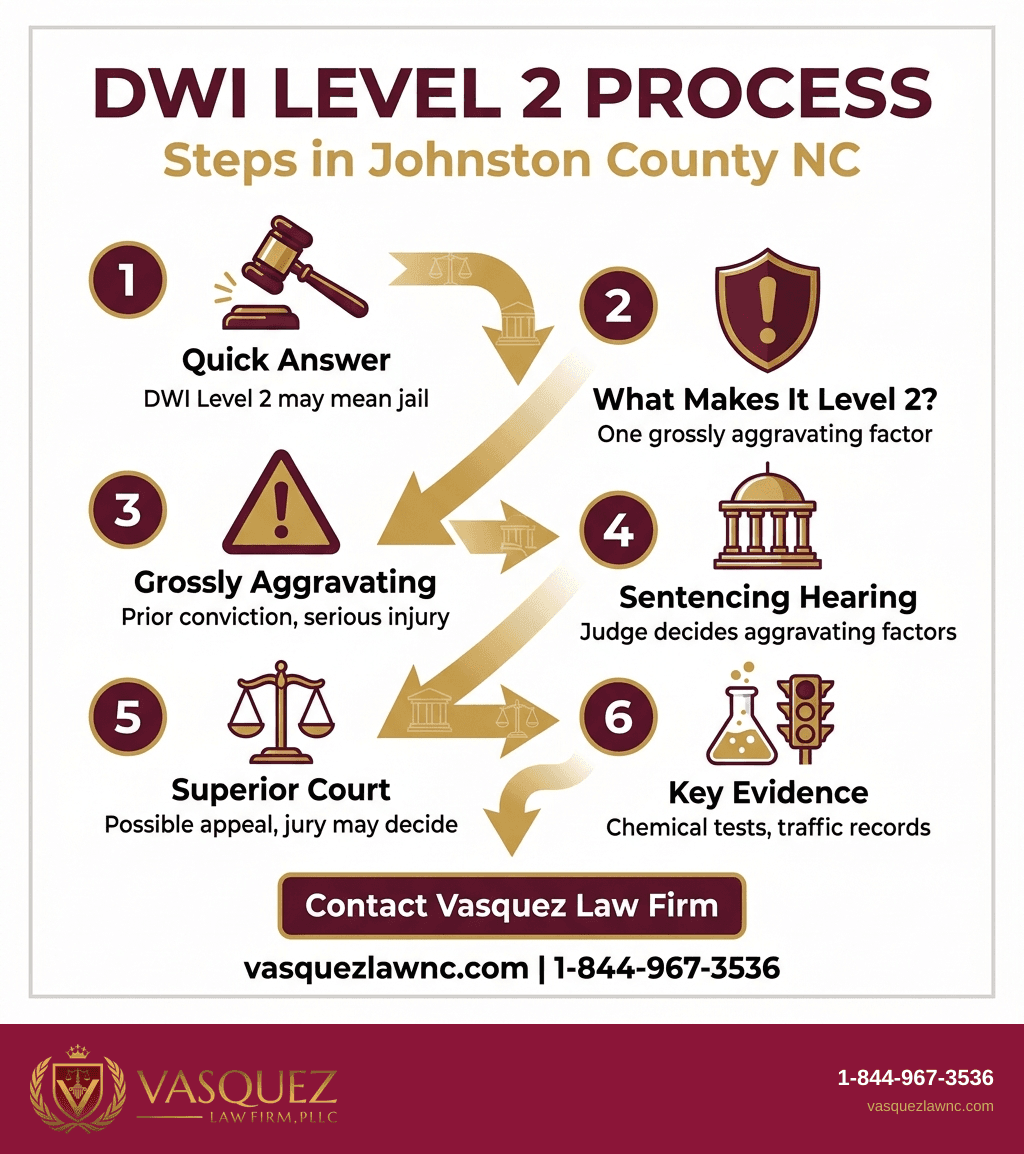
DWI Level 2 is a North Carolina sentencing level. It is not a separate driving offense. Under N.C. Gen. Stat. § 20-179(h), Level Two punishment may include imprisonment from seven days to 12 months. Level Two usually results when one listed grossly aggravating factor applies. The child-passenger factor is different. It can produce Level One.
- The court first considers grossly aggravating factors.
- A qualifying prior DWI can affect the level.
- Serious injury can be a grossly aggravating factor.
- Probation conditions may include treatment and alcohol monitoring.
What makes a DWI Level 2 in Johnston County, NC?
A person convicted of impaired driving does not automatically receive one fixed sentence. The court must decide whether grossly aggravating factors exist. A grossly aggravating factor is a fact that can raise the punishment level sharply. The court then considers ordinary aggravating and mitigating factors. An aggravating factor may increase punishment. A mitigating factor may support less punishment.
Level Two applies when only one listed grossly aggravating factor applies. The child-passenger factor is an exception. That factor has its own Level One result.
The judge must impose the Level Two punishment under subsection (h) of this section if it is determined that only one of the other grossly aggravating factors applies.
The statute lists several grossly aggravating factors. They include a prior impaired-driving conviction within seven years before the present offense. Serious injury to another person caused by impaired driving is another listed factor. Each prior qualifying conviction counts as a separate factor.
Grossly aggravating factors
The child-passenger factor covers several situations. It applies when a child under 18 was in the vehicle. It also applies when a person with the mental development of a child under 18 was in the vehicle. It also applies when a person with a physical disability preventing unaided exit was in the vehicle at the time of the offense.
Two qualifying grossly aggravating factors generally lead to Level One. Three or more lead to Aggravated Level One. These differences show why an early review matters. The review should cover the alleged facts and the driving history. For broader information about criminal defense representation for Johnston County charges, review the firm’s criminal defense practice area.
What happens at a DWI sentencing hearing?
After a conviction under G.S. 20-138.1, G.S. 20-138.2, a second or subsequent conviction under G.S. 20-138.2A, or a second or subsequent conviction under G.S. 20-138.2B, or when any of those offenses are remanded back to district court after an appeal to superior court, the judge shall hold a sentencing hearing to determine whether there are aggravating or mitigating factors that affect the sentence to be imposed. The prosecutor must make feasible efforts to obtain the full traffic-conviction record. The prosecutor must present that record to the judge. Upon the defendant's request, the prosecutor must furnish the defendant or defense counsel a copy of the traffic-conviction record a reasonable time before introducing it into evidence.
The State bears the burden of proving beyond a reasonable doubt that an aggravating factor exists, and the offender bears the burden of proving by a preponderance of the evidence that a mitigating factor exists.
The burden of proof matters. The court must record its findings in writing. Those findings must identify the aggravating and mitigating factors that the court found.
If the case reaches superior court
A defendant may appeal to superior court. If the State intends to use one or more aggravating factors under subsections (c) or (d) of this section, the State must provide the defendant with notice of its intent. The deadline is no later than 10 days before trial. The notice must identify every factor the State seeks. In superior court, a jury generally decides disputed aggravating factors unless the defendant validly waives a jury trial. However, the judge—not the jury—determines whether convictions exist under subsections (c)(1) and (d)(5).
In our experience, people often bring only the citation to a first consultation. That document may not answer the sentencing questions. The issue may depend on the certified traffic record. It may also depend on the chemical-analysis result. Revocation documents can matter too. Records linked to the alleged injury may also matter. Preserving and reviewing these materials can show what the State must prove. It can also show which facts remain disputed.
What evidence affects a Level 2 DWI sentence?
A chemical-analysis result can affect sentencing. A chemical analysis is a test used to measure alcohol concentration. In every instance in which a valid chemical analysis is made of the defendant, the prosecutor shall present evidence of the resulting alcohol concentration. For purposes of the ordinary aggravating factor in subsection (d)(1)—gross impairment while driving or an alcohol concentration of 0.15 or more within a relevant time after driving—chemical-analysis results presented at trial or sentencing are sufficient and conclusive proof of alcohol concentration and cannot be modified by any party, with or without court approval.
Ordinary aggravating factors include especially reckless or dangerous driving. They also include negligent driving that leads to a reportable crash. Certain recent motor-vehicle convictions may count. A conviction under G.S. 20-141.5 for speeding while fleeing or attempting to elude apprehension is an aggravating factor. A conviction under G.S. 20-141 for speeding at least 30 miles per hour over the legal limit is also an aggravating factor. Passing a stopped school bus is also listed. Except for the prior-conviction factor in G.S. 20-179(d)(5), the conduct behind an aggravating factor must occur during the same transaction or occurrence as the impaired driving. These factors matter when no grossly aggravating factor controls the level.
Mitigating factors and records
The statute lists possible mitigating factors. One example is slight impairment solely from alcohol. The alcohol concentration must be no higher than 0.09. Another example is safe and lawful driving apart from impairment. A safe driving record may also help. Impairment caused mainly by a lawfully prescribed drug may matter. The drug must have been taken within the prescribed dosage. The court evaluates the specific facts in each case.
Other statutory mitigation may involve voluntary treatment steps. It may involve continuous abstinence shown through approved alcohol monitoring. It may also involve early use of an ignition interlock device. An ignition interlock device is a device that can prevent a vehicle from starting after alcohol is detected. A DWI defense requires close attention to statutory conditions. It should not rely on assumptions. Read about North Carolina warrantless blood draw issues if blood testing is part of the charge.
What penalties can a Level 2 DWI bring?
Level Two punishment requires a sentence with a minimum of seven days. The maximum is 12 months. The judge may suspend the sentence only under specific conditions. Special probation must require at least seven days of imprisonment. Alternatively, it must require at least 90 consecutive days without alcohol. An approved continuous alcohol-monitoring system must verify that abstinence.
The statute requires 240 hours of community service as an additional condition of special probation when Level Two rests on the factor in subsection (c)(1) or (c)(2), the prior impaired-driving conviction occurred within five years before the current offense, and the judge suspends all active imprisonment and imposes abstinence verified by continuous alcohol monitoring. The statute requires a substance-abuse assessment when probation is imposed. It also requires the education or treatment required by G.S. 20-17.6.
License consequences and related conditions
A criminal sentence and a license consequence are separate issues. The North Carolina DMV explains its administrative processes on its license suspension page. Read the actual notice and court documents. Do not rely only on another person’s experience. License rules can depend on facts that differ from one case to another.
The court may impose other lawful probation conditions. Probation means court supervision in the community. Unless the judge rules out delegation in the judgment, the Division of Community Supervision and Reentry may impose specified requirements on eligible defendants on supervised probation only after finding a probation violation or a high risk of reoffending through a validated assessment. These requirements may include reporting, assessment, monitoring, treatment, electronic monitoring, and curfew. Limited confinement requires a probation violation; high-risk status alone is insufficient. Exercise of delegated authority also requires supervisory approval and compliance with the statute's procedures. The court and probation officials must follow the procedures in the statute.
A Level 2 allegation calls for prompt review of the charge, record, and hearing issues. Vasquez Law Firm handles DWI matters in Johnston and Harnett counties. Se Habla Español.
Call 1-844-967-3536.
What mistakes should you avoid after a Johnston County DWI arrest?
One common mistake is treating a Level 2 allegation as the final sentence. The court has not imposed the sentence merely because someone alleges Level 2. The sentencing hearing still requires findings. The evidence for each claimed factor matters.
Another mistake is assuming every traffic conviction has the same effect. The statute distinguishes between several categories. These include qualifying impaired-driving convictions. They also include license revocation. Specific point-related motor-vehicle convictions can matter as well.
- Ignoring court papers: Keep every citation, release condition, notice, and court date together.
- Guessing about prior records: Obtain and review the actual traffic-conviction record.
- Missing treatment records: Keep proof of assessments, recommendations, treatment, and compliance.
- Driving without checking status: Review DMV notices and any limited driving privilege carefully.
- Assuming a guilty plea ends the analysis: Sentencing factors can still determine the punishment level.
- Failing to preserve evidence: Save documents, notices, and information related to testing or alleged injury.
- Waiting to request help: A consultation can help organize issues before a court setting.
If you remember one point: DWI Level 2 in Johnston County, NC depends on statutory findings. Review the charge, record, and alleged factors together.
What county rules apply to DWI defense in Johnston County?
North Carolina impaired-driving sentencing law applies through N.C. Gen. Stat. § 20-179. This article addresses DWI matters arising in Johnston County. Vasquez Law Firm accepts DWI and alcohol-related criminal defense matters in Johnston and Harnett counties.
Johnston County notes
A court hearing can address more than one issue. It can involve sentencing after conviction. A pending charge does not prove that a grossly aggravating factor exists. The review should also include the charging documents, admissible evidence, and the person’s record.
For related court-process information, see this guide to DWI checkpoints in Johnston County. If probation becomes an issue after sentencing, the firm also provides information on Johnston County probation violations.
When should you request a DWI consultation now?
Request a consultation promptly if the allegation includes serious injury. Prompt help may also matter if it includes a claimed prior DWI or a revoked license. Other reasons include a child passenger, chemical testing, or a court notice about aggravating factors. Seek help if you are considering a plea. You may also need help with a traffic record. You may need help understanding probation and treatment requirements.
Do not use this article to decide whether a fact applies to you. An individualized review considers your documents and procedural posture. It also considers the available evidence. Vasquez Law Firm can discuss a DWI Level 2 in Johnston County, NC. The firm can also discuss related criminal-defense concerns within its service area.
About Vasquez Law Firm
Vasquez Law Firm combines compassionate communication with determined representation. The firm’s Yo Peleo® commitment means taking legal concerns seriously. It also means helping clients understand the process. William J. Vasquez leads the firm. Bilingual support staff help clients communicate comfortably. Se Habla Español.
For criminal defense matters, the firm serves Johnston, Harnett, and Pitt counties. DWI and other alcohol-related charges are handled in Johnston and Harnett counties. In-person criminal-defense meetings are available in Smithfield, NC for Johnston and Harnett matters. You can also review the firm’s criminal defense services before requesting a consultation.
Frequently Asked Questions
Is a DWI Level 2 a felony in North Carolina?
N.C. Gen. Stat. § 20-179 sets sentencing levels for impaired-driving convictions. Level Two is a punishment level within that statute. This guide does not classify offenses beyond the sentencing framework stated in § 20-179. The key issue for a Level Two sentence is whether one listed grossly aggravating factor applies, other than the child-passenger factor.
What can lead to DWI Level 2?
The statute lists grossly aggravating factors, including a qualifying prior impaired-driving conviction, driving by the defendant at the time of the offense while the defendant's driver's license was revoked pursuant to G.S. 20-28(a1), and serious injury to another person caused by the defendant's impaired driving at the time of the offense. One applicable factor generally produces Level Two. The statute treats the child-passenger factor differently, producing Level One.
What happens if I plead guilty to a DWI?
After a conviction under G.S. 20-138.1, G.S. 20-138.2, a second or subsequent conviction under G.S. 20-138.2A, or a second or subsequent conviction under G.S. 20-138.2B, or when any of those offenses are remanded back to district court after an appeal to superior court, the judge shall hold a sentencing hearing to determine whether there are aggravating or mitigating factors that affect the sentence to be imposed. The court considers grossly aggravating factors first. If none apply, it weighs aggravating and mitigating factors. A plea can therefore be only one part of the case. The sentencing record, chemical-analysis evidence, driving record, and claimed factors may still affect the result.
Can a prior DWI affect my punishment level?
Yes. A prior impaired-driving conviction can be a grossly aggravating factor if it occurred within seven years before the current offense. Each qualifying prior conviction is a separate grossly aggravating factor. The statute also treats certain older impaired-driving convictions as ordinary aggravating factors when the court is weighing factors without a grossly aggravating factor.
What if I was driving with a revoked license?
The statute lists as a grossly aggravating factor driving by the defendant at the time of the offense while the defendant's driver's license was revoked pursuant to G.S. 20-28(a1). The applicable revocation provision and evidence in the individual case matter. Review official notices and court documents carefully.
Can alcohol monitoring replace all jail time for Level 2?
Level Two punishment may be suspended only if a condition of special probation is imposed to require the defendant to serve a term of imprisonment of at least seven days or to abstain from consuming alcohol for at least 90 consecutive days, as verified by a continuous alcohol monitoring system. Other facts can affect the sentence and probation conditions. The statute’s requirements should be reviewed before assuming a particular option is available.
Do mitigating factors matter in a DWI sentence?
They can matter when the court finds no grossly aggravating factors and must weigh ordinary aggravating and mitigating factors. The statute lists possible mitigation, including slight impairment resulting solely from alcohol with an alcohol concentration that did not exceed 0.09 at any relevant time after the driving, driving that was safe and lawful except for the impairment, a safe driving record, and impairment caused primarily by a lawfully prescribed drug for an existing medical condition when the amount taken was within the prescribed dosage. The defendant bears the burden to prove a mitigating factor by a preponderance of the evidence.
Where can I seek help for a Johnston County DWI?
Vasquez Law Firm handles DWI and alcohol-related criminal defense matters in Johnston and Harnett counties. Request a consultation to discuss the charge, court papers, driving record, and claimed sentencing factors. A consultation is not a promise about the result. It is a chance to understand the legal process and questions raised by the case.
Sources and References
Request a consultation with Vasquez Law Firm if you need to discuss a DWI Level 2 in Johnston County, NC. Se Habla Español.
Call 1-844-967-3536.
Facing a DUI/DWI charge in NC?
Every DUI case is different. We defend DWI charges in 12 North Carolina counties and have handled hundreds. 15-min call to walk through your specifics, no fee.
Keep Reading


William Vasquez
Founder & CEO, Vasquez Law Firm, PLLC
William Vasquez is the founder and CEO of Vasquez Law Firm, PLLC, a results-driven firm specializing in immigration, criminal defense, personal injury, and workers' compensation. A U.S. Air Force veteran and recipient of the Joint Service Achievement Medal, William is dedicated to fiercely fighting for his clients' rights.
Related Legal Services
Need legal help? Learn more about get criminal defense help today, or contact us for a free evaluation.
You can also visit our North Carolina defense practice for more information.