Misdemeanor vs. Felony Charges and NC Penalties
Facing misdemeanor vs felony charges in Harnett County? See how North Carolina classes offenses and prior records affect sentencing. Request a consultation.
Published on October 29, 2026· Updated October 29, 2026
Protect your record and your freedom
Free, confidential review.
Free & confidential · Se habla espanol · Mon-Fri 8am-7pm, Sat 9am-2pm (ET)
Have questions? Talk to an attorney - free evaluation.
Call 1-844-967-3536Protect Your Record and Your Freedom
A confidential case review. Call Mon-Fri 8am-7pm, Sat 9am-2pm ET.
Misdemeanor vs. Felony Charges and NC Penalties
Misdemeanor and felony charges in Harnett County can lead to very different sentencing rules. But the label alone does not decide a case. North Carolina classifies offenses by statute. It uses separate sentencing grids for misdemeanor prior convictions and felony prior record levels. This guide explains the definitions in N.C. Gen. Stat. § 14-1. It also explains the punishment frameworks in N.C. Gen. Stat. §§ 15A-1340.23 and 15A-1340.17.
If you face a criminal accusation in Harnett County, request a consultation with Vasquez Law Firm. William J. Vasquez and our bilingual support staff can discuss the next practical step. Se Habla Español.
Call: 1-844-967-3536
Quick Answer
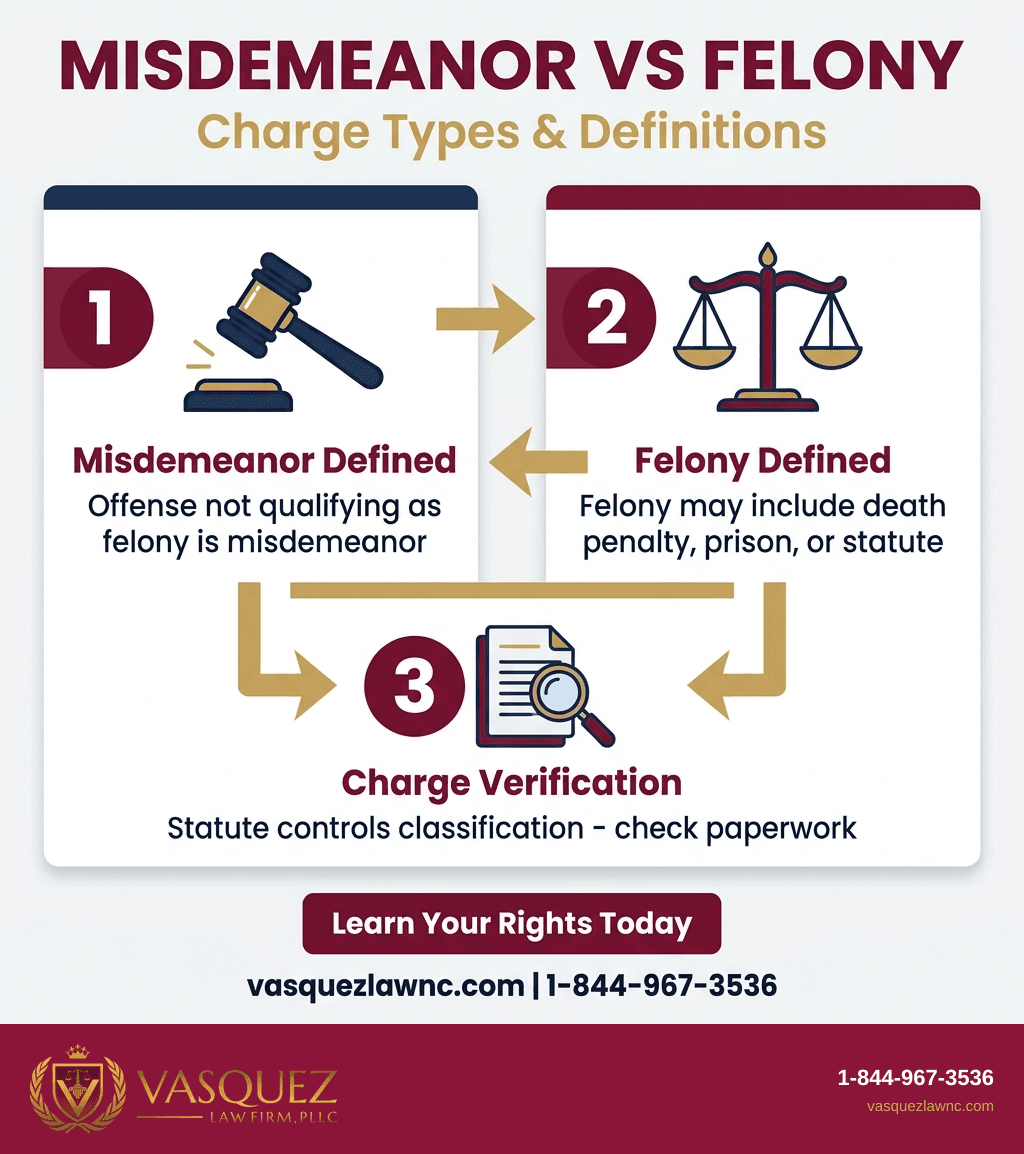
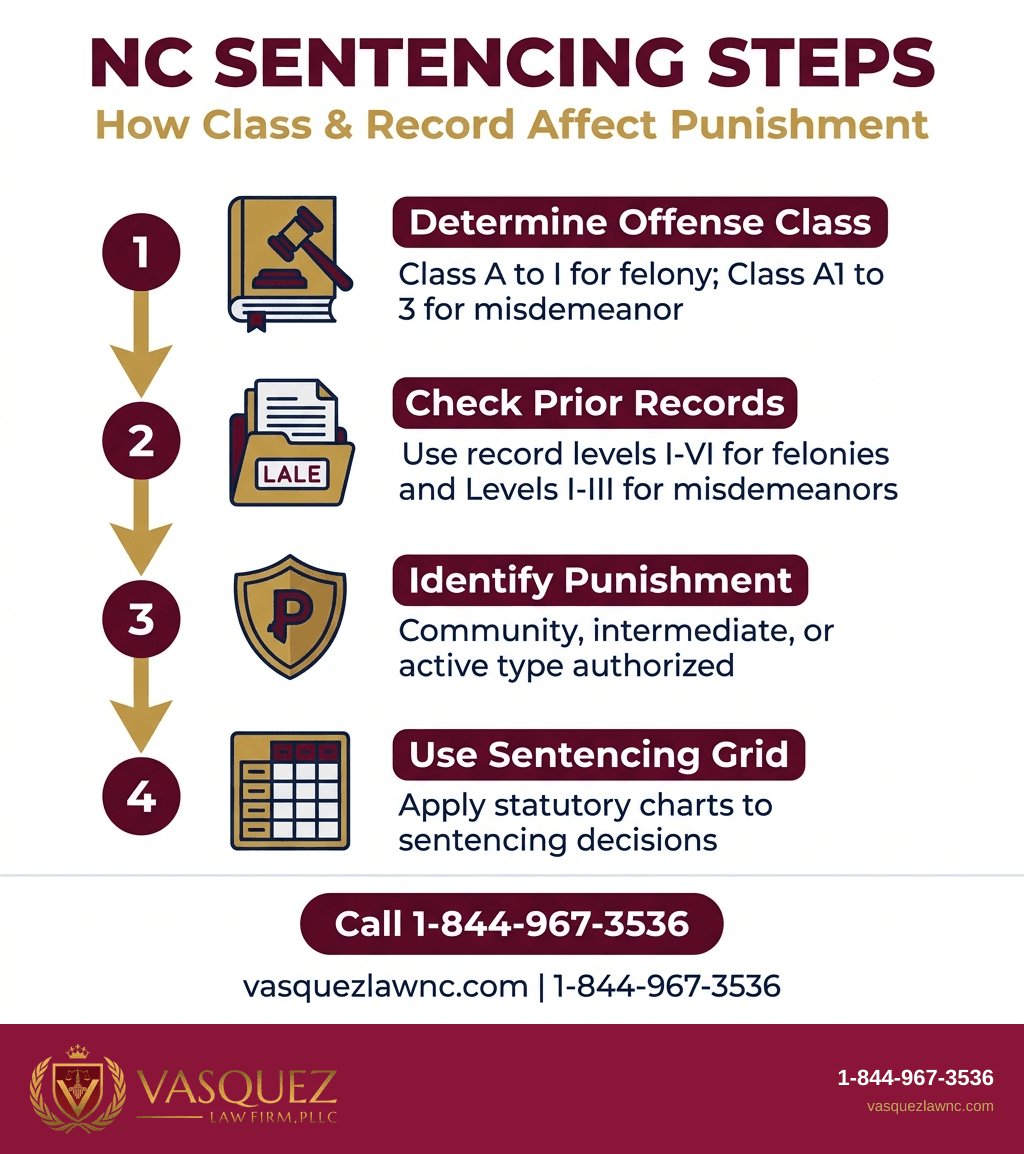
Under N.C. Gen. Stat. § 14-1, a felony is an offense that was a common-law felony, may be punished by death, may be punished by State prison imprisonment, or is called a felony by statute. Any other crime is a misdemeanor. The offense class and prior record then guide the authorized punishment range.
- Felonies use lettered classes and prior record levels.
- Misdemeanors use classes and prior conviction levels.
- A court may consider community, intermediate, or active punishment where authorized.
- The statute defining the charged offense controls its classification.
What makes an offense a misdemeanor or felony in North Carolina?
A person may hear the words felony or misdemeanor at an arrest, first appearance, or court date. Those labels have a defined meaning in N.C. Gen. Stat. § 14-1. The statute gives several ways an offense qualifies as a felony. One way is when a statute calls it a felony.
A felony is a crime which: (1) Was a felony at common law; (2) Is or may be punishable by death; (3) Is or may be punishable by imprisonment in the State's prison; or (4) Is denominated as a felony by statute.
The same statute gives the basic misdemeanor rule. A crime that does not meet one of those felony definitions is a misdemeanor. This is why the exact charging statute matters. A charge name alone is not a safe substitute for reading the statute and the charging paperwork.
Review misdemeanor and felony charges in Harnett County with the offense citation. Do not rely on what another person heard. The criminal defense service page explains how the firm helps people facing criminal defense matters in Harnett County.
Why the statutory classification matters
Classification is the starting point for sentencing. It is not the whole result. The sentencing statutes use the offense class together with a person’s prior convictions or prior record level. A court also looks at the punishment allowed in the relevant grid.
How do misdemeanor classes and prior convictions affect sentencing?
Under N.C. Gen. Stat. § 15A-1340.23, misdemeanor sentencing is based on offense classification and prior conviction level. The chart lists Level I for no prior convictions, Level II for one to four prior convictions, and Level III for five or more prior convictions.
For example, the chart lists Class A1 ranges from one to sixty days at Level I, one to seventy-five days at Level II, and one to one hundred fifty days at Level III. It lists Class 1 ranges from one to forty-five days at Level I and II. It then lists one to one hundred twenty days at Level III.
Community, intermediate, and active punishment
According to § 15A-1340.23, "C" indicates that a community punishment is authorized; "I" indicates that an intermediate punishment is authorized; and "A" indicates that an active punishment is authorized. The available dispositions vary by class and prior conviction level.
Unless otherwise provided for a specific offense, the maximum fine that may be imposed is two hundred dollars ($200.00) for a Class 3 misdemeanor and one thousand dollars ($1,000) for a Class 2 misdemeanor.
For a Class 1 or A1 misdemeanor, the statute says that the fine is in the court’s discretion. Specific offense statutes can provide different punishment rules. This is one reason to bring every charging document to a consultation.
How do felony classes and prior record levels affect punishment?
A felony sentencing review begins with the offense class and prior record level. Prior record levels are indicated by Roman numerals I through VI, as specified in the chart in N.C. Gen. Stat. § 15A-1340.17.
Felony classes run from A through I in the chart. The chart gives a disposition and sentencing ranges. It identifies mitigated, presumptive, and aggravated ranges for imprisonment when those ranges apply. The presumptive range is the middle range in the cell.
A Class I felony example
For Prior Record Level I, the Class I row shows minimum imprisonment terms of three to four months in the mitigated range, four to six months in the presumptive range, and six to eight months in the aggravated range. These are ranges for the minimum term, not the maximum term; subsection (d) specifies the corresponding maximum terms. The disposition at that level is C, meaning community punishment is authorized. Different prior record levels in that same class have different entries.
The chart also lists I, indicating intermediate punishment, and A, indicating active punishment. Misdemeanor and felony charges in Harnett County therefore require attention to the crime class and record calculation. For related background, read about an arrest in Harnett County and early defense steps.
What should you do after misdemeanor or felony charges?
The first useful document is usually the citation, warrant, criminal summons, or other charging paper. It identifies the alleged offense. It can help a defense review begin. Do not alter documents. Do not rely on a verbal description of the accusation.
- Keep every court paper, release condition, and notice together.
- Write down the date, location, and names of possible witnesses while details remain clear.
- Preserve messages, photos, video, receipts, and other material that may matter.
- Follow court orders and release conditions exactly.
- Request a consultation before making decisions based only on the charge label.
We typically see people arrive with a court notice but without the complete charging paper. They may also lack a clear record of prior convictions. Those documents matter. The class and prior-record framework may shape the sentencing analysis. Bring what you have. Identify where other records may be located.
Do not make a major decision based only on the words misdemeanor or felony. Speak with the firm about the charge, paperwork, and court setting. Se Habla Español.
Call: 1-844-967-3536
Which documents should you bring to a criminal defense consultation?
A court notice with a case number can be useful. It is not the only important paper. A careful review of misdemeanor and felony charges in Harnett County depends on documents that identify the alleged statute, charge class, and conditions set by the court.
- The citation, warrant, summons, or indictment you received.
- Bond paperwork and written release conditions.
- Any notice identifying a court date or courtroom.
- Photos, messages, videos, call logs, or receipts related to the allegation.
- Names and contact information for possible witnesses.
- A list of prior convictions or cases you know about.
Prior record levels are indicated in the sentencing charts in § 15A-1340.17 and § 15A-1340.23. The documents help identify questions that need a closer legal review.
Which mistakes can make criminal charge decisions harder?
A common mistake is treating every misdemeanor as insignificant. Another is treating every felony as a guaranteed prison result. North Carolina’s sentencing grids show why that shortcut is unreliable. Classification, record level, and the authorized disposition each have a role.
- Ignoring court papers: Keep and review every notice.
- Guessing the charge class: Check the statute listed in the charge.
- Failing to preserve evidence: Save relevant material without changing it.
- Assuming a prior conviction cannot matter: Record levels appear in both statutory systems.
- Missing a condition of release: Read the written terms closely.
- Making public statements about the facts: Discuss the matter carefully with qualified counsel.
- Waiting to organize records: Gather court and evidence documents promptly.
If you remember one point, remember this: misdemeanor and felony charges in Harnett County are legal classifications. The exact offense statute and record framework matter.
What county limits apply to criminal defense representation?
County-focused criminal defense information
This article addresses North Carolina criminal-law classifications. It focuses on Harnett County charges. Vasquez Law Firm handles criminal defense matters in Johnston, Harnett, and Pitt counties. The firm’s criminal defense work does not extend to every North Carolina county.
For an allegation involving controlled substances, review the firm’s information about drug possession charges in Harnett County. A charge’s classification still depends on the statute used for that offense and the circumstances alleged.
When should you request a consultation about criminal charges?
A person should seek a prompt legal review after receiving paperwork that identifies a criminal charge. Early organization can prevent avoidable confusion. This includes confusion about the court date, release terms, documents, and alleged offense class.
- You received a citation, warrant, summons, or indictment.
- You have a court notice or release condition.
- You do not know whether the accusation is a misdemeanor or felony.
- You have questions about how prior convictions may be considered.
- You have evidence that could be lost or overwritten.
- You need help reading the charge and court paperwork.
For a broader look at conditions after conviction, see unsupervised probation information for Johnston County. It concerns a separate topic. It can still help explain why written court terms require close attention.
About Vasquez Law Firm
Vasquez Law Firm provides criminal defense representation for eligible matters in Johnston, Harnett, and Pitt counties. The firm also handles immigration, personal injury, workers’ compensation, and traffic matters within the applicable service areas. Its Yo Peleo® commitment reflects a direct, respectful approach to protecting a client’s legal position.
William J. Vasquez leads the firm. Bilingual support staff assist English and Spanish-speaking clients. The firm offers consultations for criminal defense matters. For Johnston and Harnett County matters, in-person meetings may be available in Smithfield, NC. Se Habla Español.
Experience and communication
Criminal charges can create uncertainty before a person understands the statute cited on the paperwork. Vasquez Law Firm focuses on clear communication, document review, and preparation for the next court-related decision. No article can replace advice based on the actual charge and record.
Frequently Asked Questions
What is the basic felony definition in North Carolina?
N.C. Gen. Stat. § 14-1 defines a felony as a crime that was a common-law felony, may be punishable by death, may be punishable by State prison imprisonment, or is denominated a felony by statute. The charge’s specific statute remains important because it identifies the offense and its classification.
What is a misdemeanor under North Carolina law?
Under N.C. Gen. Stat. § 14-1, any crime that does not meet the statute’s felony definition is a misdemeanor. That broad definition does not itself state the penalty for a particular offense. Misdemeanor sentencing is then governed by the offense class, prior conviction level, and any specific statute that provides a different rule.
What does the felony sentencing grid include?
The felony sentencing chart in N.C. Gen. Stat. § 15A-1340.17 includes offense classes and prior record levels, and provides mitigated, presumptive, and aggravated ranges where applicable. A Class I allegation should not be evaluated from its letter alone.
Can prior convictions affect a misdemeanor sentence?
Yes. Under N.C. Gen. Stat. § 15A-1340.23, prior conviction levels are used: Level I applies to no prior convictions, Level II applies to one through four prior convictions, and Level III applies to five or more prior convictions. The sentencing grid entries can change with the prior conviction level.
Can prior record affect a felony sentence?
Yes. N.C. Gen. Stat. § 15A-1340.17 provides a chart with Prior Record Levels I through VI, each with specified point ranges. The chart places a different sentencing entry at the intersection of offense class and record level. Accurate record review is therefore a central part of understanding a felony sentencing framework.
What do C, I, and A mean in the sentencing charts?
Both sentencing statutes define the disposition letters. C means community punishment is authorized. I means intermediate punishment is authorized. A means active punishment is authorized. The letter or letters in a particular cell depend on the offense class and the applicable prior conviction or prior record level.
Can a misdemeanor judgment include a fine?
Under N.C. Gen. Stat. § 15A-1340.23, any judgment that includes a sentence of imprisonment may also include a fine. Unless otherwise provided for a specific offense, the maximum fine is two hundred dollars for a Class 3 misdemeanor and one thousand dollars for a Class 2 misdemeanor. The amount of the fine for a Class 1 misdemeanor and a Class A1 misdemeanor is in the discretion of the court.
What should I bring when discussing a charge?
Bring the citation, warrant, summons, indictment, bond papers, release conditions, and court notices you received. Also preserve relevant messages, photos, videos, receipts, and witness information. These materials can help identify the alleged statute, the stated charge, and the questions that require a closer review of misdemeanor or felony classification.
Sources and References
- North Carolina DMV license suspension information
- North Carolina Judicial Branch
- Legal Information Institute
Do not let a charge label answer every question for you. Contact Vasquez Law Firm to request a confidential consultation about misdemeanor and felony charges in Harnett County. Se Habla Español.
Call: 1-844-967-3536
Need legal help?
Immigration in NC and FL. Personal injury and workers compensation across NC. Criminal defense in select NC counties depending on the charge (DWI in 12 counties), and traffic tickets in 20 NC counties. Tell us your county and we will tell you exactly what we can do.
Keep Reading

For how Vasquez Law Firm can help, see our criminal defense page.
Reviewed by Attorney Vasquez, Managing Attorney

William Vasquez
Founder & CEO, Vasquez Law Firm, PLLC
William Vasquez is the founder and CEO of Vasquez Law Firm, PLLC, a results-driven firm specializing in immigration, criminal defense, personal injury, and workers' compensation. A U.S. Air Force veteran and recipient of the Joint Service Achievement Medal, William is dedicated to fiercely fighting for his clients' rights.
Related Legal Services
Need legal help? Learn more about our criminal defense legal services, or contact us for a free evaluation.
You can also visit our NC defense attorneys for more information.