How Do You Get a Misdemeanor Expunged in Johnston?
How do you get a misdemeanor record expunged in Johnston County? See waiting periods, affidavits, fees, and filing steps. Request a consultation.
Published on October 13, 2026· Updated October 13, 2026
Protect your record and your freedom
Free, confidential review. 24/7.
Free & confidential · Se habla espanol · 24/7

Have questions? Talk to an attorney - free evaluation.
Call 1-844-967-3536Protect Your Record and Your Freedom
A confidential case review - available 24/7 for emergencies.
How Do You Get a Misdemeanor Expunged in Johnston?
A misdemeanor conviction can stay visible in court and law-enforcement records until a judge enters an expunction order. Expunction means a court process that removes an eligible record from official records. People often ask, how do I get a misdemeanor record expunged in Johnston County, N.C. Gen. Stat. § 15A-145.5 provides a way to seek expunction of qualifying nonviolent misdemeanor convictions. The process includes a waiting period, sworn statements, record searches, service on the district attorney, and a court decision.
For a Johnston County criminal record question, request a consultation with Vasquez Law Firm. Se Habla Español.
Call 1-844-967-3536.
Quick Answer
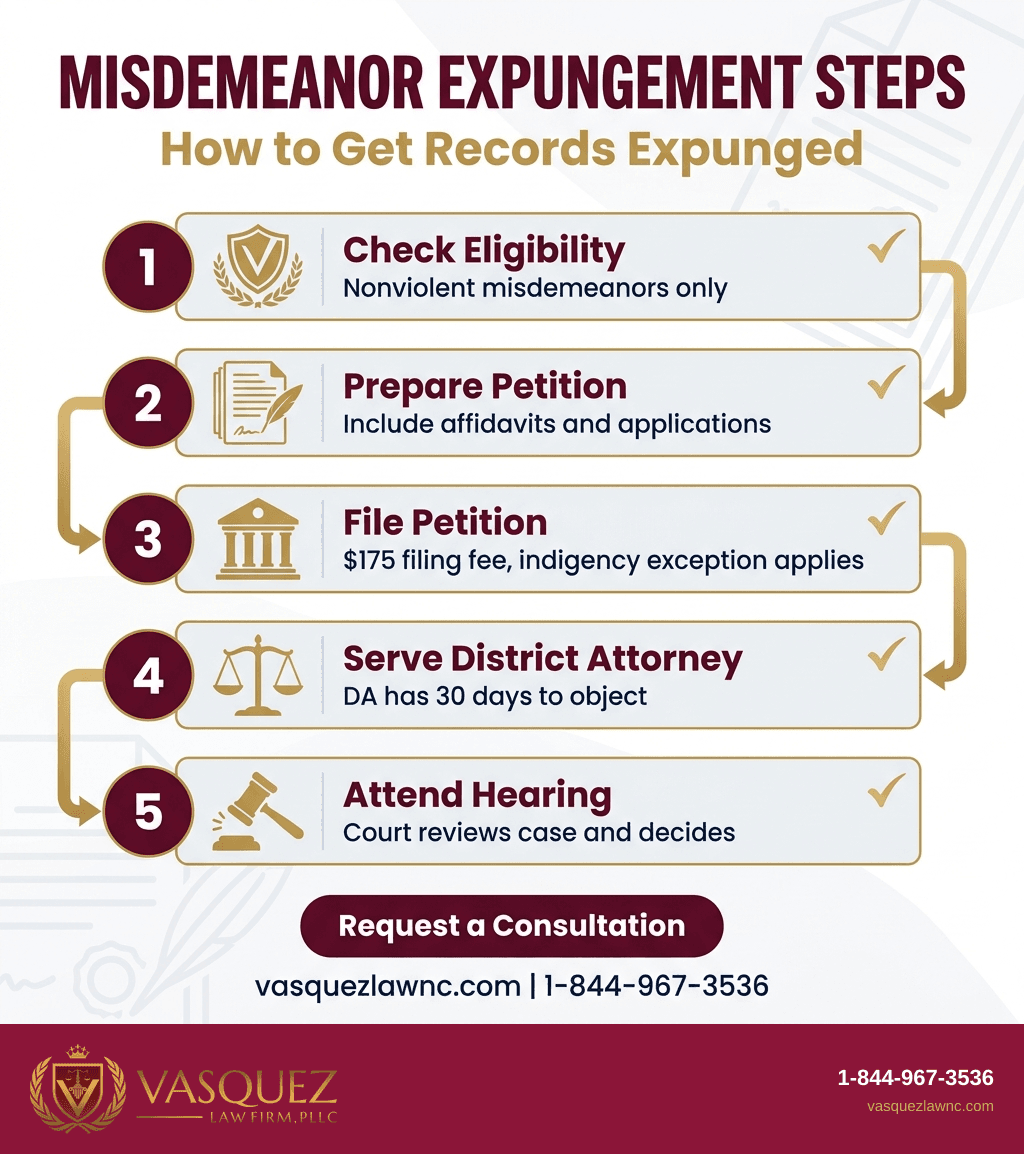
To seek a misdemeanor expunction in Johnston County under N.C. Gen. Stat. § 15A-145.5, file a petition in the county of conviction after the required waiting period. A petition is a formal written request to the court. The court must find that the offense qualifies. It must also find that several record, character, restitution, and timing conditions are met.
- One qualifying misdemeanor generally has a three-year waiting period.
- More than one qualifying misdemeanor generally has a seven-year waiting period.
- The petition requires your affidavit and two character affidavits.
- The district attorney has 30 days to object.
- The clerk filing fee is $175, subject to the indigency exception.
Which misdemeanor convictions can be expunged in Johnston County?
A person convicted of one qualifying nonviolent misdemeanor may file a petition no earlier than three years after the conviction or completion of an active sentence, probation, or post-release supervision. The later event controls. If the petition covers more than one qualifying misdemeanor, the waiting period is seven years. That period runs from the last conviction or completion of the relevant sentence or supervision, whichever is later.
N.C. Gen. Stat. § 15A-145.5 defines a nonviolent misdemeanor by listing exclusions. An exclusion is an offense that the law does not allow the court to expunge under this section. A Class A1 misdemeanor is excluded. An offense with assault as an essential element is also excluded. So are an impaired-driving offense, certain stalking offenses and other offenses the statute specifically lists, and an attempt to commit an excluded offense.
“An offense involving impaired driving as defined in G.S. 20-4.01(24a) is not eligible for expunction.”
This means an expunction review starts with the exact statute of conviction. It does not start with the informal name of the charge. A conviction that seems minor may still fall within an exclusion. For related charge information, review the firm’s Johnston County criminal defense services.
What does one session of court mean?
Multiple qualifying misdemeanor or felony convictions from the same session of court count as one conviction under this statute. This rule can affect the waiting-period category. It does not make an excluded offense eligible.
What steps are required for a North Carolina expungement petition?
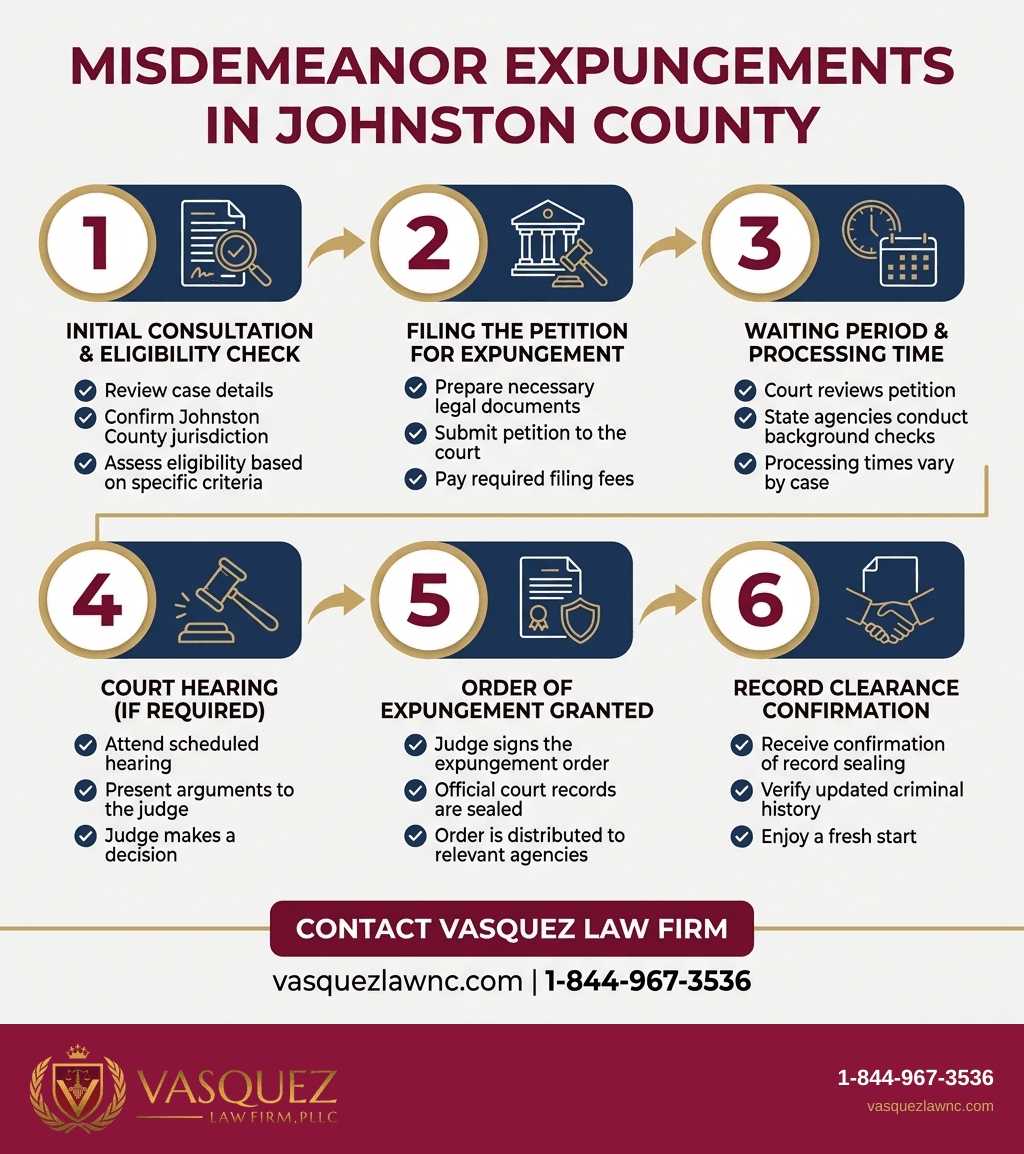
How do I get a misdemeanor record expunged in Johnston County after the waiting period ends? File the petition in the court of the county where the conviction occurred. The statute calls this filing a motion in the cause in the criminal case. A motion in the cause is a written request filed within an existing court case.
- Identify every conviction proposed for expunction. Confirm the correct county.
- Calculate the waiting period from the later controlling event.
- Prepare the petitioner affidavit about good moral character and qualifying record history.
- Get affidavits from two people who are not related to you or each other by blood or marriage.
- Submit the Administrative Office of the Courts-approved application for record searches.
- File with the clerk of superior court. Serve the district attorney.
- Attend a hearing if one is scheduled. Provide accurate information.
The application authorizes name-based State and national criminal-history checks. It also authorizes a search for warrants and pending cases. In addition, it authorizes a search of confidential expunction records. The court can consider more information. This may include information from law enforcement, the district attorney, victims, and a probation officer.
What if convictions occurred in more than one county?
For multiple convictions covered by the seven-year category, petitions must be filed in each county of conviction. N.C. Gen. Stat. § 15A-145.5(c4) requires the petitions to be filed within 120 days. The court may allow a later filing if it finds good cause. Good cause means a legally sufficient reason for missing the usual deadline. This detail can matter before someone files in only one county.
What documents belong with an NC expungement petition form?
The paperwork is more than a request to remove a record. N.C. Gen. Stat. § 15A-145.5(c1) requires a petitioner affidavit, two qualifying character affidavits, the approved records-search application, and an affidavit about outstanding restitution orders or civil judgments for restitution.
- Case number and the court of conviction.
- Petitioner affidavit about good moral character.
- Record-history statement required for the misdemeanor waiting period.
- Two character affidavits from eligible people.
- Approved application authorizing criminal-history, warrant, pending-case, and expunction-record searches.
- Affidavit confirming no outstanding restitution order or restitution civil judgment.
- Information about related petitions in other counties, if applicable.
We often see people arrive with a case number but without the two required character affidavits. They may also lack a clear list of convictions in other counties. Those omissions can cause avoidable delays. A consultation can help organize the petition before filing.
Why does restitution matter?
The court must find that the petitioner has no outstanding restitution orders or civil judgments that represent court-ordered restitution. Restitution is money ordered to repay a victim for a loss. Review the case history carefully before signing an affidavit. Do not treat a payment issue as a detail that can wait until after filing.
How long does a misdemeanor expungement take in NC?
The statute gives several fixed periods. These periods measure eligibility and the district attorney’s objection period. They do not give a total estimate for processing the case. For one qualifying misdemeanor, the threshold is three years. For more than one qualifying misdemeanor, the threshold is seven years.
After filing, the district attorney has 30 days to object. The court may grant an additional 30 days if someone shows good cause. Victims may attend a hearing upon request. The judge may also seek more investigation or verification from a probation officer.
“Upon filing of the petition, the petition shall be served upon the district attorney of the court in which the case was tried resulting in conviction.”
Do not assume automatic expungement in NC. Section 15A-145.5 describes a petition process and required court findings. If the court grants the petition, it orders expunction from court records. It also directs law-enforcement agencies with records of the conviction to expunge them.
What does free expungement in NC mean for filing costs?
As of October 2026, a person filing under N.C. Gen. Stat. § 15A-145.5 pays the clerk of superior court $175 when filing the petition. The statute makes an exception for a petition filed by an indigent person. An indigent person is someone who cannot pay the fee under the applicable financial standard. Whether a person qualifies for indigency is a question to raise before filing.
Free expungement programs and legal clinics may have their own screening rules. The statute’s filing-fee rule still matters. A petition must include the required materials and follow the correct county process. An inaccurate petition can create more work than a careful review at the start.
For help reviewing a record and the petition route, see the firm’s criminal defense representation for Johnston County matters. Vasquez Law Firm handles criminal defense matters in Johnston, Harnett, Pitt, and Cumberland counties.
What mistakes can block a misdemeanor expunction?
A seven-year waiting period can run from the last conviction or from completion of active sentence, probation, or post-release supervision. The later event controls. Filing before that later date is a common mistake. Another mistake is counting a traffic matter as irrelevant without checking whether it is listed in the petition.
- Using the charge name instead of the statute. Confirm whether an exclusion applies.
- Filing too early. Calculate the later statutory date.
- Leaving out a conviction. Review the record before signing the affidavit.
- Using related affidavit witnesses. The two character witnesses must meet the statutory relationship rule.
- Ignoring restitution. Confirm that no qualifying order or judgment remains outstanding.
- Missing multi-county filings. File each required petition within the statutory 120-day period.
- Assuming an expunction is automatic. Submit the petition and meet the court’s findings.
If you remember one point, remember this: eligibility depends on the exact conviction, record history, documents, and dates.
How does Johnston County handle the court location for expunction?
For a conviction in Johnston County, § 15A-145.5 directs the petitioner to file in the county where the person was convicted. This county-specific filing rule is why the court file and case number matter. The statute also requires service on the district attorney in the court where the case was tried.
Johnston County notes
Vasquez Law Firm’s criminal defense practice covers Johnston, Harnett, Pitt, and Cumberland counties. Smithfield, NC is available for in-person criminal-defense meetings for Johnston and Harnett county matters. An expunction request remains a court process. A judge decides whether the statutory findings are met.
When should you request a criminal record consultation?
Request a consultation before filing if any of these situations apply:
- Your conviction involved assault, impaired driving, or stalking.
- You have more than one misdemeanor conviction.
- You have convictions from multiple counties.
- You completed probation or post-release supervision later than the conviction date.
- You have a pending case, warrant, indictment, or felony probable-cause finding.
- You are on bond or personal recognizance in another criminal matter.
- You are unsure whether restitution remains due.
- You previously received an expunction under this section.
Before submitting sworn affidavits, request a consultation with Vasquez Law Firm. Se Habla Español.
Call 1-844-967-3536.
About Vasquez Law Firm
Vasquez Law Firm provides bilingual support for criminal defense, immigration, personal injury, workers’ compensation, and traffic matters. The firm’s Yo Peleo® commitment reflects a direct, caring approach to legal problems that can affect work, family, and future opportunities.
William J. Vasquez leads the firm. For criminal defense matters within the firm’s service area, the firm can review the court record. The firm can discuss the statutory expunction process. It can also explain questions to raise about a particular petition. Se Habla Español.
Attorney Trust and Experience
William J. Vasquez is admitted to the North Carolina State Bar. A criminal-record review should rely on the actual judgment, case file, record history, and the requirements of N.C. Gen. Stat. § 15A-145.5.
Frequently Asked Questions
Are misdemeanors easy to get expunged in North Carolina?
They are not automatic. Under N.C. Gen. Stat. § 15A-145.5, the court must find that the conviction is eligible, the waiting period is complete, the petitioner has good moral character, and other conditions are met. Excluded offenses include Class A1 misdemeanors, offenses with assault as an essential element, impaired-driving offenses, and other listed categories.
Can I file after one misdemeanor conviction?
Yes, a petition may be available for one qualifying nonviolent misdemeanor. The petition cannot be filed earlier than three years after conviction or completion of active sentence, probation, or post-release supervision, whichever is later. The petitioner must also satisfy the statute’s record, character, restitution, and eligibility conditions.
What happens with two misdemeanor convictions?
For more than one qualifying nonviolent misdemeanor, the filing threshold is seven years after the last conviction, other than a traffic offense not listed in the petition, or seven years after related sentence or supervision is served, whichever is later. Multiple convictions in the same session of court receive special treatment under § 15A-145.5(b).
Do I need character affidavits for expungement?
Yes. The statute requires affidavits from two people who know the petitioner’s character and reputation in the community where the petitioner lives. They cannot be related to the petitioner or to each other by blood or marriage. The petition also requires the petitioner’s own affidavit concerning good moral character and required record-history statements.
Can a pending charge affect my expunction petition?
Yes. The court must find that the petitioner has no outstanding warrant or pending criminal case, is not under indictment, and has no felony probable-cause finding in a federal or state court. The court also considers whether the petitioner is free on bond or personal recognizance for a disqualifying criminal matter.
How much is the Johnston County expunction filing fee?
As of October 2026, § 15A-145.5(g) requires a $175 clerk of superior court filing fee. The provision does not apply to a petition filed by an indigent person. Filing costs are separate from any cost of obtaining legal advice or assistance preparing materials for an expunction petition.
Can I expunge a misdemeanor if I owe restitution?
The court must find that the petitioner has no outstanding restitution orders or civil judgments representing amounts ordered for restitution. The petition includes an affidavit addressing that condition. Review the case history and payment status before filing because an unresolved qualifying restitution obligation can prevent the required court finding.
What happens after an expunction is granted?
Section 15A-145.5(e) directs the court to order the conviction expunged from court records and direct law-enforcement agencies with records of the conviction to expunge them. The effect is governed by N.C. Gen. Stat. § 15A-153, with stated exceptions, including disclosure rules for certain law-enforcement certification processes.
Sources and References
How do I get a misdemeanor record expunged in Johnston County? Start by carefully reviewing the conviction, dates, record history, and petition requirements. Contact Vasquez Law Firm to request a confidential consultation. Se Habla Español.
Call 1-844-967-3536.
Need legal help?
Immigration in NC and FL. Personal injury and workers compensation across NC. Criminal defense in Johnston, Harnett, Pitt and Cumberland counties, and traffic tickets in 11 NC counties. Tell us your county and we will tell you exactly what we can do.
Keep Reading

For how Vasquez Law Firm can help, see our criminal defense page.
Reviewed by Attorney Vasquez, Managing Attorney

William Vasquez
Founder & CEO, Vasquez Law Firm, PLLC
William Vasquez is the founder and CEO of Vasquez Law Firm, PLLC, a results-driven firm specializing in immigration, criminal defense, personal injury, and workers' compensation. A U.S. Air Force veteran and recipient of the Joint Service Achievement Medal, William is dedicated to fiercely fighting for his clients' rights.
Related Legal Services
Need legal help? Learn more about learn about our criminal defense practice, or contact us for a free evaluation.
You can also visit criminal defense services in Harnett County for more information.