NC Workers Compensation Exclusivity Ruling Reversed in 2026
North Carolina workers compensation exclusivity changed after an appeals court reversal. See how staffing status may affect claims, request a free evaluation.
Published on October 12, 2026· Updated October 13, 2026
Hurt on the job?
Free review of your workers' comp claim.
Free & confidential · Se habla espanol · 24/7
Have questions? Talk to an attorney - free evaluation.
Call 1-844-967-3536Hurt on the Job? Claim What You Are Owed
A review of your workers' comp claim - we handle the fight.
NC Workers Compensation Exclusivity Ruling Reversed in 2026
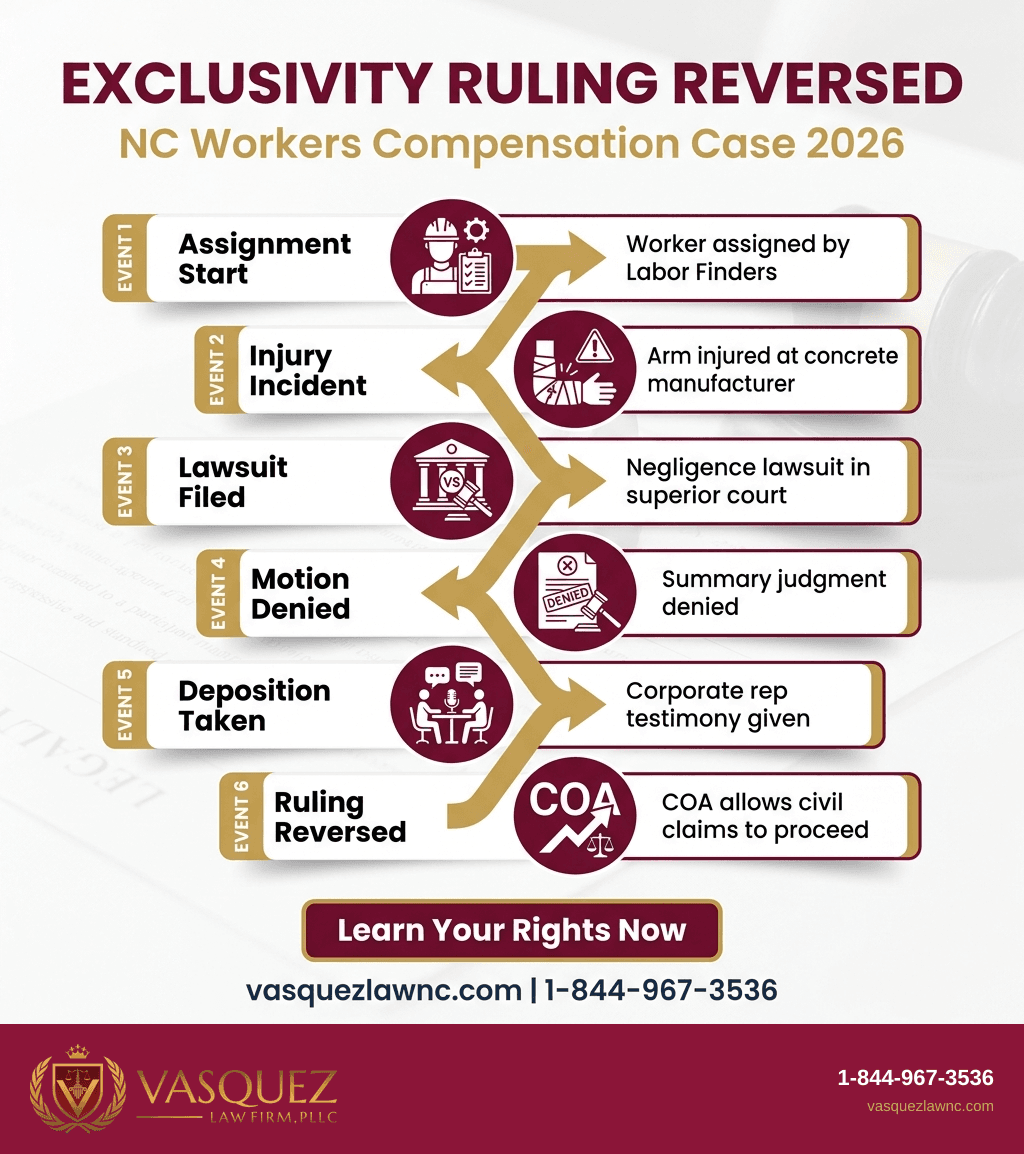
On October 7, 2026, the North Carolina Court of Appeals reopened a negligence case. The case involves a temporary worker whose arm, wrist, and hand suffered extensive injuries in a cement mixer. In case No. COA26-41, the court ruled that North Carolina workers compensation exclusivity did not block the worker's civil claims at this stage.
The decision raises a central question for workers assigned through staffing agencies. Was the injured person also an employee of the company where the work happened? The answer may decide whether the Workers' Compensation Act is the only way to seek recovery. It may also decide whether a negligence claim can continue. Our North Carolina workers' compensation attorneys evaluate workplace injury issues involving direct employers, staffing agencies, and host companies.
Legal disclaimer: This article provides general legal information. It is not legal advice for any individual claim. Facts, contracts, insurance coverage, and filing requirements can change the analysis. The workers' compensation legal team at Vasquez Law Firm helps injured people throughout North Carolina by phone.
What happened in the North Carolina workers compensation exclusivity ruling?
The Court of Appeals reversed an order. That order had granted the manufacturing company partial summary judgment. Summary judgment is a decision made without a trial when the court finds no important factual dispute. The appellate court said the record did not show an implied contract of hire between the temporary worker and the company where he was assigned. An implied contract of hire is an employment agreement shown by the parties' actions instead of a written document. The court sent the case back to Rowan County Superior Court for more proceedings.
Labor Finders assigned the worker to a North Carolina manufacturer of concrete blocks and pipes. The assignment began in March 2022. On May 4, 2022, an employee of the manufacturer told him to clean dried cement from mixer blades. According to the opinion, his right arm became trapped beneath a mixing blade.
The worker filed a superior court lawsuit on April 2, 2024. He alleged negligence, negligence per se, gross, willful, and wanton negligence, and punitive damages. Negligence means failing to use reasonable care. Negligence per se means breaking a safety law or rule in a way that causes the injury. Punitive damages are money meant to punish especially serious conduct. He also filed a separate workers' compensation claim against Labor Finders with the North Carolina Industrial Commission.
The trial court first denied both sides' partial-summary-judgment motions on February 10, 2025. A motion asks the court to decide an issue without a full trial. After a June 4, 2025 deposition of the company's corporate representative, both sides asked the court to reconsider. A deposition is sworn testimony taken before trial. The superior court later ruled for the company on jurisdiction. Jurisdiction means the court's legal power to hear a case. The worker appealed.
Because there was no record evidence of an implied contract of hire between Plaintiff and Defendant, neither the joint employment doctrine nor the lent employee doctrine applies.
The Court of Appeals reviews summary judgment decisions anew. This is called de novo review. The court concluded that the Workers' Compensation Act's exclusivity provision did not remove the superior court's power to hear the negligence claims. An exclusivity provision is a rule that limits a worker to one legal remedy. The reversal does not decide whether the manufacturer was negligent. It decides only that the civil case can continue.
The opinion focused on evidence about Labor Finders. Labor Finders hired, assigned, and paid the worker. The company representative also testified about the manufacturer. The manufacturer did not pay his wages or benefits. It did not list him on its employee rolls. It also did not include him on its workers' compensation policy.
Who can this North Carolina workers compensation exclusivity ruling affect?
The decision directly concerns a worker placed by Labor Finders at the Rowan County manufacturer. Its reasoning may matter more broadly to temporary workers and host companies. Staffing arrangements can create disputes about who qualifies as an employer under North Carolina workers compensation exclusivity rules.
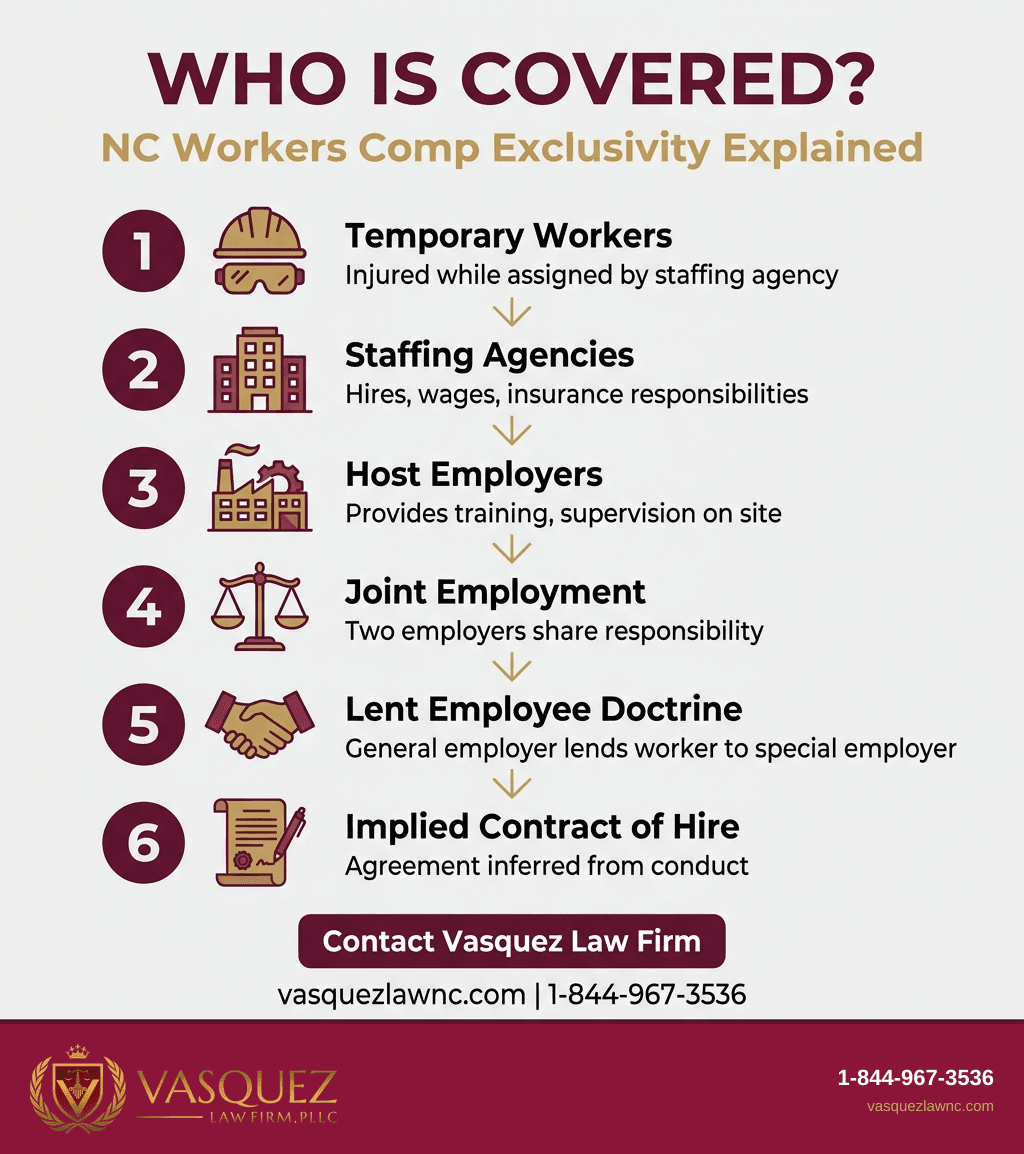
The staffing contract said that all temporary personnel assigned to the manufacturer were Labor Finders employees. Labor Finders was responsible for hiring, assigning, disciplining, terminating, and reassigning workers. It also handled wages and benefits, payroll taxes, unemployment contributions, and workers' compensation insurance. The manufacturer was responsible for training and supervision while the worker was on assignment.
Those responsibilities did not end the inquiry. North Carolina recognizes both joint employment and lent employment. Joint employment means that two employers may share an employment relationship with one worker. Lent employment concerns a general employer lending a worker to a special employer. Under either doctrine, the first question is whether the worker made an express or implied contract of hire with the claimed employer.
An implied contract of hire is a real agreement inferred from the parties' conduct and circumstances. It is not simply a label in a staffing agreement. In COA26-41, the appellate court found no record evidence of such a contract between the worker and the manufacturer.
Defendant essentially wants the benefit of the exclusivity provision of the Worker’s Compensation Act without the burdens associated with being Plaintiff’s employer—Defendant cannot have it both ways.
A temporary worker should not assume that supervision at a job site automatically decides employment status. The dissent reached the opposite result. A dissent is a judge's written disagreement with the majority decision. The dissent reasoned that the manufacturer's training and supervisory role, together with other factors, supported an implied employment relationship.
That disagreement shows why several types of evidence can matter. These include contracts, payroll records, insurance information, deposition testimony, work instructions, and job-site control. In our experience, the first question after a staffing-agency injury is often who carried the worker's compensation coverage. Another key question is who controlled the work that caused the injury.
What does North Carolina law say about workers compensation exclusivity?
N.C. Gen. Stat. § 97-10.1 contains the North Carolina workers compensation exclusivity rule. When an employee and employer are subject to and comply with the Act, workers' compensation remedies generally exclude other claims against that employer for the same workplace injury.
The tradeoff has existed for many years. Workers' compensation can provide limited but assured benefits. The worker usually does not need to prove that the employer was negligent. In exchange, an employee generally cannot seek potentially greater negligence damages from that employer in civil court.
That statutory limit applies to claims against an employer. It does not automatically apply to every separate entity connected to a worksite. The Court of Appeals relied on this difference in COA26-41. The court held that the exclusivity provision did not apply. The record did not establish the manufacturer as the worker's employer.
How does the lent employee doctrine work?
Under the lent employee doctrine, a general employer lends a worker to a special employer. The special employer can be liable for workers' compensation if three conditions exist. First, the worker has a contract of hire with that employer. Second, the work is essentially that employer's work. Third, the employer has the right to control work details.
What is joint employment?
Joint employment can exist when one worker has contracts with two employers. Both employers must control the work at the same time. The services must also be the same or closely related for each employer. Under Lassiter v. Robeson County Sheriff's Department, 388 N.C. 594 (2025), the contract-of-hire question comes first.
North Carolina's definition of employee appears in N.C. Gen. Stat. § 97-2(2). It includes a person working under an express or implied appointment, contract of hire, or apprenticeship. An express agreement is directly stated. An implied agreement is shown through conduct or circumstances. The specific facts of the assignment remain important.
What should an injured temporary worker do after this ruling?
First, report the injury through the staffing agency and the host company. Keep a copy of each report. Keep any incident number and the names of supervisors or witnesses. Prompt reporting can preserve important facts. Equipment conditions and work instructions may still be identifiable soon after the injury.
Second, get necessary medical care. Preserve medical records, work restrictions, bills, and photographs of visible injuries. If a doctor gives restrictions, provide them to the entities that assigned and supervised the work.
Third, collect documents that show the employment arrangement. Useful records include the staffing assignment, pay stubs, onboarding materials, time sheets, safety training records, job instructions, messages, and any written agreement you received. Read our guide on filing a North Carolina workers' compensation claim for more claim-preparation information.
Fourth, identify who controlled the task. Write down who directed the work and supplied the equipment. Also note who provided safety gear, trained workers, approved schedules, and could remove someone from the assignment. These facts relate to the employment-status analysis discussed in COA26-41.
Fifth, do not sign a release before understanding its consequences. Do not assume which claim is available. The North Carolina Industrial Commission explains claim procedures on its Injured Workers page. A workplace condition that creates an ongoing safety concern may also be reported through OSHA's safety and health complaint process.
Were you hurt while assigned through a staffing agency? Vasquez Law Firm offers a free case evaluation for injured people anywhere in North Carolina. Se Habla Español.
What should workers watch next after COA26-41?
The case now returns to Rowan County Superior Court. The Court of Appeals reversed the jurisdiction ruling. This allows further proceedings on the worker's claims. The court did not rule on negligence, damages, punitive damages, or the lawsuit's final outcome.
Workers and businesses should watch how courts apply the contract-of-hire analysis to staffing arrangements. COA26-41 places special weight on the actual record. Important facts include who hired and paid the worker. They also include whether benefits were available, whether payroll and unemployment contributions were made, and whether workers' compensation coverage included the worker.
It is not yet settled whether the defendant will seek further appellate review in this case. For the rule a worker can rely on today, employment status remains a jurisdictional fact. Courts evaluate that fact under the specific evidence presented.
The North Carolina Industrial Commission's Workers' Compensation Claims page remains an official place to check for claim-process information. Workers can also review practical questions about co-employment in North Carolina before deciding what documents to preserve.
Frequently Asked Questions
Does COA26-41 mean every temporary worker can sue a host company?
No. The Court of Appeals ruled on the record before it. It found no evidence of an implied contract of hire between this worker and the manufacturer. A different staffing assignment may involve different contracts, payroll practices, insurance arrangements, training, supervision, or evidence of an employment agreement.
What did the Court of Appeals reverse?
The court reversed the superior court's grant of partial summary judgment for the manufacturer on subject-matter jurisdiction. The trial court had concluded that the Workers' Compensation Act's exclusivity provision barred the worker's negligence claims. The appellate court held that the provision did not apply on this record.
Can a worker have two employers under North Carolina law?
Yes. North Carolina recognizes joint employment and lent employment in appropriate circumstances. Both doctrines require an initial finding that the worker made a contract of hire, express or implied, with the claimed employer. Courts then examine the remaining legal requirements for the particular doctrine.
Why did wages and benefits matter in this case?
The company's corporate representative testified that Labor Finders paid wages and benefits, while the manufacturer did not. The representative also testified that the worker was not eligible for the manufacturer's benefits and was not carried on its employee rolls. The appellate court considered that evidence when analyzing an implied contract of hire.
Does workers' compensation exclusivity protect entities that are not employers?
Generally, N.C. Gen. Stat. § 97-10.1 bars additional claims against an employer that is covered by and complies with the Workers' Compensation Act. The Court of Appeals explained that exclusivity does not automatically bar claims against separate entities. Whether an entity is an employer depends on the applicable legal test and evidence.
What documents can help clarify employment status after an injury?
Staffing agreements, assignment notices, pay stubs, benefit records, tax and payroll records, safety training materials, work instructions, time sheets, insurance communications, and witness information can be relevant. These documents may help show who hired, paid, trained, supervised, insured, and controlled work details at the time of injury.
Sources
- N.C. Court of Appeals, No. COA26-41, filed October 7, 2026
- North Carolina Industrial Commission, Workers' Compensation Claims
- North Carolina Industrial Commission, Injured Workers
Legal disclaimer: This information is not individualized legal advice. If a staffing-agency assignment or workplace injury raises questions about workers' compensation coverage and a possible civil claim, speak with an attorney about your facts.
Vasquez Law Firm offers a free case evaluation to injured workers throughout North Carolina.
Reviewed by Attorney Vasquez, Managing Attorney
Hurt at work? You have rights.
NC workers' comp covers medical bills and lost wages — even for undocumented workers. 15-min call to see what you qualify for.
Keep Reading


William Vasquez
Founder & CEO, Vasquez Law Firm, PLLC
William Vasquez is the founder and CEO of Vasquez Law Firm, PLLC, a results-driven firm specializing in immigration, criminal defense, personal injury, and workers' compensation. A U.S. Air Force veteran and recipient of the Joint Service Achievement Medal, William is dedicated to fiercely fighting for his clients' rights.
Related Legal Services
Need legal help? Learn more about experienced work injury attorneys in Charlotte, or contact us for a free evaluation.
You can also visit NC workers comp legal help for more information.