Can Injured NC Temp Workers Sue the Host Company in 2026?
By William J. Vásquez · Updated November 5, 2026
North Carolina workers compensation exclusivity explained. Learn how special employers may affect injury claims, then contact us for a free case evaluation.
Published on November 4, 2026· Updated November 5, 2026
Hurt on the job?
Free review of your workers' comp claim.
Free & confidential · Se habla espanol · Mon-Fri 8am-7pm, Sat 9am-2pm (ET)
Have questions? Talk to an attorney - free evaluation.
Call 1-844-967-3536Hurt on the Job? Claim What You Are Owed
A review of your workers' comp claim - we handle the fight.
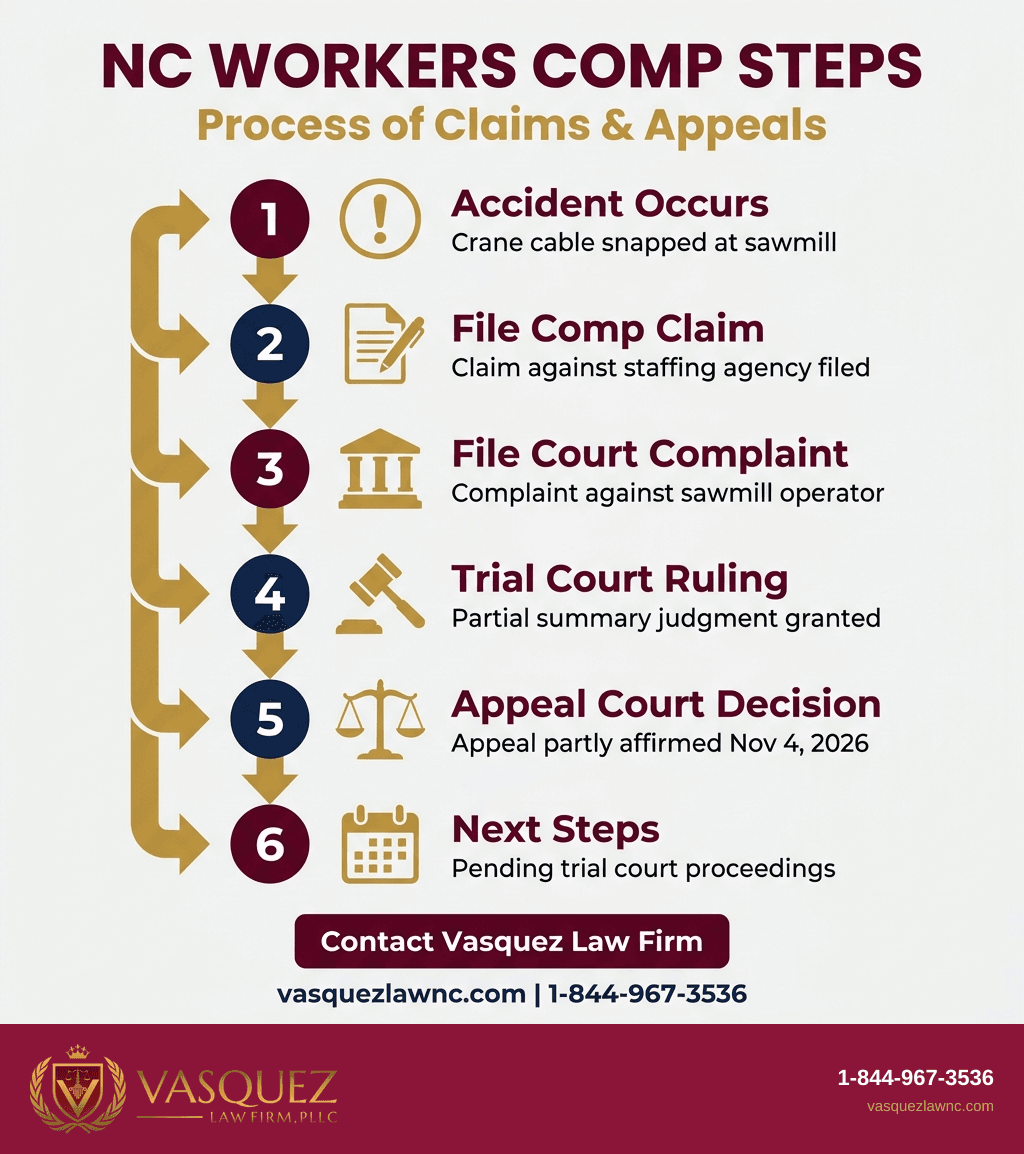
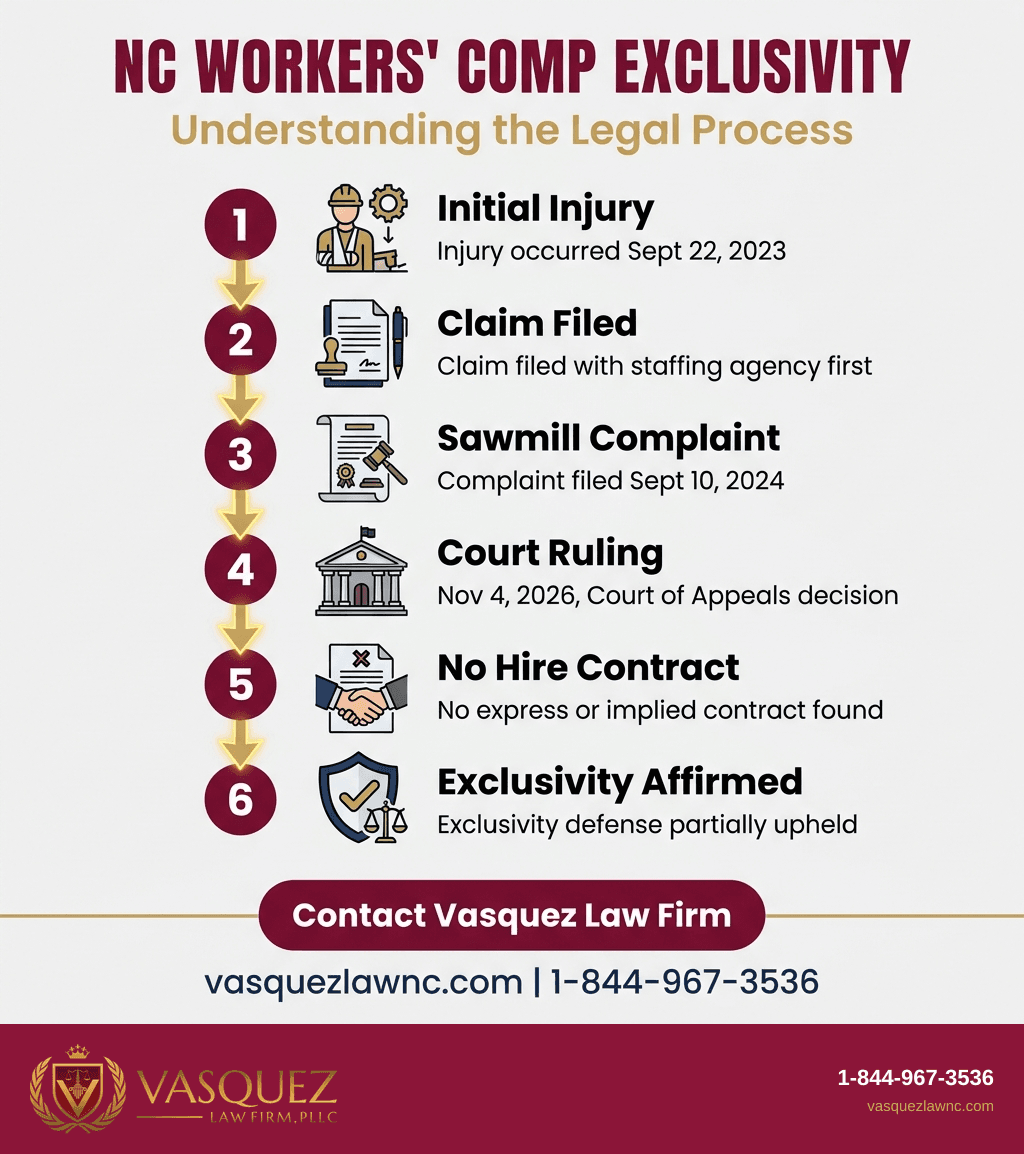
On September 22, 2023, a crane cable snapped at a North Carolina sawmill. A three-person crew was changing saw blades. A steel blade holder fell onto a mechanic assigned by a staffing agency. The accident left him permanently paralyzed from the waist down.
On November 4, 2026, the North Carolina Court of Appeals held that the trial court did not err by granting Plaintiff partial summary judgment in case No. COA26-281, although a higher court may still review the decision. The court concluded that there was no express or implied contract of hire between the worker and the sawmill operator, so the first prong of the special employment test was not met.
This ruling matters to temporary workers, staffing agencies, and host companies across North Carolina. The workers' compensation legal team at Vasquez Law Firm helps injured workers examine the separate roles of the staffing company and the business where an injury occurred.
Legal information only: This article explains a published appellate decision. It is not legal advice for any individual claim. Workers' compensation and civil injury claims depend on specific contracts, testimony, and facts.
Do you have questions about a staffing-agency work injury? Contact Vasquez Law Firm for a free case evaluation about your workers' compensation options and potential claims.
What did the Court of Appeals decide about North Carolina workers' compensation exclusivity?
The Court of Appeals affirmed part of a Durham County Superior Court order on November 4, 2026. The court held that the trial court did not err by granting Plaintiff partial summary judgment on the exclusivity provision defense under the Workers' Compensation Act.
The worker began the sawmill assignment on September 14, 2023. The staffing agreement required CDT HR, LLC to recruit, employ, pay, insure, and handle workers' compensation claims for its assigned workers. The sawmill operator directed and supervised the work at the job site. It also agreed to provide a safe work environment and needed training.
The dispute over two employment relationships
The injured mechanic filed a workers' compensation claim against the staffing agency. He filed that claim before filing the September 10, 2024 superior court complaint against the sawmill operator. The operator then argued that it was a special employer. That status would usually make workers' compensation the exclusive remedy against it.
The court focused on whether the worker had a contract of hire with the operator. A contract of hire is an agreement that creates an employment relationship. The operator admitted that no express contract existed. An express contract is one stated directly in words or writing.
The operator relied on an implied contract instead. An implied contract is an actual agreement inferred from the parties' conduct and relationship.
Defendant cannot disclaim an employment relationship before the Industrial Commission and then rely upon that same relationship in superior court to invoke the exclusivity provision of the Act.
The court found no express or implied contract of hire. In proceedings before the N.C. Industrial Commission, the operator had said that no employer-employee relationship had ever existed between it and the worker. Its corporate representative also testified that CDT employed the worker.
The appeal was only partly resolved
The operator also challenged the trial court's refusal to grant summary judgment on contributory negligence and punitive damages. Summary judgment is a decision without a trial when the law and undisputed facts support one side. The Court of Appeals dismissed that portion of the appeal because the denial of summary judgment was interlocutory and the operator failed to establish a basis for immediate appellate review. The court also declined the operator’s request for discretionary review. Interlocutory means that the case remained pending and had not reached a final judgment.
The appellate court therefore affirmed the ruling on exclusivity. It dismissed the remaining appeal for lack of jurisdiction. Jurisdiction means the court's legal power to decide an issue. The negligence case may continue in superior court, subject to later trial-court proceedings. The North Carolina Supreme Court may still review the Court of Appeals’ decision.
Who can this North Carolina workers' compensation ruling affect?
This decision directly concerns a worker employed by a staffing agency. The agency assigned the worker to another company's facility. That company supervised the worker's daily tasks. The staffing agency kept responsibility for payroll, benefits, workers' compensation coverage, and personnel functions.
The opinion does not say that every temporary worker may sue a host company after an injury. It applies the special employment doctrine to the evidence in this case. A doctrine is a legal rule that courts use to decide similar issues. The first required element was missing. There was no contract of hire, either express or implied, between the worker and the alleged special employer.
The key distinction is consent to employment
North Carolina law recognizes that a general employee of one employer can also become a special employee of another. However, courts require deliberate and informed consent before finding this type of employment relationship. That relationship can remove a worker's common-law negligence claim against the host company. Common law means law developed through court decisions rather than only through statutes.
The Court of Appeals compared this case with Solis-Santos. In that case, evidence supported an implied contract. The host company's owner also gave testimony acknowledging one. Here, the operator's earlier statements and deposition testimony pointed the other way.
As there was no express or implied contract of hire between Plaintiff and Defendant, the first prong of the Collins test has not been met.
For injured workers, the practical question is not simply who directed the shift. The record may also include the staffing contract, hiring records, pay information, benefit records, workers' compensation filings, and statements from each company about the relationship.
In our experience, the cases we handle often begin with uncertainty. A worker may not know whether the staffing agency, the host company, or both entities had legal responsibility for an injury.
That uncertainty does not excuse delay in protecting a workers' compensation claim. The N.C. Industrial Commission's injured-worker guidance describes the state claim process. A separate civil claim needs its own review of the specific facts and law.
How does workers' compensation exclusivity work in North Carolina?
N.C. Gen. Stat. § 97-10.1 is the North Carolina Workers' Compensation Act's exclusivity provision. An exclusivity provision is a rule that limits a worker to one legal remedy. When an employee and employer are subject to and comply with the Act, its remedies generally exclude other common-law remedies against that employer. This rule applies to the work injury or death.
The exchange is central to the system. Workers can seek limited, assured benefits without proving employer negligence. In return, they generally cannot bring a civil negligence action against their employer. A civil negligence action is a lawsuit claiming that someone failed to use reasonable care. Such a lawsuit may seek broader damages.
Under North Carolina law, the exclusivity provision of the Workers' Compensation Act bars the employee from bringing additional claims against his employer, not separate entities. The superior court is divested of original jurisdiction of all actions which come within the provisions of the Workers’ Compensation Act by statute.
The three-part special-employment test
Under the Collins test, the court examines three issues. First, did the worker make a contract of hire with the alleged special employer? Second, was the work essentially that employer's work? Third, did that employer have the right to control work details?
The Court of Appeals stopped at the first element. It found no contract of hire. This is important because supervision alone did not establish the employment relationship needed to invoke North Carolina workers' compensation exclusivity on these facts.
Summary judgment is governed by N.C. Gen. Stat. § 1A-1, Rule 56(c). It is proper only when no genuine issue of material fact exists. It also requires that a party be entitled to judgment as a matter of law. A material fact is a fact that could affect the result. Appellate courts review summary judgment decisions de novo. De novo means they consider the legal issue anew.
What should an injured temporary worker do after a workplace injury?
Start by preserving the facts that identify every entity involved. Keep the staffing-agency assignment, job description, onboarding materials, pay records, benefit information, incident reports, medical records, and communications from both the staffing agency and the host business.
Next, identify who hired you, who paid you, who carried workers' compensation coverage, and who controlled the task where the injury occurred. A contract may assign payroll and insurance duties differently from daily supervision. Those differences mattered in the November 4 decision.
Report the injury through the employer channels available to you. Keep proof of that report. The North Carolina workers' compensation claim process can involve documents and procedural choices. Those choices may affect the evidence available later in a disputed case.
Workers who believe unsafe conditions contributed to an injury can also review OSHA's safety and health complaint process. A safety complaint has a different purpose from a workers' compensation claim or civil lawsuit.
Do not assume that a staffing arrangement answers every liability question. Review any release, recorded statement, settlement paper, or employment document before signing it. A lawyer can assess how the work arrangement affects the remedies that may be available.
Were you injured while assigned through a staffing agency? Vasquez Law Firm serves workers anywhere in North Carolina by phone. Request a free case evaluation to discuss your workers' compensation options. Se Habla Español.
What happens next after this North Carolina workers' compensation ruling?
The Court of Appeals resolved the special-employer defense at the summary-judgment stage. It did not decide whether the operator was negligent, whether the worker was contributorily negligent, or whether punitive damages are ultimately available. Those questions remain for further superior court proceedings.
The rule readers can rely on today is narrow but important. A host company seeking the Act's immunity as a special employer must establish the required employment relationship. The first Collins element requires a contract of hire, express or implied.
It is not yet settled whether the negligence claims will succeed at trial. Readers following the case can monitor published appellate opinions through the CourtListener opinion page for case No. COA26-281. They can also track claim procedures through the N.C. Industrial Commission's workers' compensation claims page.
For workers facing similar questions, careful records create options. Documentation about hiring, supervision, and coverage can help clarify whether North Carolina workers' compensation exclusivity applies to a particular entity. The related workers compensation immunity analysis may affect whether a civil claim can proceed.
Frequently Asked Questions
Can a temporary worker have more than one employer?
Yes. North Carolina's special employment doctrine can treat a general employee as a special employee of another business while doing that business's work under its control. The court uses the three-part Collins test. A host company must show a contract of hire, work essentially belonging to it, and a right to control work details.
Why did the sawmill operator lose its exclusivity defense?
The Court of Appeals found no express or implied contract of hire between the worker and the operator. The staffing agreement assigned key employer duties to CDT. The operator also previously told the Industrial Commission that no employer-employee relationship existed and its representative identified the worker as CDT's employee.
Does daily supervision make a host company a special employer?
Not by itself under this ruling. The staffing agreement gave the operator on-the-job direction and supervision duties. Yet the court concluded the first Collins element was not met. Because no contract of hire existed, the court did not need to decide the remaining special-employment elements.
What does an interlocutory order mean?
An interlocutory order is entered while a case is still pending and does not settle the entire controversy. The Court of Appeals held that the operator's challenges involving contributory negligence and punitive damages came from an interlocutory denial of summary judgment. It dismissed that part of the appeal for lack of appellate jurisdiction.
Does this decision decide who was negligent?
The appellate decision did not determine negligence, contributory negligence, compensatory damages, or punitive damages. Those issues were not resolved by the Court of Appeals in this appeal.
What records matter after a staffing-agency workplace injury?
Important records can include the staffing agreement, assignment materials, hiring records, wages, benefits, workers' compensation paperwork, incident reports, medical records, and communications from each company. The Court of Appeals relied on the staffing agreement, prior statements to the Industrial Commission, and deposition testimony when evaluating the claimed employment relationship.
A work injury can involve more than one company and more than one legal question. Contact Vasquez Law Firm for a free case evaluation with a North Carolina workers' compensation attorney. We can discuss North Carolina workers compensation exclusivity and how it may affect your options.
Legal information only, not individualized legal advice. Outcomes depend on the facts, applicable law, and available evidence.
Sources
Reviewed by Attorney Vasquez, Managing Attorney
Hurt at work? You have rights.
NC workers' comp covers medical bills and lost wages — even for undocumented workers. 15-min call to see what you qualify for.
Keep Reading

William Vasquez
Founder & CEO, Vasquez Law Firm, PLLC
William Vasquez is the founder and CEO of Vasquez Law Firm, PLLC, a results-driven firm specializing in immigration, criminal defense, personal injury, and workers' compensation. A U.S. Air Force veteran and recipient of the Joint Service Achievement Medal, William is dedicated to fiercely fighting for his clients' rights.
Related Legal Services
Need legal help? Learn more about workers comp lawyers in North Carolina, or contact us for a free evaluation.
You can also visit NC workers comp legal help for more information.