Hit and Run Charge in Johnston County, NC: Felony Risks
By William J. Vásquez · Updated November 9, 2026
Facing a Hit and run charge in Johnston County, NC? Learn about felony risks, license revocation, and next steps. Contact Vasquez Law Firm for help today.
Published on November 7, 2026· Updated November 9, 2026
Protect your record and your freedom
Free, confidential review.
Free & confidential · Se habla espanol · Mon-Fri 8am-7pm, Sat 9am-2pm (ET)
Have questions? Talk to an attorney - free evaluation.
Call 1-844-967-3536Protect Your Record and Your Freedom
A confidential case review. Call Mon-Fri 8am-7pm, Sat 9am-2pm ET.
Hit and Run Charges Can Bring Felonies in Johnston County
A hit and run charge in Johnston County, NC may involve a misdemeanor or felony allegation. The result depends on whether the crash caused property damage, injury, serious bodily injury, or death. North Carolina General Statute § 20-166 requires drivers to stop, exchange identifying information, and provide reasonable assistance after certain crashes. The facts at the scene matter. So does what the driver knew, or reasonably should have known, about the crash and any injury.
If you face a criminal allegation after a crash in Johnston County, request a confidential consultation with Vasquez Law Firm. Se Habla Español.
Call 1-844-967-3536.
Quick Answer
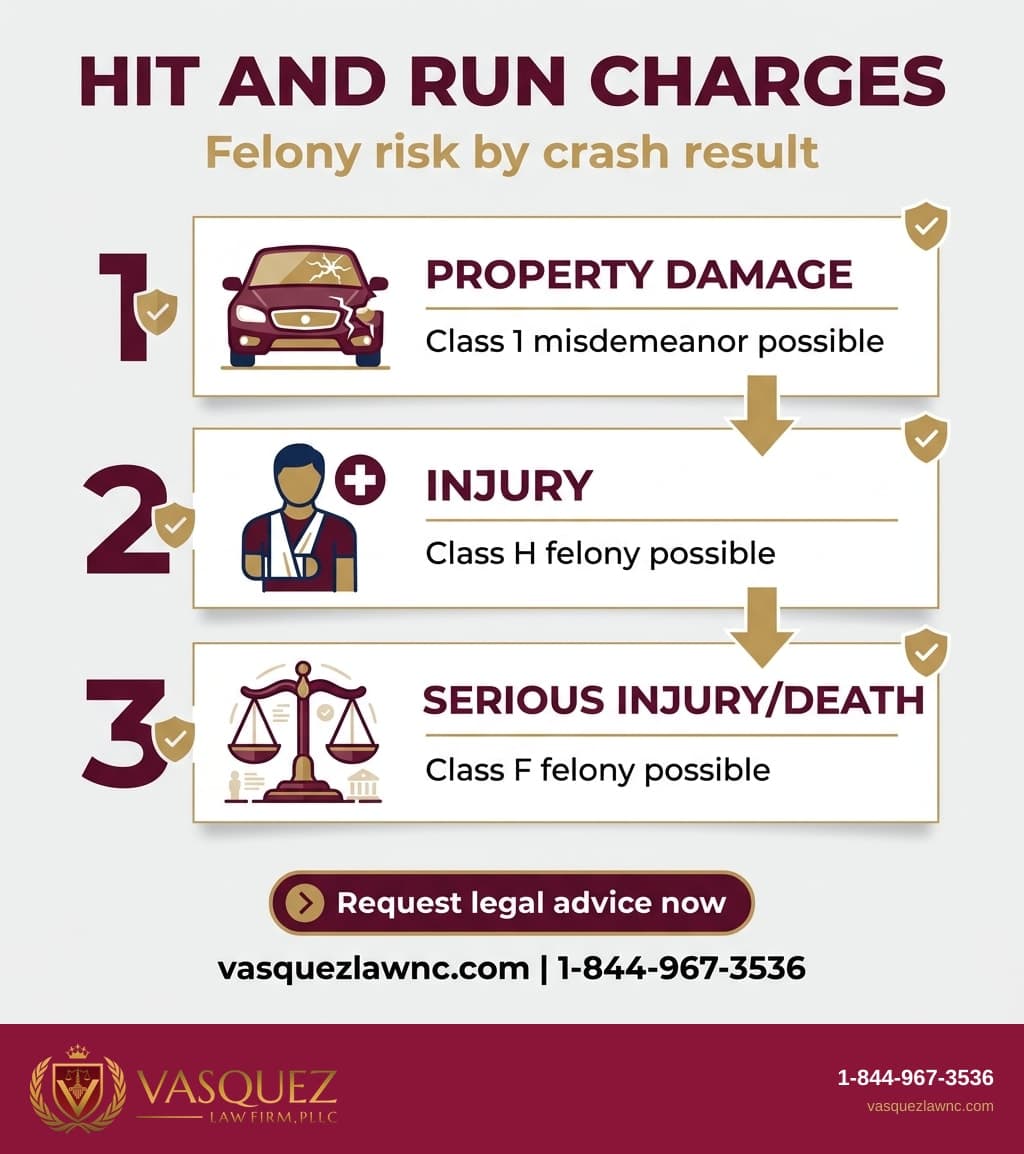
A hit and run charge may be a Class 1 misdemeanor, a Class H felony, or a Class F felony under N.C. Gen. Stat. § 20-166. The classification depends on the crash result and the legal allegation. A driver must stop and remain as required. The driver must provide identifying information and render reasonable assistance to an injured person.
- Property-only crashes can lead to a Class 1 misdemeanor.
- A crash involving injury can lead to a Class H felony.
- Serious bodily injury or death can lead to a Class F felony.
- Conviction can also lead to driver license revocation.
Why can a hit and run charge become a felony?
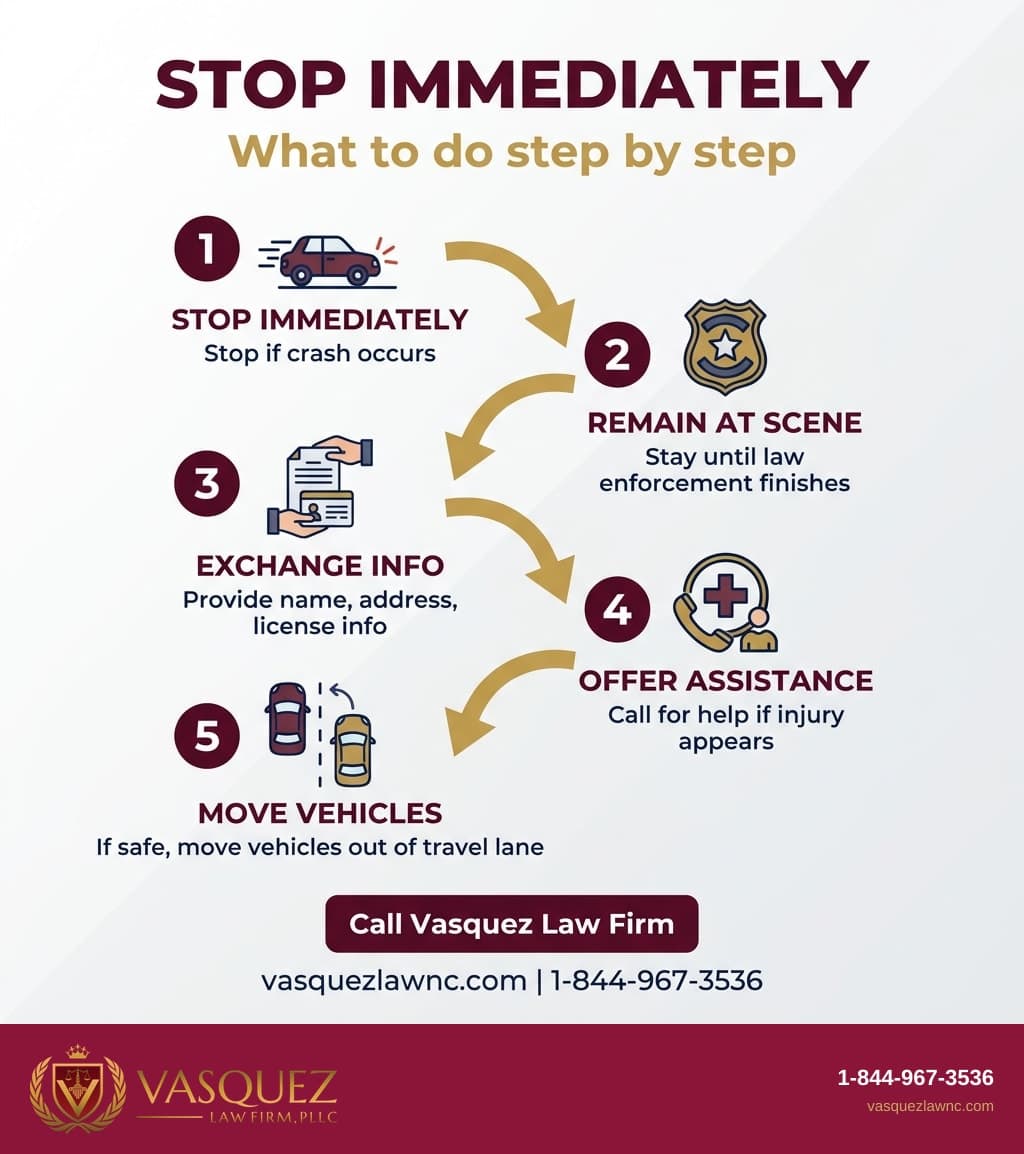
A collision involving injury creates different duties than a property-only collision. Under N.C. Gen. Stat. § 20-166(a1), a driver who knows or reasonably should know that a crash caused injury must immediately stop. The driver must remain at the scene until law enforcement completes the investigation or authorizes departure. A willful violation is a Class H felony.
The driver shall remain with the vehicle at the scene of the crash until a law-enforcement officer completes the investigation of the crash or authorizes the driver to leave and the vehicle to be removed, unless remaining at the scene places the driver or others at significant risk of injury.
Under N.C. Gen. Stat. § 20-166(a), the allegation becomes more serious if the driver knew or reasonably should have known the crash caused serious bodily injury or death. A willful violation of that subsection is a Class F felony. If a crash results in death, the statute also requires sentencing in the aggravated range for the appropriate prior record level.
The knowledge standard matters
The statute uses the phrase knows or reasonably should know. This wording makes the surrounding facts important. The collision, vehicle damage, statements, witnesses, roadway conditions, and the driver’s later actions may all matter when evaluating a hit and run charge in Johnston County, NC.
For guidance about criminal allegations in the county, review the firm’s Johnston County criminal defense representation. This article cannot determine how the statute applies to one person’s case.
What must a driver do after a Johnston County crash?
A driver involved in a crash has immediate duties under N.C. Gen. Stat. § 20-166. The proper response starts with safety. The statute permits departure to call law enforcement, obtain medical assistance or treatment, or remove oneself or others from significant risk of injury. A driver who leaves for a permitted reason must return with the vehicle within a reasonable period unless a law-enforcement officer instructs otherwise.
Information and reasonable assistance
Section 20-166(b) requires a driver obligated to stop under subsection (a) or (a1) to give the person struck and the driver or occupants of any vehicle collided with the driver’s name, address, driver’s license number, and vehicle license plate number, unless those recipients are physically or mentally incapable of receiving the information. The section also requires reasonable assistance to an injured person. Reasonable assistance includes calling for medical help when it appears necessary or when the injured person requests it.
The driver shall also render reasonable assistance to any injured person. Reasonable assistance includes calling for medical assistance if it is apparent that such assistance is necessary or is requested by the injured person.
A violation of the information or assistance requirement is a Class 1 misdemeanor. In a property-damage crash, N.C. Gen. Stat. § 20-166(c) also requires an immediate stop. For a reportable crash, the driver generally remains until an officer completes the investigation or gives permission to leave.
When may vehicles be moved?
The statute recognizes a narrow roadway-safety situation. For a crash on a highway’s main lane, ramp, shoulder, median, or adjacent area, each vehicle must be moved as soon as possible out of the travel lane and onto the shoulder or to a designated accident investigation site if both statutory conditions apply: the crash caused no injury or death, or the drivers neither knew nor had reason to know of any injury or death; and each vehicle can be normally and safely driven. That means it requires no towing and can operate under its own power and in its usual manner without additional damage or hazard to the vehicle, other traffic, or the roadway.
Cases we handle often begin with missing information. The person may not have the crash report, charging document, or paperwork that identifies the specific subsection alleged. Bringing those documents to a consultation helps identify whether the allegation concerns injury, property damage, information exchange, or assistance.
What documents matter in a hit and run defense?
A charging document may use a short description. The statute, however, contains separate duties and classifications. Preserve records before they are lost or overwritten. Do not alter messages, vehicle records, photographs, or communications connected to the crash.
- The citation, warrant, summons, or other charging document.
- Any crash report or exchange-of-information sheet.
- Photographs of the scene and all vehicle damage.
- Messages, call logs, or records related to calling for help.
- Vehicle ownership, registration, and insurance documents.
- Names and contact details for witnesses, if known.
- Any paperwork concerning license revocation or a limited driving privilege.
A person accused of a hit and run charge in Johnston County, NC should avoid discussing disputed facts on social media. A statement that seems harmless can later be compared with physical evidence or witness accounts. The same caution applies to attempts to contact an injured person or another driver without legal guidance.
North Carolina charges have distinct classifications. The firm’s explanation of misdemeanor and felony charges can help explain why the alleged crash result matters.
How can a hit and run conviction affect a driver license?
A criminal case can also affect driving privileges. N.C. Gen. Stat. § 20-166(e) directs the Division of Motor Vehicles to revoke a license after convictions under listed subsections. The length and type of revocation depend on the subsection involved and the crash result.
- A conviction under § 20-166(a) can result in a four-year revocation.
- For a conviction under § 20-166(a), § 20-166(e)(2) requires permanent license revocation if the crash resulted in another person’s death, with eligibility to apply for a new license after seven years from revocation.
- A conviction under § 20-166(a1) or § 20-166(b) can result in a one-year revocation.
- A judge may find that a longer revocation is appropriate under the circumstances, which results in a two-year revocation under § 20-166(e)(3).
On a first conviction only for a violation of subsection (a1) or (b), a judge may allow limited driving privileges as described in N.C. Gen. Stat. § 20-179.3(b)(2). The DMV may issue a new license after an application and satisfactory proof of good behavior during the revocation period, subject to conditions. Review the North Carolina DMV license suspension information for agency guidance.
For an allegation in Johnston County, our criminal defense services for crash-related charges can help you understand the court process and possible driving consequences.
What mistakes can make a hit and run allegation worse?
A common mistake is assuming minor damage means there is no duty to stop. Section 20-166(c) applies when a driver knows or reasonably should know that the vehicle was involved in a crash resulting only in property damage. A willful violation is a Class 1 misdemeanor.
- Leaving before identifying everyone involved: Stop and exchange required information when it can be received.
- Ignoring an injury request: Call for medical assistance if it is requested or appears necessary.
- Moving a vehicle without considering the statute: Section 20-166(c2) requires movement when its roadway-safety conditions apply. Other provisions also permit removal to call law enforcement, obtain medical assistance or treatment, escape significant risk of injury, or leave with an officer’s authorization or after the investigation is complete.
- Failing to return after leaving for safety: Return with the vehicle within a reasonable period unless a law-enforcement officer directs otherwise.
- Leaving a parked vehicle without proper notice: Provide information to a peace officer or leave a conspicuous written notice when the statutory conditions apply.
- Failing to report damage to a fixed object: The statute provides specific reporting options for a guardrail, utility pole, or similar fixed object.
- Making broad public statements: Preserve privacy and get legal advice before discussing disputed facts.
If you remember one thing: A crash scene creates immediate legal duties. Safety, medical assistance, identification, and communication with law enforcement should guide the response.
How is a hit and run charge handled in Johnston County?
Johnston County criminal defense notes
Hit-and-run allegations are criminal charges, not ordinary traffic-ticket matters. The precise statutory subsection can change the classification, possible license consequence, and issues that need review. A Class 1 misdemeanor allegation under § 20-166(c), a Class H felony allegation under § 20-166(a1), and a Class F felony allegation under § 20-166(a) require different legal analysis.
Vasquez Law Firm handles criminal defense matters in Johnston County. If a court notice, warrant, or citation alleges a crash-related offense, request a consultation promptly. You can also read about what happens after an arrest in Harnett County for general context about criminal case preparation in a nearby service area.
When should you request a consultation now?
A prompt consultation is particularly useful when the allegation involves injury, serious bodily injury, death, a requested license revocation, or a felony classification. Early review can help preserve documents and clarify the exact subsection charged.
- You received a warrant, citation, summons, or court date.
- The crash involved an injured person.
- Law enforcement seeks an interview or statement.
- You left because of a safety concern and need to explain the sequence of events.
- You are unsure whether you provided all required information.
- You received DMV paperwork related to revocation.
- Your vehicle, phone, or other property may contain relevant evidence.
Do not guess which subsection applies to your facts. Vasquez Law Firm can review the allegation in a Johnston County criminal case. Se Habla Español.
Call 1-844-967-3536.
About Vasquez Law Firm
Vasquez Law Firm provides criminal defense representation for eligible cases in Johnston County. William J. Vasquez leads the firm with a direct, client-centered approach. The firm’s Yo Peleo® commitment reflects a focus on protecting clients’ rights while explaining legal options in plain language.
Our bilingual support staff helps clients communicate in English or Spanish. The firm also handles immigration, personal injury, workers’ compensation, criminal defense, and traffic matters within its service rules. Criminal defense consultations for Johnston County matters may be arranged through the firm’s Smithfield, NC location.
Attorney trust and experience
William J. Vasquez is admitted to the North Carolina State Bar. A criminal charge deserves careful attention to the accusation, the statute, the evidence, and possible collateral consequences. No outcome can be promised, and each matter depends on its facts.
Frequently Asked Questions
Can you go to jail for a hit and run in North Carolina?
Yes. N.C. Gen. Stat. § 20-166 classifies willful violations differently based on the alleged crash result. Property-only violations under subsection (c) are Class 1 misdemeanors. A willful violation of the stopping and remaining duties under subsection (a1), with the required knowledge or reason to know of the crash and injury, is a Class H felony. A willful violation under subsection (a), with the required knowledge or reason to know of the crash and serious bodily injury or death, is a Class F felony. The exact charge must be reviewed carefully.
What is the minimum punishment for a hit and run?
The statute identifies criminal classifications rather than one minimum punishment for every situation. A willful property-only violation under N.C. Gen. Stat. § 20-166(c) is a Class 1 misdemeanor. A violation of the information or assistance duty in subsection (b) is also a Class 1 misdemeanor. Injury and serious-injury allegations carry felony classifications under other subsections.
Does a driver have to call for medical help after a crash?
Section 20-166(b) requires reasonable assistance to an injured person. It specifically says reasonable assistance includes calling for medical assistance when it appears necessary or when the injured person requests it. The requirement applies to a driver required to stop under subsection (a) or (a1). Whether a particular situation meets the statute depends on the facts.
What information must drivers exchange after a crash?
A driver required to stop under N.C. Gen. Stat. § 20-166(a) or (a1) must provide the driver’s name, address, driver’s license number, and vehicle license plate number. The information goes to the person struck and the driver or occupants of any vehicle collided with, unless those people are physically or mentally unable to receive it.
Can a driver move a vehicle after a crash?
For crashes on a highway’s main lane, ramp, shoulder, median, or adjacent area, § 20-166(c2) requires moving each vehicle as soon as possible out of the travel lane and onto the shoulder or to a designated accident investigation site if the crash caused no injury or death, or the drivers neither knew nor had reason to know of any injury or death, and each vehicle can be normally and safely driven. Each vehicle must require no towing and be able to operate under its own power and in its usual manner without additional damage or hazard to the vehicle, other traffic, or the roadway.
What happens after a hit and run license revocation?
The DMV revocation rules depend on the subsection of conviction. Section 20-166(e) provides different revocation periods for convictions under subsections (a), (a1), and (b). It permits applications for a new license after three years from a four-year revocation under subsection (e)(1), seven years from a permanent revocation under subsection (e)(2), or one year from revocation under subsection (e)(3); these are application thresholds, not guarantees of issuance. The Division may impose terms and conditions on a new license for the balance of the revocation period, but conditions following permanent revocation may not exceed three years.
Can a driver leave a crash scene because it feels unsafe?
The statute allows departure when remaining at the scene places the driver or others at significant risk of injury. It also permits leaving to call law enforcement, seek medical assistance or treatment, or remove people from significant risk. A driver who leaves for a permitted reason must return with the vehicle within a reasonable period unless law enforcement gives different instructions.
Should I request a consultation for a hit and run charge in Johnston County, NC?
A consultation can help identify the alleged subsection, charge classification, required court appearance, evidence to preserve, and possible driving consequences. Bring the charging document, crash report if available, DMV paperwork, and any records that show what occurred after the crash. A hit and run charge in Johnston County, NC is fact-specific, so general information cannot replace individual legal advice.
Sources and References
- North Carolina DMV license suspension information
- North Carolina Judicial Branch court information.
- U.S. Department of Justice legal information.
If you are facing a hit and run charge in Johnston County, NC, contact Vasquez Law Firm to request a confidential consultation. Se Habla Español.
Call 1-844-967-3536.
For how Vasquez Law Firm can help, see our hit and run page.
Reviewed by Attorney Vasquez, Managing Attorney


William Vasquez
Founder & CEO, Vasquez Law Firm, PLLC
William Vasquez is the founder and CEO of Vasquez Law Firm, PLLC, a results-driven firm specializing in immigration, criminal defense, personal injury, and workers' compensation. A U.S. Air Force veteran and recipient of the Joint Service Achievement Medal, William is dedicated to fiercely fighting for his clients' rights.
Related Legal Services
Need legal help? Learn more about learn about our criminal defense practice, or contact us for a free evaluation.
You can also visit criminal defense services in Johnston and Harnett counties for more information.