Drug Possession Charges in Harnett County Can Cost You
Facing drug possession charges in Harnett County? See charge levels, proof, sentencing risks, and defense steps. Request a consultation now.
Published on October 11, 2026· Updated October 11, 2026
Protect your record and your freedom
Free, confidential review. 24/7.
Free & confidential · Se habla espanol · 24/7

Have questions? Talk to an attorney - free evaluation.
Call 1-844-967-3536Protect Your Record and Your Freedom
A confidential case review - available 24/7 for emergencies.
Drug Possession Charges in Harnett County Can Cost You
A traffic stop, a vehicle search, or an item found in a shared home can lead to drug possession charges in Harnett County. The charge may range from a Class 3 misdemeanor to a felony. The substance, amount, and claimed facts affect the charge. This guide explains possible choices, proof, sentencing rules, and immediate steps under N.C. Gen. Stat. § 90-95.
Drug accusations can move quickly in Harnett County. Attorney William J. Vasquez can review the allegation and explain the next court step. Se Habla Español.
Call 1-844-967-3536.
Quick Answer
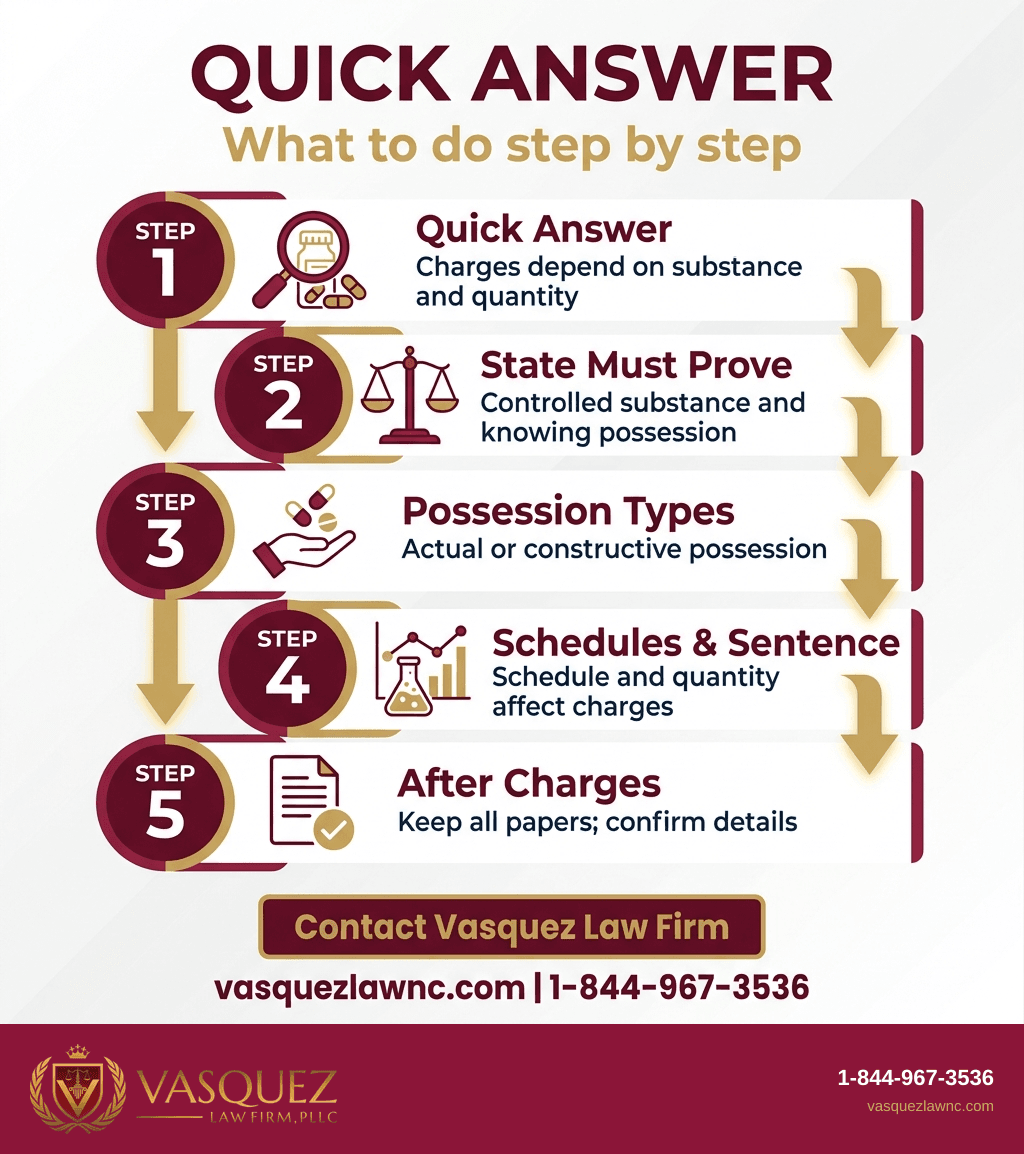
Drug possession charges in Harnett County first depend on the controlled substance and its quantity. The State must prove knowing possession. A charge may be challenged through facts about possession, searches, laboratory evidence, notice, and court procedure. Do not assume that a citation or arrest means guilt.
- Schedule I possession is generally a Class I felony.
- Many Schedule II, III, and IV cases begin as Class 1 misdemeanors.
- Cocaine, methamphetamine, amphetamine, and PCP possession are Class I felonies.
- Fentanyl or carfentanil possession is a Class H felony.
- Trafficking thresholds can bring mandatory prison terms and large fines.
What must the State prove for drug possession offenses?
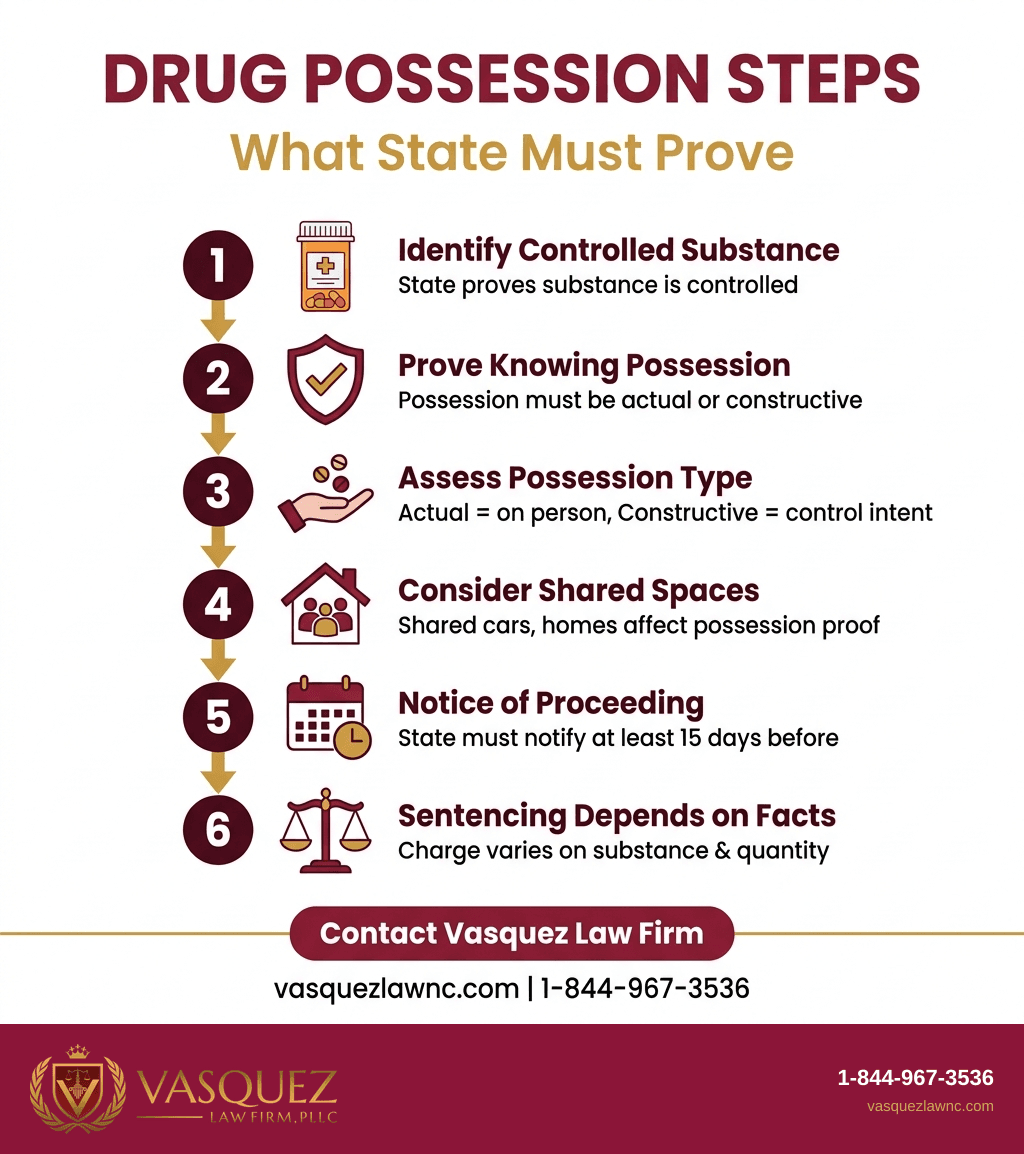
A pill bottle under a passenger seat does not, by itself, show who possessed its contents. Under G.S. 90-95(a)(3), possessing a controlled substance is unlawful unless the law authorizes it. For a possession case, the State must prove that the substance was controlled. It must also prove that the accused knowingly possessed it.
Possession can be actual or constructive. Actual possession means the substance was on the person. Constructive possession means the State claims that the person knew about the substance and had the ability and intent to control it. The substance does not need to be in the person’s pocket or hand. Shared cars, homes, bags, and rooms can make this issue central.
“Except as authorized by this Article, it is unlawful for any person: … To possess a controlled substance.”
Whether the State can prove knowing possession under N.C. Gen. Stat. § 90-95 depends on the facts of each case. The likely sentence depends on the charge, the evidence, the prior record level, any plea terms and North Carolina sentencing law.
For a broader explanation of allegations involving controlled substances, review our criminal defense representation for drug charges. An early review can preserve questions about ownership, access, and police procedure.
Actual and constructive possession
When several people could use the same place, the State may need more than proof of proximity. Statements, personal belongings, vehicle control, fingerprints, messages, and observed conduct may be disputed or explained. The specific facts matter more than an assumption based only on where an item was found.
How do substance schedules and quantity affect sentencing?
Two substances can lead to very different charges. G.S. 90-95(d)(1) classifies simple possession of a Schedule I substance as a Class I felony. It has a narrow MDPV exception. Under G.S. 90-95(d)(2), possessing Schedule II, III, or IV substances is generally a Class 1 misdemeanor. However, the statute lists important exceptions.
Possessing methamphetamine, amphetamine, PCP, or cocaine is a Class I felony. Possessing fentanyl or carfentanil is a Class H felony. More than four dosage units of hydromorphone can also raise the charge to a Class I felony. The same can happen with more than 100 dosage units of controlled substances described in subsection (d)(2).
Marijuana has separate rules. Possession of one-half ounce or less is a Class 3 misdemeanor. Any jail sentence for that amount must be suspended. More than one-half ounce can be a Class 1 misdemeanor. More than one and one-half ounces, certain amounts of hashish, or any synthetic THC or THC isolated from resin can be a Class I felony under G.S. 90-95(d)(4).
Drug possession charges in Harnett County can also become trafficking allegations. For example, G.S. 90-95(h)(3) sets the cocaine trafficking threshold at 28 grams or more. G.S. 90-95(h)(4c) sets the fentanyl or carfentanil trafficking threshold at four grams or more. Trafficking does not only mean selling. The statute includes possession, transport, delivery, manufacture, and sale.
“Any person who sells, manufactures, delivers, transports, or possesses 28 grams or more of cocaine … shall be guilty of a felony, which felony shall be known as ‘trafficking in cocaine’.”
Trafficking penalties and sentencing options
The lowest cocaine trafficking range is 28 to less than 200 grams. It is a Class G felony. It carries a 35 to 51 month prison term and at least a $50,000 fine. The lowest fentanyl trafficking range is four to less than 14 grams. It is a Class E felony. It carries a 90 to 120 month term and a $500,000 fine. These are statutory figures, not predictions for a particular case.
The statute generally bars probation or a suspended sentence for trafficking. G.S. 90-95(h)(5) and (h)(5a) contain limited rules involving substantial assistance or specific judicial findings. Substantial assistance means meaningful help to law enforcement or prosecutors. Whether either rule applies requires a review of the facts. Our page on drug crime defenses in North Carolina discusses issues that may affect a defense strategy.
What should you do after drug possession charges in Harnett County?
The first court date may arrive before a person receives the charging paper, laboratory report, or complete police narrative. Start by keeping every paper from law enforcement or the court. Confirm the charge caption, statute number, court location, and date shown on the paperwork.
- Do not discuss the allegation’s facts with other people or on social media.
- Write down what happened while the details are clear. Include stops, searches, statements, and witnesses.
- Preserve lawful records, messages, photos, receipts, and vehicle documents. Do not alter or delete anything.
- Bring charging papers, bond documents, and prior court paperwork to a consultation.
- Appear at every scheduled Harnett County court date unless the court changes it.
At our Smithfield office, people often ask whether the substance was tested. The statute allows a certified chemical analysis report in court without the analyst’s testimony. This applies only after specific notice and when no timely written objection is filed. Under G.S. 90-95(g), the State must give notice at least 15 business days before the proceeding. It must also provide a copy of the report. An objection must be filed at least five business days before the proceeding.
What documents and evidence should you preserve?
- Charging citation, warrant, indictment, or summons.
- Bond conditions and any release paperwork.
- Property receipt and towing or inventory documents.
- Names and contact information for possible witnesses.
- Photos or video lawfully obtained from the location.
- Medical prescription information, if relevant.
- A detailed timeline of the stop, search, and arrest.
Request a consultation before deciding whether to speak further with investigators. Vasquez Law Firm handles criminal defense matters in Harnett, Johnston, Pitt, and Cumberland counties, subject to the facts and charge.
Which defense options can affect a Harnett County case?
A vehicle with three occupants raises a different possession question than medicine found in a named patient’s prescription container. Defense work often begins by comparing the charge with what the evidence can actually prove. It may include review of knowledge, control, identity, the substance’s classification, quantity, and police conduct.
Search and seizure questions can matter. The Fourth Amendment and Article I, Section 20 of the North Carolina Constitution protect people from unreasonable searches and seizures. The primary statute does not explain whether a specific stop, consent search, warrant, or inventory search was lawful. That analysis requires the reports, video, warrant materials, and timeline.
The chemical analysis process can also matter. G.S. 90-95(g1) allows chain-of-custody statements under a notice-and-objection procedure. Chain of custody means the record showing who handled the evidence and when. The State must give 15 days’ notice before trial. The defendant must notify the State at least five days before trial to object under that subsection. Missing a deadline may waive an objection under the statute.
For court location and scheduling tools, consult the North Carolina Courts. The court website is a useful source for public court information. It does not evaluate your defense or tell you which evidence is admissible in your case.
What mistakes can hurt your options?
- Assuming proximity equals possession: Preserve facts showing shared access or lack of control.
- Ignoring a court date: Missing court may create more problems, including an order for arrest.
- Deleting messages: Deletion can remove context and create new questions.
- Posting about the case: Public statements can become evidence or lead to witnesses.
- Waiting on laboratory notice: Notice and objection deadlines can be short.
- Accepting a charge label without review: The schedule, weight, and alleged conduct affect classification.
- Relying on an average sentence: Sentences turn on the offense class, the prior record level and the facts, so another person’s result is not a guide to yours.
If you remember one point: do not make decisions based only on the arresting charge. Have the paperwork reviewed before important deadlines pass.
Evidence and deadlines can shape your options. Speak with Vasquez Law Firm about defense for Harnett County criminal charges. Se Habla Español.
Call 1-844-967-3536.
What court and county limits apply in Harnett County?
A charge in Harnett County is governed by North Carolina law. It moves through the local court system. Harnett County is within the firm’s criminal defense service area. This article does not describe criminal representation outside Harnett, Johnston, Pitt, or Cumberland counties.
Drug possession charges in Harnett County are not traffic matters just because an allegation began during a traffic stop. A possession charge is a criminal allegation. The court process, bond conditions, charging document, and evidence should be reviewed as criminal-case issues.
The statute also increases penalties in certain settings. Under G.S. 90-95(e)(9), possession on the premises of a penal institution or local confinement facility is a Class H felony. Subsection (e)(3) can raise a Class 1 misdemeanor drug offense to a Class I felony based on qualifying prior convictions. That increase depends on qualifying prior convictions, not on earlier arrests or charges alone.
When should you call about drug possession charges now?
A laboratory-report notice with a five-business-day objection deadline is one reason to act quickly. Other urgent triggers include an upcoming first appearance, an active bond condition, a search warrant, a felony allegation, a trafficking weight, or a charge involving fentanyl, cocaine, methamphetamine, amphetamine, or PCP.
- You received a citation, warrant, summons, or indictment.
- Police seized a vehicle, phone, cash, or prescription medication.
- A child, school, park, or detention facility allegation appears in the paperwork.
- You have a prior controlled-substance conviction.
- You received notice of a laboratory report or chain-of-custody statement.
- You face a felony or trafficking accusation.
About Vasquez Law Firm
Vasquez Law Firm provides criminal defense representation in Harnett, Johnston, Pitt, and Cumberland counties. William J. Vasquez is admitted to the North Carolina State Bar. The firm’s Yo Peleo® approach combines direct preparation with respectful, bilingual client communication.
- Bilingual support: Se Habla Español.
- Criminal defense area: Harnett, Johnston, Pitt, and Cumberland counties.
- Other focus areas: Immigration, personal injury, workers’ compensation, criminal defense, and traffic violations.
Attorney Trust and Experience
Learn about William J. Vasquez and the firm’s legal background before requesting a consultation. A consultation can identify the charge, available documents, deadlines, and questions that should be investigated.
Frequently Asked Questions
Can drug possession charges in Harnett County be dropped?
A charge may be dismissed, reduced, or proceed, depending on the evidence and prosecution decision. No result is automatic. A review may examine whether the State can prove knowing possession, whether a search was lawful, whether the material was properly identified, and whether notice requirements were met.
Is possession of cocaine a felony in North Carolina?
Yes. Under G.S. 90-95(d)(2), possession of cocaine and specified related forms is punishable as a Class I felony. At 28 grams or more, the allegation can become trafficking in cocaine under G.S. 90-95(h)(3). The statute lists a 35 to 51 month term and at least a $50,000 fine for the lowest trafficking range.
Is fentanyl possession charged more seriously?
Yes. G.S. 90-95(d)(2) classifies possession of fentanyl or carfentanil as a Class H felony. Four grams or more can constitute trafficking in fentanyl or carfentanil under G.S. 90-95(h)(4c). The lowest trafficking category carries a 90 to 120 month term and a $500,000 fine under the statute. Lab identity and weight are critical issues.
Can I be charged if drugs were in a shared car?
Being near a substance does not eliminate the State’s burden to prove knowing possession. In a shared car, facts about access, control, ownership, location, statements, and other evidence may matter. Constructive possession allegations require careful fact review. Do not create new evidence by discussing the allegation online or by deleting communications that could provide context.
What happens if I miss a lab report objection deadline?
Under G.S. 90-95(g), a certified chemical analysis report may be admitted without analyst testimony if the State gives at least 15 business days’ notice and no written objection is filed at least five business days before the proceeding. The statute says an untimely failure to object waives the objection. Seek prompt advice after receiving any laboratory notice.
Does a prior drug conviction change a simple possession charge?
It can. G.S. 90-95(e)(3) states that a Class 1 misdemeanor offense under the Article can be punished as a Class I felony after one or more qualifying prior convictions under controlled-substance laws. The prior conviction used for this elevation is not used to calculate prior record level. The exact prior record and charge must be reviewed.
What should I bring to a criminal defense consultation?
Bring every charging paper, bond document, court notice, property receipt, and laboratory notice. A written timeline of the stop, search, and arrest is also useful. Include names of potential witnesses and relevant prescription information. Do not alter records or contact alleged witnesses to influence what they say. A complete file helps identify procedural deadlines and factual questions.
Drug possession charges in Harnett County deserve a careful review before a deadline is missed. Contact Vasquez Law Firm to request a confidential consultation. Se Habla Español.
Call 1-844-967-3536.
Facing Drug Charges in Harnett County?
Drug charges carry severe penalties. Early legal intervention can make a critical difference.
Keep Reading

For how Vasquez Law Firm can help, see our drug crimes page.
Reviewed by Attorney Vasquez, Managing Attorney

William Vasquez
Founder & CEO, Vasquez Law Firm, PLLC
William Vasquez is the founder and CEO of Vasquez Law Firm, PLLC, a results-driven firm specializing in immigration, criminal defense, personal injury, and workers' compensation. A U.S. Air Force veteran and recipient of the Joint Service Achievement Medal, William is dedicated to fiercely fighting for his clients' rights.
Related Legal Services
Need legal help? Learn more about experienced defense attorneys in Smithfield, or contact us for a free evaluation.
You can also visit NC criminal defense legal help for more information.


