How Insurance Companies Handle North Carolina Crashes
How must insurance companies handle a North Carolina crash claim? Review claim responses, denials, repairs, and settlement steps. Call for a free evaluation.
Published on October 28, 2026· Updated October 28, 2026
Injured? Get what your case is worth
Free review.
Free & confidential · Se habla espanol · Mon-Fri 8am-7pm, Sat 9am-2pm (ET)

Have questions? Talk to an attorney - free evaluation.
Call 1-844-967-3536Get What Your Injury Is Worth
Schedule your consultation.
How Insurance Companies Handle North Carolina Crashes
A crash claim may involve a repair estimate, medical bills, a rental request, and calls from more than one insurance company. This guide explains how insurance companies must handle a North Carolina crash claim. It uses guidance from the North Carolina Department of Insurance and G.S. 58-63-15. It covers notice, investigation, denials, payment, total-loss decisions, and records that can protect your position.
After a serious collision, early documentation can affect your claim. Documentation means records that support what happened. Vasquez Law Firm helps injured people anywhere in North Carolina by phone. Se Habla Español.
Call 1-844-967-3536.
Quick Answer
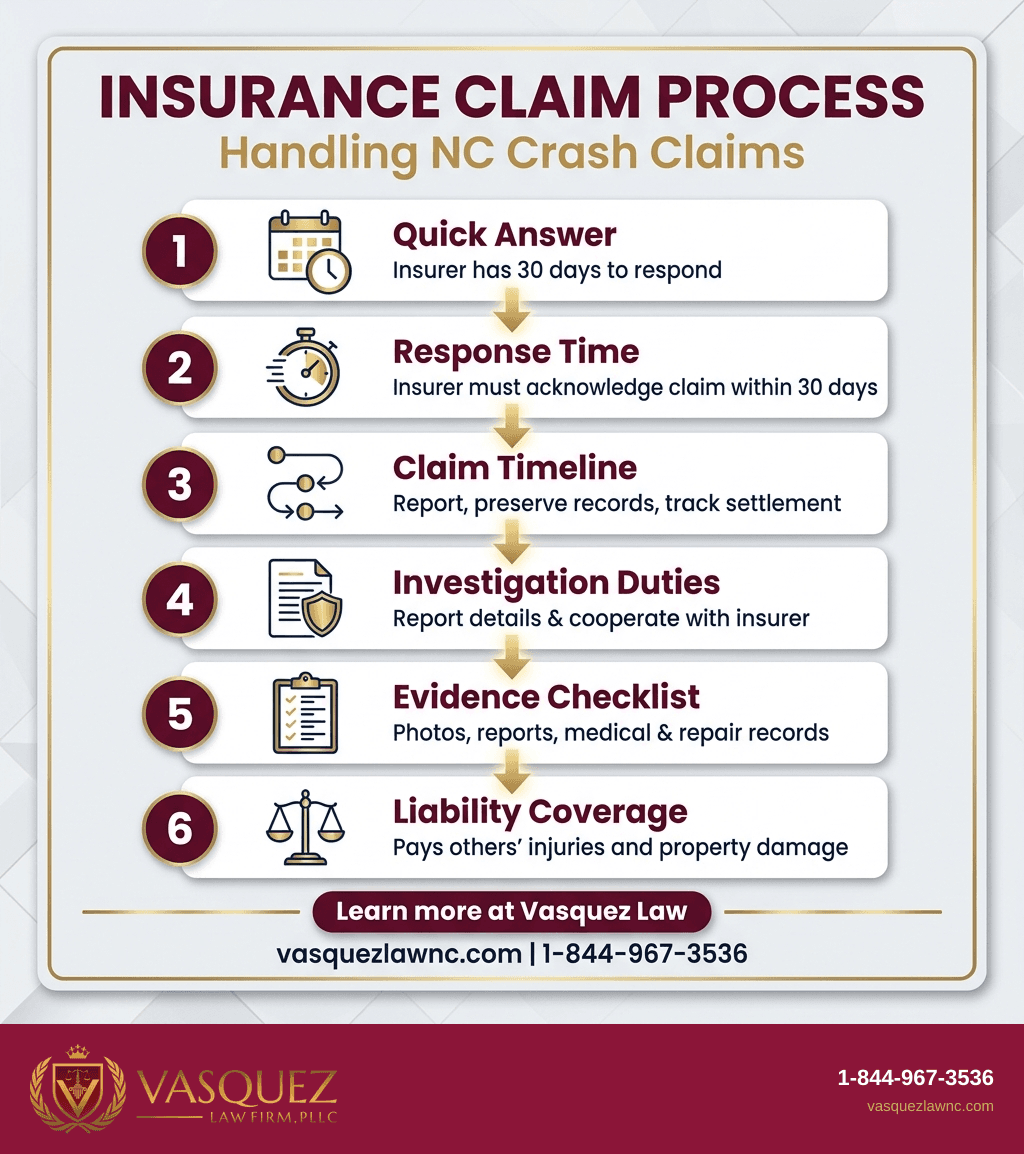
After receiving a claim, an insurer has 30 days to acknowledge it. The insurer can make a settlement offer, deny the claim, pay it, or report that its investigation continues. Settled loss and claim payments should be delivered or mailed within 10 business days. Keep records of every communication and policy document.
- Report how, when, and where the collision happened.
- Give names and addresses for injured people and witnesses.
- Cooperate with the investigation and document requests.
- Request a policy-based explanation for a denial.
How long can an insurer take to respond to a crash claim?
A claim filed after a North Carolina collision starts a specific response process. The Department of Insurance states that an insurer has 30 days after receiving a claim to acknowledge it. An acknowledgement can be an offer, denial, payment, or notice that the investigation remains ongoing.
After receiving a claim an insurance company has 30 days to acknowledge the claim.
That 30-day rule concerns acknowledgement. It does not promise that every claim will be fully resolved within that period. Once a claim is settled, loss and claim payments should be mailed or delivered within 10 business days. Save the date you reported the crash. Also save claim numbers, adjuster names, emails, letters, photographs, and estimates.
Under G.S. 58-63-15(11), an insurer commits unfair claim settlement practices when it does any of the listed acts often enough to indicate a general business practice. The list includes "failing to acknowledge and act reasonably promptly upon communications with respect to claims arising under insurance policies" and "not attempting in good faith to effectuate prompt, fair and equitable settlements of claims in which liability has become reasonably clear."
A practical claim timeline
- Report the collision and give the requested basic facts.
- Preserve records during the insurer's investigation.
- Read any offer, payment notice, or denial against the policy language.
- Track the settlement date if the claim resolves.
For crash-report records, review the North Carolina DMV crash reports information. A report can help preserve basic collision details. It does not replace your own photographs, treatment records, witness information, or policy documents.
What must you do during an insurance claim investigation?
A crash claim often begins with a short report. That report may later become important. The Department of Insurance says a policy requires the insured to notify the company how, when, and where the accident or loss happened. The report should include names and addresses of people injured and witnesses.
The policy also requires cooperation with the investigation. It requires obtaining, or authorizing the insurer to obtain, appropriate documents, medical information, and other pertinent records. Pertinent means related to the claim. Be accurate. A rushed or incomplete description can make later corrections harder to explain.
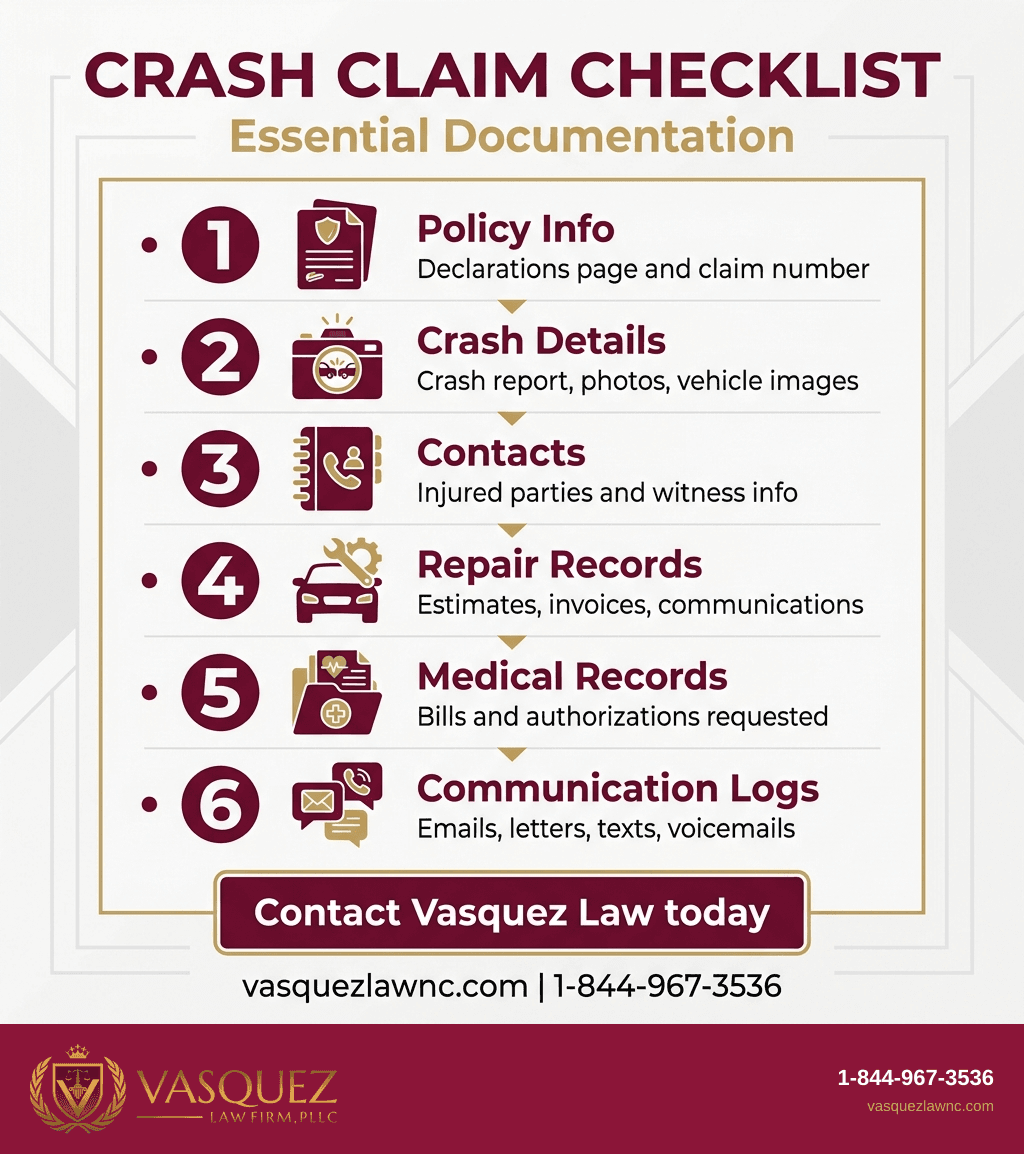
Crash claim evidence checklist
- Your policy declarations page and claim number.
- Crash report information, photographs, and vehicle-condition images.
- Names and contact details for witnesses and injured people.
- Repair estimates, invoices, and communications about vehicle value.
- Medical bills and records that you are asked to provide or authorize.
- Every email, letter, text, and voicemail with the insurer.
Cases we handle often involve a missing paper trail, not a missing injury. People may have photos on a phone. They may have no saved estimate. They may also lack a copy of a recorded statement or written confirmation of a rental or total-loss discussion. North Carolina personal injury representation can help an injured person organize evidence and evaluate the insurer's position.
What does liability insurance pay after a car accident?
Liability-only coverage does not pay the insured driver's own medical bills or vehicle repair bills. The Department of Insurance explains that liability coverage pays for other people's injuries and property damage. This applies when an insured driver becomes legally responsible.
When the at-fault driver's limits do not cover all medical bills, the Department identifies underinsured motorist coverage. This is called UIM coverage. It may protect the difference between the other driver's liability coverage and the UIM limits. Medical Payments coverage may also be relevant. For property damage, collision coverage may cover the difference.
Review the actual policy before assuming any coverage applies. The Department also explains that an insurance company cannot charge insurance points for an accident that was not your fault. Underwriting decisions and policy coverages remain fact-specific. Underwriting means the insurer's decision about risk and policy terms.
Rental cars and repair choices
A rental vehicle is commonly allowed while a vehicle is repaired. However, no statute or administrative code requires an insurer to provide one. A statute is a law passed by a legislature. An administrative code is a set of agency rules. An insurer also cannot require you to use a particular repair shop.
If the vehicle is declared a total loss, you may keep the salvage vehicle. If you keep the salvage vehicle, the insurer will deduct its salvage value from actual cash value. Actual cash value means the vehicle's value before the loss, subject to the policy and claim facts.
If you and your insurer disagree about actual cash value or the amount of loss under collision or comprehensive coverage, the policy's appraisal provision may offer a process. Each side selects an appraiser. The appraisers select an umpire. The policy describes how expenses are handled.
How should an insurer explain a claim denial or offer?
A denial letter should not leave you guessing about the coverage basis. The Department of Insurance says the company must provide a reasonable explanation for a claim denial. The explanation must relate to the policy language or applicable law.
The insurance company must provide a reasonable explanation of why your claim was denied in relation to the policy language or applicable law.
G.S. 58-63-15(11) also lists, when done often enough to indicate a general business practice, "failing to promptly provide a reasonable explanation of the basis in the insurance policy in relation to the facts or applicable law for denial of a claim or for the offer of a compromise settlement" and "refusing to pay claims without conducting a reasonable investigation based upon all available information."
Ask for the policy provision the insurer relied on. Keep the entire letter. Compare it with your declarations page and endorsements. Endorsements are policy changes or additions. Do not alter records or guess at facts. If a claim involves physical injuries, disputed responsibility, or a settlement proposal that does not account for documented harm, consider a review of North Carolina car accident rights before accepting a final release.
What crash claim mistakes can weaken your position?
A single missing document can create avoidable disputes. Start by separating facts you observed from assumptions. This includes assumptions about fault, coverage, medical care, repair value, or the other driver's policy.
Avoid these common mistakes
- Waiting to report the collision. Fix: notify the insurer with the facts requested by the policy.
- Discarding damaged property too early. Fix: photograph and preserve it when reasonable.
- Relying on a verbal promise. Fix: request written confirmation.
- Ignoring a denial letter. Fix: read the stated policy and legal basis.
- Assuming liability coverage pays your own losses. Fix: review collision, UIM, and Medical Payments provisions.
- Accepting a repair-shop directive as compulsory. Fix: remember the insurer cannot require a particular shop.
- Failing to list witnesses. Fix: provide names and addresses promptly.
If you remember one point: preserve the policy, correspondence, proof of loss, and evidence before a claim dispute becomes harder to reconstruct.
How do North Carolina insurance rules affect your crash claim?
These claim rules apply to North Carolina auto insurance matters. The North Carolina Department of Insurance offers auto and vehicle insurance consumer information. This information includes guidance on cancellations, coverage, total losses, rental vehicles, repairs, and claims.
G.S. 58-63-15 describes unfair methods of competition and unfair or deceptive acts or practices in insurance. Its claim-settlement provisions focus on conduct committed often enough to indicate a general business practice. That statutory wording matters. A specific dispute still depends on policy language, evidence, communication history, and the collision facts.
For a fatal collision, families may also need to understand North Carolina wrongful death claim issues. That is a separate legal analysis from the insurance company's initial claim handling.
If the insurer disputes fault, injury, value, or payment, call Vasquez Law Firm for a free case evaluation. Se Habla Español.
Call 1-844-967-3536.
When should you call a personal injury lawyer after a crash?
A claim can become more difficult when medical harm, fault, coverage, or vehicle value is disputed. Contacting counsel does not replace reporting the claim. It also does not replace cooperating with a legitimate investigation. It can help you understand documents before signing a release.
- You received a denial or compromise offer.
- The insurer seeks a recorded statement or broad records authorization.
- There are significant injuries or ongoing medical treatment.
- The other driver disputes responsibility.
- The insurer labels the vehicle a total loss and you dispute value.
- Available liability insurance may not cover documented losses.
- You need to understand a UIM, Medical Payments, or collision provision.
About Vasquez Law Firm
Vasquez Law Firm handles immigration, personal injury, workers' compensation, criminal defense, and traffic matters. For North Carolina personal injury cases, the firm helps clients by phone. It also provides bilingual support staff. Its Yo Peleo® commitment reflects a direct, caring approach to legal advocacy.
William J. Vasquez leads the firm. The firm focuses on clear communication, careful record review, and practical guidance at each stage of a case. Se Habla Español.
Attorney Trust and Experience
William J. Vasquez is admitted to the North Carolina State Bar. A free case evaluation can help identify the records, policy terms, and claim communications most relevant to a North Carolina crash claim.
Frequently Asked Questions
Are all insurance claims investigated?
Insurers may investigate a reported crash claim. The Department of Insurance explains that policyholders must cooperate with the investigation and provide or authorize appropriate documents, medical information, and other pertinent records. Keep a written record of requests and responses.
Do I have to notify my insurer after an accident?
Your policy requires notice of how, when, and where the accident or loss happened. It also calls for names and addresses of injured people and witnesses. Prompt, accurate notice helps create a record. Review your own policy and save confirmation that the report was made.
How long does an insurer have to acknowledge my claim?
After receiving a claim, an insurer has 30 days to acknowledge it. The acknowledgement can be an offer, denial, payment, or notice that the investigation continues. After a claim is settled, loss and claim payments should be mailed or delivered within 10 business days.
Can an insurer require a specific repair shop?
No. The Department of Insurance states that an insurance company cannot require you to go to a particular repair shop. Keep written estimates and repair communications. If vehicle value or the amount of loss under collision or comprehensive coverage is disputed, review whether the policy contains an appraisal provision.
Can I get a rental car after another driver causes a crash?
Insurance companies commonly allow a rental vehicle while a car is being repaired. However, the Department of Insurance explains that no statute or administrative code requires an insurer to offer a rental vehicle. Ask for the coverage position in writing and preserve communications about transportation needs.
What if the insurer totals my vehicle?
You may keep the salvage vehicle. If you do, the insurer deducts the salvage value from actual cash value. When requested, the insurer must provide the name and address of a salvage dealer willing to buy the salvage for the deducted amount. Save all valuation materials.
Must the insurer explain why it denied my claim?
Yes. The Department of Insurance states that the insurer must provide a reasonable explanation tied to policy language or applicable law. Read the complete notice, preserve it, and compare it with your policy. A denial can involve coverage, facts, or other issues requiring careful review.
What if the other driver's coverage is not enough?
The Department identifies UIM coverage as potential protection for the difference between the other driver's liability coverage and your UIM limits for medical losses. Medical Payments coverage may also be relevant. For property damage, collision coverage may cover the difference. The policy terms control the analysis.
Sources and References
- North Carolina Department of Insurance, FAQs About Auto Insurance
- North Carolina Department of Insurance, Auto and Vehicle Insurance
- North Carolina DMV, Crash Reports
How insurance companies must handle your crash claim in North Carolina can depend on the policy, records, and collision facts. Contact Vasquez Law Firm for a free case evaluation. Se Habla Español.
Start Your Free Evaluation Now
Call 1-844-967-3536.
Need legal help?
Immigration in NC and FL. Personal injury and workers compensation across NC. Criminal defense in select NC counties depending on the charge (DWI in 12 counties), and traffic tickets in 20 NC counties. Tell us your county and we will tell you exactly what we can do.
Keep Reading

For how Vasquez Law Firm can help, see our car accidents page.
Reviewed by Attorney Vasquez, Managing Attorney

William Vasquez
Founder & CEO, Vasquez Law Firm, PLLC
William Vasquez is the founder and CEO of Vasquez Law Firm, PLLC, a results-driven firm specializing in immigration, criminal defense, personal injury, and workers' compensation. A U.S. Air Force veteran and recipient of the Joint Service Achievement Medal, William is dedicated to fiercely fighting for his clients' rights.
Related Legal Services
Need legal help? Learn more about learn about our personal injury practice, or contact us for a free evaluation.
You can also visit statewide personal injury legal services for more information.