Who Can File Wrongful Death Claims in North Carolina?
Wrongful death claims in NC must be filed by the decedent's personal representative or collector. Learn about damages and request a free evaluation.
Published on October 19, 2026· Updated October 20, 2026
Injured? Get what your case is worth
Free review.
Free & confidential · Se habla espanol · Mon-Fri 8am-7pm, Sat 9am-2pm (ET)
Have questions? Talk to an attorney - free evaluation.
Call 1-844-967-3536Get What Your Injury Is Worth
Schedule your consultation.
Who Can File Wrongful Death Claims in North Carolina?
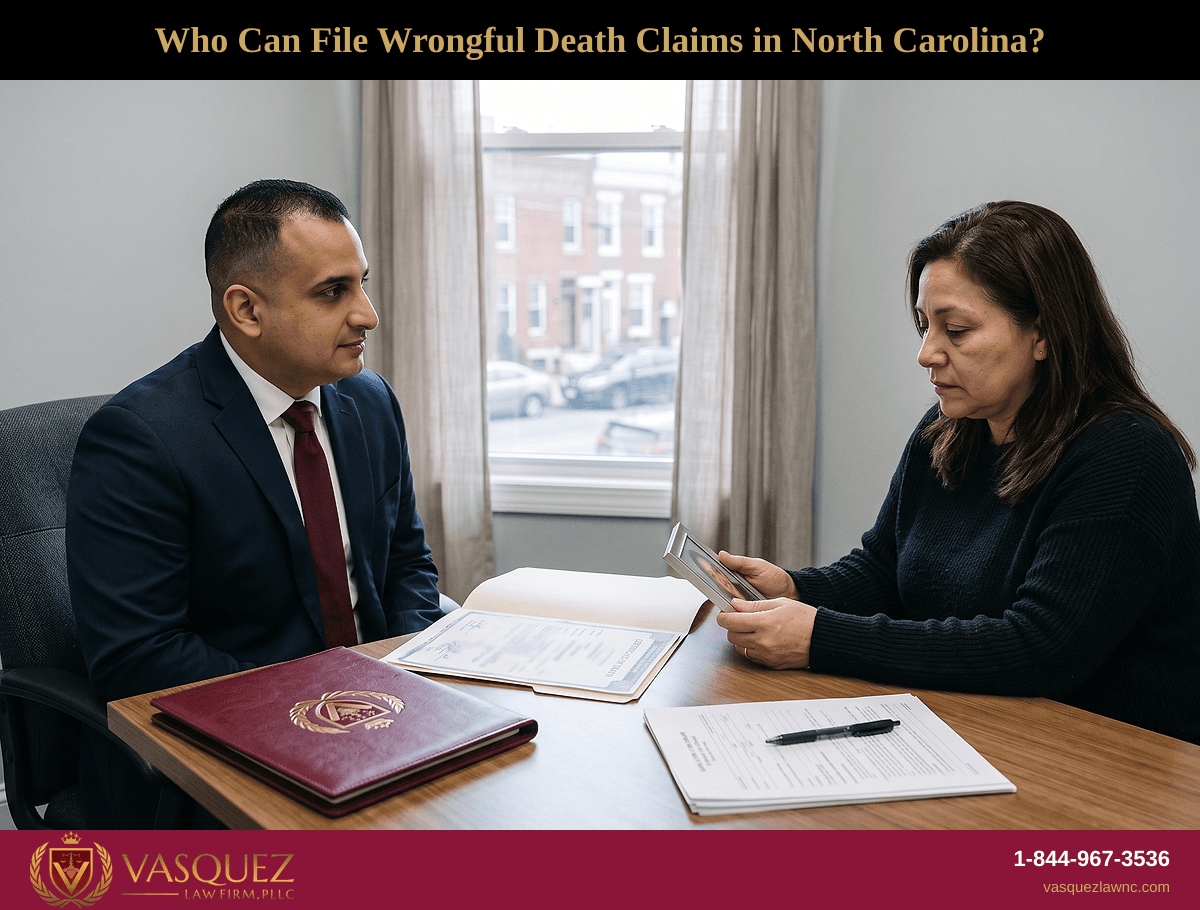
A fatal crash, unsafe property condition, or other wrongful act can leave a family with urgent questions. The family may want to know who is responsible. It may also need financial help. Wrongful death claims in NC follow a specific statutory process. A statute is a written law. The claim is brought by the decedent's personal representative or collector. N.C. Gen. Stat. § 28A-18-2 describes the process for bringing a wrongful death action and the distribution of any recovery.
If you are considering wrongful death claims in NC, Vasquez Law Firm can discuss the facts in a free case evaluation. Se Habla Español.
Call 1-844-967-3536.
Quick Answer
According to N.C. Gen. Stat. § 28A-18-2(a), an action for damages for wrongful death may be brought by the personal representative or collector of the decedent. Damages that may be recovered include expenses for care, treatment, and hospitalization incident to the injury resulting in death, compensation for pain and suffering of the decedent, reasonable funeral expenses, the present monetary value of the decedent to the persons entitled to receive the damages recovered, punitive damages in certain circumstances, and nominal damages.
- The personal representative or collector brings the action.
- The statute lists specific categories of damages.
- A recovery is distributed under the Intestate Succession Act.
- Estate expenses and attorney fees are addressed before distribution.
Who may file a wrongful death lawsuit in North Carolina?
A spouse, child, parent, or other loved one may have a strong personal interest in the case. Under N.C. Gen. Stat. § 28A-18-2(a), the action for damages must be brought by the personal representative or collector of the decedent. A personal representative is the person authorized to act for a deceased person's estate. A collector is a person authorized to collect and manage estate property.
“the person or corporation that would have been so liable, and the personal representatives or collectors of the person or corporation that would have been so liable, shall be liable to an action for damages, to be brought by the personal representative or collector of the decedent”
This rule matters at the start of wrongful death claims in NC. It preserves the claim even though the injured person died. The statute applies where the wrongful act, neglect, or default would have entitled the injured person to damages had that person survived.
The personal representative's role
The personal representative pursues the action for the decedent's claim. This role is different from the people entitled to receive damages after a recovery. The statute addresses the process for bringing the action and the distribution of any recovery.
Families should preserve records that identify the decedent. They should document the injury and death. They should also show expenses connected to the injury. A report may be useful after a vehicle collision. The North Carolina crash report information page explains how crash reports may be requested.
For guidance about civil injury issues that can lead to a fatal claim, review the firm's North Carolina personal injury representation. This is a North Carolina practice area. A free case evaluation can help a family identify documents worth protecting.
What damages can be recovered in wrongful death claims in NC?
A recovery can reflect more than a final medical bill. Damages may include expenses for care, treatment, and hospitalization incident to the injury resulting in death, compensation for the decedent's pain and suffering, and reasonable funeral expenses.
“Damages recoverable for death by wrongful act include: (1) Expenses for care, treatment and hospitalization incident to the injury resulting in death; (2) Compensation for pain and suffering of the decedent; (3) The reasonable funeral expenses of the decedent”
The statute also permits recovery for the present monetary value of the decedent to the people entitled to receive the damages. This means the value, at the present time, of what the decedent provided. That value may include reasonably expected net income. It may also include lost services, protection, care, assistance, society, companionship, comfort, guidance, kindly offices, and advice.
When punitive damages may be part of a claim
Punitive damages may be recovered as provided in N.C. Gen. Stat. § 28A-18-2(b)(5), including such punitive damages as the decedent could have recovered pursuant to Chapter 1D of the General Statutes had the decedent survived, and punitive damages for wrongfully causing the death of the decedent through malice or willful or wanton conduct, as defined in G.S. 1D-5.
Damages depend on the facts. Medical invoices may show care costs. Employment information may relate to net income. Testimony and records may also relate to the services, guidance, and companionship listed by the statute. The law allows evidence that reasonably tends to establish these elements. It also allows evidence of the present monetary value of the decedent.
Cases we handle often begin with families who have medical bills. Those families may not yet have records showing household services, care, guidance, or work history. Keeping each category separate can make the evidence easier to identify. It can also help connect each record to a claimed loss.
Who receives money recovered in a wrongful death lawsuit?
The person bringing the action and the people receiving a recovery are not always the same. Any amount recovered shall be distributed as provided in the Intestate Succession Act.
The statute sets an order for money recovered in the action. First, the money reimburses the estate for expenses incurred in pursuing the action. Next, it is applied to attorney fees. The remainder is distributed as the statute directs.
How estate debts affect a recovery
A wrongful death recovery is not generally treated as an estate asset for paying debts or devises. A devise is property given under a will. The statute makes exceptions for burial expenses. It also makes exceptions for reasonable hospital and medical expenses incident to the injury resulting in death.
The statute generally limits the recovery applied to those hospital and medical expenses to $4,500 and no more than 50% of the damages recovered after deducting attorney fees. These limits do not apply to subrogation rights exercised under G.S. 135-48.37.
Claims for burial expenses and the specified hospital and medical expenses need approval from the clerk of superior court. A party adversely affected by the clerk's decision may appeal to superior court in term time. This means the appeal follows the court's scheduled term. These details are one reason families should organize bills, payment records, and communications.
A fatal automobile collision can also raise insurance questions. The North Carolina Department of Insurance auto and vehicle insurance page provides consumer information about vehicle insurance. It does not decide the damages available in a particular wrongful death case.
What evidence supports a North Carolina wrongful death claim?
A hospital invoice can support treatment expenses. It cannot show every category of wrongful death damages by itself. Under N.C. Gen. Stat. § 28A-18-2(c), all evidence which reasonably tends to establish any of the elements of damages included in subsection (b), or otherwise reasonably tends to establish the present monetary value of the decedent to the persons entitled to receive the damages recovered, is admissible in an action for damages for death by wrongful act.
Records to preserve
- Medical and hospital records tied to the injury resulting in death.
- Invoices and receipts for care, treatment, hospitalization, and funeral expenses.
- Employment and income records relevant to reasonably expected net income.
- Records showing household services, care, assistance, guidance, and support.
- Collision records, photographs, witness information, and insurance communications where applicable.
- Documents identifying the personal representative or collector.
The statute provides that in all actions brought under this section the dying declarations of the deceased shall be admissible as provided for in G.S. 8-51.1. A dying declaration is a statement made by a person who believes death is near. Evidence questions can have serious effects. Records should be preserved rather than altered. For a related discussion of treatment expenses after an injury, see medical bills after a North Carolina accident.
Practical step list:
- Identify the personal representative or collector who can bring the action.
- Gather documents related to the injury, death, expenses, and losses.
- Separate medical, funeral, income, and household-service evidence.
- Keep insurance and incident records together.
- Ask for a free case evaluation before making important decisions about a claim.
Questions about evidence or recoverable damages deserve careful attention. Vasquez Law Firm helps people anywhere in North Carolina by phone. Se Habla Español.
Call 1-844-967-3536.
What mistakes can affect wrongful death damages and distribution?
One common error is treating every family member as the person who may file the action. The statute assigns that task to the personal representative or collector. Another error is focusing only on invoices. Families may overlook evidence of lost services, protection, care, assistance, companionship, comfort, guidance, and advice.
- Mixing up filing authority and distribution: Confirm who serves as personal representative or collector.
- Discarding household records: Preserve records that help show care, services, and assistance.
- Ignoring pain and suffering evidence: Save medical records and other relevant evidence.
- Combining all expenses in one file: Sort treatment, hospital, funeral, and burial records.
- Assuming estate creditors receive all recovery: Read the statutory distribution provisions carefully.
- Forgetting clerk approval issues: Keep support for burial and qualifying medical expense claims.
- Making broad statements to insurers without records: Gather the documents first.
If you remember one point: wrongful death claims in NC involve two issues. One is the authority to bring the action. The other is the separate statutory rules for damages and distribution. A family can protect its position by preserving records early. It should also confirm the proper representative.
For another injury-focused resource, see the firm's North Carolina truck crash claim guide. The facts of any fatal injury matter. A statutory category of damages still requires supporting evidence.
When should a family call about a wrongful death lawsuit?
Calling early can help a family organize records while information is available. A free case evaluation may be appropriate when a death followed a wrongful act, neglect, or default. The conduct must be something that could have supported an injury claim if the person had lived.
- A family needs to identify the personal representative or collector.
- Medical, hospital, or funeral bills are arriving.
- There may be evidence of the decedent's pain and suffering.
- The family needs to preserve proof of income, services, care, or guidance.
- An insurer seeks information after a crash or other event.
- Questions arise about burial expenses or qualifying hospital and medical expenses.
- A family needs to understand the distinction between the action and distribution.
Vasquez Law Firm offers North Carolina personal injury representation. A conversation is not a guarantee of any result. It is an opportunity to discuss the available information. It also allows discussion of the statutory framework under N.C. Gen. Stat. § 28A-18-2.
About Vasquez Law Firm
Vasquez Law Firm combines compassionate service with determined representation. The firm's Yo Peleo® message, meaning “I Fight,” reflects a commitment to stand with people facing difficult legal problems.
William J. Vasquez is admitted to the North Carolina State Bar. The firm handles immigration, personal injury, workers' compensation, criminal defense, and traffic violation matters within its service scope. For North Carolina injury matters, the firm can assist clients by phone. Bilingual support staff are available. Se Habla Español.
Attorney trust and experience
William J. Vasquez provides legal representation grounded in careful preparation and direct communication. A wrongful death matter deserves attention to the proper representative's identity. It also requires attention to the evidence supporting damages. The statutory distribution process also matters.
Frequently Asked Questions
Who can bring a wrongful death action in North Carolina?
Under N.C. Gen. Stat. § 28A-18-2(a), an action for damages for wrongful death may be brought by the personal representative or collector of the decedent. The people who ultimately receive a recovery are addressed separately through the statute's distribution language and the Intestate Succession Act. Families should avoid assuming that personal loss alone gives a person authority to file the lawsuit.
Can a wrongful death claim include pain and suffering?
Yes. Damages recoverable for death by wrongful act include compensation for pain and suffering of the decedent. Medical records and other evidence may be relevant to that issue. The statute provides that all evidence which reasonably tends to establish any of the elements of damages included in subsection (b) is admissible, so preserving relevant records is important.
Can funeral expenses be recovered in a wrongful death case?
The statute includes reasonable funeral expenses of the decedent among the damages recoverable for death by wrongful act. It also separately addresses burial expenses when describing how a recovery may be applied. Families should retain invoices, receipts, and payment records so that expenses can be identified accurately.
Does the claim include lost income and household help?
It can. The statute includes the present monetary value of the decedent to the persons entitled to receive damages. Listed components include reasonably expected net income and the decedent's services, protection, care, and assistance. It also includes society, companionship, comfort, guidance, kindly offices, and advice.
Who receives money from a wrongful death recovery?
After reimbursement of estate expenses incurred in pursuing the action and payment of attorney fees, the recovery is distributed as provided in the Intestate Succession Act. The statutory rule distinguishes distribution from the authority to bring the lawsuit. It also limits use of the recovery as estate assets, subject to the listed exceptions.
Are punitive damages available in a wrongful death case?
Punitive damages may be recovered as provided in N.C. Gen. Stat. § 28A-18-2(b)(5), including such punitive damages as the decedent could have recovered pursuant to Chapter 1D of the General Statutes had the decedent survived, and punitive damages for wrongfully causing the death of the decedent through malice or willful or wanton conduct, as defined in G.S. 1D-5.
Can medical and hospital expenses be part of the recovery?
Yes. The damages section includes expenses for care, treatment, and hospitalization incident to the injury resulting in death. The distribution provisions also address reasonable hospital and medical expenses incident to the injury. These provisions have particular limits and approval requirements, so families should preserve complete billing records.
What evidence may be used to prove wrongful death damages?
Under N.C. Gen. Stat. § 28A-18-2(c), all evidence which reasonably tends to establish any of the elements of damages included in subsection (b), or otherwise reasonably tends to establish the present monetary value of the decedent to the persons entitled to receive the damages recovered, is admissible in an action for damages for death by wrongful act. The statute also addresses admissibility of dying declarations.
Sources and References
If you need to discuss wrongful death claims in NC, contact Vasquez Law Firm for a free, confidential case evaluation. Se Habla Español.
Start Your Free Evaluation Now
Call 1-844-967-3536.
Injured through no fault of your own?
15-min case review — we tell you what your claim is worth.

Keep Reading


For how Vasquez Law Firm can help, see our wrongful death page.
Reviewed by Attorney Vasquez, Managing Attorney

William Vasquez
Founder & CEO, Vasquez Law Firm, PLLC
William Vasquez is the founder and CEO of Vasquez Law Firm, PLLC, a results-driven firm specializing in immigration, criminal defense, personal injury, and workers' compensation. A U.S. Air Force veteran and recipient of the Joint Service Achievement Medal, William is dedicated to fiercely fighting for his clients' rights.
Related Legal Services
Need legal help? Learn more about NC personal injury legal team, or contact us for a free evaluation.
You can also visit statewide personal injury attorneys for more information.