How Johnston County Probation Violations Can Affect You
How does probation work for criminal offenses in Johnston County? See violation responses, confinement rules, and court options. Request a consultation.
Published on October 20, 2026· Updated October 22, 2026
Protect your record and your freedom
Free, confidential review.
Free & confidential · Se habla espanol · Mon-Fri 8am-7pm, Sat 9am-2pm (ET)
Have questions? Talk to an attorney - free evaluation.
Call 1-844-967-3536Protect Your Record and Your Freedom
A confidential case review. Call Mon-Fri 8am-7pm, Sat 9am-2pm ET.
How Johnston County Probation Violations Can Affect You
A missed appointment, a new charge, or an unreported change can bring a probation case back to a judge. How does probation work for criminal offenses in Johnston Co? North Carolina law lets a court continue, change, extend, or sometimes revoke probation. The result depends on the claimed violation, the probation terms, and the case record.
Facing a Johnston County probation allegation? William J. Vasquez can review the allegation and court process with you. Se Habla Español.
Call 1-844-967-3536.
Quick Answer
Probation may be reduced, terminated, continued, extended, modified, or revoked by a judge as provided in N.C. Gen. Stat. § 15A-1344. The judge may continue probation, change its conditions, order confinement in certain situations, extend probation, or activate a suspended sentence as allowed by law.
- A violation report can lead to a hearing.
- Revocation is limited by the type of alleged violation.
- Written notice matters for unsupervised probation.
- A hearing can occur after probation ends if statutory conditions are met.
How does probation work after criminal court in Johnston County?
A criminal judgment may include probation instead of immediate active incarceration. Incarceration means being held in jail or prison. The judgment may also include a suspended sentence. A suspended sentence is a sentence that can be activated later if the court allows it.
The court order lists the conditions. Conditions are the rules a person must follow during probation. A person on probation must understand that order. The court measures the alleged breach against those exact conditions.
Under N.C. Gen. Stat. § 15A-1344(a), probation generally may be reduced, terminated, continued, extended, modified, or revoked by a judge authorized to sit in the sentencing court and resident or presiding in the relevant district where probation was imposed, violated, or where the probationer resides. Subsections (a1) and (b) establish exceptions for local judicially managed accountability and recovery court cases and certain unsupervised probation cases in which the sentencing judge has limited jurisdiction.
How does probation work for criminal offenses in Johnston Co in practical terms? A probation officer may report an alleged violation. The court then decides the response after following the required process. The statute also requires reasonable notice to the district attorney. This notice applies to a hearing that substantially affects probation.
For an overview of criminal defense representation for Johnston County charges, start with the original judgment. Then review every allegation in the report. Those documents define the issues for the hearing.
What conditions can lead to a violation?
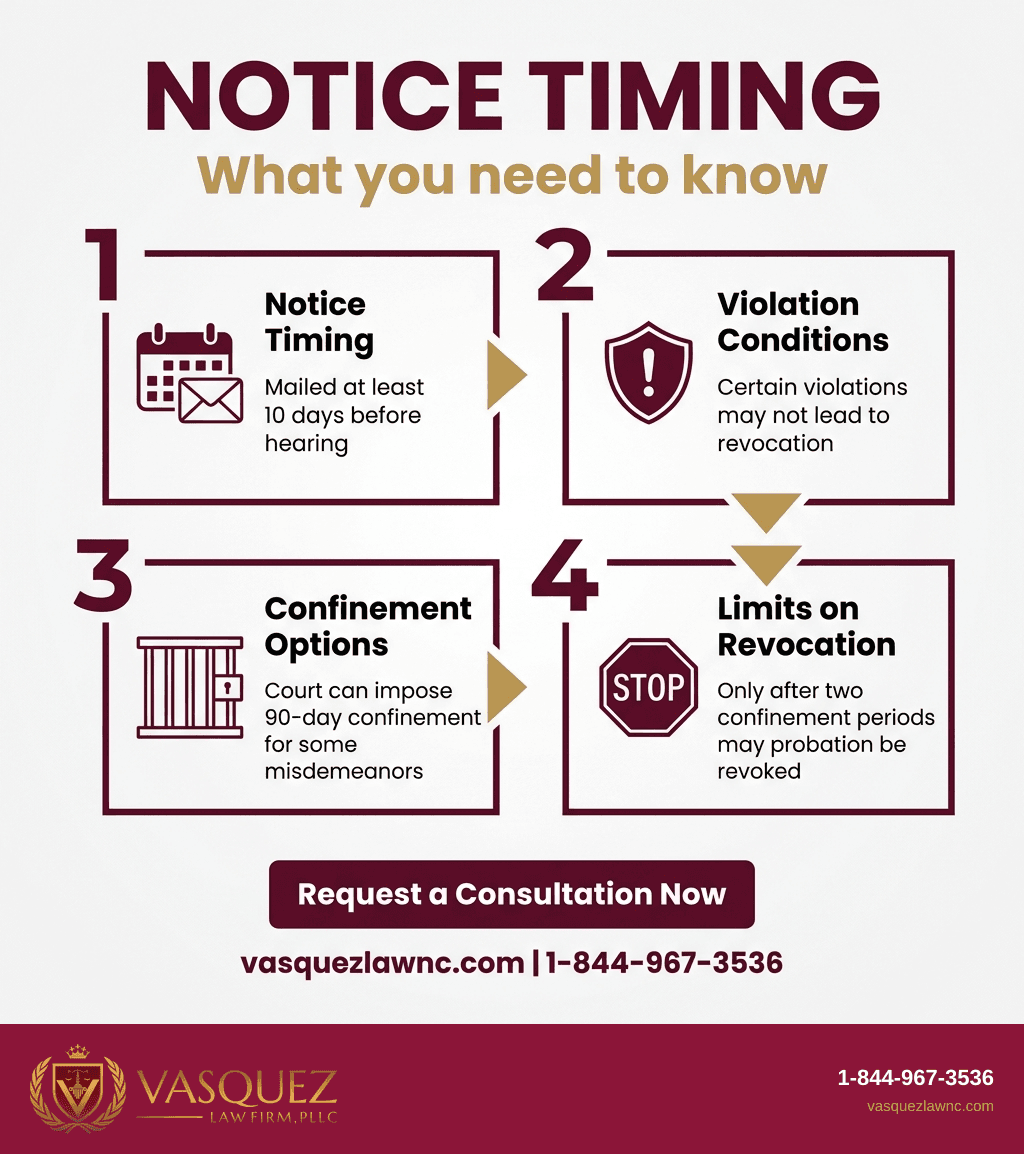
Probation conditions differ from one judgment to another. Section 15A-1344 separates violations of N.C. Gen. Stat. § 15A-1343(b)(1) and § 15A-1343(b)(3a) from other violations. This difference matters. The court has less power to revoke probation for other conditions.
The court may only revoke probation for a violation of a condition of probation under G.S. 15A-1343(b)(1) or G.S. 15A-1343(b)(3a), except as provided in G.S. 15A-1344(d2).
What happens at a Johnston County probation violation hearing?
A violation hearing brings the alleged conduct before a judge. The court may continue probation, with or without modifying the conditions, or may place the defendant on special probation as provided in the statute.
Revocation and activation of a suspended sentence are possible only within the limits set by the statute. Revocation means ending probation because of a violation. Activation means putting a suspended sentence into effect.
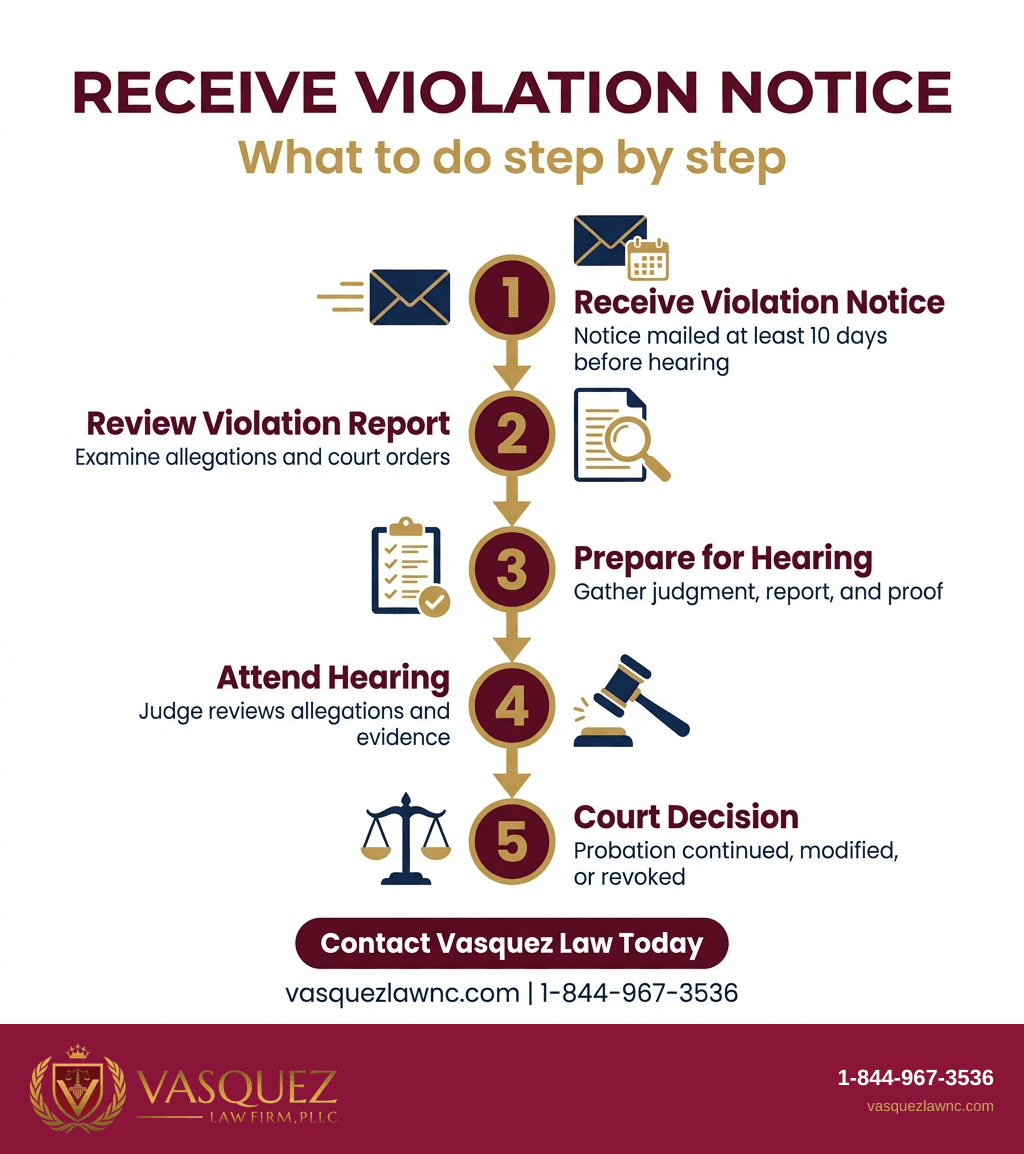
Notice of a hearing in response to a violation of unsupervised probation shall be given either by personal delivery to the person to be notified or by depositing the notice in the United States mail in an envelope with postage prepaid, addressed to the person at the last known address available to the preparer of the notice and reasonably believed to provide actual notice to the offender. The notice shall be mailed at least 10 days prior to any hearing and shall state the nature of the violation.
If the court gave mailed notice and the person does not appear, the court may terminate probation. It may also address unpaid monetary obligations. The court may instead authorize more notice and further proceedings. Attendance and preparation are therefore important.
What should you bring to a probation hearing?
- The probation judgment and any later modification orders.
- The violation report or hearing notice.
- Records relevant to the stated allegation.
- A written timeline of contacts, appointments, and court dates.
- Any proof showing compliance with a listed condition.
Do not change records. Do not contact witnesses to change their testimony. Review the report carefully. Identify each allegation. Request a consultation before making decisions that could affect the hearing.
Can the court impose confinement instead of revoking probation?
A single non-revocable violation does not automatically end probation. Non-revocable means that the violation does not, by itself, allow the court to revoke probation. For a felony supervision case, the rule is different from the rule for certain listed conditions.
When a defendant under supervision for a felony conviction has violated a condition of probation other than G.S. 15A-1343(b)(1) or G.S. 15A-1343(b)(3a), the court may impose 90 consecutive days of confinement in the custody of the Division of Community Supervision and Reentry of the Department of Adult Correction. However, if 90 days or less remain on the maximum imposed sentence, confinement is limited to that remaining period. A defendant may receive only two periods of confinement under this subsection.
The court may not revoke probation unless the defendant has previously received a total of two periods of confinement under this subsection.
The statute contains separate confinement language for misdemeanor cases sentenced under Article 81B. It also contains separate language for misdemeanor cases not sentenced under Article 81B. For multiple offenses related to the violation, the confinement period runs concurrently on those cases. Concurrently means that the periods run at the same time.
When a defendant has violated a condition of probation, the court may modify the probation to place the defendant on special probation as provided in N.C. Gen. Stat. § 15A-1344(e). Except for probationary sentences for impaired driving under G.S. 20-138.1, the total of all periods of confinement imposed as an incident of special probation, but not including an activated suspended sentence, may not exceed one-fourth the maximum sentence of imprisonment imposed for the offense.
Cases we handle often involve a person who has the hearing notice but not the original probation judgment. That judgment is vital. It identifies the actual conditions and the suspended sentence. Bring the judgment if you have it. If you do not have it, seek help locating the court record before the hearing.
A probation allegation can move quickly once a hearing is set. Speak with Vasquez Law Firm about the notice, judgment, and available court responses. Se Habla Español.
Talk About Your Probation Case
Call 1-844-967-3536.
What steps should you take after a probation violation notice?
Start with the exact notice. Compare its allegations with the written judgment. Then preserve documents that address the listed facts. Do not assume that a missed detail is unimportant. A hearing can change probation conditions. It can also affect a suspended sentence.
- Read every allegation and the hearing date.
- Locate the original judgment, amendments, and prior violation orders.
- Make a factual timeline of the events in the report.
- Collect records tied directly to the alleged violation.
- Discuss the matter with counsel before the hearing.
- Appear as directed unless the court changes the setting.
At any time prior to the expiration or termination of the probation period or in accordance with subsection (f) of this section, the court may after notice and hearing and for good cause shown extend the period of probation up to the maximum allowed under G.S. 15A-1342(a) and may modify the conditions of probation. A hearing extending or modifying probation may be held in the absence of a defendant who fails to appear for the hearing after a reasonable effort to notify the defendant.
What common mistakes can make probation problems worse?
- Ignoring mailed notice: Keep your current address available to supervising personnel.
- Bringing only an oral explanation: Preserve documents that support the relevant facts.
- Confusing a modification with revocation: Read the proposed response and statute carefully.
- Missing the original judgment: Obtain the order that defines the conditions.
- Assuming probation ended without checking: A written violation report filed before expiration can preserve court authority.
- Waiting to seek help: Review the hearing papers promptly.
If you remember one point: A probation violation hearing concerns the written conditions, the alleged facts, and the court's lawful response. Bring the judgment and notice to any consultation.
Can probation be changed after the probation period ends?
The court may extend, modify, or revoke probation after the expiration of the period of probation if certain conditions are met as set forth in N.C. Gen. Stat. § 15A-1344(f).
Before expiration, the State must have filed a written violation report with the clerk. The report must show an intent to hold a hearing on one or more alleged violations. The timing of this filing matters.
The court must find that the probationer did violate one or more conditions of probation prior to the expiration of the period of probation and must find for good cause shown and stated that the probation should be extended, modified, or revoked.
This rule makes dates in the court file important. Do not rely only on an assumption about when supervision ended. Review the judgment, violation report, and clerk's record together.
Which Johnston County criminal probation issues need quick legal review?
A hearing notice deserves prompt review. So does a proposed activation of a suspended sentence. A request to modify conditions also deserves prompt review. Vasquez Law Firm handles criminal defense matters in Johnston, Harnett, Pitt, and Cumberland counties.
This article concerns North Carolina probation law. It also concerns the court process relevant to Johnston County matters. The facts and documents in an individual case may change the analysis.
Consider Johnston County misdemeanor expungement information separately from probation compliance. Expungement means removing or limiting public access to certain criminal records under applicable law. An expungement question and an active probation allegation can involve different legal standards and procedural steps.
When should you request a consultation now?
- You received a violation report or hearing notice.
- You face a possible suspended-sentence activation.
- You need to compare the allegations with the written judgment.
- You were notified by mail and have a scheduled hearing.
- You have prior confinement under § 15A-1344(d2).
- Your probation period is close to expiration or has recently expired.
- You need records from the original criminal case.
About Vasquez Law Firm
Vasquez Law Firm provides criminal defense representation for eligible matters in Johnston, Harnett, Pitt, and Cumberland counties. William J. Vasquez leads the firm's work. His approach focuses on the record, the court process, and clear client communication.
The firm's Yo Peleo® commitment means it takes preparation seriously while treating clients with respect. Our bilingual support staff can assist clients in English and Spanish. In-person criminal defense meetings are available in Smithfield, NC for Johnston and Harnett county matters.
Attorney Trust and Experience
William J. Vasquez is admitted to the North Carolina State Bar. The firm handles immigration, personal injury, workers' compensation, criminal defense, and traffic violations within its defined service areas.
Frequently Asked Questions
What can a judge do after a probation violation?
If a probationer violates a condition of probation at any time prior to the expiration or termination of the period of probation, the court, in accordance with the provisions of G.S. 15A-1345, may continue the defendant on probation, with or without modifying the conditions, may place the defendant on special probation as provided in subsection (e), or, if continuation, modification, or special probation is not appropriate, may revoke the probation and activate the suspended sentence imposed at the time of initial sentencing, if any, or may order that charges as to which prosecution has been deferred be brought to trial; provided that probation may not be revoked solely for conviction of a Class 3 misdemeanor.
Can probation be revoked for every violation?
The court may only revoke probation for a violation of a condition of probation under G.S. 15A-1343(b)(1) or G.S. 15A-1343(b)(3a), except as provided in G.S. 15A-1344(d2). Imprisonment may be imposed pursuant to G.S. 15A-1344(d2) for a violation of a requirement other than G.S. 15A-1343(b)(1) or G.S. 15A-1343(b)(3a).
What is a 90-day confinement response?
When a defendant under supervision for a felony conviction has violated a condition of probation other than G.S. 15A-1343(b)(1) or G.S. 15A-1343(b)(3a), the court may impose 90 consecutive days of confinement in the custody of the Division of Community Supervision and Reentry of the Department of Adult Correction. However, if 90 days or less remain on the maximum imposed sentence, confinement is limited to that remaining period. The court may not revoke probation unless the defendant has previously received a total of two periods of confinement under this subsection. A defendant may receive only two periods of confinement under this subsection.
Does mailed notice of an unsupervised probation hearing count?
Notice of a hearing in response to a violation of unsupervised probation shall be given either by personal delivery to the person to be notified or by depositing the notice in the United States mail in an envelope with postage prepaid, addressed to the person at the last known address available to the preparer of the notice and reasonably believed to provide actual notice to the offender. The notice shall be mailed at least 10 days prior to any hearing and shall state the nature of the violation.
Can probation be extended after the original term ends?
The court may extend, modify, or revoke probation after expiration if the State filed a written violation report with the clerk before expiration indicating its intent to conduct a violation hearing; the court finds that a violation occurred before expiration; and the court finds, for good cause shown and stated, that probation should be extended, modified, or revoked. Any extension remains subject to the maximum allowed under G.S. 15A-1342(a).
What is special probation?
In placing the defendant on special probation, the court may continue or modify probation conditions and require continuous or noncontinuous periods of imprisonment. Confinement other than an activated suspended sentence may not extend beyond the probation period or two years after special probation is imposed, whichever comes first. Except for probationary sentences for impaired driving under G.S. 20-138.1, the total of all periods of confinement imposed as an incident of special probation, but not including an activated suspended sentence, may not exceed one-fourth the maximum sentence of imprisonment imposed for the offense.
Does probation start immediately after court?
The judgment controls the terms of a particular probation sentence. This article cannot determine the start details for an individual case without reviewing that judgment and court record.
What should I bring to a probation consultation?
Bring the probation judgment, violation report, hearing notice, prior modification orders, and records tied to the allegation. A clear timeline can also help identify the relevant facts. For a Johnston County matter, request a consultation promptly so the written conditions and court documents can be reviewed before the scheduled hearing.
Sources and References
How does probation work for criminal offenses in Johnston Co when a violation is alleged? Start with the judgment and notice. Then request a consultation with Vasquez Law Firm. Se Habla Español.
Call 1-844-967-3536.
Need legal help?
Immigration in NC and FL. Personal injury and workers compensation across NC. Criminal defense in Johnston, Harnett and Pitt counties, and traffic tickets in 10 NC counties. Tell us your county and we will tell you exactly what we can do.
Keep Reading

For how Vasquez Law Firm can help, see our criminal defense page.
Reviewed by Attorney Vasquez, Managing Attorney

William Vasquez
Founder & CEO, Vasquez Law Firm, PLLC
William Vasquez is the founder and CEO of Vasquez Law Firm, PLLC, a results-driven firm specializing in immigration, criminal defense, personal injury, and workers' compensation. A U.S. Air Force veteran and recipient of the Joint Service Achievement Medal, William is dedicated to fiercely fighting for his clients' rights.
Related Legal Services
Need legal help? Learn more about get criminal defense help today, or contact us for a free evaluation.
You can also visit defense attorneys serving Johnston and Harnett counties for more information.