North Carolina Court Affirms Denial of Suppression for Warrantless Blood Draw in 2026
Can police take blood without consent after a crash? This North Carolina warrantless blood draw ruling explains your rights. Request a consultation today.
Published on October 21, 2026· Updated October 22, 2026
Protect your record and your freedom
Free, confidential review.
Free & confidential · Se habla espanol · Mon-Fri 8am-7pm, Sat 9am-2pm (ET)
Have questions? Talk to an attorney - free evaluation.
Call 1-844-967-3536Protect Your Record and Your Freedom
A confidential case review. Call Mon-Fri 8am-7pm, Sat 9am-2pm ET.
On October 21, 2026, the North Carolina Court of Appeals affirmed the denial of a suppression motion after an officer ordered a blood draw without a warrant following a fatal Johnston County collision, but a higher court may still review this decision. A suppression motion asks a court to keep certain evidence out of the case. The decision is North Carolina Court of Appeals case No. COA25-216. It examines when a North Carolina warrantless blood draw may fit the emergency exception to the Fourth Amendment warrant requirement.
The ruling did not give police permission to take blood in every impaired-driving investigation. The court reviewed the facts of this case, including a fatal collision, an active investigation, suspected impairment, travel to the magistrate, and alcohol's continued loss from the bloodstream. People facing DWI charges in Johnston or Harnett County should know that a criminal defense attorney can review whether the same facts existed in their case.
Need legal help?
Immigration in NC and FL. Personal injury and workers compensation across NC. Criminal defense in Johnston, Harnett and Pitt counties, and traffic tickets in 10 NC counties. Tell us your county and we will tell you exactly what we can do.
Legal disclaimer: This article provides general legal information, not legal advice for any individual case. A court's ruling depends on the record before it. That record can include testimony, timing, and objections that were properly preserved.
What happened in the North Carolina warrantless blood draw ruling?
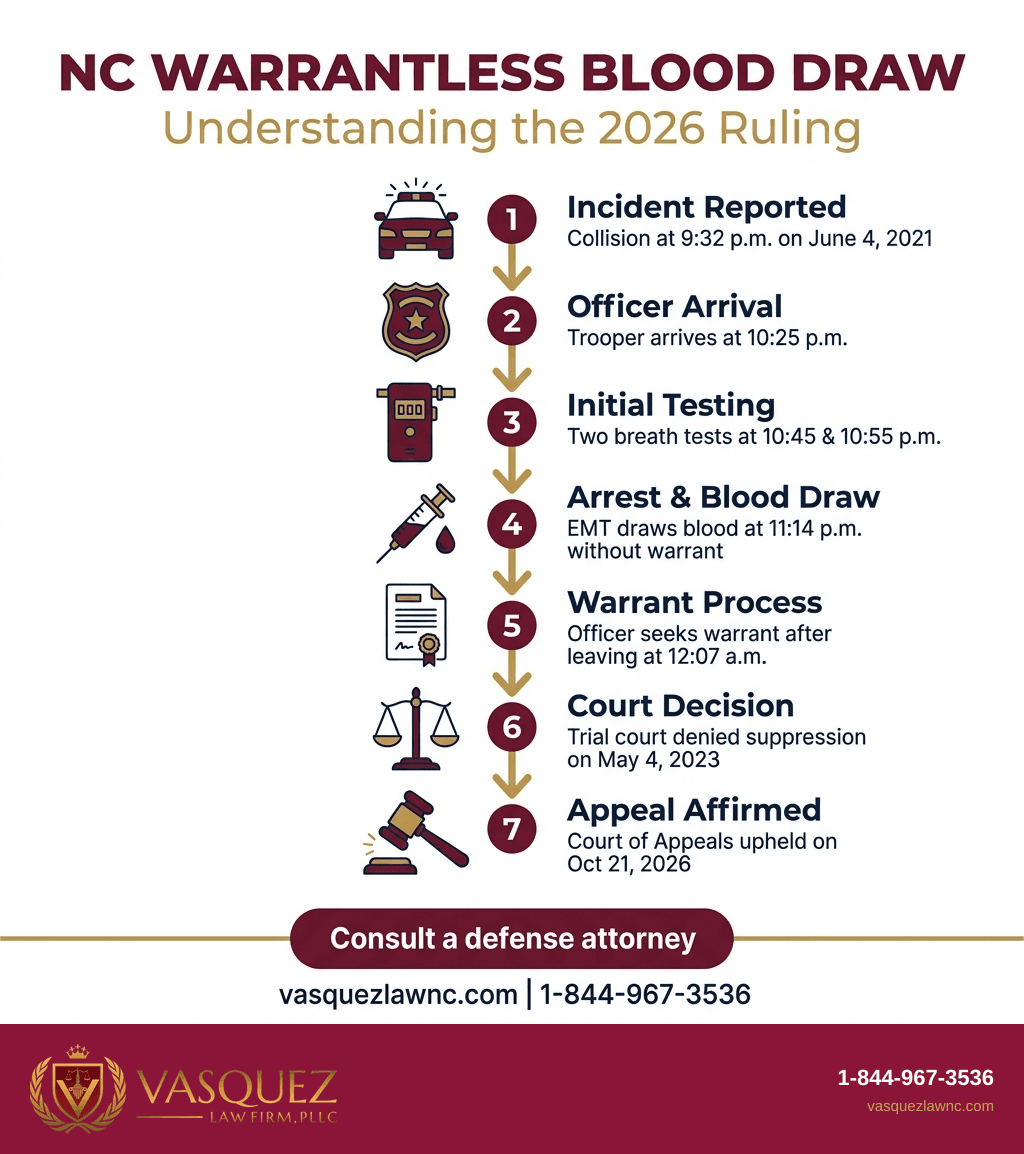
The collision was reported at 9:32 p.m. on June 4, 2021. The Court of Appeals said the defendant's SUV struck and killed a motorcyclist. The lead investigating trooper arrived at 10:25 p.m. Other officers and emergency responders had already reached the scene.
The opinion describes a scene that was closed to traffic. Officers collected witness accounts and made field sketches. They measured the roadway and documented debris. They also investigated competing theories about how the collision happened. The trooper observed delayed thought, mumbled speech, and slurred speech. He also smelled alcohol. The defendant acknowledged drinking one beer.
At 10:45 p.m., a preliminary breath test produced a 0.08 result. Field sobriety testing followed. A second preliminary breath test at 10:55 p.m. also produced a 0.08 result. The officer then arrested the defendant for driving while impaired.
“The natural dissipation of alcohol in the bloodstream does not constitute an exigency in every case sufficient to justify conducting a blood test without a warrant.”
After the defendant refused consent, an EMT drew blood at 11:14 p.m. The initial test showed 0.08 grams of alcohol per one hundred milliliters of blood and cocaine metabolites. The officer later sought a warrant. He left the scene at 12:07 a.m. He applied at 12:56 a.m. He obtained a second draw at 1:07 a.m. That draw showed 0.04 grams of alcohol per one hundred milliliters of blood and cocaine metabolites.
The trial court denied suppression on May 4, 2023. The defendant then pleaded guilty on November 1, 2023. The defendant reserved the right to appeal the suppression ruling under N.C. Gen. Stat. § 15A-979(b). The Court of Appeals affirmed on October 21, 2026. A higher court may still review the decision.
Why did timing become central?
The opinion focuses on whether the officer had enough time to seek a warrant while evidence was diminishing. The magistrate's office was 21.2 miles away. The usual travel time was 28 minutes. The officer left the collision scene and began the warrant process. The warrant process and second draw took about an hour after he left.
Who does this North Carolina warrantless blood draw decision reach?
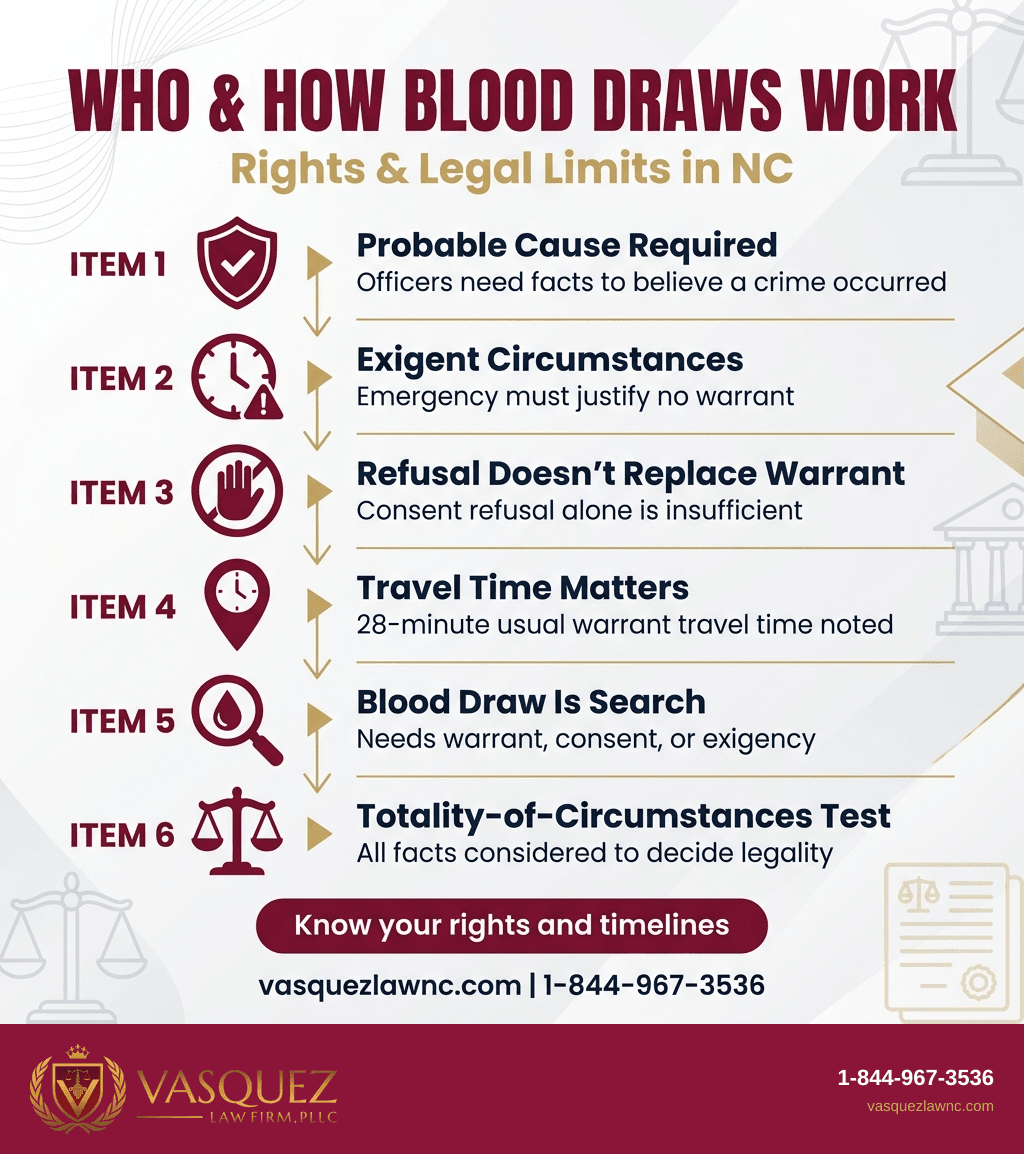
The ruling directly resolves the suppression question in case No. COA25-216. It gives guidance to North Carolina courts. Those courts may review warrantless blood draws after impaired-driving allegations. The ruling does not remove the need for officers to show probable cause. Probable cause means facts that would lead a reasonable person to believe a crime occurred or evidence will be found. To rely on exigent circumstances, officers must also show a compelling need for immediate action and insufficient time to secure a warrant.
A blood draw is a search under the Fourth Amendment and Article I, Section 20 of the North Carolina Constitution. The court repeated that police may draw blood after getting a warrant or valid consent. Police may also draw blood when they have probable cause plus exigent circumstances. Exigent circumstances means an emergency in which the need for immediate official action leaves too little time to get a warrant.
The court found that several circumstances worked together here. The case involved a fatal crash investigation. Officers had many public-safety and evidence-preservation tasks. The scene was far from the magistrate. The later warrant also took time to secure. The court rejected the argument that a shift change created the emergency. It also rejected the argument that the lead officer improperly created the emergency by staying at the scene.
“We therefore hold the totality of the circumstances surrounding the investigation gave rise to exigent circumstances justifying the warrantless blood draw.”
That language is important. The court did not say that alcohol dissipation alone was enough. A driver stopped in a routine setting may face a different legal analysis. The same may be true for a person involved in a complex fatal collision. The details matter. They include when probable cause arose and what officers did before the draw. They also include whether other officers were available. The court may consider how quickly a warrant could realistically be obtained.
What the decision does not authorize
The opinion does not authorize a North Carolina warrantless blood draw simply because police suspect alcohol use. Under the framework discussed by the court, officers still need probable cause. They also need facts that support an objectively reasonable emergency. This means a reasonable officer could view the emergency as real under the facts known at the time. A refusal to consent does not replace these constitutional requirements.
In our experience, many cases turn on the timeline. The timeline may begin with the officer's first observations. It may continue through the arrest and the chemical-analysis request. It may end with the decision to seek a warrant. Each step can affect the legal review.
What does North Carolina law already say about blood draws?
N.C. Gen. Stat. § 20-139.1(d1) permits an officer with probable cause to compel blood or urine samples without a court order after a refusal. The officer must reasonably believe that the delay needed for an order would result in dissipation of the alcohol concentration in the person's blood or urine. The statute still operates within constitutional limits.
The constitutional starting point is the Fourth Amendment and Article I, Section 20. In State v. Romano, cited by the Court of Appeals, the North Carolina Supreme Court recognized that a blood draw is a search. The Court of Appeals also relied on Missouri v. McNeely. That case requires a review of each case. It does not allow a blanket rule based only on alcohol metabolism.
How does the totality-of-circumstances test work?
The totality-of-circumstances test requires a court to review the whole situation. In this case, the court considered several facts. They included the roadway closure and the presence of emergency personnel. They also included collision reconstruction, evidence collection, and witness interviews. The court considered the lead investigator's responsibilities. It reviewed travel to the magistrate and the eventual warrant timeline.
The court compared the facts of this case with prior North Carolina decisions. The analysis shows that a valid blood draw search depends on the specific facts and circumstances. The State must establish the facts that support probable cause and exigency in the specific record.
The North Carolina DMV license suspension information explains administrative suspension issues separately from the criminal court case. A criminal charge and a driving privilege issue can move on different tracks.
What should you do after a blood draw without consent?
First, preserve the timeline. Write down when the collision or stop occurred. Record when officers first spoke with you. Also record when testing happened and when you were arrested. Note when rights were read and when blood was drawn. Small timing details can matter in a North Carolina warrantless blood draw analysis.
Second, keep every document. This includes charging papers and bond paperwork. Keep chemical-analysis rights forms and receipts. Keep medical records connected to the draw. Also keep any warrant paperwork and notices affecting your license. Do not alter social-media posts, video, messages, or other possible evidence.
Third, identify possible recordings and witnesses. Body-camera footage may clarify what happened. Dash-camera video may also help. Dispatch records, ambulance records, and scene photographs may show the order of events. A defense review can compare these materials with officer testimony and court findings.
Fourth, get a prompt legal review of the facts. A motion to suppress asks a court to exclude evidence gathered in violation of constitutional rules. Filing one does not guarantee that evidence will be excluded. The review requires careful examination of probable cause, consent, and any warrant. It also requires review of the claimed exigent circumstances.
For charges in Johnston or Harnett County, request a consultation with Vasquez Law Firm. Our North Carolina criminal defense team handles DWI and alcohol-related criminal charges in those counties. Se Habla Español. Request a consultation to discuss the record and your options.
What should you watch after this 2026 ruling?
The decision leaves the main practical rule in place. Courts must assess the facts known to officers at the time of a warrantless blood draw. Warrant access and police conduct before the claimed urgency may also matter.
The key question for a person facing charges is whether that person's own facts created a real lack of time to obtain a warrant. A fatal-collision record with prolonged scene work is not the same as every roadside DWI investigation.
How Serious Are My Charges?
Find out what you're facing and your options
Question 1 / 3
What are you charged with?
Keep Reading
Watch published opinions from the North Carolina appellate courts. Also watch case filings in the trial court. The full opinion in case No. COA25-216, is the starting point for understanding the court's reasoning. Defendants should also keep court dates and license notices organized. A missed response can create consequences apart from the suppression issue.

Frequently Asked Questions
Can police draw blood without consent in North Carolina?
Police may seek a blood draw with a warrant, valid consent, or probable cause plus exigent circumstances. The Court of Appeals stressed that alcohol dissipation alone does not automatically establish an emergency.
Can you refuse a blood draw request?
A person can refuse consent, but refusal does not necessarily stop a blood draw. Officers may seek a warrant or, in a properly supported emergency, proceed without one. In No. COA25-216, the defendant refused consent, and the court found the trial court relied on the overall exigent circumstances rather than treating refusal as the legal basis for the search.
What made the blood draw lawful in this case?
The court cited the fatal collision investigation, numerous scene-management tasks, evidence collection, the roadway closure, the distance to the magistrate, and the expected delay in obtaining a warrant. It also found the officers' conduct reasonable during the investigation. The ruling depended on the combined circumstances, not one fact alone.
Does a 0.08 preliminary breath test end the legal analysis?
No. The opinion described two preliminary breath tests with 0.08 readings, officer observations, field sobriety testing, and the collision investigation. The suppression issues on appeal concerned whether exigent circumstances justified the warrantless draw and whether the trial court improperly relied on the defendant's refusal to consent. Chemical-test results do not remove the court's duty to assess how evidence was obtained.
What is a motion to suppress?
A motion to suppress asks a court to exclude evidence obtained through an unlawful search, seizure, or interrogation. In this case, the defendant sought to exclude evidence from the first blood draw. The trial court denied the motion, and the Court of Appeals affirmed after reviewing whether the findings supported exigent circumstances, though a higher court may still review the decision.
Can police rely only on alcohol leaving the bloodstream?
No. The Court of Appeals quoted the rule that natural alcohol dissipation does not create an exigency in every case. Courts must consider the total circumstances. Relevant facts may include the scene's demands, the timing of probable cause, delays connected to a warrant application, and whether law enforcement conduct before the claimed emergency was reasonable.
Legal disclaimer: This article is general information and not individualized legal advice. If you face a DWI or alcohol-related criminal charge in Johnston or Harnett County, contact Vasquez Law Firm to request a consultation. The firm meets criminal-defense clients in Smithfield, NC, and can evaluate the facts, records, and deadlines that apply to your situation.
Sources
Reviewed by Attorney Vasquez, Managing Attorney

William Vasquez
Founder & CEO, Vasquez Law Firm, PLLC
William Vasquez is the founder and CEO of Vasquez Law Firm, PLLC, a results-driven firm specializing in immigration, criminal defense, personal injury, and workers' compensation. A U.S. Air Force veteran and recipient of the Joint Service Achievement Medal, William is dedicated to fiercely fighting for his clients' rights.
Related Legal Services
Need legal help? Learn more about how our defense attorneys can help, or contact us for a free evaluation.
You can also visit North Carolina criminal defense firm for more information.