Can Your Personal Injury Claim in NC Wait Three Years?
How long do you have to file a personal injury claim in NC? See the three-year rule, discovery issues, and steps to protect your claim. Call now.
Published on October 11, 2026· Updated October 11, 2026
Injured? Get what your case is worth
Free review.
Free & confidential · Se habla espanol · 24/7

Have questions? Talk to an attorney - free evaluation.
Call 1-844-967-3536Get What Your Injury Is Worth
Schedule your consultation.
Can Your Personal Injury Claim in NC Wait Three Years?
A crash on U.S. 70 near Smithfield can leave an injured person focused on treatment, missed work, and insurance calls. The filing deadline may also decide whether a court can hear the case. If you are asking, “How long do you have to file a personal injury claim in NC?” the general answer under G.S. 1-52 is three years. However, the date when the clock starts may need careful review.
Need help protecting a North Carolina injury claim? William J. Vasquez can review the timing issues in a free case evaluation. Se Habla Español.
Or call 1-844-967-3536.
Quick Answer
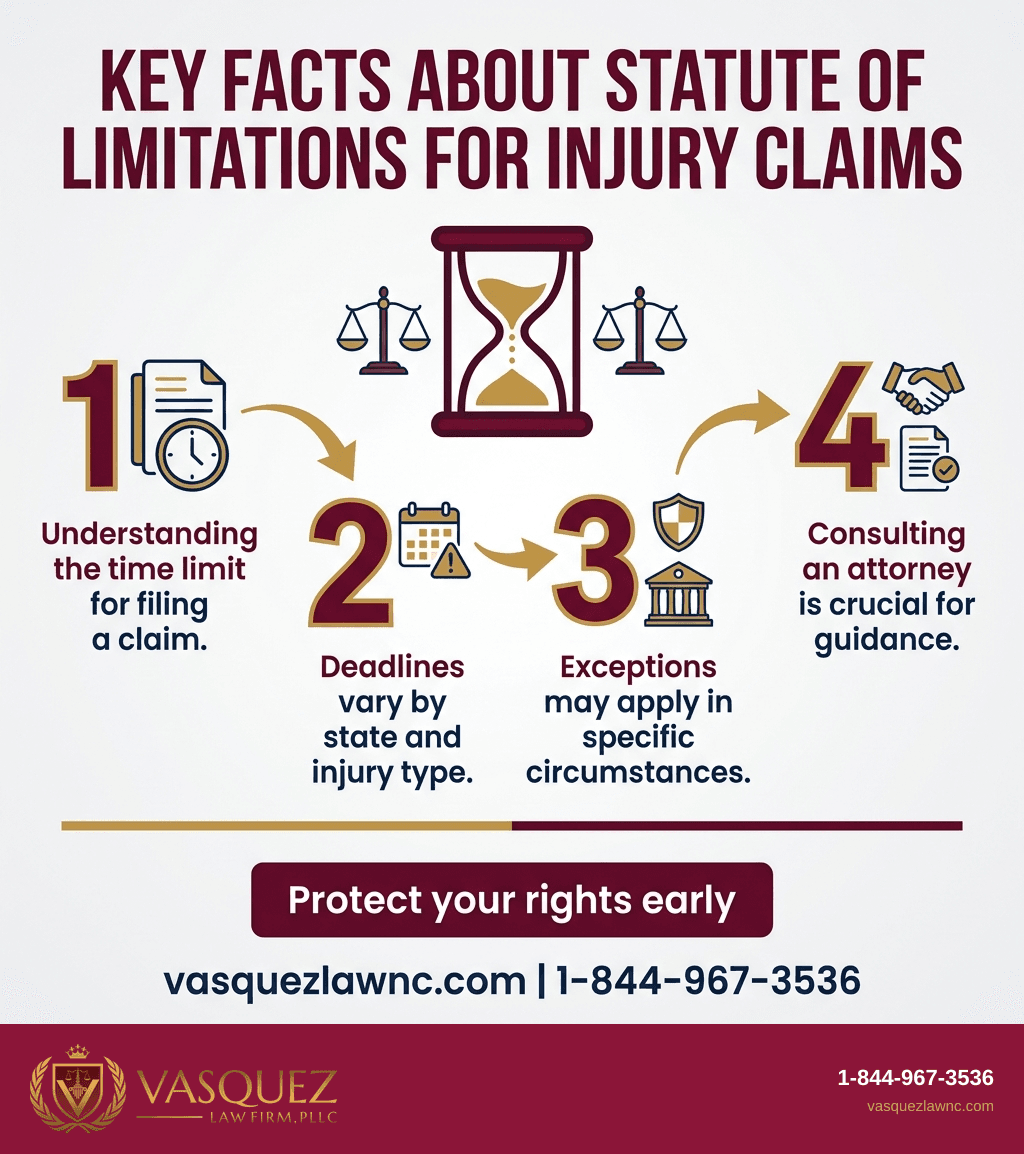
For most North Carolina personal injury lawsuits, G.S. 1-52 provides a three-year limitations period. A limitations period is the time allowed to file a lawsuit. Under G.S. 1-52(16), the claim generally accrues when bodily harm becomes apparent, or reasonably should have become apparent, whichever happens first. Waiting until the final month can create avoidable risk.
- Three years is the general court-filing deadline for covered injury claims.
- The injury discovery date can matter.
- A claim may face a separate 10-year outer limit in G.S. 1-52(16).
- An insurance discussion does not itself preserve a lawsuit.
- Wrongful death claims generally have a shorter, two-year deadline from the date of death under G.S. 1-53(4).
- Medical malpractice and workplace injuries involve different rules and are outside this guide.
Why does the NC personal injury statute of limitations matter?
A statute of limitations is a law that sets the time for filing a lawsuit. Picture a person injured in a vehicle collision. The person spends two years treating a painful shoulder. An insurance adjuster may continue discussing payment. A court deadline can still approach. The question, “How long do you have to file a personal injury claim in NC?” matters because filing after the applicable deadline can give the other side a basis to seek dismissal.
G.S. 1-52 is the main source for the general three-year rule. Section 1-52(5) includes actions for “any other injury to the person or rights of another,” except claims addressed elsewhere. Section 1-52(16) specifically addresses when personal injury and physical property damage claims accrue.
Unless otherwise provided by law, for personal injury or physical damage to claimant's property, the cause of action, except in causes of actions referred to in G.S. 1-15(c), shall not accrue until bodily harm to the claimant or physical damage to his property becomes apparent or ought reasonably to have become apparent to the claimant, whichever event first occurs.
This wording means the review is not always limited to the collision date. It focuses on when bodily harm became apparent. It also asks when the harm reasonably should have become apparent. For help understanding the stages of an injury case, see our North Carolina personal injury services.
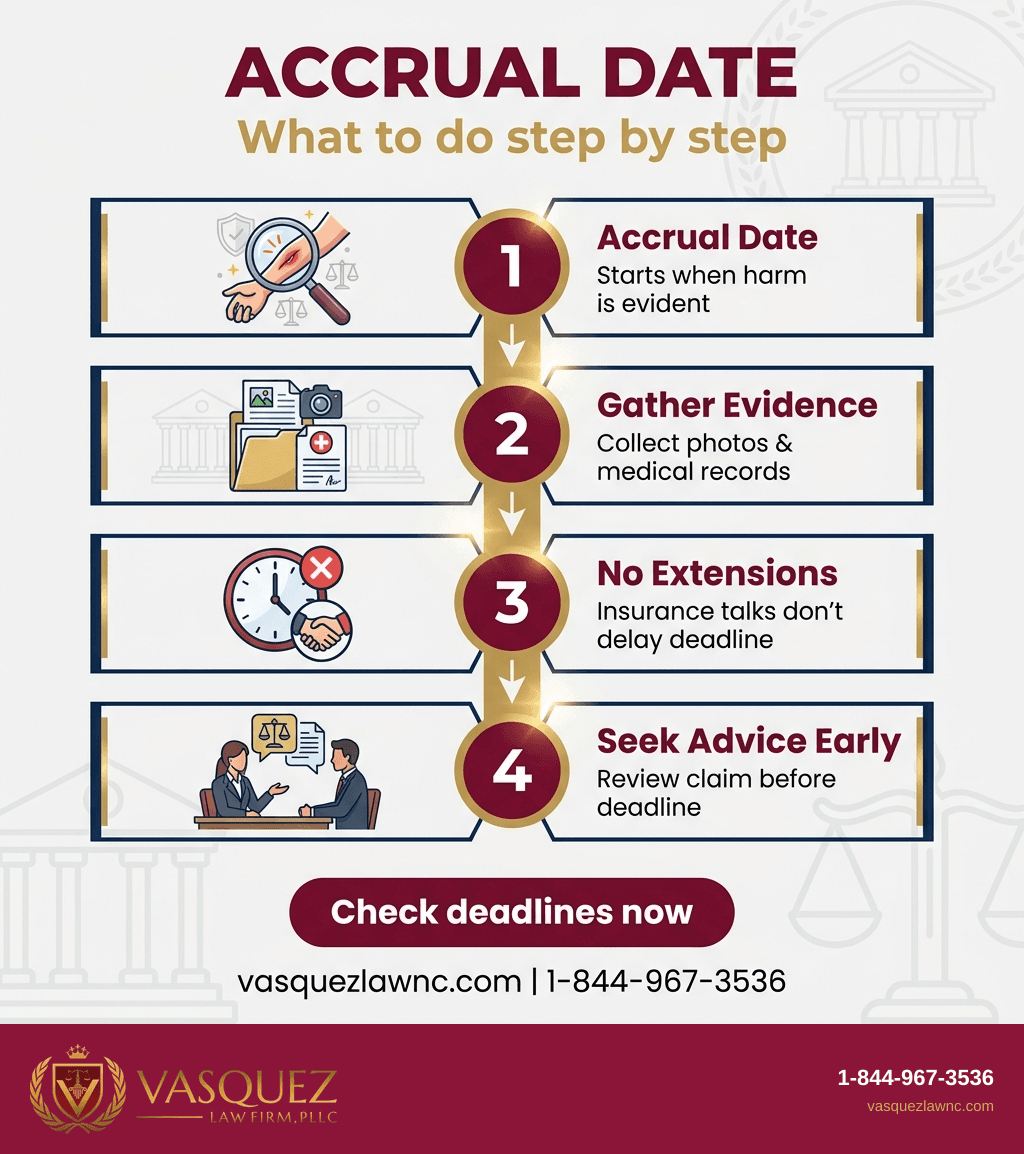
What is an accrual date?
An accrual date is the date when the law treats a legal claim as starting for deadline purposes. The statute requires a fact-based review. That review considers when an injury became apparent. The statute does not provide one calendar formula for every accident or symptom.
What should you do before the three-year injury deadline?
Evidence can begin to disappear on day one after a collision. Vehicle damage gets repaired. Witnesses forget details. Electronic records may not remain available forever. A timely review can identify the likely deadline. It can also address these practical problems before they become harder to solve.
- Write down the date, location, and sequence of events while details are clear.
- Seek appropriate medical care. Keep discharge papers, bills, and treatment records.
- Photograph injuries, vehicles, debris, road conditions, and visible property damage when possible.
- Keep insurance letters, claim numbers, emails, and recorded-message notices.
- Request a case review well before the third anniversary or any possible discovery date.
- Confirm whether another statute may apply before assuming G.S. 1-52 controls.
North Carolina personal injury claims may involve negligence. Negligence generally means that a person failed to use reasonable care and caused harm. Our explanation of how negligence can affect an injury claim discusses that basic concept. Liability proof and filing deadlines are separate issues. Strong evidence does not automatically overcome a missed deadline.
Do insurance communications extend the deadline?
North Carolina's statute does not say that negotiations, settlement talks, or an insurer’s request for records extends the filing deadline. Do not treat a claim number, a verbal assurance, or continuing talks as a substitute for checking the legal deadline. Put every important date in writing. Get advice early.
Which records support a personal injury claim in North Carolina?
A crash report may identify drivers. A clinic record may document symptoms. A wage record may show time missed from work. Each document answers a different question. Gathering records early can also show what was known, and when it was known, about an injury.
- Collision report, incident number, and photographs.
- Emergency, clinic, imaging, therapy, and pharmacy records.
- Itemized medical bills and health-insurance explanation of benefits.
- Pay stubs, employer attendance records, and missed-work documentation.
- Names and contact information for witnesses.
- Vehicle repair estimates and receipts for damaged personal property.
- Insurance correspondence and copies of any release offered for signature.
For a Smithfield-area roadway incident, preserve the report number and the exact location. The North Carolina Department of Transportation provides public transportation information. Its website does not decide who is legally liable. Keep documents in a dated folder. Do not rely only on memory.
What if you do not have every record?
Missing paperwork does not answer the deadline question by itself. Start with what you have. This may include photos, appointment confirmations, and insurer messages. A legal review can identify records to request. The review should occur before the potential limitations period expires.
How does the three-year personal injury timeline work?
Consider an injury that is obvious on the date of a wreck. Under the language of G.S. 1-52(16), that date may be important. Bodily harm is apparent in this example. In another situation, a person may have no apparent harm until later. The statute directs attention to when harm became apparent. It also considers when harm should reasonably have become apparent.
G.S. 1-52(16) also includes an outer limit. It states that, except as provided in named statutes, “no cause of action shall accrue more than 10 years from the last act or omission of the defendant giving rise to the cause of action.” This is commonly called a statute of repose. A statute of repose is an outside deadline tied to a defendant’s last act or failure to act. It is not the same as the three-year limitations period.
Except as provided by G.S. 130A-26.3 or G.S. 1-17(d) and (e), no cause of action shall accrue more than 10 years from the last act or omission of the defendant giving rise to the cause of action.
The statute does not explain every procedural question that may arise in a particular lawsuit. It does not say how long a personal injury settlement will take. Settlement timing depends on treatment progress, disputed fault, insurance coverage, records, and whether a lawsuit is filed.
Does the same deadline apply to insurance claims?
Not always. G.S. 1-52(12) addresses a claim for loss covered by an insurance policy subject to the three-year limitation in G.S. 58-44-16. The statute does not say that every policy, notice requirement, or contract dispute follows one deadline. Review the policy promptly. Do not assume an insurance deadline matches a lawsuit deadline.
Cases we handle often involve a missed early step. People may save medical bills but discard adjuster letters. They may also fail to record treatment dates. Those details can matter when deciding what was known, when a claim accrued, and what information supports damages. Our injury claim representation in North Carolina includes a review of timing and evidence issues.
Do not wait until the final weeks to ask about a filing deadline. Call Vasquez Law Firm for a free case evaluation. Se Habla Español.
Call 1-844-967-3536.
What mistakes can shorten your time to protect an injury claim?
A person may correctly remember that North Carolina has a three-year rule. That person may still make a damaging decision. The mistake is often waiting for an insurer to make the next move. The statute controls court timing. An adjuster’s preferred schedule does not.
- Waiting for treatment to end: Track the legal deadline while treatment continues.
- Assuming a claim form equals a lawsuit: Ask whether a court filing is needed to preserve rights.
- Using the crash date without reviewing discovery: Document when symptoms first became apparent.
- Ignoring a policy deadline: Read insurance notices and policy terms promptly.
- Signing a release quickly: Understand what claims the document may resolve.
- Throwing away evidence: Preserve photos, damaged items, receipts, and communications.
- Confusing different claim types: Verify whether another statute applies.
If you remember one thing: three years is a general rule under G.S. 1-52. It is not a reason to wait for three years. A timely filing analysis is safer than a last-minute assumption.
What North Carolina rules apply to Smithfield injury cases?
A Smithfield collision remains governed by North Carolina law even if an insurer communicates from another state. This guide addresses North Carolina personal injury claims only. Vasquez Law Firm helps injured people anywhere in North Carolina by phone. This includes people with injuries connected to Smithfield and Johnston County.
NC notes
G.S. 1-52(5) and G.S. 1-52(16) are the cited statutory provisions for the general three-year framework discussed here. The North Carolina Judicial Branch offers public court information. Court procedures and deadlines must still be evaluated against the specific facts. Medical malpractice, legal malpractice, and workplace injuries may have different rules. They are not covered by this personal injury guide.
When should you call about a personal injury deadline now?
A claim deserves prompt attention when the legal date is uncertain. Call soon if any of these facts apply:
- The accident happened close to three years ago.
- You discovered a possible injury after the incident date.
- An insurer has offered a release or settlement check.
- You have received a denial or a deadline letter.
- Multiple vehicles, businesses, or insurance policies are involved.
- You missed work or have ongoing medical care.
- You are unsure whether a lawsuit has already been filed.
- You believe another deadline may apply.
About Vasquez Law Firm
Vasquez Law Firm handles immigration, personal injury, workers’ compensation, criminal defense, and traffic matters. For North Carolina injury matters, the firm offers bilingual support. It also focuses on preserving evidence, understanding deadlines, and communicating clearly. The firm’s “Yo Peleo®” message reflects a commitment to stand up for clients while treating them with care.
- Bilingual support: Se Habla Español.
- Service area: North Carolina personal injury matters.
- Experience: William J. Vasquez has practiced for more than 15 years.
- Contact: Free case evaluations are available by phone.
Attorney Trust and Experience
William J. Vasquez is admitted to the North Carolina State Bar. A deadline review requires careful attention to documents and dates. It should not rely on assumptions from a general internet answer. You can read about William J. Vasquez and the firm’s background before requesting a case evaluation.
Frequently Asked Questions
How long do you have to file a personal injury claim in NC?
G.S. 1-52 generally provides three years for personal injury actions. Under G.S. 1-52(16), the claim accrues when bodily harm becomes apparent or reasonably should have become apparent, whichever occurs first. Different statutes can apply to other types of claims. Do not wait for the third anniversary without reviewing the facts and possible court deadline.
Does filing an insurance claim stop the three-year clock?
No. North Carolina's statute does not say that an insurance claim, negotiation, or adjuster conversation stops the deadline for a lawsuit. G.S. 1-52(12) addresses certain insurance-policy claims, while G.S. 1-52(16) addresses personal injury accrual. Policy notice duties and court-filing deadlines can differ, so preserve both issues rather than assuming one protects the other.
When does a personal injury claim start in North Carolina?
For the claims addressed in G.S. 1-52(16), the statute says the cause of action does not accrue until bodily harm becomes apparent or reasonably should have become apparent. The answer can depend on medical records, symptoms, and other evidence. The statute does not provide a single answer for every fact pattern, so early review is useful.
What is a statute of repose?
A statute of repose is an outer time limit tied to the defendant’s last act or omission. G.S. 1-52(16) states that, with listed exceptions, no cause of action accrues more than 10 years after that act or omission. It differs from a limitations period because it is not focused solely on when injury becomes apparent.
How long does a personal injury settlement usually take?
North Carolina law does not set a settlement timetable. A settlement may depend on the injuries, treatment records, fault dispute, available insurance, and willingness of the parties to resolve the matter. The three-year statute concerns a legal filing period, not a promise that negotiations will finish within any particular number of months or years.
Is the deadline different for a wrongful death claim?
Yes. When a person dies because of someone else's negligence, North Carolina generally requires the wrongful death lawsuit to be filed within two years after the date of death under G.S. 1-53(4). That is shorter than the three-year rule for a personal injury claim. Families should not rely on the three-year period after a fatal crash.
How much of a $25,000 settlement will I receive?
The statute does not address settlement allocation. The amount a person receives can depend on medical bills, health-insurance reimbursement interests, liens, expenses, fee agreements, and the written settlement terms. A settlement figure alone cannot show a net recovery. Review documents carefully before accepting or signing any release.
What if I am not sure when my injury became apparent?
Save medical notes, appointment dates, symptom journals, and communications that show when symptoms began or were identified. G.S. 1-52(16) uses both actual awareness and when harm reasonably should have become apparent. The statute does not prescribe one type of proof, so a fact-specific review is necessary before relying on a later date.
Sources and References
If you are asking how long you have to file a personal injury claim in NC, do not rely on a general deadline alone. Contact Vasquez Law Firm for a free, confidential case evaluation. Se Habla Español.
Start Your Free Evaluation Now
Call 1-844-967-3536.
Need legal help?
Immigration in NC and FL. Personal injury and workers compensation across NC. Criminal defense in Johnston, Harnett, Pitt and Cumberland counties, and traffic tickets in 11 NC counties. Tell us your county and we will tell you exactly what we can do.
Keep Reading

Reviewed by Attorney Vasquez, Managing Attorney
For how Vasquez Law Firm can help, see our North Carolina personal injury page.

William Vasquez
Founder & CEO, Vasquez Law Firm, PLLC
William Vasquez is the founder and CEO of Vasquez Law Firm, PLLC, a results-driven firm specializing in immigration, criminal defense, personal injury, and workers' compensation. A U.S. Air Force veteran and recipient of the Joint Service Achievement Medal, William is dedicated to fiercely fighting for his clients' rights.
Related Legal Services
Need legal help? Learn more about how our injury attorneys can help, or contact us for a free evaluation.
You can also visit North Carolina personal injury lawyers for more information.