How to Get Suspended License Back in Johnston County, NC
By William J. Vásquez · Updated November 9, 2026
How to get suspended license back in Johnston County, NC? Review DMV requirements, restoration conditions, and restrictions. Contact Vasquez Law Firm for help.
Published on November 8, 2026· Updated November 9, 2026
Fight your ticket
Get a flat-fee quote to help keep points off your record.
Confidential · No obligation · Se habla espanol · Mon-Fri 8am-7pm, Sat 9am-2pm (ET)
Have questions? Talk to an attorney - free evaluation.
Call 1-844-967-3536Fight Your Ticket, Protect Your License
A review that can keep points off your record.
How to Get Suspended License Back in Johnston County, NC
A suspended license can affect work, school, medical appointments, and family responsibilities. How to get suspended license back in Johnston County, NC depends on why the Division of Motor Vehicles suspended or revoked your driving privileges. They also depend on the conditions for restoration. N.C. Gen. Stat. § 20-19 sets different suspension and revocation periods. It also sets restoration limits, hearing rights, and financial-responsibility rules. This guide explains the law in practical terms. It also explains which records to check and what questions to ask before you drive again.
Need help understanding a Johnston County ticket or license offense? Vasquez Law Firm can review the charge and provide a quote on the ticket. Se Habla Español.
Call us: 1-844-967-3536
Quick Answer
To address how to get a suspended license back in Johnston County, NC, first identify the exact DMV action and its legal basis. The legal basis is the law that allowed the DMV to act. Then determine whether the applicable period has ended. Also check whether restoration conditions apply. These conditions may include financial responsibility or a driving restriction.
- Review the DMV notice and driver record.
- Identify the statute behind the action.
- Check for restoration conditions and restrictions.
- Do not drive until privileges are restored.
Why was my North Carolina driver’s license suspended or revoked?
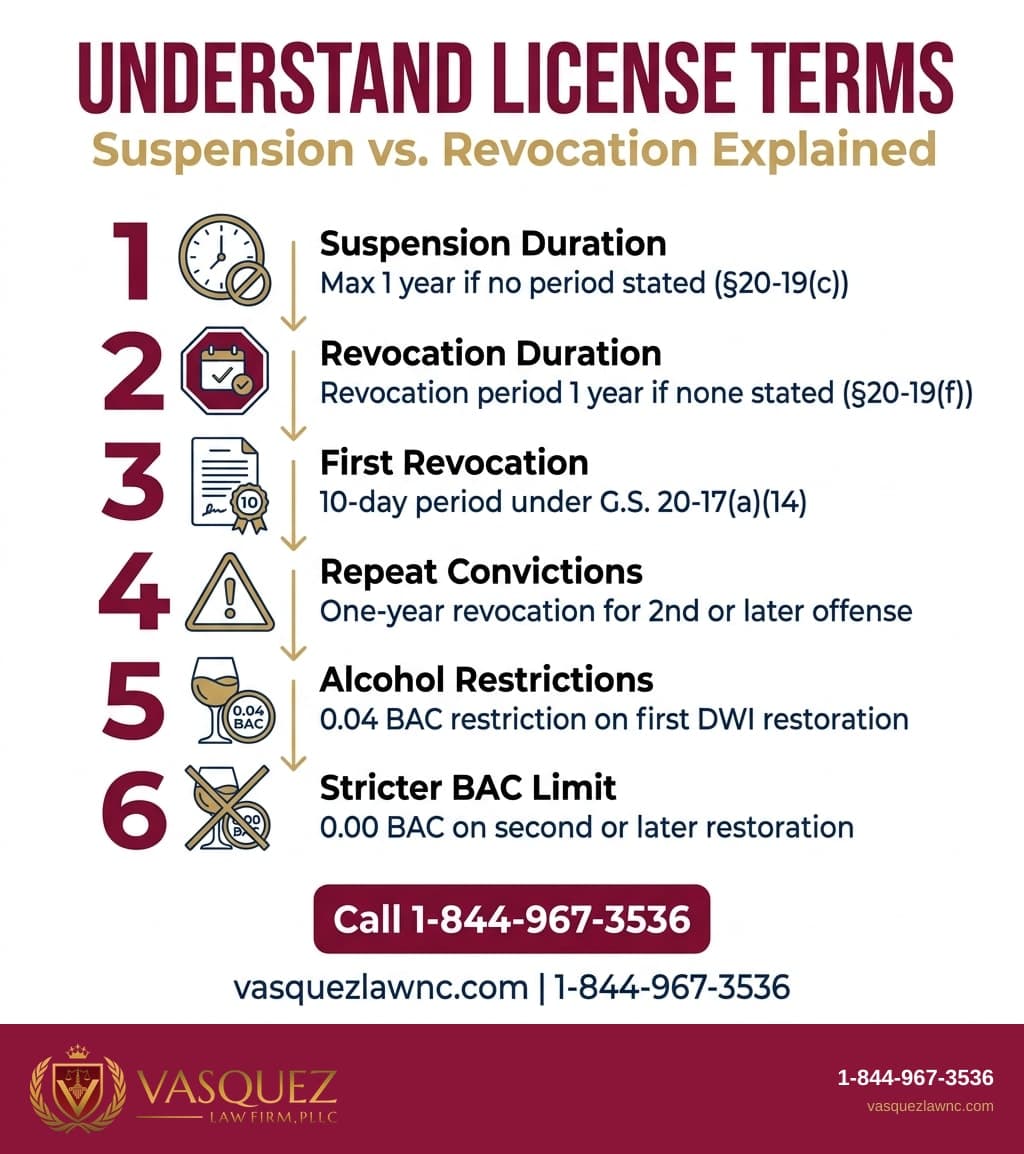
A license action called a suspension is not always the same as a revocation. A suspension usually stops driving privileges for a period. A revocation takes those privileges away under the law and can involve a longer or different process. Under N.C. Gen. Stat. § 20-19(c), a suspension under Article 2 without a stated period may last no more than one year. Under § 20-19(f), a revocation under another Article 2 provision without a stated period is one year.
The statute gives different periods to specific categories. Under G.S. 20-17(a)(14), the revocation period for a first conviction is ten days. A second or later conviction, as defined by G.S. 20-138.2B(d), carries a one-year revocation. The first practical task in a North Carolina traffic and license offense matter is matching the DMV action to the cited law. The cited law is the statute listed in the notice, order, or record.
Check the action, not just the label
A DMV letter, court paperwork, and driver record may use terms that sound alike. Those terms can lead to different restoration paths. Read the listed statute carefully. Also read the effective date and every condition on the notice. The official NC DMV license suspension information is a useful starting point. It can help you check administrative requirements.
N.C. Gen. Stat. § 20-19(a) allows the Division discretion, up to six months, for suspensions under G.S. 20-16(a)(8) or (9). Here, discretion means the Division can decide the period within the legal limit. Section 20-19(b) allows discretion, up to twelve months, for a suspension under G.S. 20-16(a)(10). These provisions show why the specific basis matters. A general statement that a license is “suspended” does not answer every question.
What steps help reinstate a suspended driver’s license?
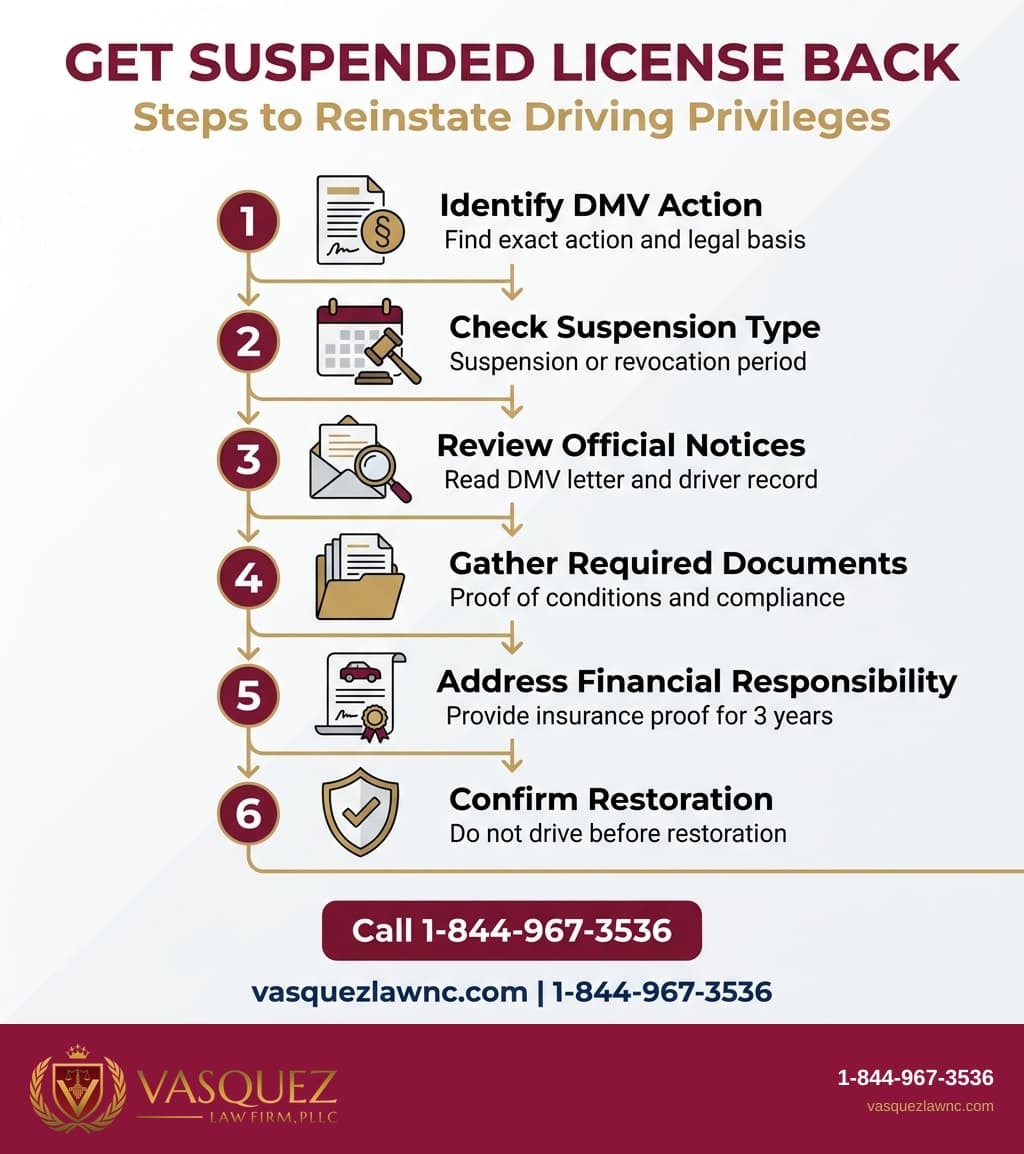
A person trying to reinstate driving privileges should begin with written records. Do not rely on memory or assumptions. Get the notice. Confirm the suspension or revocation category. Then compare the notice with the driver record. The NC DMV driver records page explains the agency’s records services. A current record can show whether another action is active.
- Read the DMV order and identify the cited statute.
- Review the driver record for active actions.
- Determine the period stated by the applicable law or order.
- Gather documents showing compliance with any listed condition.
- Address financial responsibility if § 20-19(k) applies.
- Confirm the restoration before operating a vehicle.
Financial responsibility after restoration
N.C. Gen. Stat. § 20-19(k) requires proof that the person notified an insurance agent or company. It also requires proof that the person is financially responsible before restoration for many Article 2 suspensions or revocations. Financial responsibility means proof that the person has the required ability to cover vehicle-related responsibility. The statute permits an insurance certificate. It also permits a qualifying binder or policy. It permits a Division-provided written certificate for applicants who do not own currently registered motor vehicles and do not operate other people's nonfleet private passenger motor vehicles that lack commercial motor vehicle liability insurance.
The financial responsibility must remain effective for at least three years after restoration. A failure to maintain it can lead to a thirty-day suspension. Material misrepresentation on the written certificate can be grounds for a ninety-day suspension. Material misrepresentation means an important false statement. These rules make it important to keep coverage and records current.
How can an alcohol restriction affect license restoration?
For some restored licenses, the driving privilege includes an alcohol concentration restriction. This restriction limits the alcohol concentration allowed while driving. N.C. Gen. Stat. § 20-19(c3)(1) applies a 0.04 restriction to a first restoration after a DWI conviction under G.S. 20-138.1. A second or later restoration after such a conviction carries a 0.00 restriction under § 20-19(c3)(2). A restored license does not always mean unrestricted driving.
For the first restoration of a drivers license for a person convicted of driving while impaired, G.S. 20-138.1, ... that the person not operate a vehicle with an alcohol concentration of 0.04 or more at any relevant time after the driving.
Other categories have different restrictions. A restoration after impaired driving in a commercial motor vehicle, habitual impaired driving, felony death by vehicle, or certain other listed matters carries a 0.02 restriction. For restoration after a conviction under G.S. 20-138.3, the restriction is that the person not operate a vehicle with an alcohol concentration of greater than 0.00 at any relevant time after driving. The number matters. A driver should not assume that one restriction applies to every case.
How long can restrictions remain?
Section 20-19(c3) states that these restrictions last seven years from restoration after a permanent revocation. They last until age twenty-one for a G.S. 20-138.3 revocation. They last three years in other cases. A violation of a restriction imposed under § 20-19(c3), or a willful refusal to submit to chemical analysis, results in a one-year revocation. If the original revocation was imposed under subsection (d), subsection (e), or G.S. 20-138.5(d), any remaining portion of the original revocation before its reduction is reinstated, and the additional year begins after all other revocation periods end. Chemical analysis means testing used to measure alcohol concentration.
We typically see people focus on receiving a restored card. They may overlook the printed restriction. A driver should read every restriction before getting behind the wheel. The driver should preserve the restoration paperwork. The driver should also promptly investigate any DMV notice alleging a violation. Waiting can affect hearing rights and deadlines.
Questions about a Johnston County suspension, ticket, or license offense should be addressed before you drive. Vasquez Law Firm can provide a quote on the ticket. Se Habla Español.
Call 1-844-967-3536
Can I request a DMV hearing about a restoration restriction?
A driver accused of violating an alcohol concentration restriction may have a hearing process under N.C. Gen. Stat. § 20-19(c5). A hearing is a formal chance to challenge the alleged violation. The Division must notify the person that the license is revoked. The revocation becomes effective on the thirtieth calendar day after mailing. This does not happen if the person requests a hearing in writing before the order becomes effective.
If the person properly requests a hearing, the person retains the person's license, unless it is revoked under some other provision of law, until the hearing is held, the person withdraws the request, or the person fails to appear at a scheduled hearing.
The hearing occurs in the county where the charge was brought. The listed issues are whether the officer had reasonable grounds. They also include whether the required rights notice was given. Another issue is whether the license carried the restriction. The final listed issue is whether chemical analysis exceeded that restriction.
What happens after the Division hearing?
Under § 20-19(c6), there is no ordinary appeal from the Division decision. A person who properly requested and received a hearing may petition the superior court of the county where the hearing occurred for discretionary review within thirty days after the decision is mailed. A petition is a formal request for court review. The court reviews the record. It also reviews limited procedural and findings issues.
For a Johnston County license offense, traffic violation representation in the counties the firm serves can help identify the relevant court papers and DMV action. The legal question depends on the stated basis for the revocation. The notice and record should be reviewed together.
What if my license revocation lasts years or is permanent?
A longer revocation has separate statutory restoration standards. Statutory means set by law. N.C. Gen. Stat. § 20-19(d) sets a four-year revocation for specified repeat impaired-driving offenses and for revocations under G.S. 20-17(a)(9) based on a violation of G.S. 20-141.4(a3). The Division may conditionally restore the license after at least two years if the statutory proof requirements are met. Conditional restoration means driving is allowed only under stated conditions.
For a permanent revocation under § 20-19(e), the statute permits possible conditional restoration after at least three years under subsection (e1). The person must meet its proof requirements. Subsection (e2) also describes conditional restoration after at least twenty-four months in a specified G.S. 20-17(a)(2) situation. That route includes continuous alcohol monitoring and other listed proof.
Conditional restoration is not unrestricted driving
Section 20-19(e3) permits the Division to impose reasonable conditions or restrictions for up to five years after restoration under subsections (e1), (e2), or (e4). A permanent revocation involving impaired driving and a fatality has another conditional-restoration route under § 20-19(i). That route is available after at least five years and upon the listed proof.
Before relying on any restoration possibility, collect the applicable court and DMV documents. A driver’s license reinstatement overview may also help frame the questions to ask about the record. The overview does not replace review of the person’s current DMV record or order.
What mistakes can delay suspended license restoration?
A driver can create a new problem by treating an expired period as automatic restoration. The statute ties many outcomes to conditions, restrictions, insurance proof, notices, and the specific legal reason for the action. Time alone may not restore driving privileges. These are common mistakes to avoid:
- Driving before confirmation: Wait for restoration confirmation and read every restriction.
- Ignoring the cited statute: Match the action to the statutory category.
- Missing a written hearing request: For § 20-19(c5), make the request before the order’s effective date.
- Forgetting financial responsibility: Address § 20-19(k) where it applies.
- Assuming every restriction is the same: 0.04, 0.02, and 0.00 restrictions apply to different listed circumstances.
- Discarding notices: Keep DMV orders, court papers, and insurance documents together.
- Ignoring later mail: A new revocation order may require quick review.
If you remember one point: how to get a suspended license back in Johnston County, NC begins with the exact DMV action and statute, not a general online checklist. The correct answer also depends on the conditions attached to that action.
What Johnston County traffic license issues can the firm review?
Johnston County is among the North Carolina counties where Vasquez Law Firm handles traffic tickets, speeding tickets, DWLR, and other license offenses. DWLR means driving while license revoked. This article concerns traffic and license matters. DWI, reckless driving, and hit-and-run matters involve different legal categories. They should not be treated as ordinary traffic tickets.
A court charge and a DMV action may be related. They are not interchangeable. Bring or preserve the citation, court date information, DMV notice, driver record, insurance materials, and any restoration order. That document set makes it easier to identify what needs attention first. It can also help separate a court issue from a DMV issue.
When should I call about a suspended license now?
Call promptly for a ticket quote if you received a license-related citation in Johnston County, a DMV revocation notice, or paperwork showing a court date. Early review can help you identify whether the issue concerns a suspension, revocation, condition of restoration, or driver-record entry. Early review can also help protect a deadline.
- A DMV order lists an effective date.
- Your license shows an alcohol concentration restriction.
- You received an affidavit or notice connected to chemical analysis.
- You need to determine whether insurance proof is required.
- You have a citation for DWLR or another license offense.
- Your record shows more than one active action.
About Vasquez Law Firm
Vasquez Law Firm represents people with immigration, personal injury, workers’ compensation, criminal defense, and traffic matters. The firm’s Yo Peleo® commitment reflects a direct, respectful approach to legal problems. Bilingual support staff are available for clients who prefer Spanish.
William J. Vasquez has practiced for more than fifteen years. For traffic matters, the firm handles tickets, speeding tickets, DWLR, and other license offenses in Johnston County and other approved North Carolina traffic counties. The firm can provide a quote on a ticket. It can also explain the next practical step.
Attorney trust and experience
William J. Vasquez is admitted to the North Carolina State Bar. You can review William J. Vasquez’s background and legal services before contacting the firm.
Frequently Asked Questions
How do I get a suspended license back in Johnston County?
Start by identifying the DMV action and the statute listed on the notice or driver record. N.C. Gen. Stat. § 20-19 uses different periods and restoration conditions depending on the category. Review whether insurance proof, a restriction, or another condition applies. Do not assume that the end of a stated period alone restores driving privileges.
Does a suspension always last one year?
No. Section 20-19(c) sets a maximum of one year for certain suspensions where Article 2 provides no specific period. Other provisions have different periods. For example, § 20-19(a) allows up to six months for listed G.S. 20-16(a) suspensions, while § 20-19(b) allows up to twelve months for another listed category.
What proof of insurance can be required for restoration?
Under N.C. Gen. Stat. § 20-19(k), qualifying proof can include an insurance certificate, a qualifying binder, or a qualifying policy. Applicants who do not own currently registered motor vehicles and do not operate other people's nonfleet private passenger motor vehicles that lack commercial motor vehicle liability insurance may sign a Division-provided written certificate. The required financial responsibility must remain in effect for at least three years after restoration.
Can an alcohol restriction lead to another revocation?
Yes. Section 20-19(c3) states that violating a restriction imposed under that subsection, or willfully refusing chemical analysis, results in a one-year revocation. If the original revocation was imposed under subsection (d), subsection (e), or G.S. 20-138.5(d), any remaining portion of the original revocation before its reduction is reinstated, and the additional year begins after all other revocation periods end. The applicable restriction can be 0.04, 0.02, or 0.00 depending on the listed conviction or revocation category. Read the restored license and all DMV orders carefully before driving.
Can I request a hearing after a restriction violation notice?
Section 20-19(c5) permits a written request for a Division hearing before the revocation order’s effective date. If the request is properly made, the person retains the license until the hearing, withdrawal of the request, or failure to appear, unless another law revokes it. The hearing is held in the county where the charge was brought.
Can a permanent revocation ever be conditionally restored?
Section 20-19(e1) permits the Division to conditionally restore certain permanently revoked licenses after at least three years if the statutory proof requirements are satisfied. Other provisions address specified circumstances and timelines. Conditional restoration can include restrictions for up to five years under § 20-19(e3), so restoration may not mean unrestricted driving.
Should I drive with an expired license while I wait for restoration?
Do not treat an expired card or the passage of time as proof that your driving privilege is restored. A suspension or revocation can involve a separate DMV action, financial responsibility, or a restriction on the restored license. Confirm your current status through the proper DMV record and preserve documents showing any restoration decision.
What documents should I bring for a license offense quote?
Bring the citation, DMV notice, driver record, court information, insurance documents, and any prior restoration order. These materials help identify whether the matter is a ticket, suspension, revocation, or alleged restriction violation. Vasquez Law Firm handles qualifying traffic and license offenses in Johnston County and can provide a quote based on the ticket.
Sources and References
How to get a suspended license back in Johnston County, NC is a record-specific question. Contact Vasquez Law Firm to request a quote on a Johnston County ticket or license offense. Se Habla Español.
Call: 1-844-967-3536
Need legal help?
Immigration in NC and FL. Personal injury and workers compensation across NC. Criminal defense in select NC counties depending on the charge (DWI in 12 counties), and traffic tickets in 20 NC counties. Tell us your county and we will tell you exactly what we can do.
Keep Reading
For how Vasquez Law Firm can help, see our license suspension page.
Reviewed by Attorney Vasquez, Managing Attorney

William Vasquez
Founder & CEO, Vasquez Law Firm, PLLC
William Vasquez is the founder and CEO of Vasquez Law Firm, PLLC, a results-driven firm specializing in immigration, criminal defense, personal injury, and workers' compensation. A U.S. Air Force veteran and recipient of the Joint Service Achievement Medal, William is dedicated to fiercely fighting for his clients' rights.
Related Legal Services
Need legal help? Learn more about our traffic violation legal services, or contact us for a free evaluation.
You can also visit North Carolina traffic lawyers for more information.