Can Fighting a Speeding Ticket in Johnston County Help?
Fighting a speeding ticket in Johnston County, NC? See the speed thresholds, work-zone penalties, and next steps. Call Vasquez Law for a ticket quote.
Published on October 10, 2026· Updated October 11, 2026
Fight your ticket
Free review to keep points off your record.
Free & confidential · Se habla espanol · 24/7
Have questions? Talk to an attorney - free evaluation.
Call 1-844-967-3536Fight Your Ticket, Protect Your License
A review that can keep points off your record.
Can Fighting a Speeding Ticket in Johnston County Help?
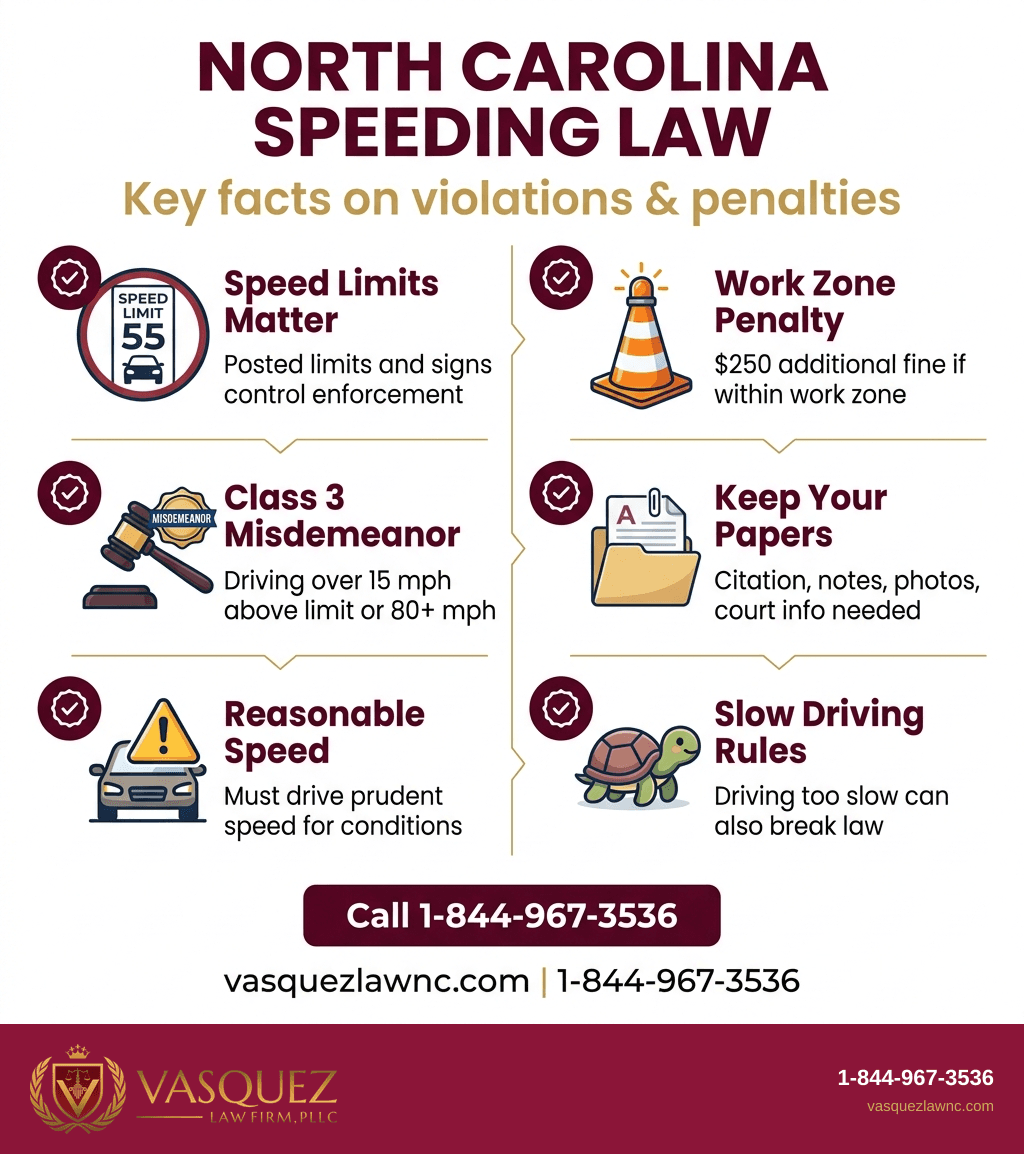
A ticket alleging 16 mph over the posted limit can carry more than a routine fine. Under N.C. Gen. Stat. § 20-141(j1), driving more than 15 mph above the lawful speed limit, or driving over 80 mph, is a Class 3 misdemeanor. Fighting a speeding ticket in Johnston County, NC starts with reading the citation carefully, preserving the details, and understanding what the statute does and does not say.
Need a quote for a Johnston County traffic ticket? Vasquez Law Firm can review the charge information with you. Se Habla Español.
Call: 1-844-967-3536
Quick Answer
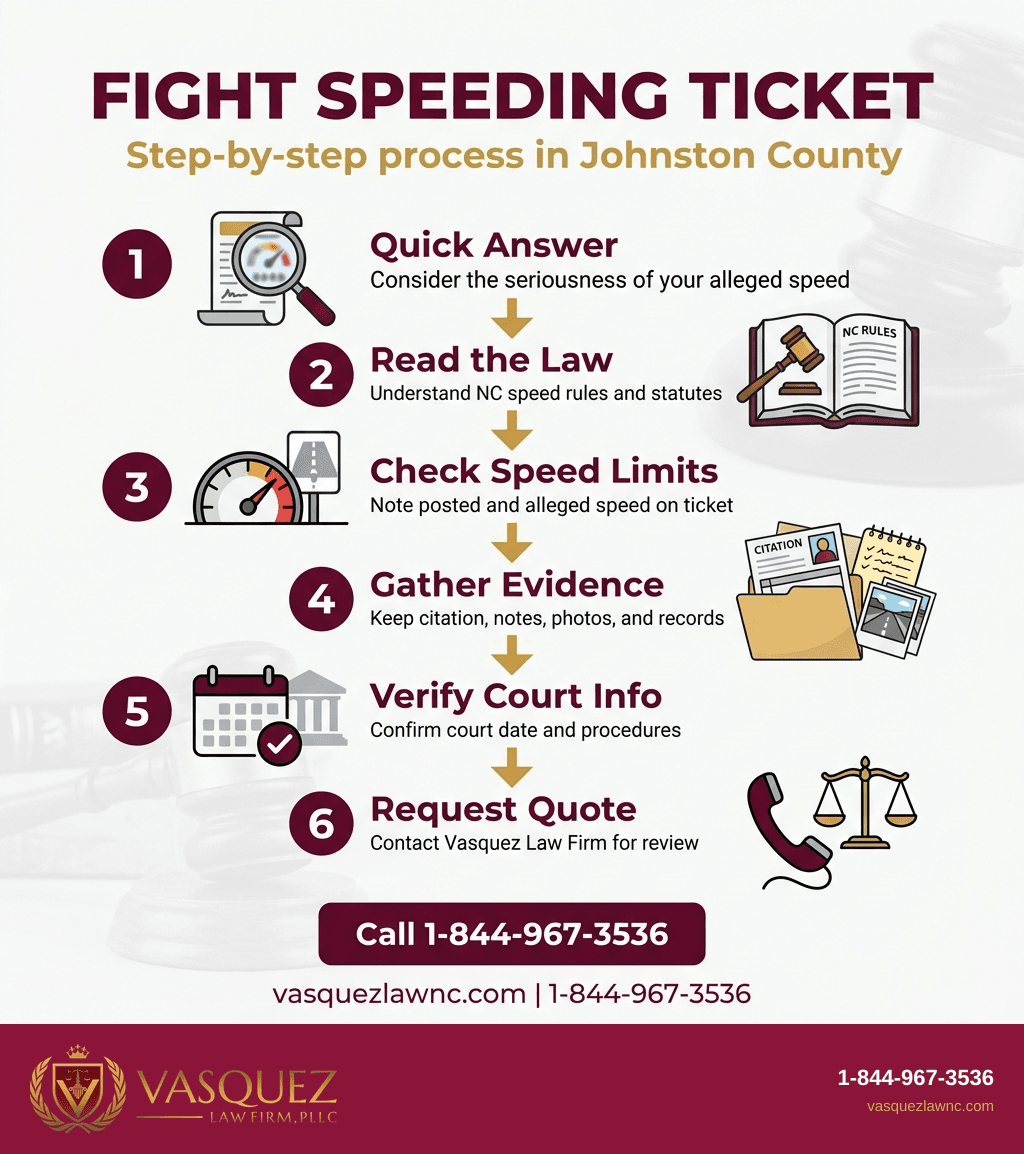
Fighting a speeding ticket in Johnston County, NC may be worth considering when the alleged speed could trigger a misdemeanor, a work-zone penalty, or other serious consequences. N.C. Gen. Stat. § 20-141 sets speed rules and some penalties, but it does not promise a particular court result.
- Read the charged speed and posted limit.
- Keep the citation and court information.
- Do not assume paying is the only choice.
- Request a quote before making a decision.
What does North Carolina speed law say about your ticket?
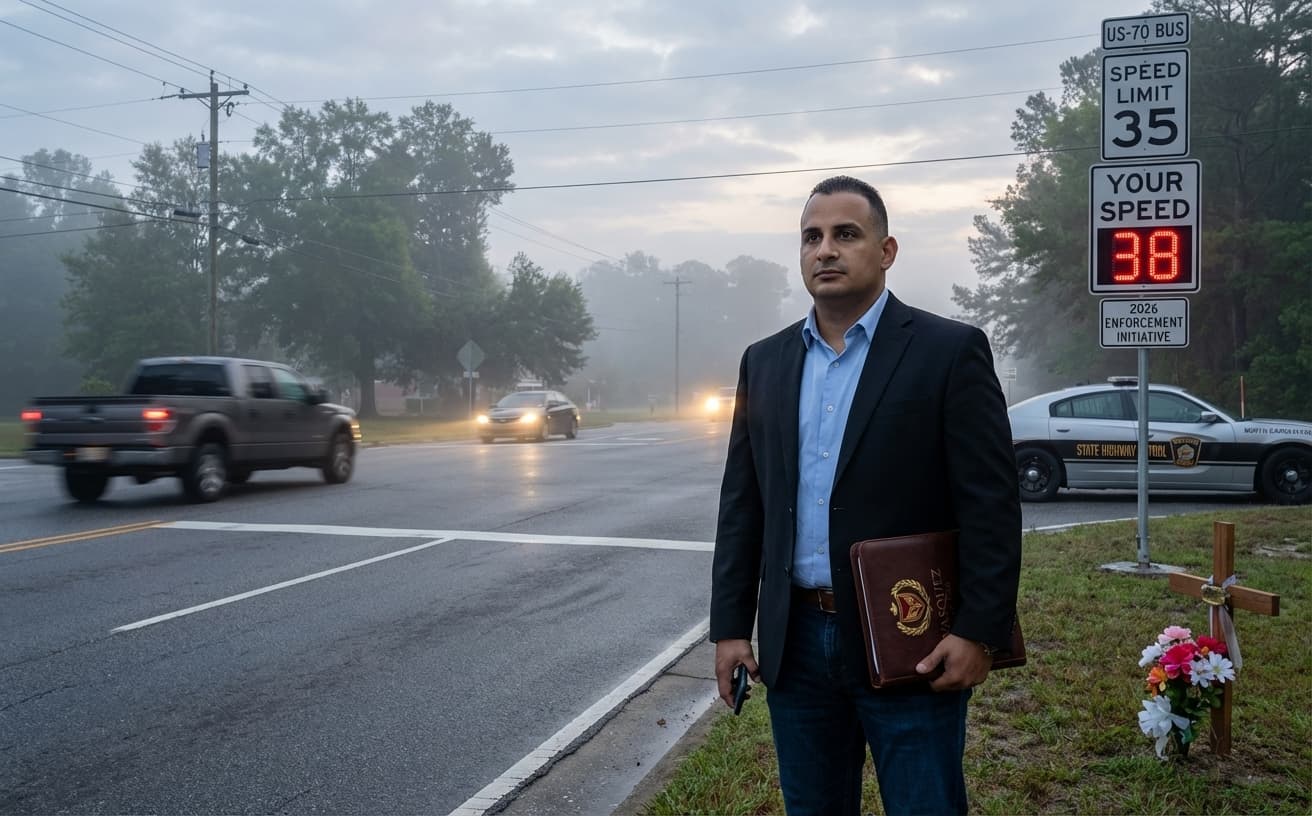
A driver traveling 66 mph in a posted 50 mph area is alleged to be 16 mph over the limit. That difference matters because § 20-141(j1) states that a person driving more than 15 mph above the lawful limit, or over 80 mph, is guilty of a Class 3 misdemeanor.
No person shall drive a vehicle on a highway or in a public vehicular area at a speed greater than is reasonable and prudent under the conditions then existing.
That sentence appears in N.C. Gen. Stat. § 20-141(a). The statute also gives default limits of 35 mph inside municipal corporate limits and 55 mph outside municipal corporate limits, unless another lawful, posted limit applies. Signs matter because limits set under several parts of the statute become effective when appropriate notice signs are erected.
For help evaluating the allegation, review the firm’s Johnston County traffic violation services. Fighting a speeding ticket in Johnston County, NC requires attention to the specific roadway, posted sign, alleged speed, and citation language.
Reasonable and prudent speed
The statute does not treat the posted number as the only safety issue. Section 20-141(m) says that traveling below a listed limit does not remove the duty to reduce speed when necessary to avoid a collision or injury.
How should you fight a speeding ticket in Johnston County?
A citation can contain the date, place, alleged speed, posted limit, charge, and court information. Start by making a clear copy before the paper is misplaced. The primary statute does not provide a deadline or a courtroom procedure, so rely on the information printed on the citation and verify court details directly.
- Read every line of the citation.
- Write down your memory of traffic, weather, signs, and the stop.
- Photograph lawful public signs or roadway conditions only if it is safe.
- Gather registration, license, and any relevant records.
- Ask for a quote on the ticket before choosing how to respond.
We typically see that people first focus on the fine and overlook the alleged speed, posted limit, and exact charge. Those three details can determine whether § 20-141(j1), the work-zone provision, or another part of the statute may matter.
What documents should you keep?
- The original citation and a readable copy.
- Notes made promptly about the stop.
- Photos showing posted signs, when lawfully and safely obtained.
- Any documents tied to a claimed speedometer issue.
- Proof of a court date or later notice.
Read about related license concerns in this guide to North Carolina driver’s license reinstatement issues. It is general information and does not establish the outcome of a speeding charge.
What happens if speeding occurred in a highway work zone?
A work-zone citation can involve an additional $250 penalty. Under § 20-141(j2), that amount is imposed in addition to other Chapter 20 penalties when a driver exceeds the speed limit set and posted in a highway work zone.
A “highway work zone” is the area between the first sign that informs motorists of the existence of a work zone on a highway and the last sign that informs motorists of the end of the work zone.
The statute says the additional penalty applies only if signs are posted at the beginning and end of the work-zone segment stating the penalty. It also directs an officer issuing a citation to indicate the vehicle speed, posted work-zone limit, and whether § 20-141(j1) was violated.
These details make the citation especially important. The statute does not set one outcome for every work-zone case, and it does not say that every construction area automatically creates the extra penalty. A review of the actual charging information is necessary.
Can driving too slowly also violate the law?
Yes. Sections 20-141(c), (g), and (h) address certain posted minimum speeds and prohibit driving so slowly that normal traffic is impeded, except where slower driving is necessary for safety or legal compliance. Minimum-speed signs must be posted under the circumstances described in the statute.
Before you resolve a ticket, get a clear quote from the firm. Se Habla Español.
Call 1-844-967-3536
Which speeding ticket mistakes can make a Johnston County case harder?
One common mistake is treating every speeding allegation as identical. A claim of more than 15 mph over the limit is materially different under § 20-141(j1) from a lower alleged speed. A work-zone allegation may also involve the separate $250 penalty in § 20-141(j2).
- Ignoring the paperwork: Keep the citation and verify its information.
- Guessing the charge: Read the statute number and alleged speed.
- Forgetting the sign: Note the posted limit and location.
- Assuming a prayer for judgment is always available: Section 20-141(p) makes a driver charged with more than 25 mph over the posted limit ineligible for that disposition.
- Waiting to ask questions: Obtain a ticket quote while you can still organize records.
- Posting details online: Keep case discussions private until you understand the issue.
If you remember one point: compare the alleged speed with the posted limit before deciding what to do.
Where can traffic ticket help be provided in North Carolina?
This traffic information is focused on Johnston County and Smithfield. Vasquez Law Firm handles traffic matters in Johnston, Harnett, Pitt, Cumberland, Mecklenburg, Cabarrus, Union, Gaston, Stanly, Lincoln, and Wake counties.
County-focused notes
A Johnston County citation may direct a driver to the Johnston County Courthouse. N.C. Gen. Stat. § 20-141 does not identify courtroom schedules, prosecutor contact details, filing deadlines, or local administrative practices. Confirm those facts from the citation or appropriate court source rather than relying on general online statements.
For a broader explanation of ticket issues, see traffic ticket lawyer information for North Carolina drivers. The firm can quote a traffic ticket, not promise a result.
When should you call for a ticket quote now?
Call promptly if the citation alleges more than 15 mph over the limit, a speed over 80 mph, or a work-zone violation. Those facts appear directly in § 20-141 and can change the seriousness of the charge.
- The ticket alleges a Class 3 misdemeanor.
- The alleged speed is more than 25 mph over the posted limit.
- The citation identifies a highway work zone.
- You cannot read the court information.
- You need help understanding the charged statute.
- You have documents suggesting an equipment issue.
About Vasquez Law Firm
Vasquez Law Firm serves people with traffic violations in the listed North Carolina counties. William J. Vasquez leads a firm focused on immigration, personal injury, workers’ compensation, criminal defense, and traffic matters. “Yo Peleo®” reflects a commitment to careful, determined advocacy.
Our bilingual support staff can assist in English and Spanish. For a speeding ticket, call for a quote on the ticket and bring the citation details to the conversation.
Frequently Asked Questions
Is 20 mph over the speed limit a felony in North Carolina?
No. Going 20 mph over, by itself, is not a felony under North Carolina's speeding statute. N.C. Gen. Stat. § 20-141(j1) states that driving more than 15 mph above the lawful limit, or over 80 mph, is a Class 3 misdemeanor. The statute does not say that 20 mph over is a felony. The precise charge still depends on the citation and facts.
Is it worth getting help for a speeding ticket in Johnston County?
It can be useful to obtain a ticket quote when the alleged speed is high, the charge references a work zone, or the citation alleges more than 15 mph over the posted limit. Section 20-141(j1) identifies a Class 3 misdemeanor threshold. A quote helps you understand available assistance without assuming any specific result.
What is the best way to fight a speeding ticket?
Start with accurate information. Preserve the citation, identify the alleged speed and posted limit, write down your recollection, and keep lawful documentation about signs or conditions. There is no single best defense or guaranteed method. A review must focus on the actual charge, roadway facts, and court information listed on the ticket.
What is the default speed limit inside a municipality?
Section 20-141(b)(1) lists 35 mph inside municipal corporate limits for all vehicles, except as otherwise provided in Chapter 20. A different validly posted limit may apply. The statute says some changed limits become effective only after appropriate signs are erected. Check the cited location and posted sign rather than relying only on the default rule.
What is the default speed limit outside a municipality?
Section 20-141(b)(2) lists 55 mph outside municipal corporate limits for vehicles other than school buses and school activity buses, except as otherwise provided. The Department of Transportation may set a different reasonable and safe speed limit after an engineering and traffic investigation. Posted signs remain central to determining the applicable limit.
What is the work-zone speeding penalty?
Section 20-141(j2) requires a $250 penalty for speeding above the set and posted limit in a highway work zone, in addition to other Chapter 20 penalties. The added penalty applies only when signs at the beginning and end of the segment state the penalty. The statute does not say that every roadway project automatically triggers it.
Can a driver get a prayer for judgment for speeding?
The statute gives one clear restriction. Under § 20-141(p), a driver charged with speeding more than 25 mph over the posted speed limit is ineligible for a prayer for judgment continued. The statute does not explain every requirement or possible disposition for other charges. Individual facts and local procedure may matter.
What should I bring when asking for a ticket quote?
Bring or send a readable citation, the alleged speed, posted limit, location, court information, and notes about the stop. If the ticket identifies a work zone, preserve that fact. These details help identify whether § 20-141(j1), § 20-141(j2), or another provision may be relevant. Do not alter the citation or rely on memory alone.
Sources and References
- North Carolina DMV
- N.C. Gen. Stat. § 20-141, Speed restrictions (North Carolina General Assembly)
Fighting a speeding ticket in Johnston County, NC begins with the exact information on your citation. Contact Vasquez Law Firm for a quote on the ticket. Se Habla Español.
Call 1-844-967-3536
Reviewed by Attorney Vasquez, Managing Attorney
Got a Speeding Ticket in Johnston County?
Points add up fast. We can often get tickets reduced or dismissed entirely.
Keep Reading


William Vasquez
Founder & CEO, Vasquez Law Firm, PLLC
William Vasquez is the founder and CEO of Vasquez Law Firm, PLLC, a results-driven firm specializing in immigration, criminal defense, personal injury, and workers' compensation. A U.S. Air Force veteran and recipient of the Joint Service Achievement Medal, William is dedicated to fiercely fighting for his clients' rights.
Related Legal Services
Need legal help? Learn more about traffic ticket lawyers in North Carolina, or contact us for a free evaluation.
You can also visit traffic lawyers in Johnston County for more information.