CDL Violations Can Disqualify Johnston County Drivers
CDL violations in Johnston County can suspend commercial driving privileges. Review key disqualifications and call Vasquez Law Firm for a ticket quote.
Published on October 22, 2026· Updated October 22, 2026
Fight your ticket
Free review to keep points off your record.
Free & confidential · Se habla espanol · Mon-Fri 8am-7pm, Sat 9am-2pm (ET)
Have questions? Talk to an attorney - free evaluation.
Call 1-844-967-3536Fight Your Ticket, Protect Your License
A review that can keep points off your record.
CDL Violations Can Disqualify Johnston County Drivers
A commercial driver can lose the privilege to operate a commercial motor vehicle after one conviction, a chemical-test refusal, or certain repeat traffic violations. CDL violations in Johnston County can affect more than a regular license. N.C. Gen. Stat. § 20-17.4 creates separate commercial disqualification periods. A commercial disqualification means a period when a driver cannot use commercial driving privileges. This guide explains the penalties listed in that statute. It also explains which documents to keep and which questions to review before resolving a ticket.
A CDL ticket can put your commercial driving privilege at risk. Vasquez Law Firm helps drivers with traffic matters in Johnston County. Se Habla Español.
Call: 1-844-967-3536
Quick Answer
CDL violations in Johnston County may lead to a commercial driving disqualification. This can happen even when the charge arose in a noncommercial vehicle. Under N.C. Gen. Stat. § 20-17.4, disqualification periods are set by statute for specific offenses.
- Some major offenses carry a one-year disqualification.
- An offense or act requiring disqualification under subsection (a) produces a three-year disqualification if it occurred while transporting hazardous material requiring the vehicle to be placarded.
- Two serious traffic violations can produce a sixty-day period.
- Out-of-state conduct can affect a North Carolina commercial privilege.
Which CDL violations can disqualify a commercial driver?
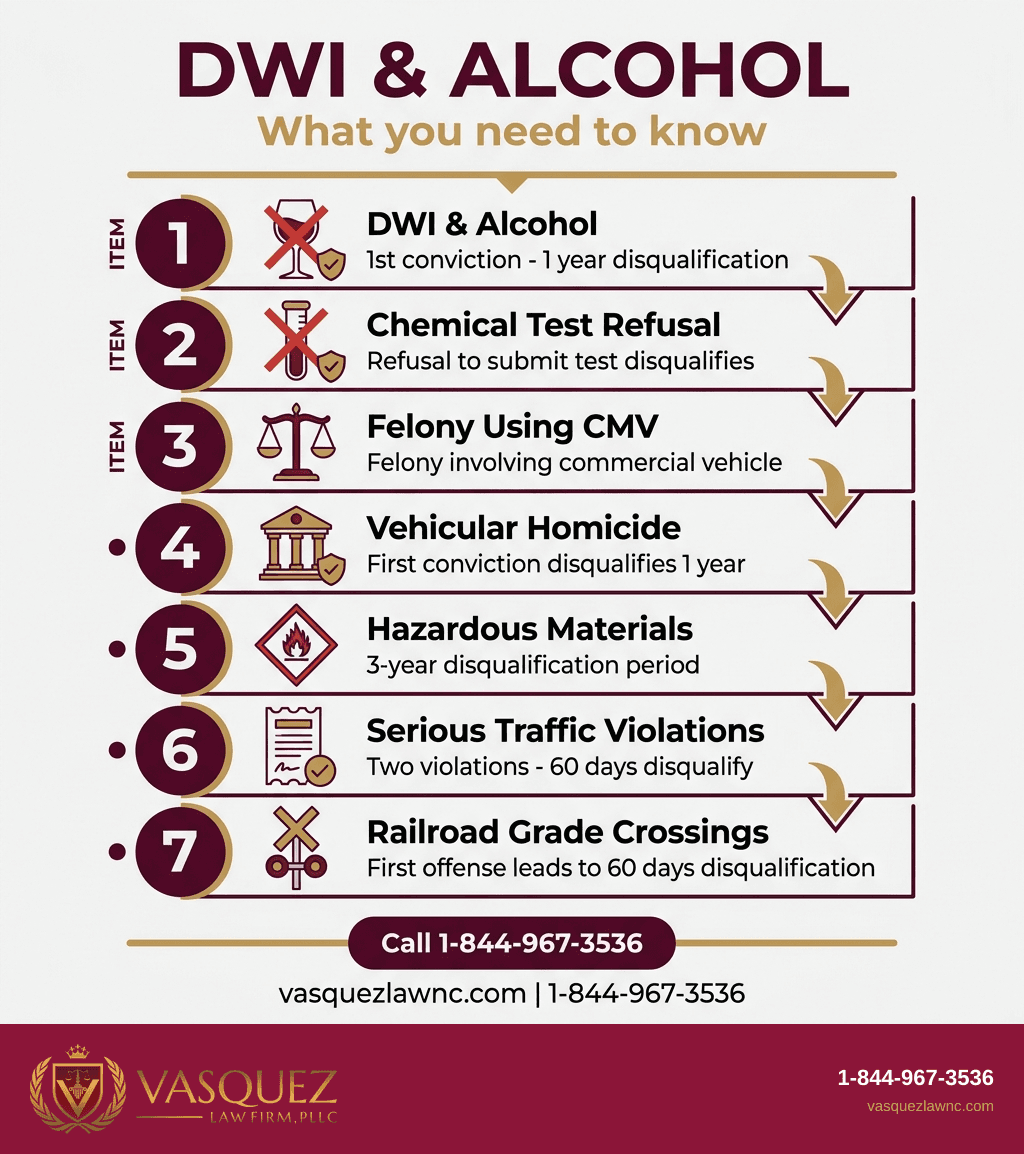
A driver holding a commercial drivers license can be disqualified from driving a commercial motor vehicle for one year after a first conviction of driving while impaired under G.S. 20-138.1, even if the conviction occurred while driving a noncommercial motor vehicle. The statute also lists a first conviction of a felony in the commission of which a commercial motor vehicle was used, refusal to submit to a chemical test when charged with an implied-consent offense, a second or subsequent conviction of driving a commercial motor vehicle after consuming alcohol under G.S. 20-138.2A, a civil license revocation under G.S. 20-16.5, a first conviction of vehicular homicide or manslaughter while operating a commercial motor vehicle, driving a commercial motor vehicle during a period of disqualification, and a conviction of fraud in connection with issuance of a commercial drivers license or commercial learner's permit.
The statute also includes refusal to submit to a chemical test in an implied-consent offense. An implied-consent offense is a case where the law requires a driver to take a chemical test under stated conditions. A civil license revocation is another listed basis. This applies when the revocation arose from a charge involving conduct that occurred while the person was operating a commercial motor vehicle or holding a commercial drivers license. These categories show why a CDL driver should review three separate results. The results may affect the criminal case, the regular license, and the commercial license.
How do alcohol-related CDL rules differ?
A first conviction of driving a commercial motor vehicle after consuming alcohol under G.S. 20-138.2A produces a ten-day commercial disqualification. A second or subsequent conviction under that statute can produce a one-year disqualification. These periods are different. Therefore, the exact allegation and final result are important.
For help understanding traffic ticket options, review the firm’s traffic violation representation for North Carolina drivers. A ticket quote lets the firm review the allegation and county. The firm can then discuss possible next steps.
How do serious traffic violations affect a CDL?
Convictions for two serious traffic violations arising from separate incidents within a three-year period result in a sixty-day commercial disqualification if the violations were committed in a commercial motor vehicle or while holding a commercial drivers license. Convictions for three or more such violations result in a one-hundred-twenty-day disqualification. This disqualification is added to, and served after, any prior disqualification.
The statute specifically includes violations of G.S. 20-140(f) and G.S. 20-141(j3) in its definition of serious violation. A driver should get the charging paper and check the cited statute. The driver should also keep the date and location of every incident. These details matter because the rule requires separate incidents within the stated period.
What about railroad grade crossing offenses?
A first conviction for a railroad grade crossing offense under G.S. 20-142.1 through G.S. 20-142.5 committed while operating a commercial motor vehicle results in a sixty-day disqualification. A conviction within any three-year period for a second offense involving any combination of those provisions results in a one-hundred-twenty-day disqualification. A conviction within any three-year period for a third or subsequent such offense results in a one-year disqualification.
Reviewing a Johnston County license points guide can help a driver understand two separate issues. Points and commercial disqualification are not the same. Do not assume that a routine response to a ticket protects a CDL.
What should you do after a CDL citation?
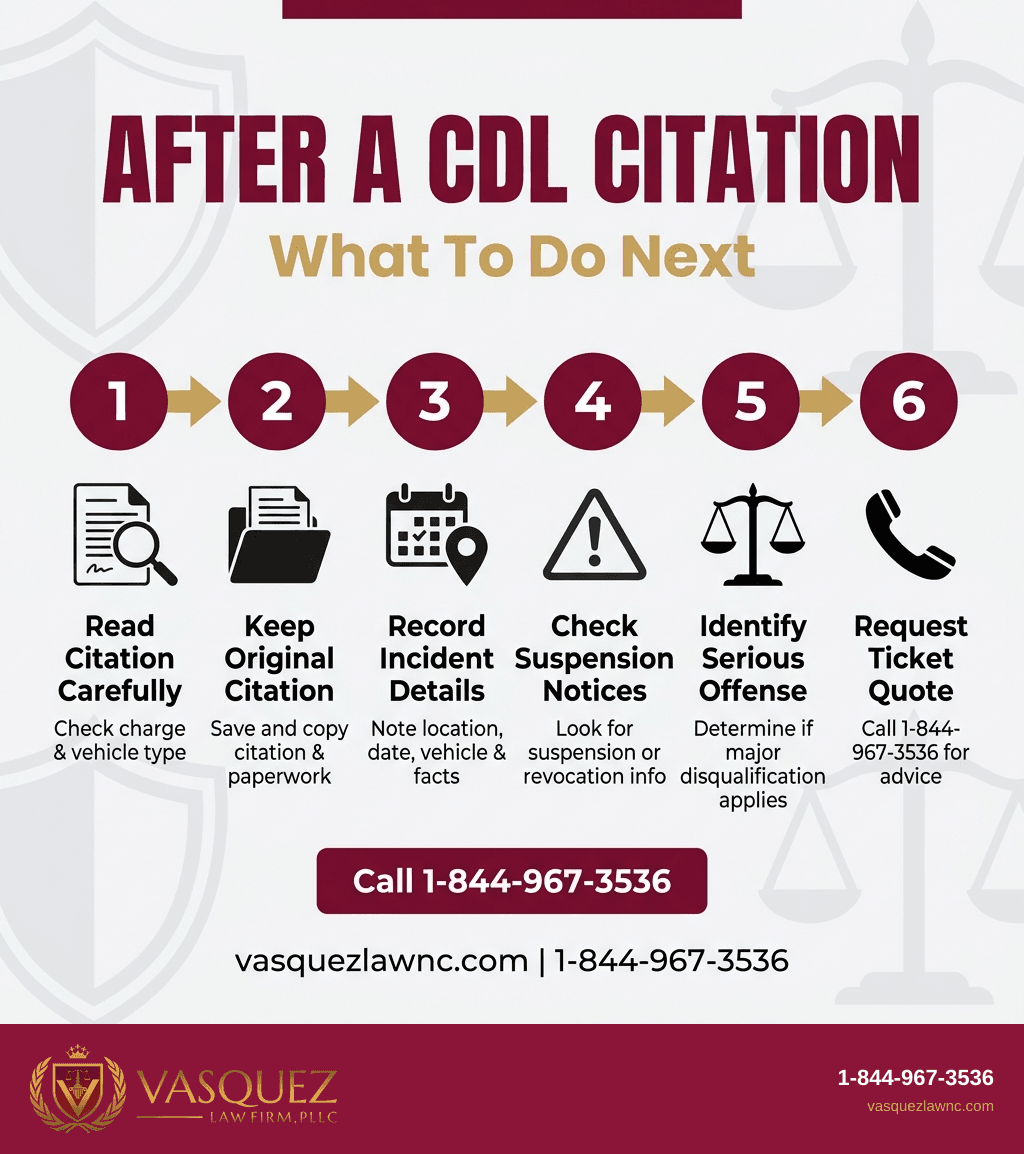
Read a citation line by line before making any payment or entering any plea. First, confirm the charge and court information. Confirm the vehicle type listed on the citation. Also check whether the incident involved a commercial motor vehicle. Keep the original citation. Make a copy for your records.
- Save the citation, any officer paperwork, and your driver record.
- Write down the location, vehicle, and facts while they are fresh.
- Check whether you received any notice involving suspension, revocation, or out-of-service status.
- Identify whether the charge may be a serious traffic violation or major disqualifying offense.
- Request a ticket quote before choosing how to resolve the charge.
Cases we handle often involve drivers who have the ticket but lack a current driver record. Some also lack paperwork that shows their commercial status. Those papers can help identify the issue. The issue may concern the regular license, the commercial privilege, or both.
Why should you get your driving record?
The North Carolina DMV explains how drivers may request driver records. A current record can help a driver compare prior incidents with the statutory thresholds. A statutory threshold is a required limit or condition in a law. The record can also show whether an out-of-state event has appeared on the North Carolina record.
Before you pay a commercial-driver ticket, ask for a clear quote on the ticket and the county process. Se Habla Español.
Call: 1-844-967-3536
When can CDL violations lead to lifetime disqualification?
If a person who has been disqualified from driving a commercial motor vehicle for a conviction or refusal described in subsection (a) is, as the result of a separate incident, subsequently convicted of an offense or commits an act requiring disqualification under subsection (a), that person is disqualified for life. The Division may adopt guidelines, including conditions, under which a disqualification for life under this subsection may be reduced to 10 years.
Other provisions impose lifetime disqualification without the possibility of reinstatement after ten years. These include a conviction for a third or subsequent violation of G.S. 20-138.2, a conviction for a fourth or subsequent violation of G.S. 20-138.2A, or a third refusal to submit to a chemical test when charged with an implied-consent offense that occurred while the person was driving a commercial motor vehicle.
A person is disqualified from driving a commercial motor vehicle for life if that person either uses a commercial motor vehicle in the commission of any felony involving the manufacture, distribution, or dispensing of a controlled substance, or possession with intent to manufacture, distribute, or dispense a controlled substance or is the holder of a commercial drivers license at the time of the commission of any such felony.
G.S. 20-17.4(c) provides that a person is disqualified from driving a commercial motor vehicle for life if that person either uses a commercial motor vehicle in the commission of any felony involving the manufacture, distribution, or dispensing of a controlled substance, or possession with intent to manufacture, distribute, or dispense a controlled substance or is the holder of a commercial drivers license at the time of the commission of any such felony. Upon receiving notice of prohibited status in the federal Drug and Alcohol Clearinghouse, the Division must disqualify a CDL holder from operating a commercial motor vehicle. The disqualification lasts at least thirty days and continues until the Division receives proof of successful completion of assessment and treatment by a substance abuse professional in accordance with 49 C.F.R. § 382.503.
Can out-of-state violations or out-of-service orders affect a CDL?
The Division shall withdraw the privilege to operate a commercial vehicle of any resident of this State or person transferring to this State upon receiving notice of the person's conviction or Administrative Per Se Notice in another state for an offense that, if committed in this State, would be grounds for disqualification. The period of disqualification shall be the same as if the offense occurred in this State.
An out-of-service order tells a driver or company that a vehicle cannot be operated under the stated conditions. For a person holding or required to hold a commercial learner's permit or commercial drivers license, a conviction for a first out-of-service-order violation while operating a commercial motor vehicle brings a disqualification of 180 days to one year, subject to the special rule below. A conviction for a second violation during any 10-year period, arising from separate incidents, brings a disqualification of two to five years. A conviction for a third or subsequent violation during any 10-year period, arising from separate incidents, brings a disqualification of three to five years. If the violation occurs while transporting hazardous materials as defined in 49 C.F.R. § 383.5 or operating a commercial vehicle designed or used to transport 16 or more passengers, including the driver, a first conviction brings a disqualification of 180 days to two years; a second or subsequent conviction during any 10-year period, arising from separate incidents, brings a disqualification of three to five years.
What should a suspension notice prompt?
The DMV provides general information about license suspension. Keep every notice. Compare its language with the citation and driving record. A person is disqualified from driving a commercial motor vehicle for the period during which the person's regular or commercial drivers license is revoked, suspended, or cancelled.
For a related discussion, see North Carolina driver’s license reinstatement information. CDL violations in Johnston County deserve prompt review. The commercial consequences may not match the label a driver uses for the ticket.
What CDL mistakes should Johnston County drivers avoid?
A common mistake is treating a citation as only a fine. A guilty disposition can have commercial consequences under a separate statute. A disposition is the final result of a charge. Another mistake is relying on an employer’s summary. Read the charging document and official notices instead.
- Paying before review: First identify the exact charge and potential CDL consequence.
- Ignoring prior incidents: Compare separate incidents against the serious-violation rule.
- Losing paperwork: Keep citations, notices, and driver records together.
- Overlooking vehicle status: Note whether the event involved a commercial motor vehicle.
- Ignoring another jurisdiction: Preserve documents from out-of-state proceedings.
- Driving after an order: An out-of-service order can carry its own disqualification.
- Assuming a regular license result ends the issue: Check the commercial privilege separately.
If you only remember one thing: CDL violations in Johnston County can create a commercial disqualification that is different from the ordinary license consequence.
Which county traffic matters can Vasquez Law Firm review?
North Carolina traffic county notes
Vasquez Law Firm handles traffic matters in Johnston, Harnett, Pitt, Mecklenburg, Cabarrus, Union, Gaston, Stanly, Lincoln, and Wake counties. The commercial disqualification statute discussed here is N.C. Gen. Stat. § 20-17.4. A driver facing a ticket in one of these counties can call for a quote on the ticket.
Commercial driving is a privilege regulated by statute. The outcome of any ticket depends on the charge, record, court process, and facts. This article does not replace individualized advice.
When should you call about a CDL ticket now?
- The citation alleges a commercial motor vehicle violation.
- You received an out-of-service order.
- You hold a CDL and the allegation involves alcohol or a chemical test.
- Your record includes prior serious traffic violations.
- The incident occurred outside North Carolina.
- You received a suspension, revocation, cancellation, or disqualification notice.
- You transport placarded hazardous materials.
About Vasquez Law Firm
Vasquez Law Firm provides dedicated representation in immigration, personal injury, workers' compensation, criminal defense, and traffic violations. The firm’s Yo Peleo® commitment means direct, respectful advocacy. It also means clear communication about the next legal step.
William J. Vasquez leads the firm. Bilingual support staff are available for clients who prefer Spanish. For qualifying traffic matters in the firm’s listed North Carolina counties, contact the firm for a quote on the ticket. Se Habla Español.
Frequently Asked Questions
Can a noncommercial vehicle DWI affect a CDL?
A first conviction of G.S. 20-138.1, driving while impaired, for a holder of a commercial drivers license that occurred while the person was driving a motor vehicle that is not a commercial motor vehicle, disqualifies a person from driving a commercial motor vehicle for one year.
How long can two serious traffic violations disqualify a CDL?
A person is disqualified from driving a commercial motor vehicle for 60 days if that person is convicted of two serious traffic violations, or 120 days if convicted of three or more serious traffic violations, arising from separate incidents occurring within a three-year period, committed in a commercial motor vehicle or while holding a commercial drivers license. This disqualification shall be in addition to, and shall be served at the end of, any other prior disqualification.
Can an out-of-state CDL violation affect North Carolina driving?
The Division shall withdraw the privilege to operate a commercial vehicle of any resident of this State or person transferring to this State upon receiving notice of the person's conviction or Administrative Per Se Notice in another state for an offense that, if committed in this State, would be grounds for disqualification. The period of disqualification shall be the same as if the offense occurred in this State.
What happens after a first commercial alcohol-consumption conviction?
A person who is convicted for a first offense of driving a commercial motor vehicle after consuming alcohol under G.S. 20-138.2A is disqualified from driving a commercial motor vehicle for 10 days.
Can refusal of a chemical test affect a CDL?
Refusal to submit to a chemical test when charged with an implied-consent offense, as defined in G.S. 20-16.2, is a ground for disqualification from driving a commercial motor vehicle for one year.
What should I bring when requesting a ticket quote?
Bring or send the citation, court paperwork, any suspension or disqualification notice, and a current driver record if available. Also preserve documents about an out-of-state event or out-of-service order. These records help identify the charged statute and whether commercial driving status affects the issue.
Sources and References
CDL violations in Johnston County can put commercial driving work at risk. Call Vasquez Law Firm for a quote on your ticket. Se Habla Español.
Call: 1-844-967-3536
Need legal help?
Immigration in NC and FL. Personal injury and workers compensation across NC. Criminal defense in Johnston, Harnett and Pitt counties, and traffic tickets in 10 NC counties. Tell us your county and we will tell you exactly what we can do.
Keep Reading

For how Vasquez Law Firm can help, see our CDL violations page.
Reviewed by Attorney Vasquez, Managing Attorney

William Vasquez
Founder & CEO, Vasquez Law Firm, PLLC
William Vasquez is the founder and CEO of Vasquez Law Firm, PLLC, a results-driven firm specializing in immigration, criminal defense, personal injury, and workers' compensation. A U.S. Air Force veteran and recipient of the Joint Service Achievement Medal, William is dedicated to fiercely fighting for his clients' rights.
Related Legal Services
Need legal help? Learn more about learn about fighting traffic tickets, or contact us for a free evaluation.
You can also visit Smithfield traffic violation attorneys for more information.