NC Allows License Renewals More Than 180 Days Early
By William J. Vásquez · Updated November 12, 2026
North Carolina driver license law changes affect early renewals, insurance lapse replies, learner permits, and CDL records. Know your options, call for a quote.
Published on November 12, 2026· Updated November 12, 2026
Fight your ticket
Get a flat-fee quote to help keep points off your record.
Confidential · No obligation · Se habla espanol · Mon-Fri 8am-7pm, Sat 9am-2pm (ET)
Have questions? Talk to an attorney - free evaluation.
Call 1-844-967-3536Fight Your Ticket, Protect Your License
A review that can keep points off your record.
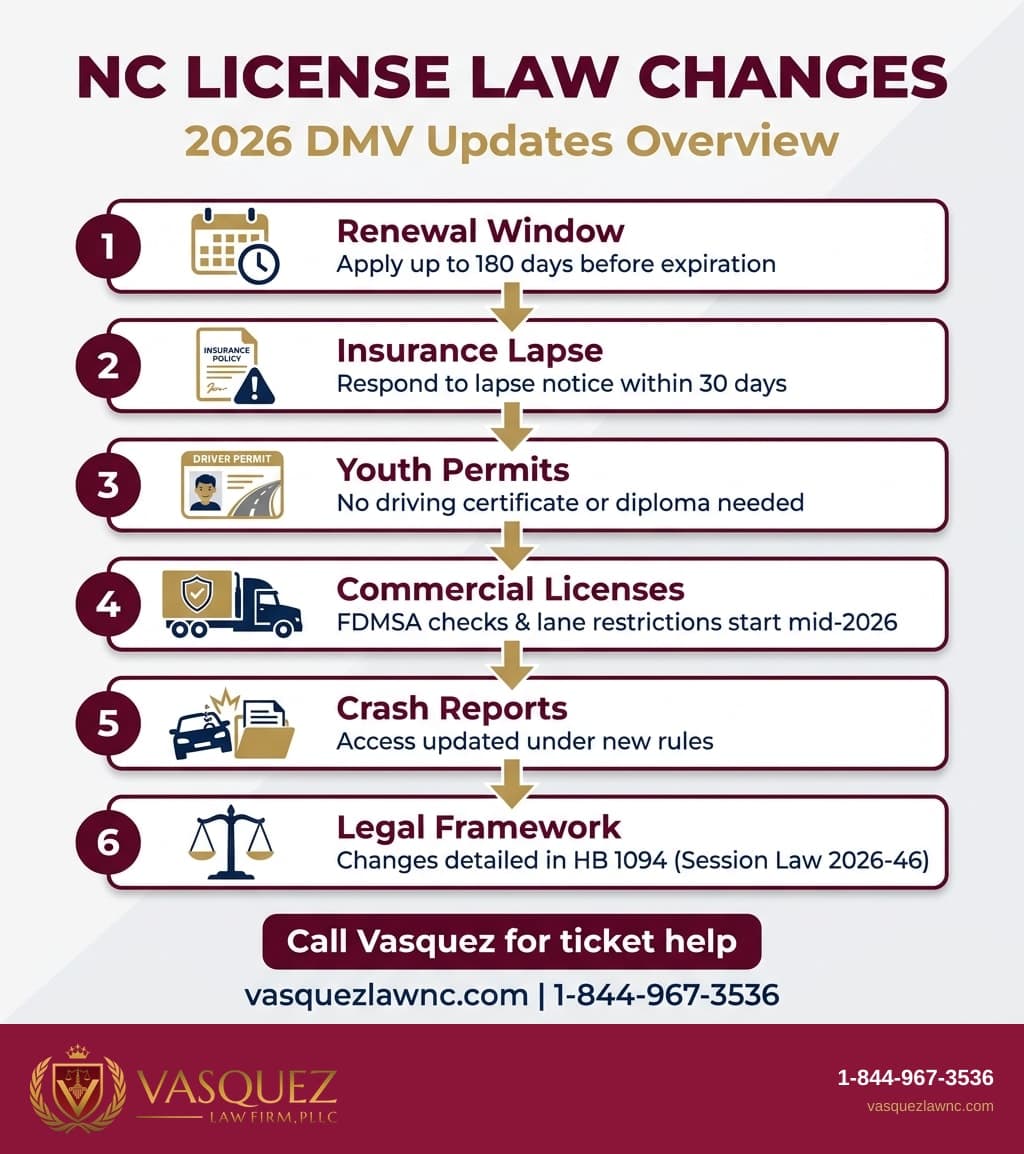
North Carolina driver license law changes took effect at several points in 2026. They changed when residents can renew. They also changed how owners answer an insurance lapse notice. Some young drivers can now seek permits under different rules. Session Law 2026-46, also known as HB 1094, combines these DMV changes with transportation measures. Those measures affect commercial licenses, crash reports, plates, and speed rules.
For a driver facing a ticket or license issue, a date on an NCDMV notice can control the next step. Our North Carolina traffic violation team handles tickets, speeding matters, driving while license revoked cases, and other license offenses in the firm’s service counties.
Legal disclaimer: This article gives general information. It is not legal advice for any person or case. A reader with a suspension, civil penalty, or traffic charge should review the notice. The reader should also get advice based on the facts. For case-specific help, the firm’s traffic ticket attorneys can assess the ticket and license records.
What changed under the North Carolina driver license law changes?
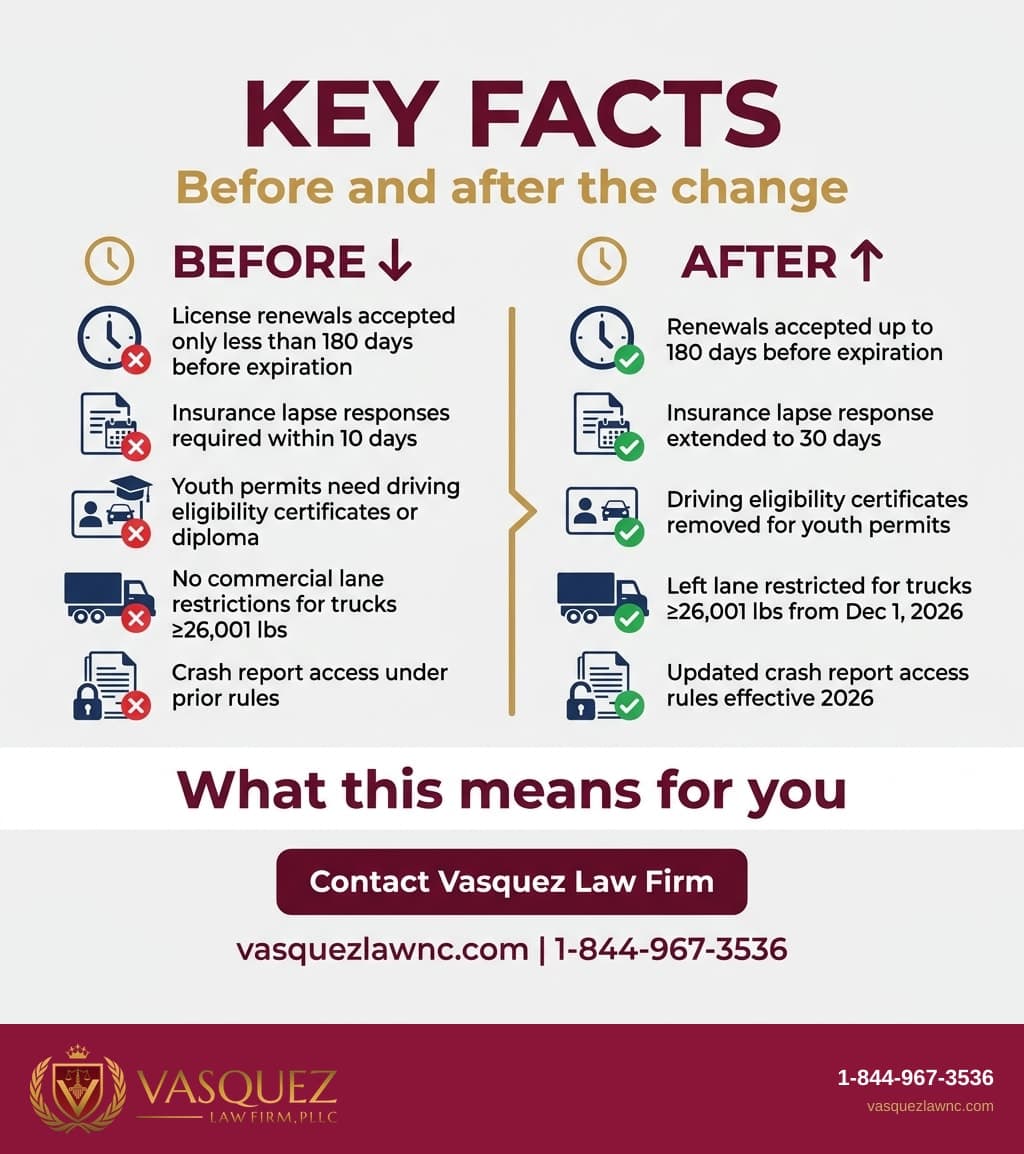
October 1, 2026, was the effective date for several changes. These included early regular license renewals. They also included longer response periods for insurance lapses. The changes removed driving eligibility certificate requirements for youth permits and provisional licenses. These changes appear in Session Law 2026-46 (HB 1094). The North Carolina General Assembly enacted that law.
Under amended G.S. 20-7(f)(3a), a person may apply to the Division to renew a license at any time before the license expires. Renewals more than 180 days before expiration are permitted and have a different fee calculation. The fee for a regular drivers license renewed during the 180-day period before the license expires is the fee set out in subsection (i) of this section. The fee for a regular drivers license renewed more than 180 days before the license expires is the fee for a duplicate license set out in G.S. 20-14, plus the fee for a regular drivers license set out in subsection (i) of this section, minus the per year fee set out in subsection (i) of this section for each full year of validity remaining in the period for which the license was issued.
"A person may apply to the Division to renew a license at any time before the license expires." (SL 2026-46 (HB 1094), Section 3)
G.S. 20-311(a) now requires that when the Division receives evidence, by a notice of termination of a motor vehicle liability policy or otherwise, that the owner of a motor vehicle registered or required to be registered in this State does not have financial responsibility for the operation of the vehicle, the Division shall notify the owner electronically or by mail. The notice shall inform the owner of the evidence demonstrating lapse and that the owner must respond to the notice within 30 days of the date the notice was sent. The owner's response must explain how the owner has met the duty to have continuous financial responsibility for the vehicle. This applies to notices issued on or after October 1, 2026. The prior response period was 10 days.
Section 9 also became effective October 1. It removes the driving eligibility certificate or diploma requirement from listed limited learner permit and provisional license provisions. It also directs NCDMV to restore a permit or license revoked under G.S. 20-13.2(c1) because of certificate ineligibility. The person must meet all other requirements.
Commercial license changes arrived earlier
The revised provisions require record checks before the Division issues a commercial driver license. They also address prohibited status in the Federal Motor Carrier Safety Administration's Commercial Driver's License Drug and Alcohol Clearinghouse. These changes became effective July 1, 2026, and apply to commercial drivers license and commercial drivers permit disqualifications initiated on or after that date.
A separate rule begins December 1, 2026. It applies to offenses committed on or after that date. It restricts vehicles with a gross vehicle weight rating of 26,001 pounds or more from using the left-most lane of a qualifying controlled-access highway. The restriction is subject to the exceptions written into G.S. 20-146(f).
Who do these NCDMV changes reach?
The early-renewal provision concerns a person renewing a regular driver license. The text addresses a regular driver license and explains how the Division calculates the fee when renewal happens more than 180 days before expiration.
The insurance provision reaches the owner of a motor vehicle registered or required to be registered in North Carolina. It applies when the Division receives evidence that financial responsibility ended. The owner’s response must explain how continuous financial responsibility was maintained. The response period is now longer, but the explanation is still required.
"The notice shall inform the owner of the evidence demonstrating lapse and that the owner must respond to the notice within 30 days of the date the notice was sent." (Source: SL 2026-46 (HB 1094))
The learner permit changes reach people at least 15 but less than 18. They apply to people who seek a limited learner permit under G.S. 20-11. They also affect people in the provisional license levels described in the statute. Certain new North Carolina residents between 16 and 18 are also covered. They must have an unrestricted out-of-state license.
Commercial provisions reach applicants for commercial driver licenses. They also reach employers of commercial drivers. Before issuing a commercial driver license, NCDMV must obtain records from CDLIS, the National Driver Register, the Clearinghouse, and each state where the person held a license. Employers may not knowingly allow a driver to operate a commercial motor vehicle during a period listed in amended G.S. 20-37.19(b).
Crash-report access also changes
Section 4 authorizes NCDMV to provide an unredacted crash report through secure electronic means. An unredacted report is a report that has not had protected information removed. The report must have been collected under G.S. 20-166.1. The recipient must be a person directly involved in the crash. The authority is framed by 18 U.S.C. § 2721. That is the federal Driver’s Privacy Protection Act provision referenced in the session law.
In our experience, the first question after a license notice is often whether a response will stop the suspension or penalty process. The answer depends on the notice. It also depends on the evidence of coverage and the legal process tied to that action.
What laws frame these driver license changes?
G.S. 20-7 governs driver licenses. G.S. 20-11 governs limited learner permits and provisional licenses for people under 18. The session law makes specific changes to those sections.
G.S. 20-311 addresses financial responsibility for vehicles. Its amended notice provision requires an owner to explain how continuous financial responsibility was met. This applies after NCDMV receives evidence of a lapse. Based on the owner's response, NCDMV must take the appropriate action listed in the statute.
G.S. 20-4.03 governs administrative hearing fees and written hearing requests before the Division. The session law keeps the rule that a hearing request must be in writing. The request must also include the applicable fee. It further says any pending revocation, suspension, civil penalty assessment, or other adverse action shall not be stayed upon receipt of an administrative hearing request unless the request complies with the requirements of this subsection.
Plate and record provisions are separate rules
Section 6 repeals G.S. 20-79(c1). Section 6.5 revises G.S. 20-63.1 concerning reflectorized plates. Reflectorized plates are designed to reflect light. Section 6.5 removes its mandatory replacement language. Section 7 addresses title-service fee adjustments and commission contractor rules. These provisions are separate from a driver’s license suspension or a traffic charge.
For commercial drivers, G.S. 20-37.17 now requires the Division to obtain specified record information before issuing a commercial license.
Drivers can request their NCDMV driver records to review information connected to a license issue. A record can help. However, it should be read with the actual notice, court paperwork, and proof of insurance.
What should you do after receiving an NCDMV notice?
A notice dated on or after October 1, 2026, about an insurance lapse should be read immediately. Confirm the vehicle listed in the notice. Check the coverage period and the owner information. Review the explanation NCDMV seeks. Preserve policy declarations, insurer correspondence, proof of reinstatement, vehicle-sale records, and other documents. These records may support continuous financial responsibility.
Next, use the response method identified in the notice. The revised G.S. 20-311(a) gives an owner 30 days from the notice’s sent date to respond. A response should directly address the evidence described by NCDMV. It should not simply state that coverage exists now.
If a suspension, revocation, civil penalty, or other adverse action is already pending, review G.S. 20-4.03 and the notice. Look for hearing instructions. The session law says a hearing request must be written. It must also include the applicable administrative hearing fee. A pending adverse action is not automatically stayed by a request. The request must meet those requirements.
Prepare a focused file
Keep the NCDMV notice, your license number, vehicle registration, insurance records, and court papers in one file. Commercial drivers should also preserve employer notices. They should keep documents related to a Clearinghouse status. A driver with a learner permit question should identify the permit level involved. The driver should also confirm whether all remaining G.S. 20-11 requirements are met.
For a ticket, license offense, or suspension matter in the firm’s North Carolina traffic service area, call Vasquez Law Firm at 1-844-967-3536 for a quote on the ticket. Se Habla Español. Call for a Ticket Quote
What should North Carolina drivers watch next?
January 1, 2027, is the deadline for NCDMV to report findings and recommendations on a possible percentage-of-revenue funding model. The required study includes possible effects on customer service, wait times, staffing, technology modernization, accountability, and legislative oversight.
January 15, 2027, is the deadline for the State Auditor’s Ferry Division performance audit report. The report must go to the Joint Legislative Transportation Oversight Committee and Fiscal Research Division. That ferry work is separate from the driver license provisions. Both reports could still inform future transportation legislation.
Drivers should monitor the Session Law 2026-46 page. They should also monitor NCDMV’s license suspension information page. These pages may provide official materials connected to a suspension or license status.
Many drivers still ask how NCDMV will handle early renewals and insurance-lapse responses in individual cases. The rule today concerns notices issued on or after October 1, 2026. Those notices receive the 30-day response period written into G.S. 20-311(a).
Frequently Asked Questions
Can I renew my regular North Carolina driver license early?
Yes. Amended G.S. 20-7(f)(3a) allows a person to apply to renew a regular driver license at any time before it expires. The statute retains the 180-day period and provides a different fee calculation for a renewal made more than 180 days before expiration. Review the license type and NCDMV renewal instructions before submitting an application.
How long do I have to answer an insurance lapse notice?
For notices issued on or after October 1, 2026, G.S. 20-311(a) gives the owner 30 days from the date the notice was sent. The response must explain how the owner met the duty to maintain continuous financial responsibility for the vehicle. Keep documents that directly support that explanation.
Did the law remove learner permit requirements for every teenager?
No. Section 9 removes the driving eligibility certificate or diploma requirement from listed G.S. 20-11 provisions. A person seeking a limited learner permit or provisional license must still meet the other requirements applicable to that permit level. The session law also directs restoration for certain certificate-based revocations when all other requirements are met.
Can a person directly involved in a crash obtain an unredacted crash report electronically?
Section 4 allows NCDMV to provide an unredacted crash report by secure electronic means to a person directly involved in the crash. The authority applies to reports collected under G.S. 20-166.1 and is authorized by 18 U.S.C. § 2721. That rule concerns report access, not fault for the crash.
What changed for commercial driver licenses?
For disqualifications initiated on or after July 1, 2026, Session Law 2026-46 updates North Carolina’s commercial license provisions to conform with federal regulations. Before issuing a CDL, NCDMV must obtain records from CDLIS, the National Driver Register, the Clearinghouse, and each state where the person has been licensed.
Can I request an NCDMV hearing after an adverse action?
G.S. 20-4.03 requires a written administrative hearing request accompanied by the applicable fee. The statute says a hearing will not be granted unless the request complies. It also provides that a pending suspension, revocation, civil penalty assessment, or other adverse action is not stayed unless the request meets those requirements.
Legal disclaimer: Rules about renewal, insurance, hearings, and license status can turn on the record and notice in your case. If you received a ticket or license-related notice in the firm’s traffic service area, contact Vasquez Law Firm at 1-844-967-3536 for a quote on the ticket. Get a Ticket Quote
Sources: North Carolina Session Law 2026-46 (HB 1094); NCDMV License Suspension; NCDMV Driver Records.
Reviewed by Attorney Vasquez, Managing Attorney
Need legal help?
Immigration in NC and FL. Personal injury and workers compensation across NC. Criminal defense in select NC counties depending on the charge (DWI in 12 counties), and traffic tickets in 20 NC counties. Tell us your county and we will tell you exactly what we can do.
Keep Reading


William Vasquez
Founder & CEO, Vasquez Law Firm, PLLC
William Vasquez is the founder and CEO of Vasquez Law Firm, PLLC, a results-driven firm specializing in immigration, criminal defense, personal injury, and workers' compensation. A U.S. Air Force veteran and recipient of the Joint Service Achievement Medal, William is dedicated to fiercely fighting for his clients' rights.
Related Legal Services
Need legal help? Learn more about traffic ticket help in Mecklenburg County, or contact us for a free evaluation.
You can also visit Smithfield traffic violation attorneys for more information.