North Carolina Criminal Gang Law Takes Effect in 2026
North Carolina criminal gang law changes arrive Dec. 1, 2026, with new felony levels, evidence rules, and court costs. Review your rights. Request a consultation today.
Published on October 12, 2026
Protect your record and your freedom
Free, confidential review.
Free & confidential · Se habla espanol · Mon-Fri 8am-7pm, Sat 9am-2pm (ET)
Have questions? Talk to an attorney - free evaluation.
Call 1-844-967-3536Protect Your Record and Your Freedom
A confidential case review. Call Mon-Fri 8am-7pm, Sat 9am-2pm ET.
North Carolina Criminal Gang Law Takes Effect in 2026
On December 1, 2026, North Carolina will use broader criminal gang definitions. The law also creates new firearm offenses. It raises some felony classifications and changes evidence rules for qualifying offenses. Session Law 2026-37 is also called House Bill 1173. It was ratified on July 2 and approved by the Governor on July 6.
The North Carolina criminal gang law matters for several reasons. A gang-activity allegation can affect the charged offense. It can affect the evidence presented at trial. It can also affect the felony class used at sentencing. People facing an allegation should understand the required elements. Elements are the facts prosecutors must prove. People should also preserve records early. Our North Carolina criminal defense attorneys represent clients in Johnston, Harnett, and Pitt counties.
This article provides general legal information. It is not legal advice for any individual case. A charge, a police allegation, and a conviction are different legal events. Anyone facing a criminal accusation should seek advice based on the exact allegations. The evidence and county involved also matter.
What changed under the North Carolina criminal gang law in 2026?
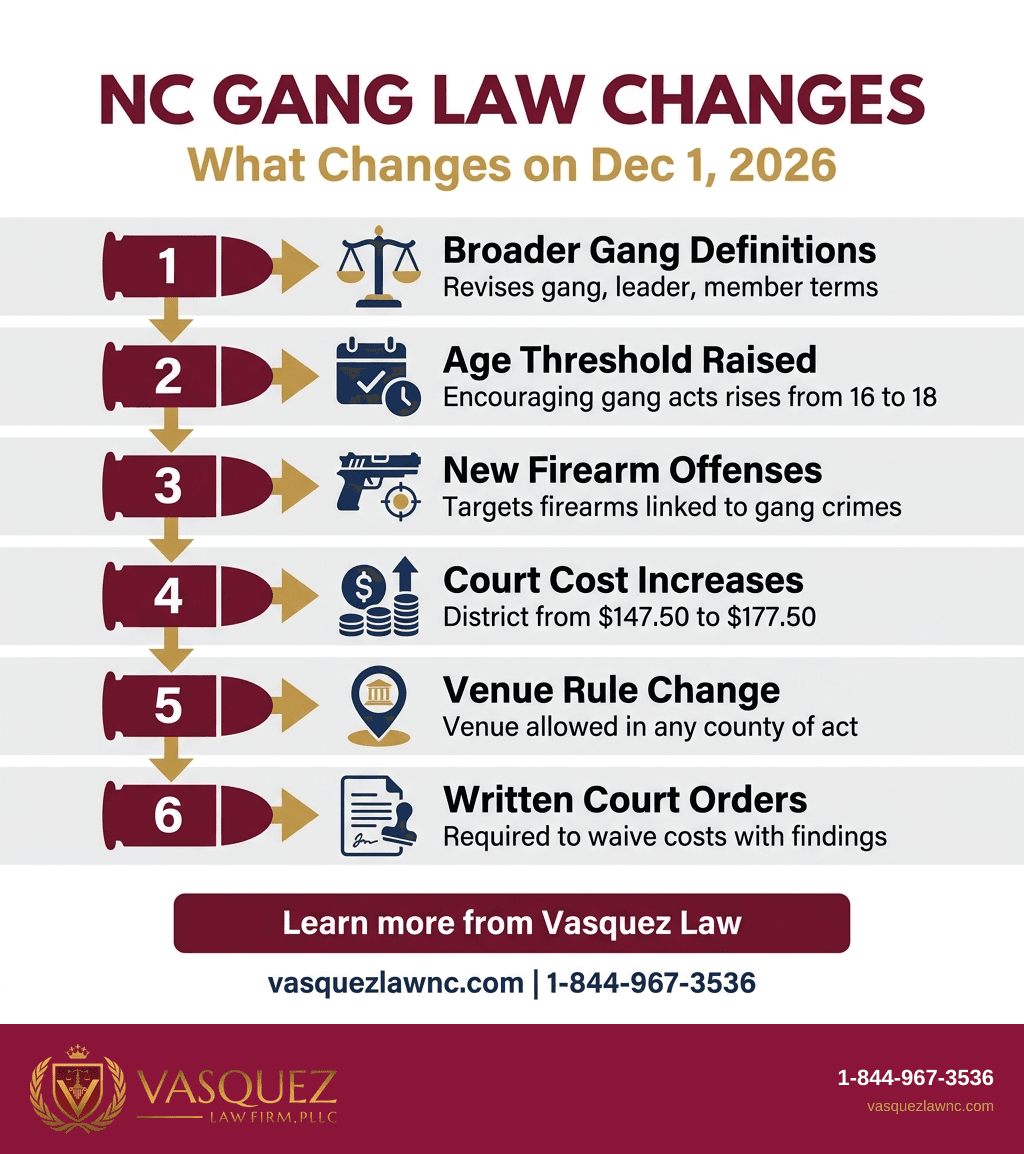
Session Law 2026-37 changes several parts of North Carolina criminal law on December 1, 2026. Its first section increases General Court of Justice costs. These costs are assessed after a conviction or guilty or no-contest plea. District court costs rise from $147.50 to $177.50. Superior court costs rise from $154.50 to $184.50.
The court-cost changes apply to costs assessed on or after December 1. The law keeps an important protection. No costs may be assessed when a case is dismissed. The law also requires a written order before a court may waive costs under the statute. That order must include findings of fact and conclusions of law. Findings of fact explain what the court decides happened. Conclusions of law explain how the law applies to those facts.
“No costs may be assessed when a case is dismissed.”
The larger changes concern Article 13A of Chapter 14. This article contains North Carolina’s criminal gang statutes. The law revises the definition of a criminal gang. It also revises the definitions of criminal gang activity, a criminal gang leader or organizer, and a criminal gang member. The law changes the age threshold for encouraging participation in gang activity. That threshold rises from 16 to 18.
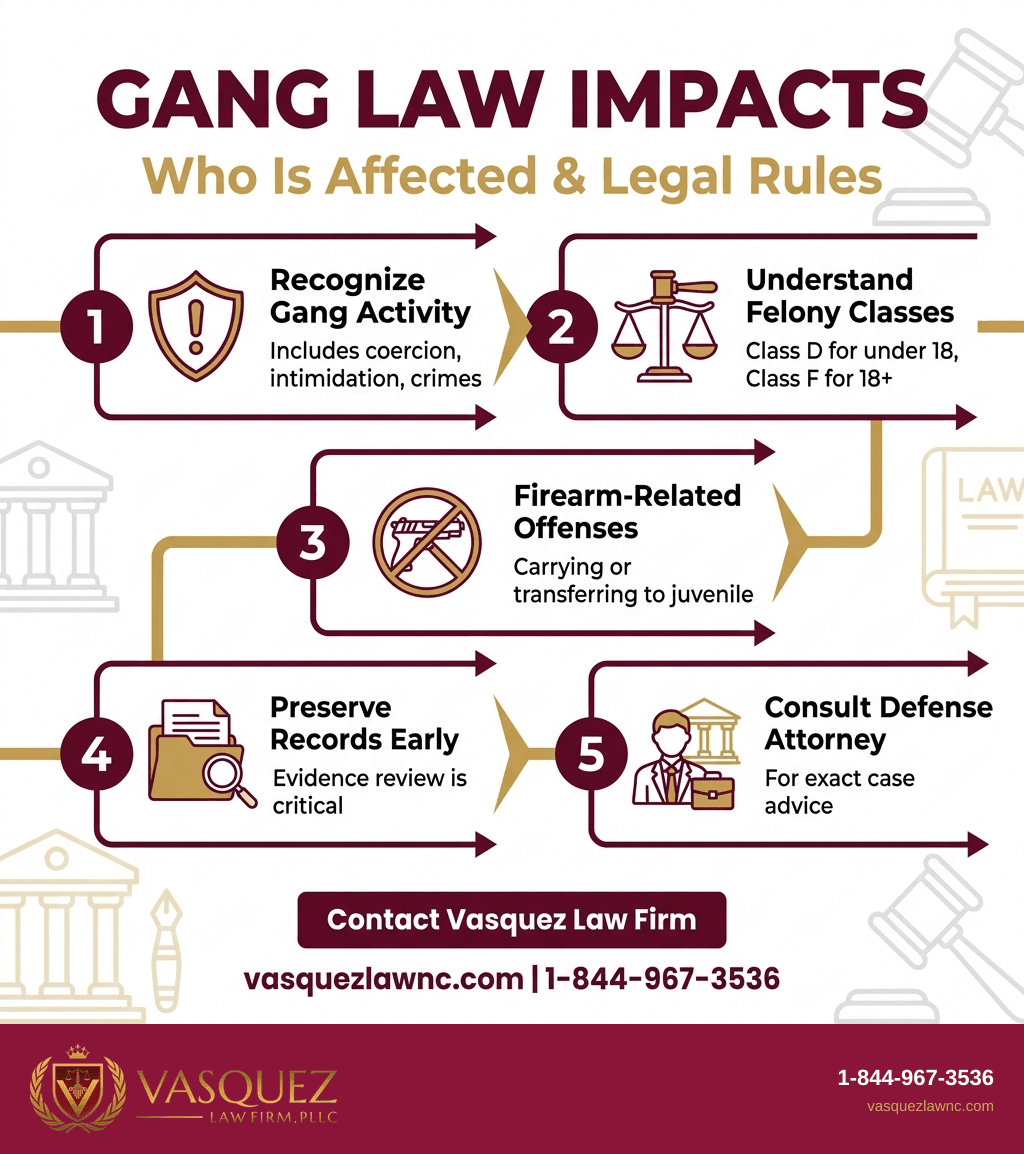
Under the revised provisions, certain conduct involving a person 18 or older becomes a Class F felony. The conduct includes causing, encouraging, soliciting, or coercing that person to participate in criminal gang activity. The same conduct involving a person under 18 becomes a Class D felony. Those classifications apply to offenses committed on or after December 1.
Session Law 2026-37 also creates two firearm-related offenses. One offense concerns a gang member’s use, carrying, or possession of a firearm. The firearm must relate to a serious felony, drug crime, or crime of violence. The other offense prohibits a gang member from selling, delivering, giving, or transferring a firearm to a juvenile. The person must know or have reasonable cause to believe the recipient is under 18.
Who can be affected by the North Carolina criminal gang law?
The North Carolina criminal gang law applies to offenses committed on or after December 1, 2026. The statute’s required elements must also be met. The revised definition describes a criminal gang as an ongoing organization, association, or group. It must include three or more persons. It must engage in criminal gang activity. It must also share identifying characteristics or behaviors.
The statute separately defines criminal gang activity. It includes several types of conduct. These include committing, attempting, soliciting, coercing, or intimidating another person to commit listed criminal offenses. Specific conditions must connect the conduct to gang interests or to participants acting collectively.
“A violation of this subsection is a Class G felony, unless subsection (c) or (d) of this section applies.”
The new firearm offense appears in N.C. Gen. Stat. § 14-50.32. The State must establish several facts. A criminal gang member must have used or carried a firearm during and in relation to a serious felony, drug crime, or crime of violence. Alternatively, the member must have possessed a firearm in furtherance of one of those crimes. The baseline offense is Class G. Brandishing raises it to Class F. Discharging the firearm raises it to Class D.
The revised member definition can also become central to a case. A person may meet the definition by satisfying at least two listed criteria. One criterion must be an admission, identification by a reliable source, or physical evidence. Examples of physical evidence include ledgers, rosters, or membership documents. Other listed considerations include prior involvement in criminal gang activity. They also include symbols, clothing, tattoos, language, photographs, social media, and communications.
These criteria are legal allegations. They are not automatic proof of guilt. The prosecution still has the burden of proof. It must prove each required element beyond a reasonable doubt. Defense review may focus on how the evidence was obtained. It may also focus on whether the evidence supports a statutory criterion. Another issue is whether the alleged crime has the required connection to criminal gang activity.
The cases we handle often turn on a specific question. Can an allegation that sounds broad be tied to the precise elements required by the statute?
North Carolina’s revised law also allows venue in any county where an act was performed as part of criminal gang activity. Venue means the county where a criminal case may be filed. This rule can affect the location of a case. It matters when allegations span more than one county.
What legal rules govern gang-related charges and sentencing?
Beginning December 1, 2026, N.C. Gen. Stat. § 14-50.16A contains the revised definitions. These definitions guide criminal gang allegations. The law excludes an association of three or more people who are not engaged in criminal gang activity. That limiting language matters. Association alone is not the complete statutory test.
N.C. Gen. Stat. §§ 14-50.17 and 14-50.18 address conduct involving another person. The conduct may cause, encourage, solicit, or coerce that person to participate in criminal gang activity. Session Law 2026-37 raises the age dividing those two statutes to 18. It also increases each offense’s felony classification.
The legislation adds N.C. Gen. Stat. §§ 14-50.32 through 14-50.35. Section 14-50.33 classifies the firearm transfer to a juvenile offense as a Class G felony. Section 14-50.34 permits proof through fact witnesses, expert witnesses, or combined fact and expert witnesses under Chapter 8C.
Rule 416 of the North Carolina Rules of Evidence is also new. It permits evidence of a defendant’s commission of criminal gang activity. The evidence may be used to prove an element of an alleged offense in specified proceedings. When a prosecutor intends to use evidence under Rule 416, the statute requires disclosure at least 10 days before trial. A judge may change the period. A judge may also excuse pretrial notice for good cause.
Sentencing exposure can also change under N.C. Gen. Stat. § 15A-1340.16E. Sentencing exposure means the punishment a person may face. For felonies other than Class A, B1, or B2 felonies, a finding can raise the sentencing class by two levels. The finding must be that the offense was committed as part of criminal gang activity. A finding that the person was a criminal gang leader or organizer raises the class by three levels.
The new law lowers the threshold for the leader or organizer definition. The threshold changes from two qualifying criteria to at least one listed criterion. This makes careful review of the State’s evidence especially important. It matters when the State alleges an enhanced sentence. An enhanced sentence is a higher punishment based on an added legal finding.
What should you do if a gang allegation appears in your case?
A person charged after December 1, 2026 should first obtain and preserve every charging document. A charging document is a paper that states the formal accusation. Review the warrant, citation, indictment, release order, and pretrial-release conditions. These documents identify the charged offense, court date, county, and formal allegations made by the State.
Next, create a factual timeline for counsel. Counsel means the lawyer handling the case. Record police contacts, searches, interviews, and property seizures. Also record witness names, social-media account access, and statements made by officers. Do not alter messages, images, account data, or physical items. Those materials could become evidence.
Ask for discovery through counsel and review it closely. Discovery is the evidence and information exchanged in a criminal case. Under Rule 416, gang-activity evidence intended for use under that rule generally requires pretrial disclosure. Materials may include witness statements or a summary of expected testimony. The timing can matter to preparation. Any judicial modification can also matter.
Do not assume that a gang-related label decides the case. The legal questions are narrower. Did the alleged conduct occur? Can the State establish membership under the statutory definition? Does the crime meet the definition of criminal gang activity? Was the evidence lawfully obtained and admissible? Admissible means allowed for use in court.
People concerned about added court costs should track the result of each charge. A dismissal and a conviction have different consequences under N.C. Gen. Stat. § 7A-304(a). Keep receipts, judgments, and payment records. Also keep any written court order involving costs.
If your case is in Johnston or Harnett County, you may request a consultation with our criminal defense legal team in Smithfield, NC. Bring your charging papers and court notices. This allows the allegations to be evaluated in context. Se Habla Español.
What should North Carolina defendants watch for next?
December 1, 2026 is the key transition date for most of Session Law 2026-37. The revised gang definitions apply to offenses committed on or after that date. The same is true for the solicitation offenses, firearm offenses, witness rules, Rule 416, venue provision, and sentencing enhancement. The increased court costs apply to costs assessed on or after that date.
That distinction is important. The date of an alleged offense may determine which version of a statute applies. Court filings and charging documents should identify the alleged date or date range. Counsel can then assess the legal framework governing the case.
Readers should watch the North Carolina General Assembly’s enacted Session Laws page. They should watch for later amendments to Session Law 2026-37. Readers should also watch the North Carolina Judicial Branch for court rules and case administration updates. Trial courts will apply these provisions through individual cases. In those cases, the evidence and statutory elements must be tested.
One material question will arise case by case. Do the alleged facts meet the revised definition of criminal gang activity? The answer depends on the charged conduct. It also depends on the State’s evidence and the statutory elements. A label alone does not answer the question.
Frequently Asked Questions
When does the North Carolina criminal gang law take effect?
Most criminal-law changes in Session Law 2026-37 take effect December 1, 2026, and apply to offenses committed on or after that date. The court-cost increase also begins December 1, but it applies to costs assessed on or after that date. The relevant date can differ depending on the issue in the case.
Can a criminal gang allegation increase a felony level?
Yes. Under revised N.C. Gen. Stat. § 15A-1340.16E, a felony committed as part of criminal gang activity may be sentenced two felony classes higher, except for Class A, B1, and B2 felonies. A finding that a person was a criminal gang leader or organizer may increase the sentencing class by three levels.
What is the new firearm offense?
N.C. Gen. Stat. § 14-50.32 makes it unlawful for a criminal gang member to use or carry a firearm during and in relation to, or possess one in furtherance of, a serious felony, drug crime, or crime of violence. The baseline classification is Class G, with higher classifications for brandishing or discharging a firearm.
Can prosecutors use expert testimony about alleged gang activity?
Yes. New N.C. Gen. Stat. § 14-50.34 permits gang activity, membership, association, leadership, and existence to be proven through fact testimony, expert testimony, or combined fact and expert testimony under Chapter 8C. The statute lists areas such as characteristics, practices, terminology, customs, rivalries, and likely crimes.
What advance notice is required for Rule 416 evidence?
Rule 416 generally requires a prosecutor who intends to offer covered gang-activity evidence to disclose it at least 10 days before trial. The disclosure includes witness statements or a summary of expected testimony. A judge may shorten, lengthen, or excuse the notice period upon a showing of good cause.
Are court costs assessed if a criminal case is dismissed?
No. N.C. Gen. Stat. § 7A-304(a), as amended by Session Law 2026-37, states that no costs may be assessed when a case is dismissed. The amended statute also sets procedures for waiving certain costs, including written findings and notice to affected government entities before a hearing.
Legal disclaimer: This article is general information and is not legal advice. Criminal allegations can carry serious consequences, and outcomes depend on the evidence, charges, court rulings, and facts of each case.
If you face charges in Johnston, Harnett, or Pitt County, contact Vasquez Law Firm to request a consultation. Our team can review your court documents, explain the allegations, and discuss potential next steps.
Reviewed by Attorney Vasquez, Managing Attorney
Need legal help?
Immigration in NC and FL. Personal injury and workers compensation across NC. Criminal defense in Johnston, Harnett and Pitt counties, and traffic tickets in 10 NC counties. Tell us your county and we will tell you exactly what we can do.
Keep Reading


William Vasquez
Founder & CEO, Vasquez Law Firm, PLLC
William Vasquez is the founder and CEO of Vasquez Law Firm, PLLC, a results-driven firm specializing in immigration, criminal defense, personal injury, and workers' compensation. A U.S. Air Force veteran and recipient of the Joint Service Achievement Medal, William is dedicated to fiercely fighting for his clients' rights.
Related Legal Services
Need legal help? Learn more about criminal defense case consultation, or contact us for a free evaluation.
You can also visit criminal defense services in Harnett County for more information.