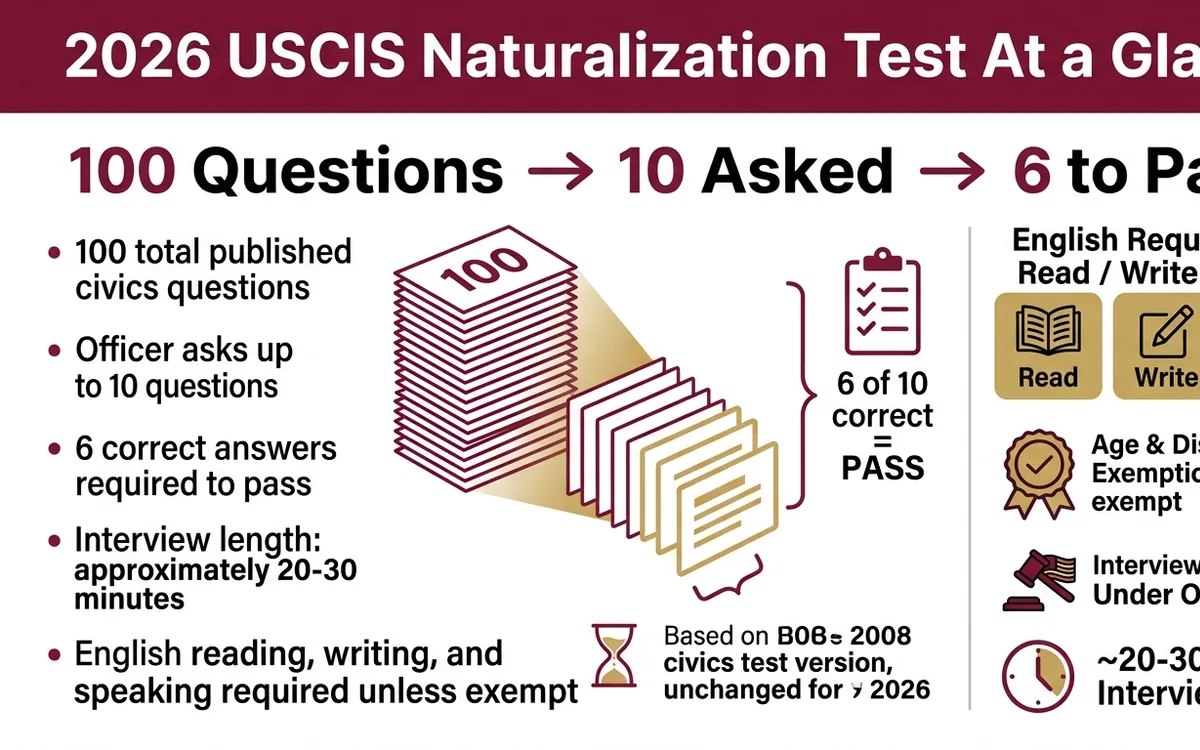
In 2026, USCIS still uses the 2008 civics test: the officer asks up to 10 of 100 published questions, and you need 6 correct answers to pass. You also must read, write, and speak basic English unless you qualify for an age or disability exemption. The interview itself runs about 20 to 30 minutes and is conducted under oath.
Last updated: January 2026.
What Happens at the N-400 Interview
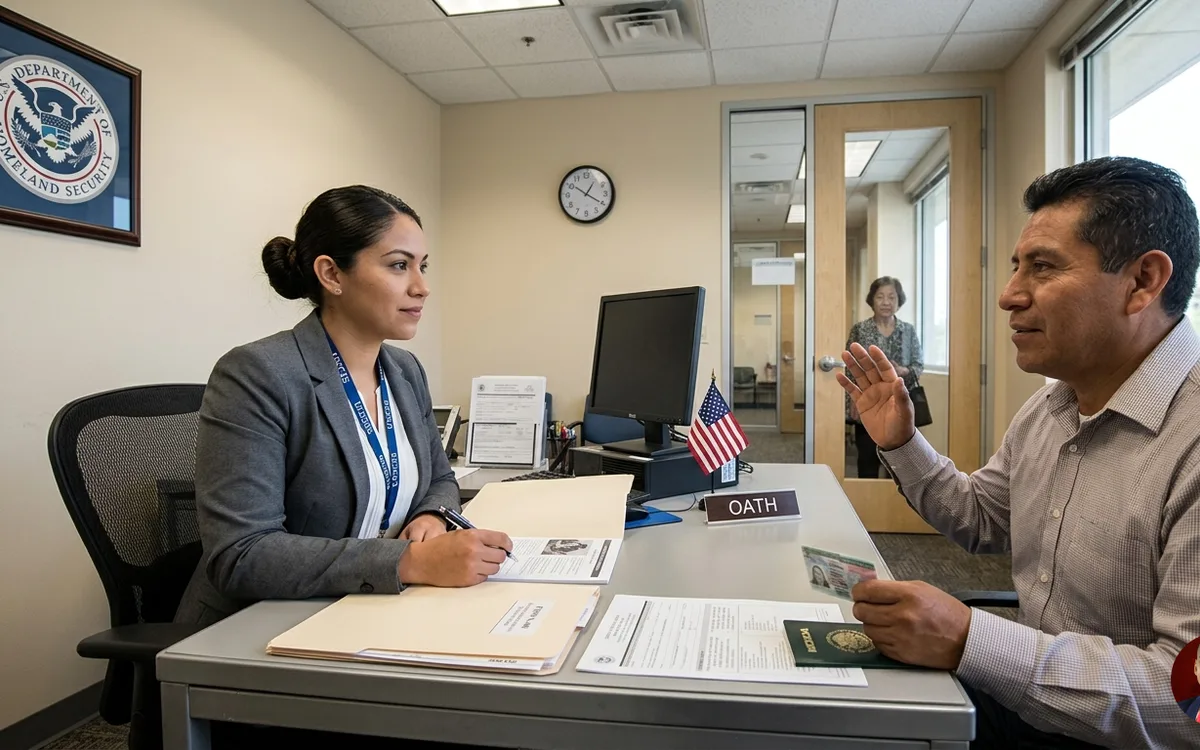
A USCIS officer reviews your Form N-400 under oath, confirms your biographical information, and asks about anything unclear in your file: prior addresses, employment history, trips outside the United States, any arrests. The interview usually runs 20 to 30 minutes. Your English ability is assessed throughout this conversation, not as a separate quiz tacked on at the end.
How Many Civics Questions Are Asked, and How Many Must You Get Right?
USCIS still administers the 2008 civics test for applicants filing in 2026. The officer asks up to 10 questions drawn from the full set of 100 published civics questions on American government and history (checked on USCIS's citizenship test page, January 2026). You pass once you answer 6 correctly, and the officer stops asking at that point. USCIS piloted a redesigned, scenario-based test in 2024 and withdrew it in early 2025, reverting to the 2008 version. No replacement has been announced as of this writing, but USCIS can change the format with limited notice, so confirm the current test page before you start studying.
What Does the English Requirement Actually Test?
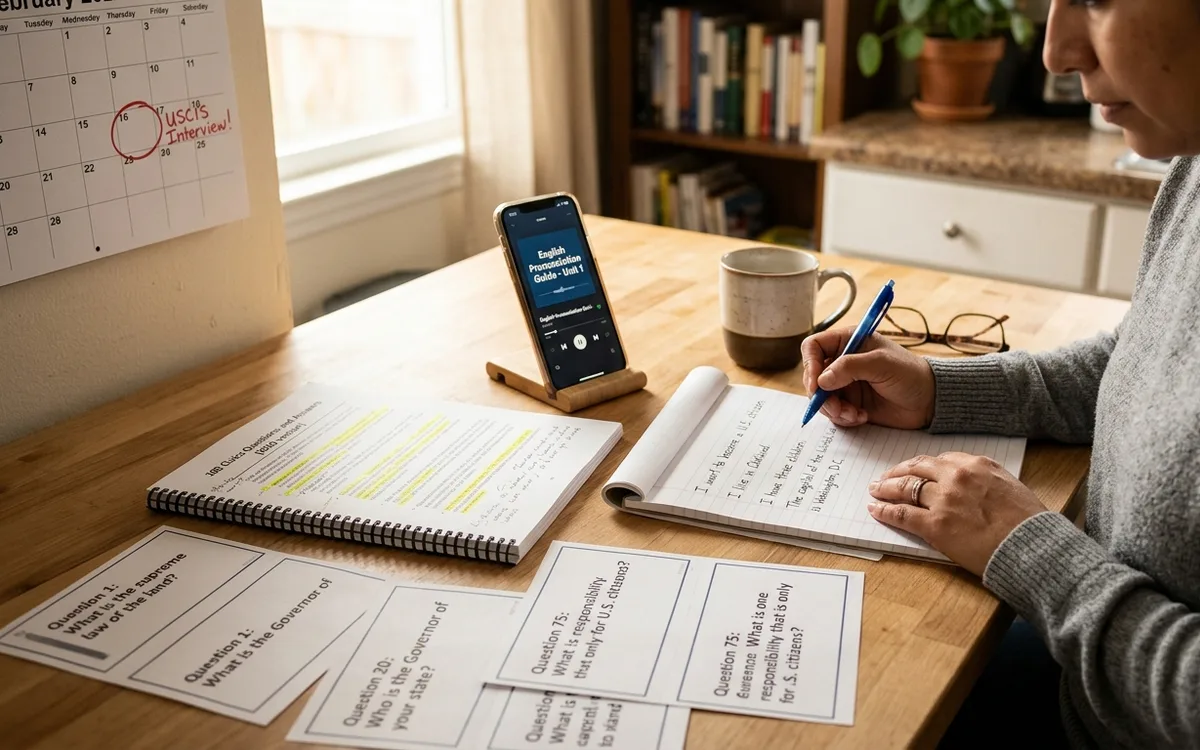
Three parts: reading one sentence aloud correctly from an approved vocabulary list, writing one sentence from dictation, and speaking, which the officer evaluates through your answers about your own N-400 rather than a standalone conversation test.
Who Qualifies for an Age or Disability Exemption?
The 65/20 exemption lets applicants study only 20 of the 100 civics questions, in a language of their choice, with an interpreter present. The 50/20 and 55/15 exemptions waive English entirely but still require the full 100-question pool, answered through an interpreter. None of these waive the interview itself or the good moral character review.
A fourth path, Form N-648, Medical Certification for Disability Exceptions, lets a licensed medical professional certify that a physical, developmental, or mental impairment prevents an applicant from meeting the English or civics requirement, or both (see USCIS's N-648 form page, checked January 2026). USCIS reviews the form for internal consistency; a vague or boilerplate certification is a common reason officers request a new one.
What Disqualifies an Applicant on Moral Character Grounds?
USCIS reviews good moral character for the five years before filing, or three years if applying based on marriage to a U.S. citizen under INA Section 312 and related provisions summarized in USCIS Policy Manual Volume 12 (checked January 2026). Certain convictions, unresolved tax debt, unpaid child support, and failure to register for Selective Service can each lead to a denial or a request for more evidence. An old conviction does not automatically disqualify you, but disclose it and discuss it with an attorney before filing, not for the first time at the interview.
What Happens After You Pass?
USCIS schedules an oath ceremony, administrative or, less often, judicial, where you take the Oath of Allegiance and receive your Certificate of Naturalization. Some applicants are sworn in the same day as their interview. Others wait weeks for a separate ceremony date, depending on the field office's schedule.
How Long Does It Take in North Carolina?
Processing time depends heavily on which field office handles your case. The USCIS Charlotte and Raleigh field offices, which process most of this firm's North Carolina naturalization clients, have historically reported N-400 timelines ranging from several months to just over a year from filing to decision, though that range shifts monthly with staffing and volume. Check your office's current figure on USCIS's Case Processing Times tool before you plan around a date; any number printed here will be stale by the time you read it.
What Does Filing Cost?
As of the firm's most recent check of USCIS's N-400 form page (January 2026), the filing fee is $760 on paper or $710 online, plus a separate biometrics fee in cases where USCIS still requires one. Confirm the current fee before submitting payment; an outdated amount is a common reason applications are rejected for insufficient payment.
Who Prepared This Page
Attorney William J. Vasquez, admitted to the North Carolina State Bar, prepares N-400 applicants for interviews conducted out of the USCIS Charlotte and Raleigh field offices, including cases involving N-648 disability waivers and moral character issues that required additional documentation ahead of the interview.
What if I fail the civics or English test? USCIS schedules a second interview, generally 60 to 90 days later, to retest only the portion you failed. Failing the same portion twice results in a denial, though you can refile later.
Can I reschedule my interview? Yes, submit a written request before the scheduled date using the process listed on your interview notice. Rescheduling pushes you to the back of that field office's queue, often adding months.
Does a Selective Service failure block naturalization? Most men who lived in the U.S. between ages 18 and 26 were required to register. A failure to register raises a moral character question but is not automatically disqualifying, particularly if it was not knowing and willful. Review this with an attorney before filing rather than after a denial; our Selective Service compliance guidance covers the registration process in more detail.
Does an old DUI or misdemeanor automatically disqualify me? No. USCIS weighs the offense, how long ago it occurred, and your record since. Some convictions trigger a mandatory bar; others get weighed against the rest of your history. Disclose every arrest and conviction regardless, since an undisclosed one is treated far more seriously than a disclosed one.
Can I bring an interpreter without qualifying for an age exemption? Generally no. Outside the 50/20, 55/15, 65/20 exemptions, or an approved N-648 waiver, the interview and both English tests happen in English.
What should I bring to the interview? Your interview notice, green card, passport, and anything USCIS specifically requests in that notice, such as tax transcripts or court records. Missing documents is one of the more common reasons officers continue a case instead of deciding it that day.
How does this connect to other immigration issues? A surfaced removal order, unresolved tax debt, or a green card obtained through marriage less than five years before filing can affect eligibility independent of the civics and English requirements. These overlap with our green card renewal guidance and our moral character denial resources, worth reviewing before you submit the N-400.
If your N-400 involves a prior conviction, a Selective Service gap, or a disability that may qualify for an N-648 waiver, talk through it with the firm's immigration team before your interview date, not after a denial notice arrives.