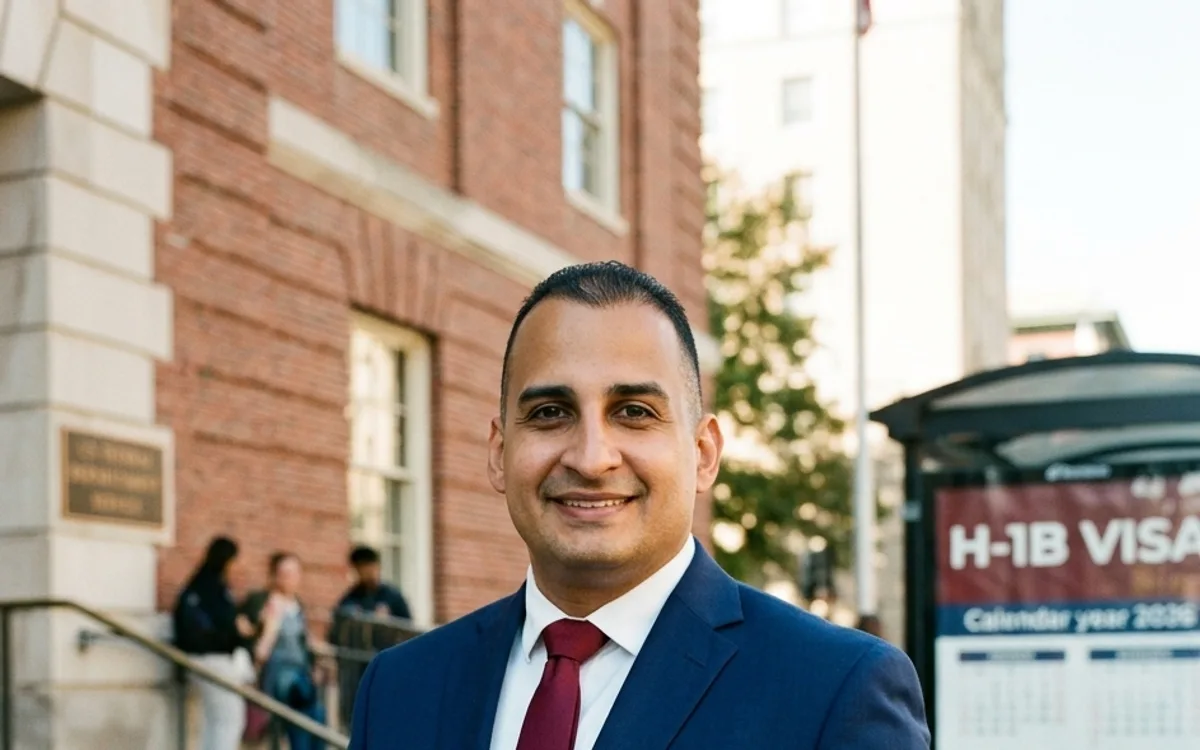
An H-1B is a U.S. work visa for specialty-occupation jobs that require at least a bachelor's degree in a specific field, sponsored by a U.S. employer filing Form I-129 with USCIS. Most 2026 petitions are still subject to an annual cap of 65,000 regular slots plus 20,000 reserved for U.S. master's degree holders, filled through USCIS's electronic registration system each March.
Last updated: February 2026. Reviewed by William J. Vasquez, founding attorney of Vasquez Law Firm, whose practice includes H-1B petitions for employers across manufacturing, healthcare, and technology.
What Is an H-1B Visa and Who Qualifies?
The H-1B category is defined at INA § 101(a)(15)(H)(i)(b) and 8 U.S.C. § 1184, and the regulations sit at 8 C.F.R. § 214.2(h). To qualify, the job must be a "specialty occupation," meaning it normally requires a bachelor's degree or higher in a specific field, not just a degree in general. The worker needs that degree, or equivalent experience USCIS will accept in its place, and a U.S. employer has to sponsor the petition. You cannot self-petition for an H-1B.
How Does the H-1B Registration and Lottery Work in 2026?
Before an employer can file Form I-129, it must first submit an electronic registration through USCIS's H-1B registration system, typically open for about two weeks in early March. Registration does not require the full petition, only basic information about the employer and worker. If registrations exceed the cap, which happens most years, USCIS runs a random selection. Selected registrants then have roughly 90 days to file the full I-129 petition, along with a certified Labor Condition Application (Form ETA-9035) from the U.S. Department of Labor confirming the wage and working conditions offered meet the prevailing wage for that occupation and location.
What Fees Apply in 2026?
Fees increased under a Department of Homeland Security fee rule published at 89 Fed. Reg. 6194 (Jan. 31, 2024), with the registration fee increase taking effect starting with the FY2026 cap season.
| Fee | Amount | Who Pays | Source |
|---|---|---|---|
| Electronic registration | $215 per beneficiary | Employer | DHS fee rule, 89 Fed. Reg. 6194, effective FY2026 registration cycle |
| Form I-129 base filing fee | $780 | Employer | Same rule, effective April 1, 2024 |
| Asylum Program Fee | $600 (employers with more than 25 full-time employees) or $300 (25 or fewer); some nonprofits exempt | Employer | Same rule |
| ACWIA training fee | $750 (fewer than 26 full-time employees) or $1,500 (26 or more) | Employer, cannot be shifted to worker | 8 C.F.R. § 214.2(h)(19); INA § 214(c)(9) |
| Premium processing (Form I-907) | $2,805 | Optional, employer or beneficiary | 8 C.F.R. § 103.7(e); USCIS fee schedule |
Premium processing guarantees a decision, approval, denial, or a Request for Evidence, within 15 calendar days, not business days, under 8 C.F.R. § 103.7(e)(2).
What Wage Level Should the Petition Use?
The Labor Condition Application requires the employer to select a prevailing wage level from the Department of Labor's Occupational Employment and Wage Statistics data, matched through the Foreign Labor Certification Data Center. There are four levels: Level I (entry), Level II (qualified), Level III (experienced), and Level IV (fully competent), based on the education, experience, and supervisory responsibility the job actually requires under DOL's Prevailing Wage Determination Policy Guidance.
In petitions our office has reviewed, the wage level is where problems start, not the paperwork itself. An employer classifies a mid-level software engineer role as Level I because the number is lower, while the job posting for the same role lists three to five years of required experience. That mismatch tells USCIS the position is not entry-level, and the result is a same-or-similar-title Request for Evidence that adds two to four months to the case.
How Long Can You Stay on H-1B Status?
USCIS grants H-1B status in increments of up to three years, with a total limit of six years under 8 C.F.R. § 214.2(h)(13)(iii)(A). Extensions beyond six years are available, but only if the worker has a pending or approved PERM labor certification, or an approved Form I-140 immigrant petition, filed at least 365 days before the six-year mark, under sections 104(c) and 106(a) and (c) of the American Competitiveness in the Twenty-First Century Act. Without that filing in place, the worker must leave the U.S. or change status when the six years run out.
Which Employers Are Exempt From the Cap?
Institutions of higher education, nonprofit entities affiliated with them, nonprofit research organizations, and governmental research organizations are exempt from the annual cap under INA § 214(g)(5)(A) and (B). A worker employed by a cap-exempt organization can file an H-1B petition at any time of year, without registering in March or waiting on lottery results.
What Happens if You Are Not Selected?
Nothing files. The registration simply expires for that fiscal year, and the employer has to register again the following March if it still wants to sponsor that worker. F-1 students on Optional Practical Training who filed a timely change-of-status H-1B petition before their OPT expired get an automatic cap-gap extension of both status and work authorization through September 30, under 8 C.F.R. § 214.2(f)(5)(vi), even if they are not selected that cycle, though the extension ends if they are not selected and no petition remains pending.
Can Your Spouse Work on H-4 Status?
An H-4 spouse can apply for work authorization under 8 C.F.R. § 274a.12(c)(26), but only if the H-1B spouse already has an approved Form I-140 or has received a post-six-year extension under AC21 sections 106(a) and (c). An H-4 spouse of a worker still inside the initial six-year period, with no pending green card process, does not qualify for an Employment Authorization Document.
What Causes Denials and RFEs?
The most common issues we see are specialty-occupation objections, where USCIS questions whether the role truly requires a specific bachelor's degree, wage-level mismatches like the one above, and employer-employee relationship problems on third-party placements. Under Matter of Simeio Solutions, LLC, 26 I&N Dec. 542 (AAO 2015), a material change in worksite location requires an amended H-1B petition, not just a notice. USCIS's Fraud Detection and National Security unit conducts unannounced site visits to confirm the worker is actually performing the duties, at the wage, and at the location listed in the petition. A mismatch discovered at a site visit can trigger a Notice of Intent to Revoke even after approval.
Frequently Asked Questions
How much does an H-1B cost in 2026? Government fees alone typically run from about $1,545 to over $3,000 per petition, combining the $215 registration fee, $780 base filing fee, the Asylum Program Fee, and the ACWIA training fee where it applies, before attorney fees or optional premium processing.
What are my odds of being selected in the lottery? USCIS does not guarantee a fixed rate. It publishes final registration and selection numbers after each cycle closes, and the odds shift every year based on how many registrations are submitted.
What happens if I'm not selected and my OPT is about to expire? If your employer filed a timely change-of-status petition, cap-gap coverage under 8 C.F.R. § 214.2(f)(5)(vi) can extend your status and work authorization through September 30, but only while a request remains pending.
Which employers don't need to enter the lottery? Universities, affiliated nonprofits, and nonprofit or governmental research organizations under INA § 214(g)(5).
Can my spouse work on H-4 status? Only if you already have an approved I-140 or a post-six-year AC21 extension.
How long can I stay on H-1B status total? Six years under 8 C.F.R. § 214.2(h)(13)(iii)(A), longer if a green card process is already underway.
Can I change employers while on H-1B? Yes, through H-1B portability under INA § 214(n), which lets you start work for a new sponsor once it files a non-frivolous H-1B petition on your behalf, before that petition is approved.
Do I need premium processing? It only speeds up the government's decision time to 15 calendar days. It does not improve your odds of approval or change the underlying eligibility requirements.
What triggers a site visit? Any H-1B worksite can be visited by USCIS's Fraud Detection and National Security unit at any time after approval, without notice, to confirm the job, wage, and location match the petition.
Is a change of status the same as consular processing? No. A worker already in the U.S. in valid status may request a change of status via Form I-129; a worker abroad, or one who prefers it, goes through a U.S. consulate instead, which involves a separate visa interview and DS-160 application.
An H-1B is rarely the end of the process for someone planning to stay in the U.S. long-term. Many H-1B holders eventually move toward the PERM labor certification process with the Department of Labor as the first step toward an employment-based green card, and the wage-level classification used on the original LCA often follows the case into that PERM filing, which is one more reason to get it right the first time. Once a PERM case and Form I-140 are approved, the worker's place in line depends on the EB-2 or EB-3 category and country of birth, and current backlogs for applicants born in India or China can run several years longer than for other countries. Families also need to plan around H-4 status separately, since a spouse's work authorization depends on where the principal worker stands in that same green card timeline. Anyone weighing these options alongside a first-time H-1B filing should look at this within the firm's broader Immigration Law practice, since the registration, the LCA, and the long-term green card strategy are usually decided together, not one at a time.
Before you call anyone, you can check two things yourself. Your employer is required to post the Labor Condition Application at the worksite, or notify affected employees electronically, for 10 business days before filing, under 20 C.F.R. § 655.734, so ask to see it. And once a petition is filed, you can track its status directly through USCIS's case status tool using the receipt number on your Form I-797 Notice of Action. If the wage level, the specialty-occupation description, or a pending Request for Evidence has you concerned, William J. Vasquez and the immigration team at Vasquez Law Firm review H-1B petitions, LCAs, and cap-exempt employer transfers for workers and employers across North Carolina. Call to have your paperwork checked before a filing deadline passes, not after an RFE arrives.