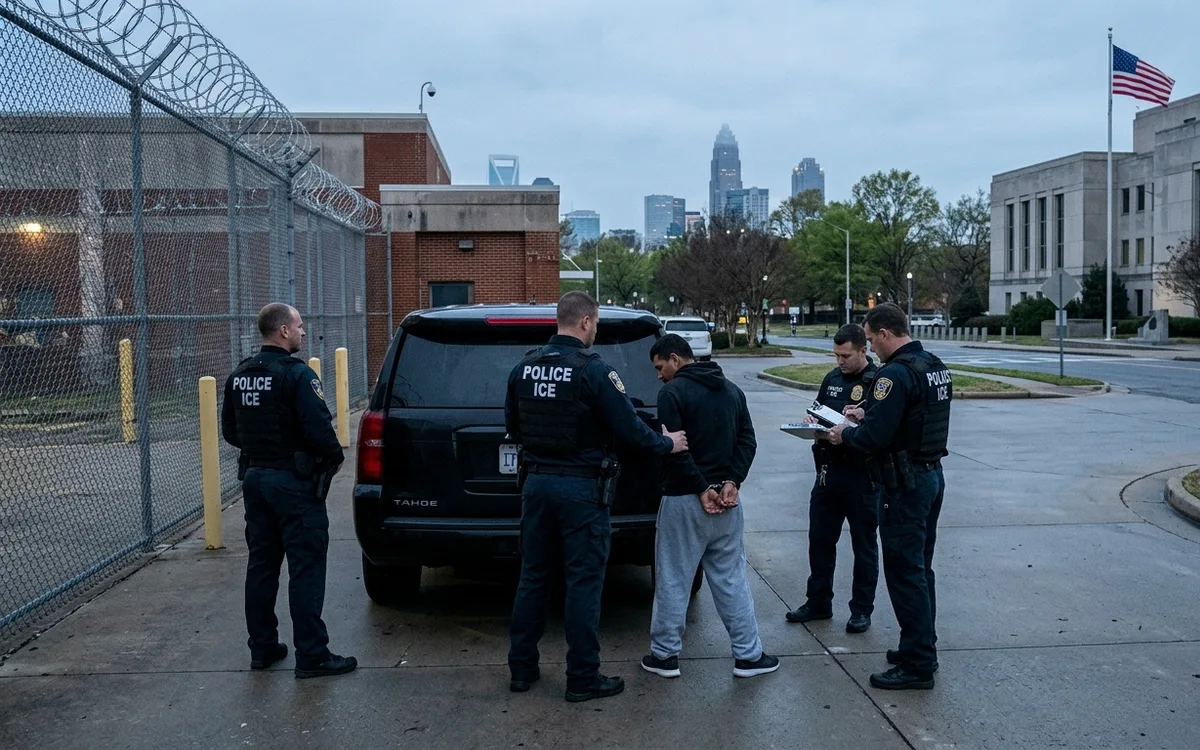
A video of an ICE arrest tied to a Chicago mass shooting is circulating, and the name attached to it is Tren de Aragua. If you searched that story because a father, brother, or neighbor in North Carolina got swept into the same net on an unrelated stop, the fear is not abstract. A gang allegation changes how an immigration case moves, and it rarely moves toward release.
TdA's designation as a Foreign Terrorist Organization under Executive Order 14157 (Jan. 20, 2025) means federal agents treat any suspected link to the group as a national-security matter, not a routine immigration violation. That designation does not stay in Chicago. It follows the person into any ICE detainer, any 287(g) hold, and any bond hearing anywhere in the country, including Charlotte.
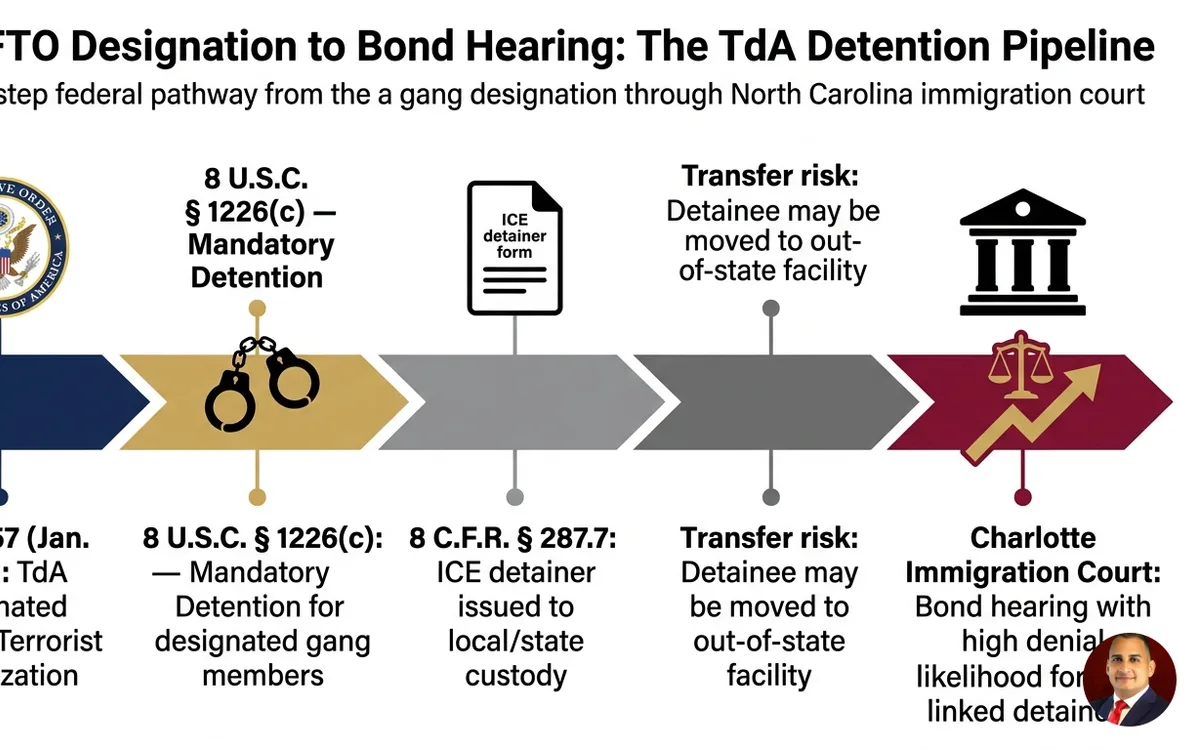
When ICE arrests a Tren de Aragua member, like the suspect tied to a Chicago mass shooting, the gang's Foreign Terrorist Organization designation (Executive Order 14157, Jan. 2025) triggers mandatory detention under 8 U.S.C. § 1226(c). In North Carolina, that means an ICE detainer under 8 C.F.R. § 287.7, transfer risk, and a steep climb at a Charlotte Immigration Court bond hearing.
The Hard Truth
The allegation alone can be enough to keep someone locked up
A gang allegation, even an unproven one, is often enough to trigger mandatory detention under 8 U.S.C. § 1226(c). An immigration judge does not have to find that the person committed a crime in Chicago or anywhere else. ICE only has to assert gang affiliation, and under Board of Immigration Appeals precedent such as Matter of E-A-G-, that assertion carries real weight even without a criminal conviction.
Here is the part most firms avoid saying plainly: once TdA comes up in a case, bond becomes difficult to obtain at Charlotte Immigration Court, and judges frequently deny it outright under the mandatory detention framework. Asylum and withholding of removal claims built on fear of TdA retaliation face a related problem, because gang membership itself is often treated as a bar to relief rather than a basis for it. We tell clients this before we tell them anything else, because a false sense of what is realistically available wastes the narrow window that does exist.
What Happens If You Wait
What delay actually costs in a detainer case
Under 8 C.F.R. § 287.7, an ICE detainer gives a North Carolina jail only 48 hours, excluding weekends and holidays, to hold someone past their release date. Miss that window without counsel lined up, and the person is often already in ICE custody and in transit before anyone can file anything.
Transfer moves fast after that. Mecklenburg County Jail Central, a 287(g) participating facility, regularly transfers ICE detainees out of state, and Stewart Detention Center in Lumpkin, Georgia is a common destination for people picked up around Charlotte. Once someone is moved, family members lose easy visitation, mail sent to the wrong facility goes missing, and the one-year filing deadline for an affirmative asylum application under 8 U.S.C. § 1158(a)(2)(B) keeps running regardless of where the person is held. A bond motion also has to be filed with the immigration court holding jurisdiction over the current detention site, so a transfer can mean starting the bond request over in a new court.
Nationally, immigration courts carried more than 3.6 million pending cases as of 2024, per TRAC Immigration at Syracuse University (tracreports.org/immigration), and ICE's FY2024 Enforcement and Removal Operations report documented more than 170,000 detainers lodged with local jails nationwide (ice.gov/features/ERO-2024). A gang-tied case does not move faster because of that backlog. Detained dockets are prioritized over non-detained ones under Charlotte Immigration Court's EOIR Local Operating Procedures, but prioritized does not mean quick, and the file still has to be built correctly the first time.
Step-by-Step Process
What Happens After ICE Lodges a Detainer for a Gang Allegation?
Local arrest or jail booking. Most North Carolina cases start with a state charge, sometimes unrelated to any gang conduct, such as a traffic stop or minor offense in Wake or Mecklenburg County.
ICE detainer issued. Under 8 C.F.R. § 287.7 (ecfr.gov) and N.C. Gen. Stat. § 162-62 (ncleg.gov), the county jail may hold the person up to 48 hours past release for ICE pickup. State law does not require the sheriff to question immigration status at arrest, but Mecklenburg County's 287(g) agreement lets its officers screen for ICE holds directly inside the jail.
Transfer to ICE custody. ICE's Charlotte Field Office, Enforcement and Removal Operations, takes custody and books the person into a detention facility, often transferring out of state if local bed space is full.
Notice to Appear and initial custody decision. ICE issues a Notice to Appear and makes an initial custody determination. When a gang allegation is attached, ICE frequently sets no bond at all, citing the mandatory detention provisions of 8 U.S.C. § 1226(c).
Bond hearing request. If mandatory detention does not clearly apply, the person can request a bond hearing before an immigration judge, typically at Charlotte Immigration Court under its EOIR Local Operating Procedures. The judge weighs flight risk and danger to the community, and a gang allegation goes directly to the danger prong.
Merits hearing on removal. If the case is not resolved at the bond stage, it proceeds to an individual merits hearing where the judge decides removability and any request for relief, including asylum, withholding of removal, or protection under the Convention Against Torture.
Appeal. A denied bond or removal order can be appealed to the Board of Immigration Appeals, and in limited circumstances to the federal circuit court covering North Carolina through a petition for review.
A Real-World Example
A composite example: a detainer that starts in Raleigh
This is a composite scenario built from the kind of case our team sees in the Triangle, not a real client and not a reported outcome. A man in Raleigh is arrested on a state charge in Wake County. During booking, Wake County Detention Center finds an ICE detainer already on file, based on a gang-database entry from another state.
He is held the full 48 hours permitted under 8 C.F.R. § 287.7, then ICE takes custody. Wake County is not a 287(g) jail, so there is no in-house ICE interview, but the detainer still controls his release. His family retains counsel and requests his A-number and detention location through the ICE Online Detainee Locator System.
Counsel reviews whether the gang-database entry supports mandatory detention under 8 U.S.C. § 1226(c) or whether a bond hearing is available. Where a hearing is available, the attorney gathers evidence on community ties, work history, and the specific basis for the gang allegation, then appears at Charlotte Immigration Court. This is where the process stands at the point this guide describes. What a judge ultimately decides depends on the individual record, and no attorney can promise that result in advance.
William J. Vasquez is licensed by the North Carolina State Bar and has focused his practice on detained removal defense and bond litigation in North Carolina for more than a decade, including cases involving disputed gang-database evidence and 287(g) detainers out of Mecklenburg County. He practices before the Charlotte Immigration Court and other EOIR immigration courts under federal immigration-bar authority (8 C.F.R. § 1292.1), which does not require separate state bar licensure in each location. His work on gang-allegation bond hearings centers on challenging the evidentiary basis ICE uses to support detention, not on predicting what a given judge will decide. Our team handles these cases; what we can control is the quality of the record and the speed of the filing, not the outcome.
Key Terms Explained
Foreign Terrorist Organization (FTO): A designation made by the U.S. Secretary of State under 8 U.S.C. § 1189 labeling a group as engaged in terrorist activity threatening U.S. security. Tren de Aragua received this designation under Executive Order 14157 (Jan. 2025).
ICE detainer: A written request, usually on Form I-247A, asking a jail to hold someone up to 48 hours past their release date so ICE can take custody, authorized under 8 C.F.R. § 287.7.
287(g) agreement: A partnership under which a local sheriff's office, such as Mecklenburg County's, is authorized by ICE to perform specific immigration-enforcement functions inside the jail, including identifying people subject to detainers.
Mandatory detention: A category under 8 U.S.C. § 1226(c) requiring ICE to hold certain noncitizens, including those with specified criminal or gang-related grounds, without the option of a bond hearing.
Bond hearing: A hearing before an immigration judge, distinct from a criminal bail hearing, where the judge decides whether someone not subject to mandatory detention can be released from immigration custody and on what conditions.
Aggravated felony: A defined category of offenses under 8 U.S.C. § 1101(a)(43) that, upon conviction, generally eliminates eligibility for most forms of immigration relief and bond.
Withholding of removal: Protection under 8 U.S.C. § 1231(b)(3) that bars deportation to a country where the person's life or freedom would be threatened, carrying a higher proof standard than asylum and fewer benefits.
Padilla advisal: The requirement from Padilla v. Kentucky, 559 U.S. 356 (2010), that a criminal defense attorney must advise a noncitizen client about the immigration consequences of a guilty plea before the plea is entered.
A-number: The unique alien registration number ICE and USCIS assign to track a noncitizen's case; family members need it to locate someone in detention through the ICE Online Detainee Locator System.
Frequently Asked Questions
Q: Does the Chicago mass shooting investigation affect an unrelated Tren de Aragua case in North Carolina? A: Not directly, but the Foreign Terrorist Organization designation under Executive Order 14157 applies nationwide. Any suspected TdA link anywhere, including an arrest connected to the Chicago shooting, can be cited by ICE to argue for mandatory detention and bond denial in a separate North Carolina case.
Q: Can a Mecklenburg County sheriff hold someone for ICE without a judicial warrant? A: Yes. Under the county's 287(g) agreement and N.C. Gen. Stat. § 162-62, jail staff can honor an ICE detainer and administrative warrant, Form I-200 or I-205, without a judge's signature, holding the person up to 48 hours past scheduled release under 8 C.F.R. § 287.7.
Q: Does a gang allegation automatically bar someone from asylum? A: Not automatically, but it is a serious obstacle. Under Board of Immigration Appeals precedent such as Matter of E-A-G-, gang membership can support a finding that bars asylum or withholding of removal, so the specific evidence behind the allegation has to be challenged directly.
Q: What happens if ICE transfers someone from North Carolina to Stewart Detention Center in Georgia? A: The bond motion and removal case generally follow the detainee to the new facility's jurisdiction. A case that started at Charlotte Immigration Court can end up proceeding before an immigration judge assigned to the Georgia facility instead.
Families searching for help after an ICE arrest want to know whether a firm actually shows up in immigration court, not just on a phone call. Reviews of our immigration team describe responsiveness during detainer holds, direct communication about the realistic odds at the bond stage, and follow-through on document requests sent to detention facilities. We do not publish outcome statistics, and we would not trust a firm that does, because no attorney can verify or guarantee what a judge decides in an individual case.
None of this is a reason to wait on its own, but a real deadline is. Every day a detainer sits unaddressed is a day closer to transfer, and a day closer to the one-year asylum filing clock running out. The honest first step, before calling anyone, is getting the person's A-number and current custody location through the ICE Online Detainee Locator System.
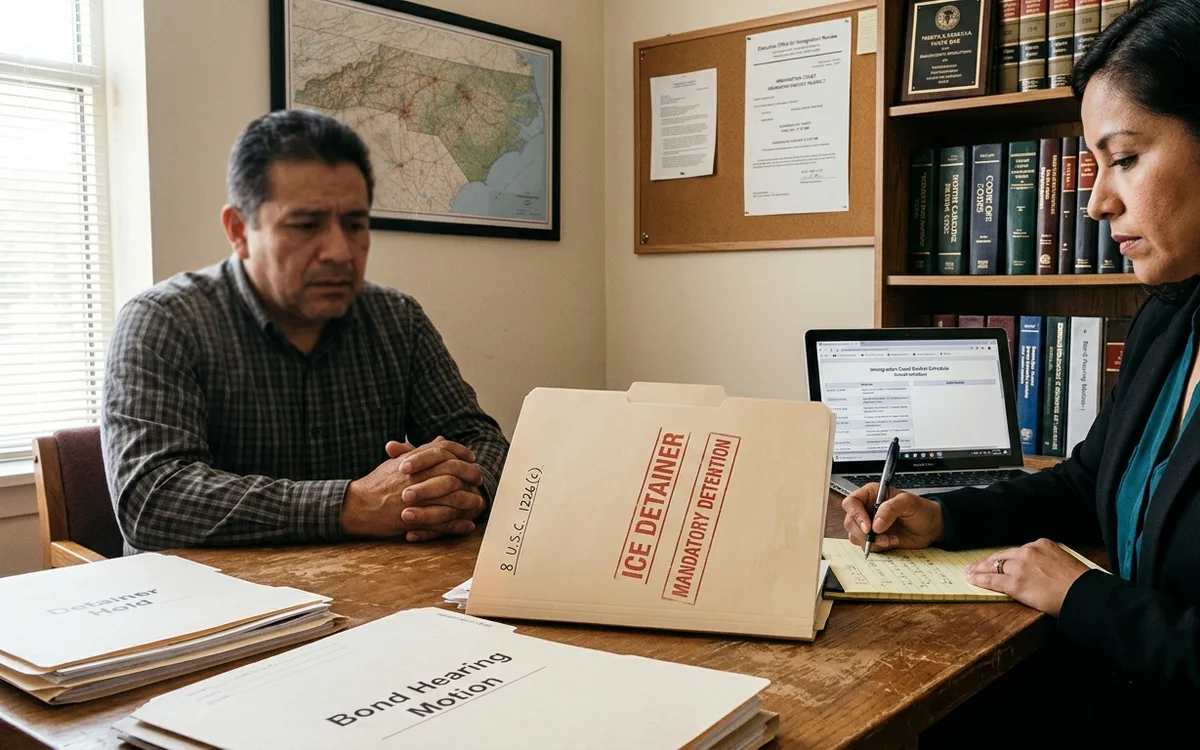
If ICE has lodged a detainer against a family member in Mecklenburg, Wake, or any North Carolina county, and a Tren de Aragua or other gang allegation is part of the file, call our office to schedule a consultation on detainer response and bond hearing preparation. We will review the detainer, the charging documents, and the basis for the gang allegation before your next court date, not after.
- ICE Detainer Defense in Mecklenburg County
- Charlotte Immigration Court Bond Hearings
- 287(g) Agreements and Your Rights in North Carolina
- Asylum and Withholding of Removal Deadlines
- What to Do When a Family Member Is Transferred Out of State
- Criminal Charges and Immigration Consequences (Padilla Advisals)