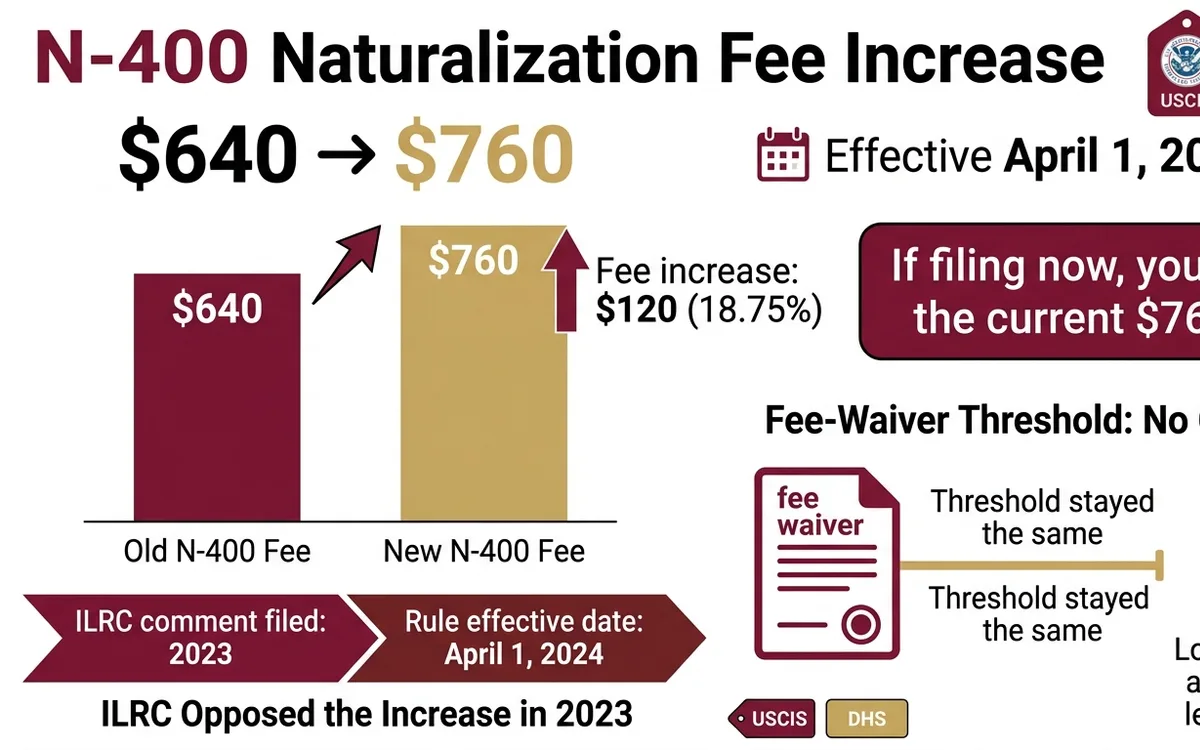
The ILRC (Immigration Legal Resource Center) filed written comments in 2023 opposing a Department of Homeland Security proposal to raise the N-400 naturalization fee from $640 to $760, arguing the increase would price out low-income applicants despite an unchanged fee-waiver threshold. DHS finalized the rule anyway; it took effect April 1, 2024. If you are filing now, you owe the current fee, not the one ILRC opposed.
What the ILRC Comment Actually Opposed
DHS published the proposed rule, "U.S. Citizenship and Immigration Services Fee Schedule and Changes to Certain Other Immigration Benefit Request Requirements," in the Federal Register on January 4, 2023, under docket number USCIS-2021-0010, with a comment period closing in early March 2023. ILRC was one of several hundred organizations that submitted comments through regulations.gov, arguing that USCIS had undercounted applicants who could not afford the increase and that its cost-allocation model shifted too much of the expense of asylum and refugee processing onto naturalization applicants, a population that does not generate that caseload.
Under the Administrative Procedure Act, 5 U.S.C. §553, an agency has to read and respond to significant public comments in its final rule. It does not have to adopt them. DHS addressed ILRC's objections in the final rule's response-to-comments section and finalized the increase anyway. The final rule published January 31, 2024, and took effect April 1, 2024.
What Changed, in Dollars
Before that date, the N-400 fee had been $640 since 2016. A separate 2020 rule would have raised it to $1,170 and eliminated the fee waiver for naturalization applicants entirely. ILRC was lead plaintiff in the lawsuit that persuaded a federal court in the Northern District of California to block that rule days before its October 2020 effective date, which is why the $640 fee stayed in place almost four more years. The 2024 rule set the paper filing fee at $760, with a $710 discount for applicants who file Form N-400 online through a USCIS account.
Attorney William J. Vasquez, admitted to the North Carolina State Bar and to practice before the Fourth, Fifth, and Eleventh Circuit Courts of Appeals, has filed N-400 applications and responded to USCIS requests for evidence for clients at the Charlotte and Raleigh field offices for more than a decade. As of early 2026, USCIS reports N-400 processing in roughly 6 to 10 months at Charlotte and 7 to 11 months at Raleigh. Both ranges move quarterly and should be checked against USCIS's own case processing time tool before you plan a trip or a job start date around them.
Frequently Asked Questions
Does the fee increase apply to my pending N-400? No. USCIS charges the fee in effect on the date it receives your application, not the date of an earlier filing or your interview date.
Can I still ask for a fee waiver? Yes. Form I-912 remains available if your household income is at or below 150% of the federal poverty guidelines, or you receive a qualifying means-tested benefit such as Medicaid or SNAP. Our fee waiver guide covers the income documentation USCIS actually wants attached to I-912.
Did ILRC's comment change anything? No. DHS responded to it in the final rule's preamble but kept the fee increase. Comments build the administrative record and can matter later in litigation; they rarely change the agency's final number.
Is this the same as the 2020 rule ILRC sued over? No. The 2020 rule would have raised the fee to $1,170 and eliminated the naturalization fee waiver outright. A court blocked it before it took effect. The 2024 rule is a separate, finalized regulation that kept the waiver in place.
When does a final USCIS rule take effect? On the date stated in its Federal Register publication, here April 1, 2024, unless a court enjoins it first, as happened with the 2020 rule.
Where do I check whether I meet the underlying eligibility requirements? Our naturalization and citizenship eligibility page covers residency, continuous presence, good moral character, and the English and civics testing requirements separately from the fee question.
Where do I check current Charlotte or Raleigh processing times? USCIS posts office-specific ranges on its case processing time tool. Our field office processing time tracker explains how to read that tool and what counts as the filing date that starts the clock.
Before you submit Form N-400, confirm the current fee amount and your waiver eligibility. A wrong fee amount is one of the most common reasons USCIS rejects a naturalization application outright. Our naturalization and citizenship team reviews N-400 filings, I-912 fee waiver requests, and USCIS requests for evidence for clients applying through both the Charlotte and Raleigh field offices.