
You already know the hard part. Asylum is closed to you, maybe because the one-year filing deadline under INA § 208(a)(2)(B) passed before you ever spoke to a lawyer, or because of a conviction that blocks asylum eligibility. The threat you fled did not go away because a form was late. You still cannot go home, and you are not sure any court can still help you.
Withholding of removal is harder to win than asylum, and it gives you less if you win. No green card. No path to bring your spouse or children into the country. You are exhausted by a system that keeps narrowing your options, and now you are being asked to clear a bar that sounds, and is, higher than what asylum ever required.
That exhaustion is reasonable, and it does not make your case hopeless. The lawyer sitting across from you needs to tell you exactly what 'more likely than not' requires, and whether your evidence can reach it, before you spend another year waiting for a hearing date in Charlotte Immigration Court.
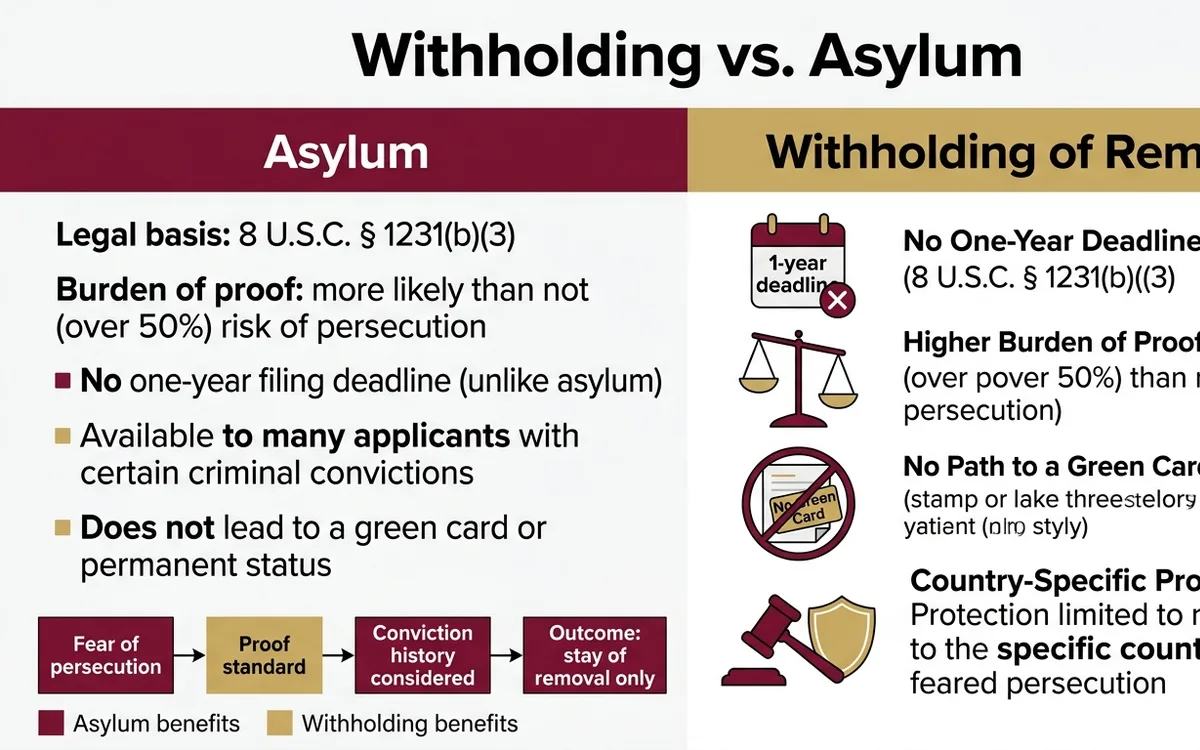
Withholding of removal is a federal protection under 8 U.S.C. § 1231(b)(3) that stops deportation to a specific country when you prove persecution there is more likely than not. Unlike asylum, it carries no one-year filing deadline and remains available to many people with certain convictions, but it grants no green card.
The Hard Truth
Withholding of removal uses a higher standard than asylum. Under INS v. Stevic, 467 U.S. 407 (1984), and 8 C.F.R. § 1208.16(b), you must show it is 'more likely than not' you will be persecuted in the country of removal, not just a 'reasonable possibility,' the standard that applies to asylum. That is a real evidentiary gap, and country-conditions evidence or a declaration alone rarely closes it.
Winning does not fix your status. A grant of withholding leaves the underlying removal order in place. You cannot petition for lawful permanent residence, you cannot petition for your spouse or children to join you, and you must keep renewing work authorization through USCIS on whatever schedule the order allows. You stay, but you stay in a legal category Congress built as a floor, not a future.
If you have a conviction, the judge will also ask whether it counts as a 'particularly serious crime' under INA § 241(b)(3)(B). An aggravated felony with an aggregate sentence of five years or more is treated as a particularly serious crime as a matter of law. Below that line, the immigration judge decides case by case, looking at the elements of the offense, the sentence, and the underlying facts.
What Happens If You Wait
Delay costs you in specific, documented ways. If you are in removal proceedings before Charlotte Immigration Court and miss a filing deadline the judge sets for your Form I-589, the judge can deem the application abandoned and order you removed without ever reaching the merits of your fear.
If you are already under a final order, enforcement can proceed at any time your case is not actively pending before an immigration judge, the BIA, or a federal court with a stay in place. There is no general grace period. A motion to reopen filed after that order becomes final faces its own 90-day deadline under 8 C.F.R. § 1003.23(b)(1), and most people get only one chance to file it.
Evidence also degrades. Witnesses in your home country become harder to reach. Country-conditions reports get replaced by newer State Department editions that may not describe the same risk in the same terms, and the longer a withholding claim sits unfiled, the thinner the record becomes at the one hearing where the record is everything.
Step-by-Step Process
Screening for the asylum bar. Before anything is filed, we confirm why asylum is off the table: a missed one-year deadline under INA § 208(a)(2)(B), a conviction, or a prior removal order. That answer determines whether withholding of removal, Convention Against Torture (CAT) protection under 8 C.F.R. § 1208.16(c), or both, are the right filings.
Filing Form I-589 in removal proceedings. The same form covers asylum, withholding, and CAT. It is filed with the Charlotte Immigration Court (EOIR) on the deadline the immigration judge sets at a master calendar hearing, typically the second or third hearing in the case.
Building the country-conditions record. This includes the U.S. Department of State's Country Reports on Human Rights Practices for the country of removal, declarations from you and witnesses, medical or psychological evaluations where relevant, and, if applicable, police or court records from the home country documenting past harm.
Addressing any criminal bar. If you have a conviction, we brief whether it is a 'particularly serious crime' under INA § 241(b)(3)(B), since that bars withholding entirely, separate from whatever bar already applies to your asylum claim.
The individual (merits) hearing. This is where you testify, the government cross-examines you, and the immigration judge applies the 'more likely than not' standard from INS v. Stevic. Merits hearings in Charlotte Immigration Court are currently scheduled months to years out, depending on the court's docket at the time of filing.
Decision and next steps. If the judge denies withholding, you have 30 days to appeal to the Board of Immigration Appeals (BIA). If the BIA affirms the denial, the next step is a petition for review to the U.S. Court of Appeals for the Fourth Circuit, which reviews removal orders arising from North Carolina.
A Real-World Example
Consider a composite example built from the fact pattern we see often in Charlotte Immigration Court, not a real client. A man we will call R. entered the United States and did not file for asylum within one year, missing the deadline under INA § 208(a)(2)(B) by several years before he ever spoke to a lawyer. By the time removal proceedings started, asylum was foreclosed.
At the master calendar hearing, the immigration judge set a filing deadline for Form I-589, seeking withholding of removal and a CAT claim in the alternative. Over the following months, R. and his attorney gathered declarations from family members still in the home country, obtained country-conditions reports documenting the specific pattern of violence he said he faced, and arranged a psychological evaluation to document the lasting effects of a prior assault.
At the individual hearing, R. testified for close to three hours. The government's attorney cross-examined him on inconsistencies between his written declaration and his testimony, a common line of questioning in withholding cases. The immigration judge took the case under advisement rather than ruling from the bench, which is routine when the record is long and the legal standard is contested.
What happens next, whether the judge grants, denies, or grants in part, depends on facts specific to each case. R.'s case illustrates the sequence every withholding claim in Charlotte Immigration Court follows: screening, filing, evidence-gathering, and a contested merits hearing.
William J. Vasquez handles removal defense matters, including withholding of removal and CAT claims, before immigration courts and the Board of Immigration Appeals. He holds federal immigration-bar standing that allows him to appear before EOIR nationwide, and he has represented clients in matters that reached the U.S. Court of Appeals for the Fourth Circuit, the circuit that reviews removal orders arising from North Carolina.
He is candid with clients about why withholding, not asylum, is the filing on the table. That conversation includes the 'more likely than not' standard from INS v. Stevic, what evidence can realistically meet it, and what a grant of withholding does and does not provide. Clients considering withholding of removal can schedule a consultation to review the specific bar in their case and the record needed to address it.
Key Terms Explained
Withholding of Removal: A form of protection under 8 U.S.C. § 1231(b)(3) (INA § 241(b)(3)) that bars the government from removing you to a specific country where it is more likely than not you would face persecution. It does not grant lawful status.
Clear Probability Standard: The evidentiary standard for withholding of removal, established in INS v. Stevic, 467 U.S. 407 (1984), requiring proof that persecution is more likely than not, a higher bar than asylum's 'reasonable possibility' standard.
Convention Against Torture (CAT) Protection: Protection under 8 C.F.R. § 1208.16(c) for people who show it is more likely than not they would be tortured, with government involvement or acquiescence, if removed. It can be sought alongside withholding of removal and has no criminal bar.
Particularly Serious Crime: A conviction that bars withholding of removal under INA § 241(b)(3)(B). Aggravated felonies with an aggregate sentence of five years or more are treated as particularly serious crimes by law; other convictions are evaluated case by case.
Form I-589: The application form used to request asylum, withholding of removal, and CAT protection in a single filing with the immigration court or USCIS.
Board of Immigration Appeals (BIA): The administrative body that reviews immigration judge decisions, including denials of withholding of removal, before any further appeal to a federal circuit court.
Individual Calendar Hearing: The merits hearing in removal proceedings where you testify, present evidence, and the immigration judge rules on your application, distinct from the shorter master calendar hearing earlier in the case.
Country Conditions Evidence: Documentation, including the U.S. Department of State's Country Reports on Human Rights Practices, used to establish the risk of persecution or torture in the country of removal.
Frequently Asked Questions
Q: Can I still apply for withholding of removal if my asylum application was denied for missing the one-year deadline? A: Yes. The one-year filing deadline under INA § 208(a)(2)(B) applies only to asylum, not to withholding of removal or CAT protection, so a missed deadline does not bar either filing.
Q: Can I get withholding of removal if I have a conviction on my record? A: It depends on the conviction. Withholding is barred if the offense is a 'particularly serious crime' under INA § 241(b)(3)(B); aggravated felonies with an aggregate sentence of five years or more are automatically treated as particularly serious, while other convictions are reviewed case by case.
Q: What is the real difference between withholding of removal and asylum? A: Asylum uses a lower 'reasonable possibility' standard and can lead to a green card and family reunification; withholding uses the higher 'more likely than not' standard from INS v. Stevic and only bars removal to one specific country, with no path to permanent status.
Q: If an immigration judge denies my asylum claim but grants withholding of removal, what do I actually get? A: You get a legally binding order barring your removal to that specific country and eligibility for work authorization through USCIS, but no green card, no family petitions, and the underlying removal order to other countries still stands.
Q: Should I pursue withholding of removal or Convention Against Torture protection? A: Many people file both in the alternative on the same Form I-589. CAT protection under 8 C.F.R. § 1208.16(c) has no criminal bar and covers torture rather than persecution, so it can remain available even when a conviction blocks withholding of removal.
Clients come to us after another attorney told them asylum was their only option, or that a conviction ended their case. North Carolina clients have rated the firm 4.8 out of 5 based on more than 200 Google reviews as of this page's last update, most citing direct communication about what a case can and cannot achieve rather than promises about results.
We do not cite outcome statistics for removal defense cases, because immigration court decisions depend on facts, evidence, and judges that vary case by case. What we can tell you is how many withholding of removal and CAT claims our attorneys have handled before Charlotte Immigration Court and the Fourth Circuit, and walk through what the record looked like in comparable cases.
You do not have to decide tonight whether withholding of removal is the right filing. You do have a filing deadline once a judge sets one at your master calendar hearing, and that date does not move because you are still deciding.
A consultation with our team can tell you, specifically, what the asylum bar in your case is, whether a CAT claim should run alongside withholding, and what evidence you would need to meet the clear probability standard before your merits hearing is scheduled.
If you are barred from asylum and facing removal to a country where you fear harm, our immigration team can review your Form I-589 strategy, the particularly serious crime analysis if a conviction is involved, and your country-conditions evidence before your next hearing in Charlotte Immigration Court. Schedule a consultation with our removal defense team to find out what a withholding of removal or CAT claim would require in your case.
- Asylum Attorney
- Convention Against Torture (CAT) Protection
- Removal Defense Representation
- Board of Immigration Appeals (BIA) Appeals
- Cancellation of Removal
- Federal Appeals, Fourth Circuit