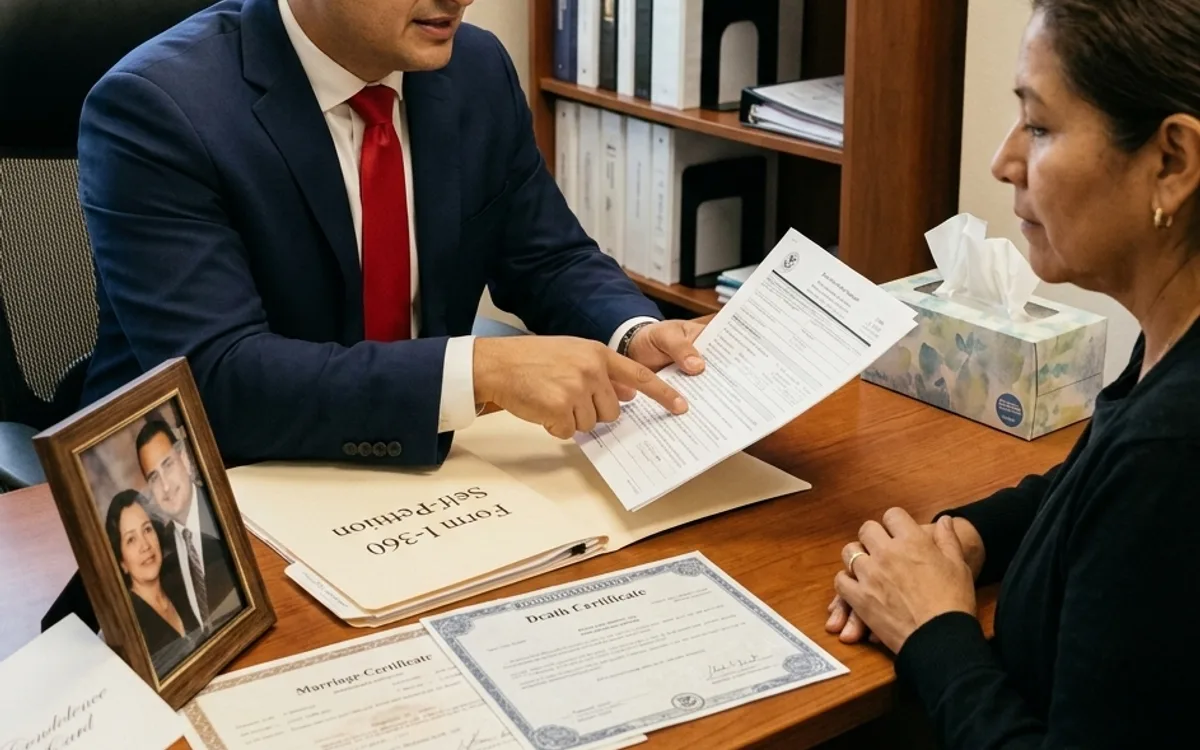
Your spouse died, and somewhere in the grief someone told you your immigration case might die with them. That is not automatically true. Congress built a specific path for surviving spouses of U.S. citizens, and it does not require your deceased spouse to have filed anything first.
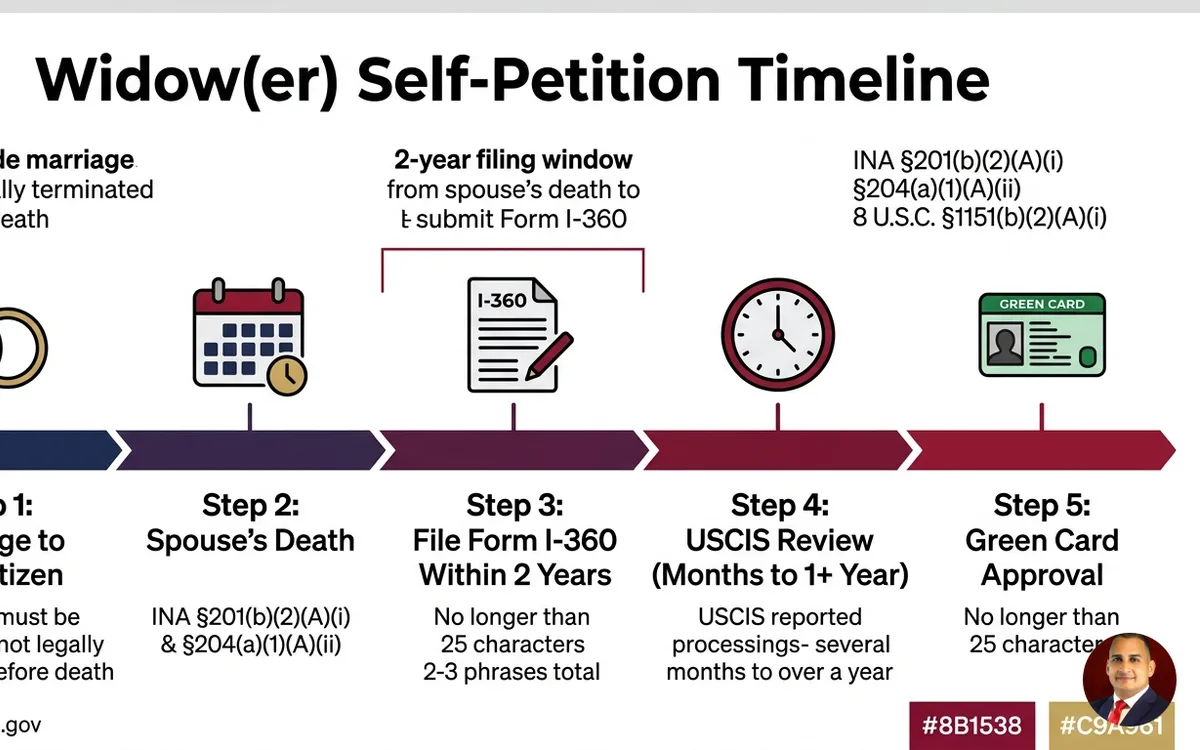
The I-360 widow(er) self-petition must be filed within two years of the death, under INA §201(b)(2)(A)(i) and §204(a)(1)(A)(ii) (8 U.S.C. §1151(b)(2)(A)(i)). Miss that window and the path generally closes. This page, last updated June 2025, walks through the filing deadline, the evidence USCIS expects, and what happens at the USCIS Charlotte Field Office and Charlotte Application Support Center along the way.
A widow(er) of a U.S. citizen can self-petition for a green card using Form I-360 within two years of the spouse's death, under INA §201(b)(2)(A)(i) and §204(a)(1)(A)(ii) (8 U.S.C. §1151(b)(2)(A)(i)). The marriage must have been bona fide and not legally terminated before the death. USCIS currently reports I-360 processing times of several months to over a year, per USCIS.gov.
The Hard Truth
The two-year filing deadline is not flexible for most widow(er)s. USCIS counts from the date of death, not the date you first learn about Form I-360, and a missed deadline is rarely excused by a sympathetic explanation. The marriage-duration rule that used to trip up short marriages is gone; Congress removed it through the Family Reunification Act of 2009 after Taing v. Napolitano, 567 F.3d 19 (1st Cir. 2009), exposed how it punished couples married less than two years when one spouse died suddenly. The filing deadline, by contrast, is still strict.
If your spouse died before filing Form I-130 on your behalf, you can still self-petition, but you carry the entire evidentiary burden alone. USCIS expects joint bank statements, a joint lease or mortgage, insurance beneficiary designations, and photographs spanning the relationship, the kind of proof a living spouse would normally help assemble. Published Administrative Appeals Office decisions on widow(er) petitions (uscis.gov/administrative-appeals) show that thin financial commingling evidence, not a flawed marriage itself, is the most common reason USCIS issues a denial.
What Happens If You Wait
Miss the two-year window and the I-360 path generally closes for good. There is no broad discretionary waiver for not knowing about the deadline under INA §204(a)(1)(A)(ii), though narrow exceptions exist for extraordinary circumstances that USCIS evaluates case by case.
A pending I-130 does not vanish when the petitioning spouse dies, but it does not finish the job either. Under 8 C.F.R. §204.2(i)(1)(iv), a pending or approved I-130 for a spouse converts automatically to widow(er) classification if the beneficiary still qualifies, but USCIS still typically needs Form I-360 to establish that eligibility cleanly on the record. Waiting to sort this out costs processing time you cannot recover, and if your work authorization or travel permission was tied to the marriage-based case, a status gap can interrupt your ability to work or reenter the country.
If removal proceedings were already underway when your spouse died, the case does not pause itself. Someone must file a motion with the Charlotte Immigration Court (EOIR, 5701 Executive Center Drive, Charlotte, NC) to administratively close or terminate proceedings once the I-360 is approved or a bona fide self-petition is pending. Without that motion, the removal case keeps moving on its own calendar regardless of your pending green card paperwork.
Step-by-Step Process
Step 1: Get the certified death certificate. In Mecklenburg County, request it through the Register of Deeds; statewide, the NC Office of Vital Records in Raleigh (NC DHHS) can issue a certified copy if the county office cannot locate the record. USCIS requires a certified copy, not a photocopy, as core evidence under 8 C.F.R. §204.2(b).
Step 2: Assemble bona fide marriage evidence while records are still accessible. Joint bank and credit statements, a joint lease or deed, life insurance beneficiary forms, jointly filed tax returns, and dated photographs all count. Affidavits from people who knew the marriage, a parent, a friend, a clergy member, can fill gaps where documents do not exist.
Step 3: File Form I-360 under the widow(er) classification. There is no filing fee for this classification (Form I-360 instructions, uscis.gov/i-360), unlike the $675 fee a citizen spouse pays to file Form I-130 (USCIS fee schedule effective April 1, 2024).
Step 4: File Form I-485 (adjustment of status) concurrently if a visa is immediately available, which it generally is for widow(er)s classified as immediate relatives under INA §201(b)(2)(A)(i). The current I-485 filing fee is $1,440 for most adult applicants (8 C.F.R. §103.7, effective April 1, 2024). Form I-765 for work authorization and Form I-131 for travel permission can be filed at the same time.
Step 5: Attend biometrics at the Charlotte Application Support Center when USCIS schedules it, typically a few weeks after filing.
Step 6: Wait for adjudication. USCIS reports I-360 and I-485 processing times ranging from several months to over a year depending on the service center and current caseload (USCIS.gov processing times page, checked June 2025); track your specific receipt number through the online case status tool.
Step 7: If USCIS denies the I-360, you can appeal to the Administrative Appeals Office within 33 days of the decision under 8 C.F.R. §103.3(a)(2)(i), or file a motion to reopen or reconsider with the original office.
Step 8: If removal proceedings are pending, file a motion to terminate or administratively close with the Charlotte Immigration Court once the I-360 is approved or bona fide evidence supports the pending self-petition.
A Real-World Example
Consider a composite scenario based on the kind of case our team sees, not a real client. Mrs. L, married to a U.S. citizen for three years, lost her husband unexpectedly before he filed Form I-130 on her behalf. She contacted our office four months after the death, still gathering paperwork and unsure whether the two-year clock was already running out.
The first weeks focused on documentation: a certified death certificate from the county Register of Deeds, joint bank statements going back to the wedding date, and affidavits from two friends who had attended the ceremony. Her spouse had handled most of the household finances, so some records existed only in his name; our team helped her request bank records and tax transcripts to fill those gaps.
Form I-360 was filed within the two-year window, along with concurrent Form I-485, I-765, and I-131 applications. She attended biometrics at the Charlotte Application Support Center about six weeks after filing. As of this writing, her case remains pending with USCIS, the typical stage where most widow(er) petitions sit for months while the agency reviews the marriage evidence and completes background checks.
William J. Vasquez is licensed to practice law and admitted to the 4th, 5th, and 11th Circuit Courts of Appeals, in addition to handling matters before USCIS, the Board of Immigration Appeals, and the Executive Office for Immigration Review. His practice includes I-360 widow(er) self-petitions, other family-based immigration filings, and removal defense before the Charlotte Immigration Court. Read more about his background, admissions, and practice areas on our attorney profile page.
Federal immigration practice does not require a state bar license tied to where a client lives; USCIS, the BIA, and EOIR are federal bodies, and any attorney admitted to practice law in a U.S. state or territory and in good standing can represent clients before them nationwide. That is why our team, based in North Carolina, represents widow(er) petitioners filing through the USCIS Charlotte Field Office and beyond.
Key Terms Explained
Form I-360: the USCIS petition form that covers several categories, including the widow(er) of a U.S. citizen self-petition; it establishes the surviving spouse's classification as an immediate relative.
Bona fide marriage: a marriage entered into for genuine reasons, not solely to obtain an immigration benefit; USCIS looks for joint finances, shared residence, and other evidence that the relationship was real.
Immediate relative: a classification under INA §201(b)(2)(A)(i) covering spouses, parents, and unmarried children under 21 of U.S. citizens, which is not subject to the annual numerical visa caps that apply to other family categories.
Administrative Appeals Office (AAO): the USCIS body that reviews denied petitions, including I-360 widow(er) self-petitions, under 8 C.F.R. §103.3; it reviews the existing record and any new evidence submitted with the appeal.
Humanitarian reinstatement (INA §204(l)): a separate process allowing certain surviving relatives to have an approved I-130 or other petition reinstated after the petitioner's death, distinct from the widow(er) I-360 pathway and used when the deceased was not the petitioning spouse.
VAWA self-petition: a filing under INA §204(a)(1)(A)(iii) for spouses, children, or parents abused by a U.S. citizen or lawful permanent resident; it requires proof of battery or extreme cruelty, unlike the widow(er) I-360 category, which requires no abuse evidence at all.
Motion to terminate: a request filed with the immigration court asking the judge to end removal proceedings, typically because the respondent has since obtained, or become eligible for, an immigration benefit like an approved I-360.
Frequently Asked Questions
Q: What happens to my pending Form I-130 if my U.S. citizen spouse dies before our interview? A: Under 8 C.F.R. §204.2(i)(1)(iv), a pending or approved I-130 for a spouse can convert to widow(er) classification if you still meet the requirements, but USCIS generally still needs Form I-360 and marriage evidence to move the case forward cleanly.
Q: Can I still self-petition if I remarry before my I-360 is approved? A: Remarriage before USCIS approves your I-360 can affect eligibility for the widow(er) classification, since INA §201(b)(2)(A)(i) requires you to remain unmarried through adjudication; talk to an attorney about timing before remarrying if your case is still pending.
Q: What is the difference between a VAWA self-petition and a widow(er) I-360 self-petition? A: A VAWA self-petition under INA §204(a)(1)(A)(iii) requires proof that the U.S. citizen or LPR spouse subjected you to battery or extreme cruelty. A widow(er) I-360 self-petition requires no proof of abuse, only a bona fide marriage and the death of the citizen spouse within the two-year filing window.
Q: What if USCIS denies my I-360 widow(er) petition? A: You can appeal to the USCIS Administrative Appeals Office within 33 days under 8 C.F.R. §103.3(a)(2)(i), or file a motion to reopen or reconsider with the field office that issued the denial.
Q: My spouse died while we were in removal proceedings. Does the immigration case just end? A: No, the removal case continues on its own calendar until the Charlotte Immigration Court grants a motion to terminate or administratively close proceedings, which typically requires showing an approved I-360 or a bona fide pending self-petition.
Grieving clients consistently tell us the same thing: they needed someone who would explain the paperwork without rushing them through the grief attached to it. Our team's approach is to walk through the deadline math and the evidence checklist in plain terms during the first conversation, then handle the filing itself. We do not publish outcome statistics for immigration matters, because federal agency decisions depend on each applicant's specific record, not on a firm's track record.
You do not need every piece of evidence gathered before you call. A conversation now can tell you whether your two-year window is still open, what records to start collecting first, and whether your situation calls for a straightforward self-petition or something more complicated, like a pending removal case or a remarriage question.
If your spouse died and you are trying to figure out your immigration options, schedule a consultation with our immigration team to review your I-360 widow(er) self-petition, your filing deadline, and the evidence you already have. Call our office or request a consultation through our family-based immigration services page to get a specific answer about your filing window before it closes.
- Family-Based Green Card Process
- I-485 Adjustment of Status Explained
- Immigration Appeals Before the AAO and BIA
- VAWA Self-Petitions for Survivors of Abuse
- William J. Vasquez Attorney Profile
- Removal Defense Before the Charlotte Immigration Court