You have already done the hardest part: you decided you cannot keep living this way. Maybe you are still in the house, still smiling at dinner, still calculating when it is safe to make a phone call. You are afraid that asking for help will mean your husband or wife finds out, that your papers depend on him, that without a police report no one will believe what happened. Federal law built a path around exactly that fear. A VAWA self-petition lets you ask for your own legal status, filed in your name alone, without your abuser ever being told.
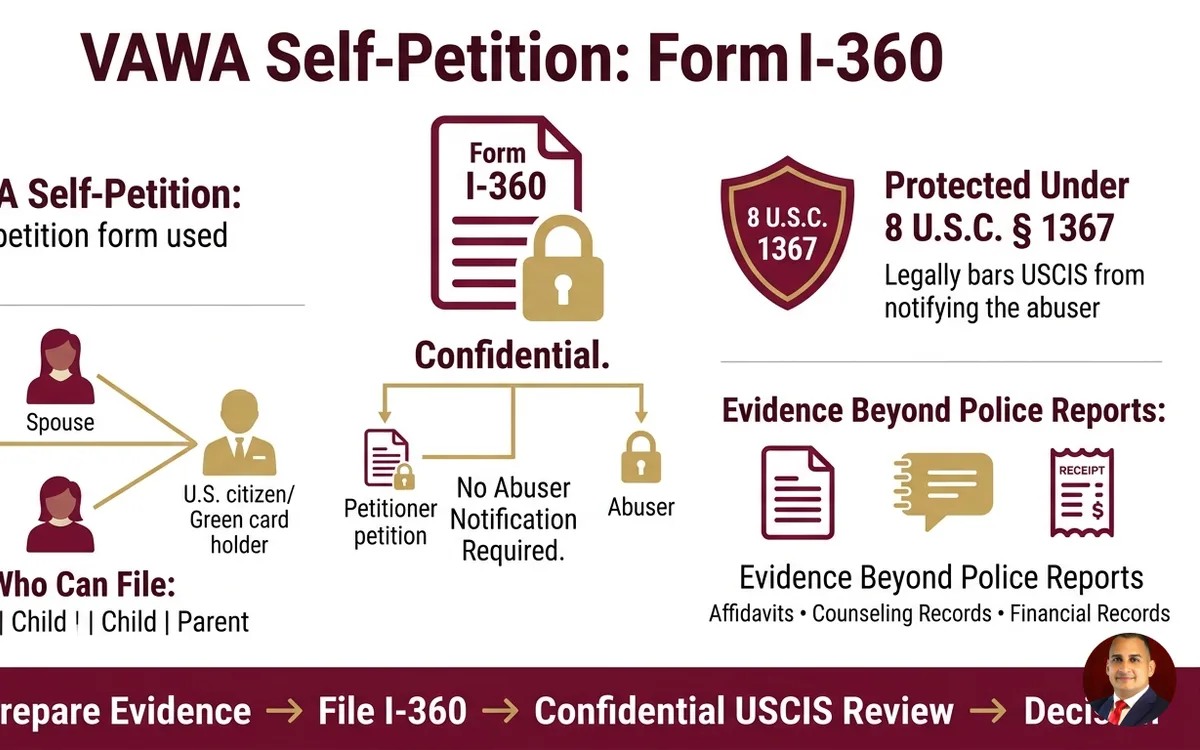
A VAWA self-petition lets an abused spouse, child, or parent of a U.S. citizen or green card holder file Form I-360 for their own immigration status, confidentially and without the abuser's knowledge or signature. Federal law (8 U.S.C. § 1367) bars USCIS from notifying the abuser. Evidence can include affidavits, counseling records, and financial records, not just police reports.
The Hard Truth
A VAWA self-petition is not automatic and not fast. You must prove you are the spouse, child, or parent of a U.S. citizen or lawful permanent resident, that the relationship was genuine, that you lived with the abuser, and that you suffered battery or extreme cruelty, a legal term covering psychological abuse, threats, and coercive control, not only physical violence. USCIS can and does deny petitions with thin evidence. If your marriage ended in divorce, you generally must file within two years under INA § 204(a)(1)(A)(iii) (8 U.S.C. § 1154(a)(1)(A)(iii)), and under Matter of Sejas, 24 I&N Dec. 236 (BIA 2007), the timing and reason for the divorce can matter to whether you still qualify. A minor criminal record connected to the abuse, like a mutual arrest where you were the one defending yourself, does not automatically disqualify you, but it has to be explained and documented as part of the good moral character showing.
What Happens If You Wait
Waiting costs you time you cannot easily get back. If your qualifying relationship ends, through divorce or your abuser's death, you generally have a two-year window to file under INA § 204(a)(1)(A)(iii), and that clock does not pause for you to gather courage. If your children are approaching 21, they can age out of eligibility to be included on your petition. Evidence gets harder to collect the longer you wait: text messages get deleted, witnesses move, and counseling records from years ago are harder to track down than the ones from last month. Staying in the home to avoid the immigration question also means staying in the situation that is harming you.
Step-by-Step Process
Step one is a confidential consultation, in person or by phone, where nothing you say is reported to your abuser or to USCIS without your direction. Step two is safety planning: a separate mailing address, a private email account, and a plan for where USCIS correspondence goes so it never reaches your abuser's hands. Step three is evidence-building: affidavits from you and people who witnessed the abuse or its effects, counseling or therapy records, financial records showing control over your money or documents, and photographs or medical records if they exist, though none of these are individually required. Step four is preparing and filing Form I-360 with a personal statement and evidence packet, sent exclusively to the USCIS Vermont Service Center, which has nationwide jurisdiction over every VAWA self-petition filed in the country. Step five is the Prima Facie Determination notice, a preliminary USCIS letter, often issued within weeks of filing, confirming the petition is complete enough to review and sometimes supporting access to certain protections while the case is pending. Step six is a concurrently filed Form I-765 application for work authorization, which allows many self-petitioners to obtain a work permit before the I-360 is decided. Step seven is the USCIS decision; processing times change and are published at uscis.gov/processing-times. Step eight, after approval, is filing Form I-485 to adjust status to a green card, either right away if a visa number is current or after a waiting period depending on the applicable category.
A Real-World Example
Consider a composite situation: a woman married to a lawful permanent resident contacts our office after her husband takes her paycheck, monitors her phone, and threatens to have her deported if she calls the police. She has no police report and no medical record of physical injury. In an initial meeting, our team documents a pattern of financial control and psychological abuse through her own written statement, a friend's affidavit describing changes in her behavior, and records from a counselor she started seeing six months earlier. We set up a P.O. box for USCIS mail and a new email address her husband does not know about. We prepare Form I-360 with a personal declaration describing specific incidents by date, a declaration from her counselor, and financial records showing her husband controlled all shared accounts. The petition is filed with the Vermont Service Center, and a Prima Facie Determination notice arrives within weeks, letting her apply for a work permit while the I-360 remains pending. From that point, the case moves through USCIS review on its own timeline, and she continues building her evidence file and responding to any requests for additional documentation.
William J. Vasquez has focused on immigration matters, including VAWA self-petitions for abused spouses, children, and parents, for years, with admission to practice in federal immigration matters including before the 4th, 5th, and 11th Circuit Courts of Appeals. He is a member of the American Immigration Lawyers Association (AILA), a marker of sustained practice in humanitarian immigration law. VAWA self-petitions filed by our office are prepared under his review, with a confidential intake process built so that safety planning happens before any paperwork is filed. Our team limits the number of new VAWA matters accepted each month so each self-petitioner gets individual attention to evidence development and safety planning, rather than a templated filing.
Key Terms Explained
VAWA self-petition: A petition filed under the Violence Against Women Act, which despite its name covers abused men, women, and children, letting an abused spouse, child, or parent of a U.S. citizen or lawful permanent resident request immigration status without the abuser's participation or knowledge, under 8 U.S.C. § 1154(a)(1)(A)(iii).
Form I-360: The USCIS form used to file a VAWA self-petition, filed exclusively with the Vermont Service Center for these cases.
Extreme cruelty: A legal standard broader than physical violence, including psychological abuse, threats, isolation, economic control, and coercive behavior that creates a pattern of domination.
Good moral character: A USCIS requirement generally covering the three years before filing, assessed case by case; minor offenses connected to surviving abuse can be addressed with explanation and supporting evidence rather than being an automatic bar.
Prima Facie Determination: A preliminary USCIS notice confirming a VAWA petition appears complete, issued while the full case is still under review, which can support eligibility for certain protections while the petition is pending.
Confidentiality provisions (8 U.S.C. § 1367): Federal law barring USCIS and other DHS components from disclosing information about a VAWA self-petition to the abuser or using abuser-provided information against the petitioner.
Derivative beneficiary: An eligible child of a VAWA self-petitioner who can be included on the same petition rather than filing separately.
Frequently Asked Questions
Q: Will my abuser be notified if I file a VAWA self-petition? A: No. Under 8 U.S.C. § 1367, USCIS is barred from disclosing information about your petition to the abuser, and the agency is required to keep your filing confidential from them.
Q: What if I do not have a police report documenting the abuse? A: A police report is not required. USCIS accepts affidavits from you and others, counseling or therapy records, financial records showing control over your money, photographs, and other credible evidence of battery or extreme cruelty.
Q: Can I self-petition if my abusive spouse is a green card holder rather than a U.S. citizen? A: Yes. VAWA self-petitions are available to the abused spouse of a lawful permanent resident, not only a U.S. citizen; the required proof of the relationship and the abuse is the same either way.
Q: Can an abused parent of a U.S. citizen son or daughter file a VAWA self-petition? A: Yes, if the citizen child is at least 21 years old. The law covers abused parents of adult U.S. citizen children, in addition to abused spouses and children.
Q: Can I get a work permit while my VAWA self-petition is pending? A: Many self-petitioners file Form I-765 along with or shortly after Form I-360 and receive work authorization once USCIS issues a Prima Facie Determination or approves the underlying petition.
Q: I already divorced my abuser. Can I still file? A: Generally yes, if you file within two years of the divorce and the divorce is connected to the abuse, under INA § 204(a)(1)(A)(iii); the specific timing matters, so review your situation with an attorney promptly.
Q: What is the difference between a VAWA self-petition and a U-visa? A: A VAWA self-petition is only available to someone abused by a U.S. citizen or permanent resident spouse, parent, or child and does not require police cooperation. A U-visa covers a broader range of qualifying crimes but generally requires certification from a police department or prosecutor confirming the victim assisted the investigation.
Clients come to us after months or years of being told by an abuser that no one would believe them or help them. Our team hears that fear often, and the VAWA intake process is built around it: a confidential first meeting, a safety plan before any form is filed, and clear explanations of what the evidence process actually requires. Feedback from the people we have represented points to the same thing again and again: being treated as credible from the first phone call mattered as much as the legal filing itself. We do not publish outcome statistics; a percentage cannot capture what a survivor went through to get to this point.
You do not have to decide tonight whether to call. But if you are already looking up how VAWA self-petitions work, some part of you has already started planning a way out. A confidential consultation costs you nothing but a conversation, and it does not commit you to filing anything.
If you are an abused spouse, child, or parent of a U.S. citizen or green card holder, our team can review your situation in a confidential consultation and explain what evidence you already have and what you still need. Call our North Carolina office or reach out through our website to speak with our immigration team about your VAWA self-petition, on your schedule and in a way your abuser will never see.