A letter arrived with a government seal, or a deadline flashed on a USCIS alert, and now you are checking the mailbox every day. If you hold Temporary Protected Status (TPS) as a Salvadoran national, that fear is familiar: a missed form, a late biometrics appointment, or a forgotten re-registration window can end your legal right to work and live in the United States. You are not alone in this. Thousands of Salvadoran families across North Carolina, from Charlotte to Greensboro, go through this same re-registration cycle every time DHS reopens the window.
This page walks through what TPS for El Salvador actually requires right now, what happens if you miss a step, and where our office fits into that process, specifically for people filing out of the Charlotte, North Carolina area.
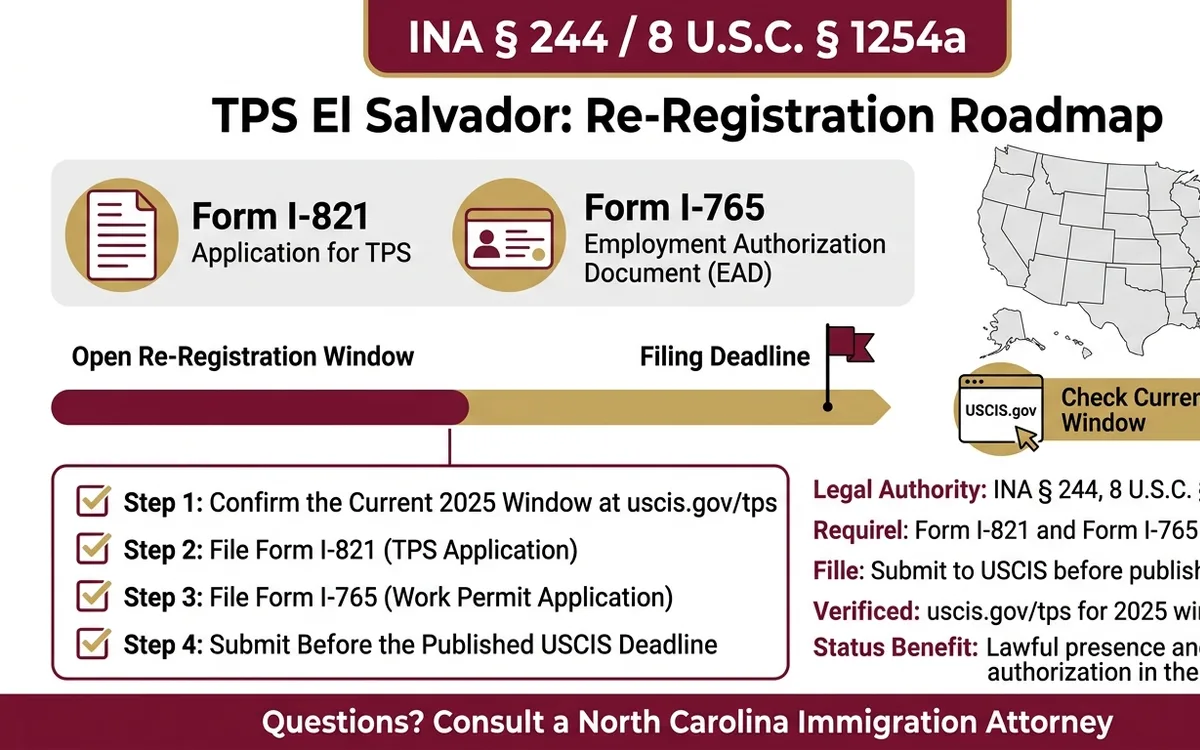
Temporary Protected Status (TPS) for El Salvador lets eligible nationals live and work lawfully in the United States under INA § 244, 8 U.S.C. § 1254a. During each open re-registration window, you must file Form I-821 and Form I-765 with USCIS before the published deadline. Check uscis.gov/tps for the current 2025 window.
The Hard Truth
TPS for El Salvador Has Survived Through Litigation, Not a Guarantee
Salvadoran TPS has stayed in effect since 2001, but not because DHS has quietly agreed to keep it. The designation nearly ended in 2018, and it has remained active largely because of the federal injunction in Ramos v. Nielsen, 321 F. Supp. 3d 1083 (N.D. Cal. 2018), which blocked termination while litigation continued. DHS has published a series of Federal Register extensions since then, most recently 88 Fed. Reg. 40285 and subsequent notices, but each one is a renewal, not a permanent status. There is no guarantee the next Federal Register notice will extend the designation again.
Re-registering also does not move you toward a green card by itself. In Sanchez v. Mayorkas, 141 S. Ct. 1809 (2021), the Supreme Court held that TPS status does not count as a lawful admission for adjustment of status purposes if you originally entered the United States without inspection. That means many longtime TPS holders cannot adjust status through TPS alone, no matter how long they have held it. An approximate 194,000 Salvadoran nationals hold TPS nationally, per DHS's most recent Federal Register notice, and each one faces this same limit.
What Happens If You Wait
What Happens If You Miss the Re-Registration Window
TPS re-registration opens for a limited period set out in the governing Federal Register notice, and the re-registration procedures at 8 C.F.R. § 244.17 require a timely filing, not a filing 'close enough.' Filing late requires you to show good cause for the delay, and USCIS can deny a late package outright. If your current Employment Authorization Document (EAD) lapses before your new one is approved, your employer can lawfully terminate you for lacking valid work authorization.
A lapsed EAD also affects your North Carolina driver's license. NCDMV ties a limited-duration license to your EAD's expiration date, so once that document expires, your license can be suspended until a new EAD is issued. If your TPS itself lapses rather than just the EAD, you can begin accruing unlawful presence under INA § 212(a)(9)(B), which carries a 3-year or 10-year reentry bar once you accumulate enough time out of status. In the worst case, a lapse combined with an encounter with immigration enforcement can result in a Notice to Appear and a case before the Charlotte Immigration Court.
Step-by-Step Process
How to Re-Register for TPS El Salvador, Step by Step
Confirm the current window. Each re-registration period is announced in a specific Federal Register notice tied to the El Salvador designation under INA § 244. Check uscis.gov/tps directly, since the filing window typically lasts 60 days and closes without extension for most applicants.
Gather your documents. You need proof of Salvadoran nationality, proof of continuous residence in the United States since the original qualifying date, and your prior TPS approval notices (Form I-797). If your civil documents need certified copies, Mecklenburg County Register of Deeds can issue certified copies of recorded vital records.
File Form I-821 and Form I-765 together. As of the USCIS fee schedule effective April 1, 2024 (89 Fed. Reg. 6194), the I-821 filing fee is $50, the I-765 fee is $520, and the biometric services fee is $30, for a combined cost of roughly $600 per applicant. Fee waivers are available through Form I-912 for applicants who meet the income or hardship criteria.
Mail the package to the USCIS Texas Service Center lockbox listed in the current form instructions. Filing at the wrong address or lockbox is one of the most common reasons a package is rejected and returned.
Attend your biometrics appointment. USCIS schedules this at an Application Support Center (ASC); applicants filing from the Charlotte area typically complete biometrics locally rather than traveling to the USCIS Charlotte Field Office itself, which does not process TPS biometrics on-site.
Wait for a decision. Per USCIS's published case processing time data for the I-765 (c)(19) category, Texas Service Center processing generally runs 3 to 7 months, though this changes with each filing cycle and should be checked directly at uscis.gov/processing-times before you rely on it.
Update your NCDMV license once your new EAD arrives. Bring the new EAD and your current license to any NCDMV office to extend your driving privileges to match your new EAD expiration date.
A Real-World Example
A Composite Example: Re-Registration From Charlotte
Consider a composite scenario, not a real client: a Salvadoran woman in her forties, living in Charlotte since 2004, has held TPS continuously since the original designation. She works at a food-processing plant and renews her EAD every re-registration cycle without issue, until a new DHS notice opens a window with a shorter 60-day period than she remembers from prior years.
She brings her prior approval notices, passport, and employer verification letter to an intake appointment. Our office reviews her filing history for gaps, confirms she still meets continuous residence requirements, and prepares Form I-821 and Form I-765 together with the correct fee amount and any required fee waiver documentation. She completes biometrics at the local Application Support Center roughly three weeks after filing.
At the point this composite scenario ends, her case is pending at the Texas Service Center, within the published processing window, and she is waiting on her new EAD before her current one expires. That pending status, not a guaranteed approval, is the realistic middle stage of most re-registration filings, and it is where most applicants sit for several months before any decision issues.
William J. Vasquez leads the firm's federal immigration practice, which includes TPS filings for Salvadoran clients across North Carolina. He has personally overseen hundreds of TPS and work-authorization filings across multiple re-registration cycles, including the filings tied to the Ramos v. Nielsen litigation period. His practice is limited to federal immigration matters before USCIS, the EOIR immigration courts, and the Board of Immigration Appeals; it does not extend to North Carolina state-court matters.
Rather than folding TPS work into a broader family-petition package, our office runs a standalone TPS intake review scoped to each Federal Register re-registration window, and offers a flat-fee re-registration service for straightforward cases. Consultations are available in Spanish. You can review William J. Vasquez's full background on his attorney profile page, and see how TPS filings connect to related work like our removal defense and adjustment of status services.
Key Terms Explained
TPS (Temporary Protected Status): Temporary immigration status under INA § 244, 8 U.S.C. § 1254a, granted to nationals of a country designated by DHS due to armed conflict, environmental disaster, or similar conditions.
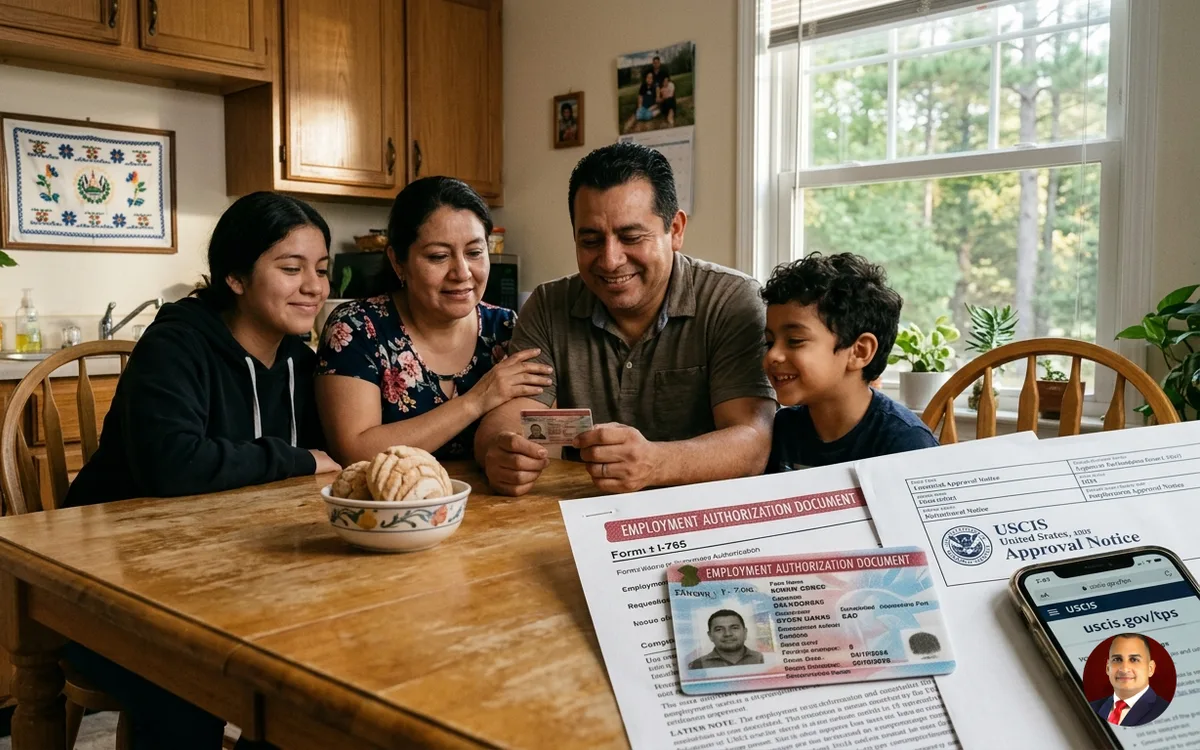
EAD (Employment Authorization Document): The physical or electronic card, issued after Form I-765 approval, that proves you are authorized to work in the United States.
Form I-821: The application form used to register or re-register for TPS.
Form I-765: The application form used to request or renew work authorization, filed alongside Form I-821 during TPS re-registration.
ASC (Application Support Center): A USCIS facility where applicants attend scheduled biometrics appointments, including fingerprinting and photographs.
Federal Register notice: The official government publication where DHS announces TPS designations, extensions, re-registration windows, and terminations.
Re-registration: The process of renewing TPS during an open window after an initial registration has already been granted, distinct from a first-time TPS application.
Adjustment of status: The process of applying for lawful permanent residence (a green card) from within the United States, governed by INA § 245 and limited for many TPS holders by the admission requirement discussed in Sanchez v. Mayorkas.
Frequently Asked Questions
Q: How much does it cost to re-register for TPS El Salvador? A: As of the USCIS fee schedule effective April 1, 2024 (89 Fed. Reg. 6194), you pay $50 for Form I-821, $520 for Form I-765, and $30 for biometrics, roughly $600 total. Applicants who cannot afford the fees can request a fee waiver with Form I-912.
Q: How long does TPS re-registration take to process? A: Per USCIS's published case processing time data for the I-765 (c)(19) category, Texas Service Center processing generally runs 3 to 7 months, though this changes with each filing cycle. Check the current figure at uscis.gov/processing-times before you plan around it.
Q: What is the difference between TPS and DACA? A: TPS is a country-based designation under INA § 244 tied to conditions in El Salvador, while DACA is an individual deferred-action policy with its own separate eligibility rules and no current path for new applicants because of ongoing litigation. The two programs use different forms, different renewal cycles, and different legal standards.
Q: Can my children get TPS if I have it? A: Children do not receive TPS automatically through a parent; each person, including children, must independently meet the nationality, residence, and filing requirements under INA § 244 and file their own Form I-821. A child born in the United States is a U.S. citizen regardless of a parent's TPS status, but a child born abroad or who entered separately needs a TPS application of their own.
Q: What happens if TPS for El Salvador is terminated entirely? A: If DHS terminates the designation rather than extending it, current TPS holders typically receive a wind-down period, often 60 to 180 days, before status and work authorization expire, based on the specific termination notice published in the Federal Register. Given the history of Ramos v. Nielsen and related litigation, termination announcements have previously been challenged in federal court, which can pause or delay implementation, but that result is never guaranteed in advance.
Q: Can I travel outside the United States with TPS? A: You generally need advance permission through Form I-131, Application for Travel Document, before leaving the country; traveling without it can be treated as abandoning your TPS application or, for some applicants, as a new unlawful entry on return. Talk with an attorney before booking travel, since the consequences depend on how and when you originally entered the United States.
Q: Does a criminal record affect my TPS eligibility? A: Under INA § 244(c)(2)(B), a conviction for any felony or two or more misdemeanors in the United States makes you ineligible for TPS, and certain other offenses can trigger inadmissibility review even without a formal TPS bar. Any pending charge or past conviction should be reviewed by an attorney before you file a re-registration package, since USCIS checks criminal history during biometrics processing.
Clients who come to us for TPS filings and broader immigration matters describe a process where someone returns their calls and explains each step in plain language, in English or Spanish. Our aggregate client feedback reflects years of handling federal immigration filings for Salvadoran, Honduran, and Haitian TPS holders across North Carolina. We do not publish outcome statistics, because case results are not something a law firm can verify or guarantee.
What we can point to is consistency: the same intake process, the same fee transparency, and the same document checklist for every TPS filing we handle.
Re-registration windows close fast, and the next one for El Salvador will be announced in a new Federal Register notice before the current period runs out. If you are unsure whether your prior filing still covers you, or whether a new notice already opened a window you have not acted on, that is worth checking before you assume you are safe.
Our office offers a flat-fee TPS re-registration review for Salvadoran applicants filing from North Carolina, along with consultations in English and Spanish. Call to schedule a consultation focused specifically on your TPS re-registration, your EAD renewal timeline, or a broader review of whether adjustment of status is realistically available in your case. Bring your prior I-797 approval notices and current EAD to that first appointment so we can review your filing history against the current Federal Register window.