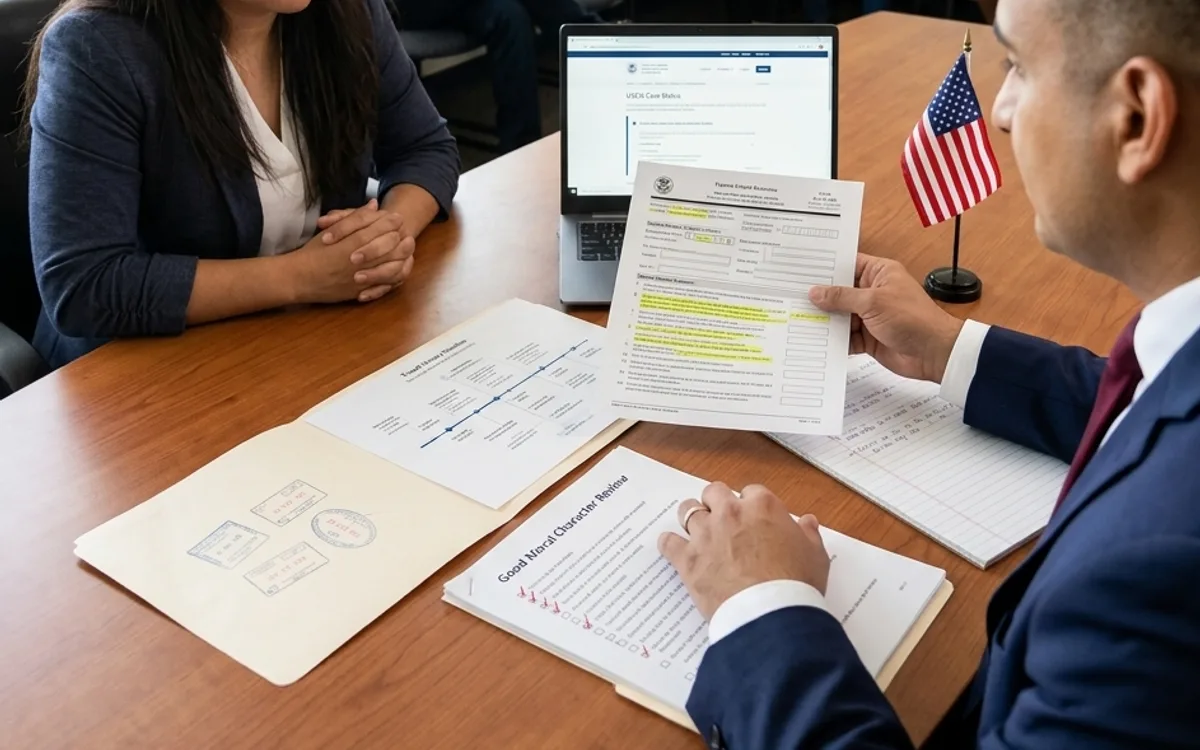
You've held a green card long enough to apply. You can see the finish line: a U.S. passport, the right to vote, no more immigration filings for the rest of your life. But Form N-400 asks about everything, every arrest, every trip abroad, every tax return you filed late. That old DUI from years ago that got dismissed, the six-month trip you took to care for a parent, the Selective Service registration you never knew you needed. USCIS will see all of it. The question is whether you've reviewed it before they do.
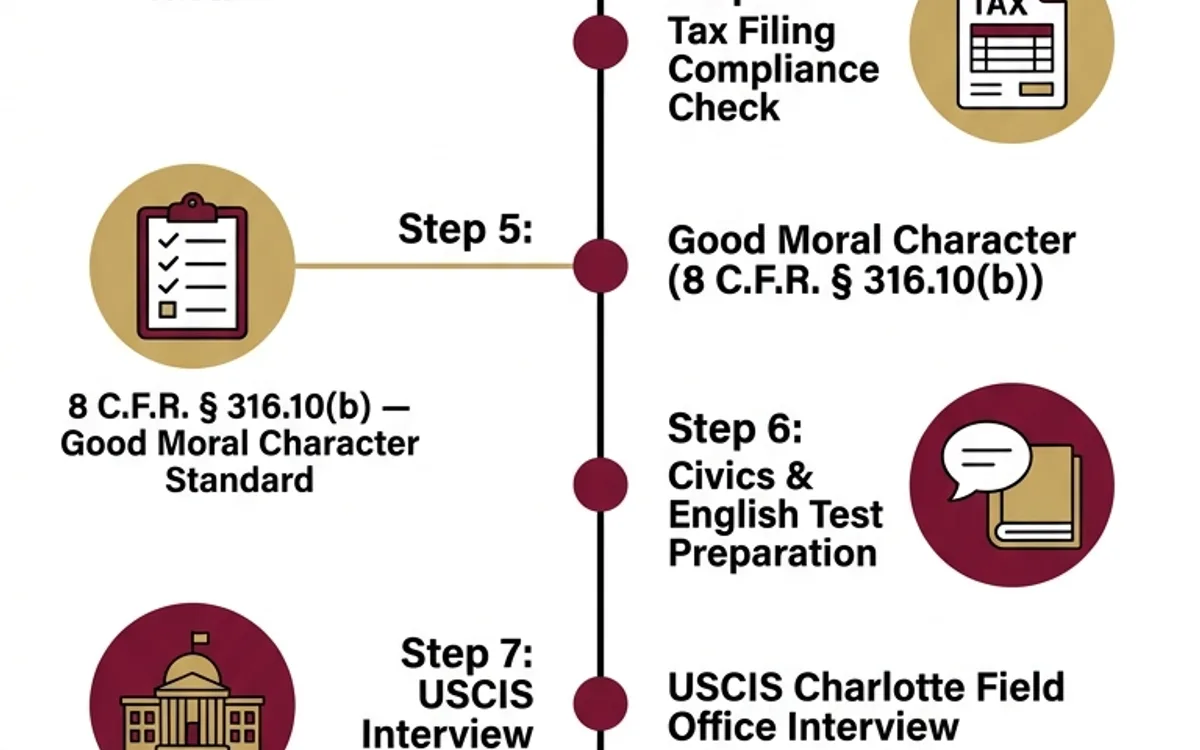
A naturalization attorney reviews your immigration history, travel records, and any arrests or tax issues against USCIS's good moral character standard under 8 C.F.R. § 316.10(b) before you file Form N-400. This catches problems that could trigger denial at the interview and prepares you for the civics and English test at USCIS's Charlotte Field Office.
The Hard Truth
Naturalization is not automatic once you hit the five-year mark. USCIS examiners apply a discretionary good moral character standard under 8 C.F.R. § 316.10(b), and an old arrest, even one that was dismissed or expunged, has to be disclosed on Form N-400 and can trigger a Request for Evidence or a longer interview. A single trip abroad lasting more than six months creates a rebuttable presumption that you broke continuous residence under INA § 316(a), and you carry the burden of proving otherwise. A disclosed issue, explained with documentation ready, rarely sinks an application on its own. What causes real trouble is an officer learning about it for the first time across the interview table, with no explanation and nothing in hand to back it up.
What Happens If You Wait
Filing too early carries a real cost. File before your five-year (or three-year, if married to a U.S. citizen under INA § 319(a)) continuous residence period is complete, and USCIS denies the application, with the current filing fee, $760 for most applicants per USCIS's fee schedule, gone. Waiting carries its own cost. Every year you delay is another green card renewal cycle, currently $455 per USCIS, and another chance to take a long trip abroad that complicates the continuous residence math later. If you have an old arrest sitting unresolved on your record, the good moral character look-back period does not shrink with time. It resets to the five years (or three years) immediately before you file, so an issue from eight years ago may carry less weight now than a new one that arises before you finally apply.
Step-by-Step Process
Eligibility screening comes first: calculate your continuous residence and physical presence days using Form N-400 Part 7, and identify your good moral character look-back period, five years generally or three if married to a U.S. citizen under INA § 319(a). From there, you file Form N-400 with USCIS and pay the $760 fee (or $380 with an approved fee reduction, per USCIS). Biometrics follow, usually at the USCIS Application Support Center in Charlotte. After that comes the wait for an interview notice; check current processing times at egov.uscis.gov rather than relying on a fixed estimate, since they shift by field office. The interview itself takes place at the USCIS Charlotte Field Office (6130 Tyvola Centre Dr), covering your N-400 answers, a civics test (you must answer at least 6 of 10 questions correctly, per USCIS), and an English reading, writing, and speaking test. USCIS then issues a decision: approved, continued for more evidence, or denied. Approval leads to an oath ceremony, scheduled by USCIS. If denied, you can request a hearing with a different officer using Form N-336 within 30 days, and after that, you have a statutory right to de novo review in federal district court under 8 U.S.C. § 1421(c), filed in the Western District of North Carolina's Charlotte Division or the Eastern District's Raleigh Division depending on your county of residence.
A Real-World Example
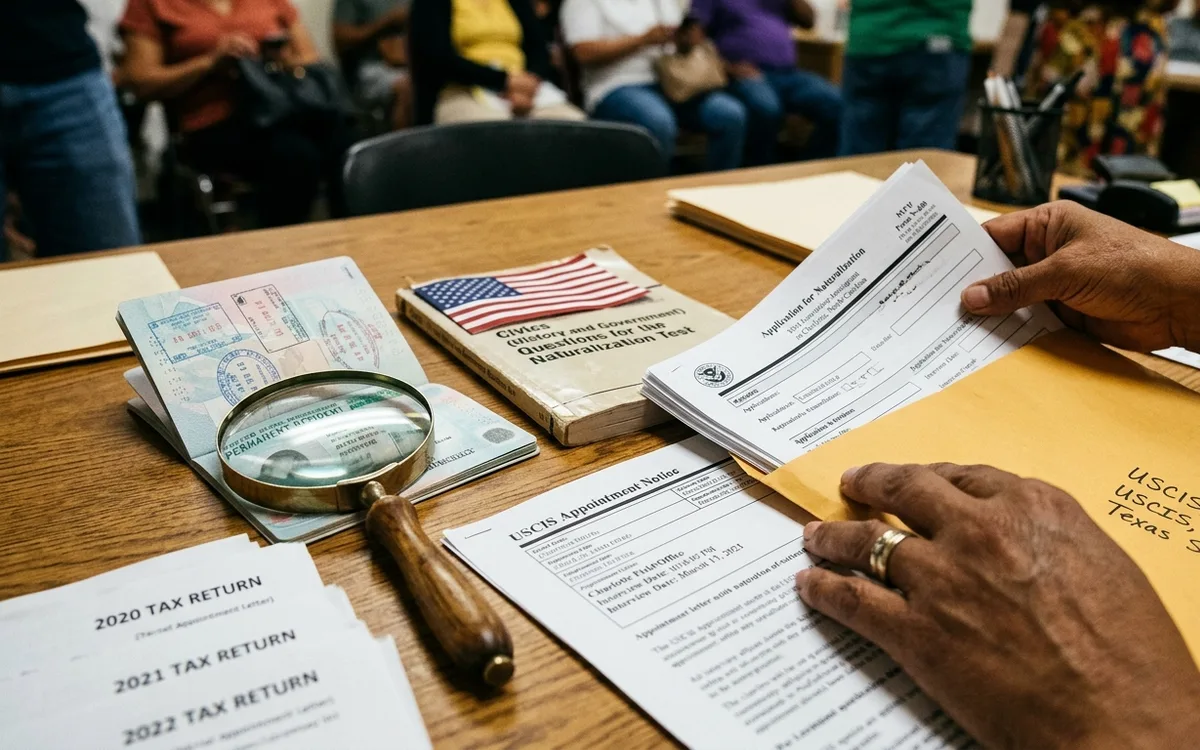
Consider a composite case. Maria, a lawful permanent resident for six years, married to a U.S. citizen for four of those years, had a shoplifting charge from years earlier that was dismissed after she completed a diversion program. Before filing, our team pulled her full travel history from her passport stamps and calculated her days abroad against Part 7 of Form N-400, finding two trips, one lasting 190 days to care for a parent. We also obtained the certified court disposition for the dismissed charge, since a dismissal still has to be explained at the interview even though it is not a conviction. We prepared a written explanation for the interview and ran a mock interview covering the civics questions and conversational English, including likely follow-up questions about the trip and the charge. At her interview at the USCIS Charlotte Field Office, the officer asked about the 190-day trip and the old charge directly, then requested additional documentation on the charge disposition. The case was continued pending that review. A continuance like this is a routine part of USCIS processing, used when the officer wants more documentation before deciding, and it comes up often in cases with a disclosed charge on the record.
William J. Vasquez is licensed to practice law in North Carolina and represents naturalization applicants nationwide in administrative proceedings before USCIS, since federal immigration practice does not require state-specific bar admission to appear at an N-400 interview. His experience includes good moral character analysis under 8 C.F.R. § 316.10(b) and continuous residence calculations under INA § 316(a) and § 319(a). If a denial advances to federal court review under 8 U.S.C. § 1421(c), that case is filed in U.S. District Court, in the Western District of North Carolina's Charlotte Division or the Eastern District's Raleigh Division depending on the applicant's county, and requires separate admission to that specific court, which our office secures as the matter requires.
Key Terms Explained
Good Moral Character (GMC): a statutory requirement under 8 U.S.C. § 1427(a) that USCIS evaluates using the regulatory factors at 8 C.F.R. § 316.10(b), covering arrests, taxes, child support, and other conduct during the look-back period.
Continuous Residence: the requirement under INA § 316(a) that you have lived in the U.S. as a permanent resident without a lengthy break for the full statutory period, usually five years or three if married to a U.S. citizen.
Physical Presence: the total number of days you were physically inside the U.S. during the statutory period, calculated on Form N-400 Part 7, separate from continuous residence.
Selective Service Registration: a federal requirement under 50 U.S.C. § 3802 for most men ages 18 to 26 living in the U.S., reviewed by USCIS as part of the good moral character analysis.
Form N-336: the form used to request a hearing before a different USCIS officer after an N-400 denial, due within 30 days of the decision.
De Novo Judicial Review: a fresh review by a federal district court, available under 8 U.S.C. § 1421(c) after a denied N-400 and exhausted administrative appeal, where the court decides the case independently rather than simply checking USCIS's work.
Oath of Allegiance: the final step in naturalization, a ceremony where you formally renounce prior allegiances and become a U.S. citizen.
Frequently Asked Questions
Q: Will an old DUI or a dismissed charge affect my good moral character review on Form N-400? A: Yes, it has to be disclosed even if the charge was dismissed, expunged, or resulted in no conviction. USCIS examiners weigh the full record under 8 C.F.R. § 316.10(b), not just the final disposition, and an unexplained arrest can trigger a Request for Evidence or a longer interview.
Q: How many days outside the U.S. break continuous residence for naturalization? A: A single trip of six months (180 days) or more creates a rebuttable presumption that you broke continuous residence under INA § 316(a), and you have to submit evidence to overcome it. A trip of one year or more generally resets the continuous residence clock entirely, absent an approved Form N-470 exception.
Q: I never registered for Selective Service. Can I still file Form N-400? A: You can still apply, but USCIS reviews Selective Service compliance as part of the good moral character analysis for men who were between 18 and 26 and living in the U.S. as a permanent resident during that window, per 50 U.S.C. § 3802. If you missed registering before turning 26, you will likely need to explain why and may need a Status Information Letter from Selective Service.
Q: What happens if I fail the civics or English test at my N-400 interview? A: USCIS gives you a second opportunity to retake the portion you failed, scheduled 60 to 90 days later at the same field office. If you fail a second time, USCIS denies the application, and you can file a new N-400 and start the process over once you are ready.
Q: Does being married to a U.S. citizen really shorten the residence requirement? A: Yes. Under INA § 319(a), you can apply after three years of continuous residence as a permanent resident instead of five, but you must have been married to and living with the same U.S. citizen spouse for all three years, and your spouse must have held U.S. citizenship that entire time.
Q: Can I reapply after a naturalization denial? A: Yes. You can request a hearing before a different USCIS officer by filing Form N-336 within 30 days of the denial, or you can file a new N-400 later once the issue that caused the denial, such as a continuous residence problem, has resolved. A denial based on good moral character during the statutory look-back period generally requires waiting until that period passes again before refiling.
Clients come to our office after researching their own case online and still feeling unsure about what their record means for naturalization. Our team has handled N-400 filings and good moral character reviews for applicants across North Carolina, from Charlotte to Raleigh, and we describe what the file actually shows, not what a reader hopes to hear. We do not publish outcome statistics because naturalization decisions rest on USCIS discretion and the specific facts of a case, not a formula.
If you are still gathering your travel records or waiting on a court disposition for something that happened years ago, that is normal. The right time to have someone review your file is before you submit it to USCIS, not after an officer asks a question you were not ready to answer.
Schedule a naturalization case review with our office before you file Form N-400. We will go through your travel history, your arrest or tax record if you have one, and the interview questions specific to the USCIS Charlotte Field Office, so you know what the officer will see before you walk into that room. Call to set up your N-400 consultation.
- Green Card Renewal and Form I-90
- Immigration Court Representation
- Good Moral Character Review for N-400 Applicants
- BIA Appeals
- Family-Based Immigration Petitions
- Naturalization Interview Preparation