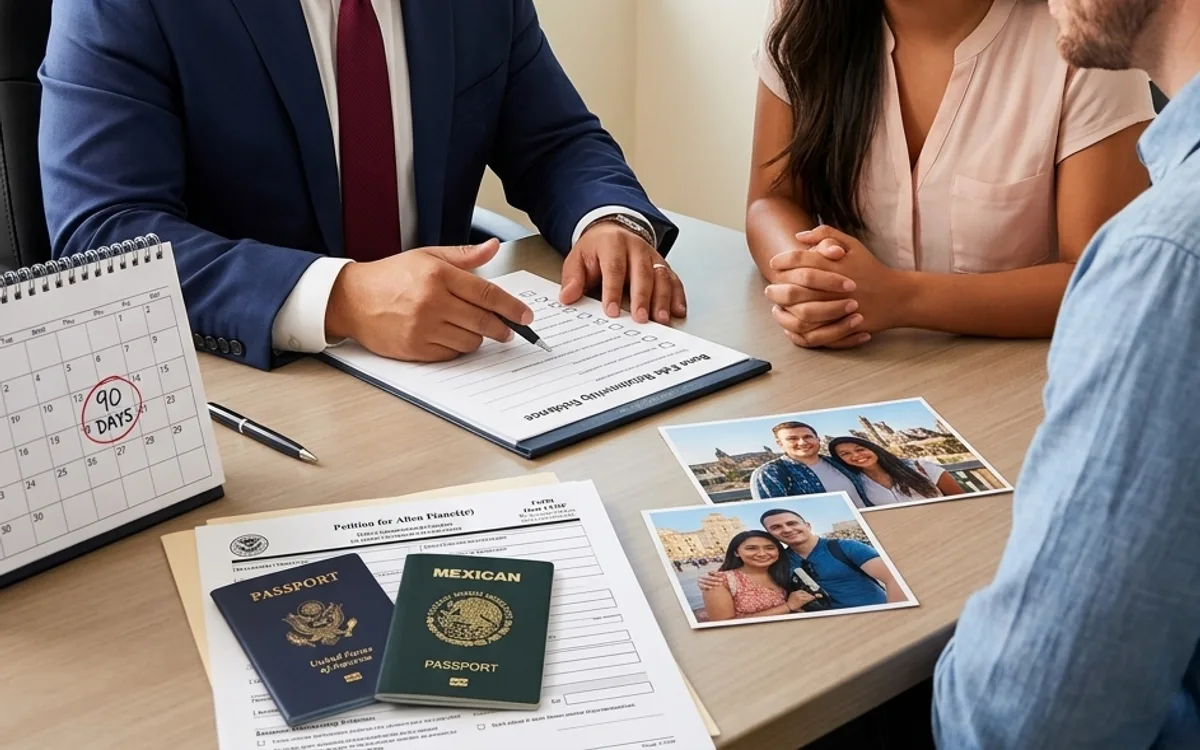
You've set a wedding date. Your fiancé(e) is overseas, the invitations are half-ordered, and USCIS is somewhere in the middle of your Form I-129F. The 90-day clock does not start until your fiancé(e) lands at the airport, but once it starts, it keeps running no matter what: a venue cancellation, a backlogged county clerk, a 221(g) administrative processing notice. Couples tend to worry less about the relationship itself and more about whether USCIS and the State Department can move fast enough to match a date already circled on the calendar.
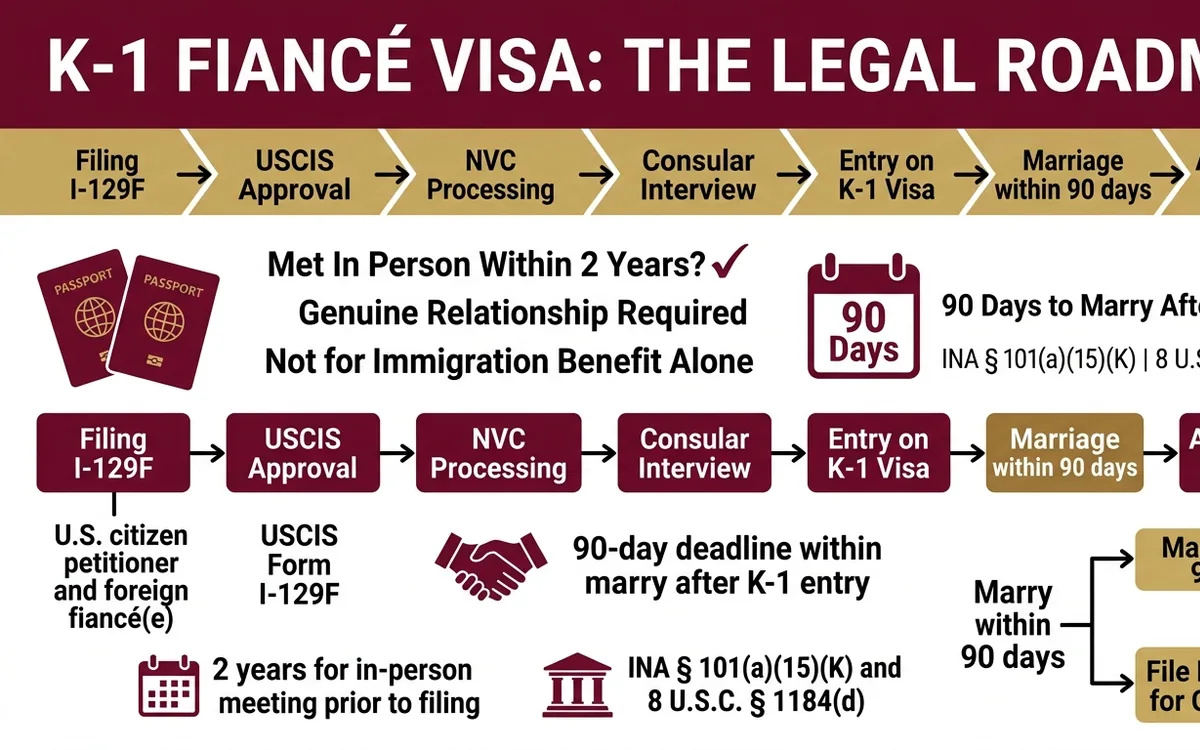
A K-1 fiancé visa lets a U.S. citizen bring a foreign fiancé(e) to the U.S. to marry within 90 days of entry, per INA § 101(a)(15)(K) and 8 U.S.C. § 1184(d). Couples must show they met in person within the prior two years and that the relationship is genuine, not entered for an immigration benefit.
The Hard Truth
At your fiancé(e)'s interview, the consular officer has exactly one job: decide whether this relationship is real or built for a visa. Officers see staged photos, copy-pasted message logs, and relationships documented only after the petition was filed, and they deny or flag cases on that basis consistent with Matter of Soriano, 19 I&N Dec. 764 (BIA 1988). The 90-day marriage window is also unforgiving. It runs from the date of entry, not the date you planned the wedding, and it does not pause for a delayed visa, a canceled flight, or a backlogged Register of Deeds. If your fiancé(e) doesn't marry you within that window, they fall out of status and cannot adjust through the K-1 petition at all.
What Happens If You Wait
Every week without a complete evidence file is a week your fiancé(e)'s case sits thinner at the interview. A consular officer who sees a petition with minimal documentation and no updates since filing is more likely to issue a 221(g) notice for administrative processing. The State Department's Bureau of Consular Affairs notes that 221(g) review can add anywhere from a few weeks to over a year, depending on the post. If the 90-day window closes before your wedding, because of a late marriage license or a delayed flight, your fiancé(e) has no lawful basis to remain. INA § 101(a)(15)(K) builds in no extension. Waiting to call a lawyer until after a Request for Evidence or 221(g) notice arrives means responding from a weaker position, and a missed in-country deadline cannot be fixed after the fact.
Step-by-Step Process
File Form I-129F with USCIS, typically routed through the Potomac Service Center, with proof of your U.S. citizenship, evidence you and your fiancé(e) met in person within the last two years, and documentation of the relationship.
Wait for approval and NVC transfer. Once USCIS approves the I-129F, it forwards the case to the National Visa Center (NVC), which assigns a case number and sends it to the U.S. consulate or embassy with jurisdiction over your fiancé(e)'s residence.
Prepare for the consular interview. Your fiancé(e) completes Form DS-160, gets a medical exam from an approved panel physician, and gathers evidence that the relationship is genuine, not only that the two of you met the legal minimum.
Attend the interview. The consular officer decides whether to issue the K-1 visa, request more documents, or issue a 221(g) notice for further administrative processing.
Enter the U.S. and start the clock. The 90-day window begins on the date of entry, commonly through Charlotte Douglas International Airport for clients settling in North Carolina.
Get the marriage license and marry. In North Carolina, couples obtain a marriage license from the county Register of Deeds, such as Mecklenburg County in Charlotte or Wake County in Raleigh, under N.C. Gen. Stat. § 51-8.1. The license and the wedding must both happen inside the 90 days.
File Form I-485 to adjust status. After the wedding, the foreign spouse files for a green card, along with Form I-765 for work authorization and Form I-131 for travel permission while the case is pending.
Attend the adjustment interview. USCIS, often through the Charlotte Field Office at 6130 Tyvola Centre Drive for North Carolina residents, schedules an interview to confirm the marriage is genuine before approving permanent residence.
A Real-World Example
Consider a composite case: a U.S. citizen in Charlotte petitions for a fiancée she met online and visited twice in Colombia before filing. Her attorney helps assemble two years of message logs, visit itineraries, flight records, and joint financial commitments, since the relationship exists mostly in texts and video calls rather than shared utility bills. USCIS approves the I-129F after four months, and NVC transfers the case to the consulate in Bogotá. At the interview, the officer issues a 221(g) notice asking for additional proof of in-person contact beyond the two documented visits. The couple submits a timeline of calls, a notarized statement from each visit's host family, and updated travel records. The case returns to the consulate for further review. The couple is still waiting on the officer's next step; this stage can run from several weeks to many months depending on the post, and there is no way to force a faster answer.
William J. Vasquez leads the firm's immigration practice. He is admitted to the North Carolina State Bar and to practice before the U.S. Court of Appeals for the Fourth, Fifth, and Eleventh Circuits, and has spent years handling fiancé and spousal visa petitions, consular interview preparation, and the adjustment of status filings that follow them. He is a member of the American Immigration Lawyers Association (AILA), the professional association for attorneys practicing in this field. Our team works directly with USCIS filings, National Visa Center case tracking, and the North Carolina county offices that issue marriage licenses, so the K-1 and K-3 process is handled by people who track it daily, not occasionally.
Key Terms Explained
Form I-129F: The petition a U.S. citizen files with USCIS to classify a foreign fiancé(e) (K-1) or spouse (K-3) for a nonimmigrant visa based on the relationship.
K-1 visa: A nonimmigrant visa under INA § 101(a)(15)(K) for the fiancé(e) of a U.S. citizen, valid for a single entry, requiring marriage within 90 days of arrival.
K-3 visa: A nonimmigrant visa for the spouse of a U.S. citizen whose immigrant visa petition (Form I-130) is still pending, meant to shorten the separation while the underlying petition processes.
National Visa Center (NVC): The State Department office that receives approved petitions from USCIS, collects fees and documents, and forwards the case to the appropriate U.S. consulate or embassy.
221(g) refusal: A provisional hold under INA § 221(g), issued when a consular officer needs more documents or more time before deciding on a visa; it is not a final denial.
Adjustment of status (Form I-485): The application a K-1 spouse (after marriage) or K-3 spouse files with USCIS to become a lawful permanent resident without leaving the United States.
Bona fide marriage: A marriage entered into to build a life together, not primarily to obtain an immigration benefit, the standard described in Matter of Soriano, 19 I&N Dec. 764 (BIA 1988).
Advance Parole (Form I-131) and Employment Authorization (Form I-765): Documents filed alongside adjustment of status that let the applicant travel internationally and work legally while the green card case is pending.
Frequently Asked Questions
Q: What happens if my fiancé(e)'s 90-day window expires before we can get married? A: There is no extension under INA § 101(a)(15)(K). If the marriage does not happen within 90 days of entry, your fiancé(e) falls out of lawful status and generally must depart the United States; they cannot simply refile from inside the country on the same visa.
Q: Can a K-1 visa holder work before the wedding? A: Not automatically. A K-1 visa holder may file Form I-765 for an Employment Authorization Document once in the United States, but work authorization is not automatic on entry and typically takes several weeks to process through USCIS.
Q: What's the real difference between a K-1 fiancé visa and a K-3 spouse visa? A: A K-1 is for couples who are not yet married and requires marriage within 90 days of U.S. entry. A K-3 is for couples already married abroad whose I-130 immigrant petition is still pending, meant to reduce separation time while that petition processes. In practice, many K-3 cases now resolve around the same time as the underlying I-130, so whether K-3 actually saves time depends on the specific case.
Q: Is an in-person meeting always required before filing Form I-129F? A: Generally yes, within the two years before filing, per INA § 101(a)(15)(K) and 8 U.S.C. § 1184(d). USCIS can waive this requirement in narrow circumstances, such as when meeting would violate strict customs of the fiancé(e)'s culture or religion, or would create extreme hardship for the petitioner, but the waiver request must be documented and is not automatically granted.
Q: What if the consulate doubts our relationship is real? A: The officer can issue a 221(g) notice requesting more evidence rather than denying outright. Strengthening the file with a longer documented history, communication records, visit itineraries, and statements from people who have spent time with the couple together addresses the officer's specific concern instead of repeating evidence already submitted.
Clients working with our immigration team describe clear, direct explanations of each filing stage, including the slow and frustrating parts. We focus on process transparency rather than numbers, because case outcomes are not something a law firm can ethically promise or quote as a statistic.
Your wedding date is fixed, but the government's timeline runs on its own schedule, and the two don't always line up. A short consultation can tell you where your case actually stands against both clocks.
Schedule a consultation with our immigration team to review your I-129F filing, build your relationship evidence file before the consular interview, and map your path from K-1 approval through adjustment of status. Call our North Carolina office or request a consultation online to get your case timeline reviewed against your actual wedding date.
- Adjustment of Status After Marriage
- Form I-130 Spousal Petitions
- Immigration Consular Interview Preparation
- Green Card Through Marriage
- Work Permits (Form I-765) for Immigrant Spouses
- Immigration Court and EOIR Proceedings