You've lived here longer than you lived anywhere else. Every school conference, every tax season, every holiday for over fifty years happened on U.S. soil, and no one ever handed you a document that said so. Now you've heard about registry, a green card path built for exactly this kind of life, and you're afraid the agency will ask for proof that no longer exists. That fear is reasonable. It is also where the real work has to start.
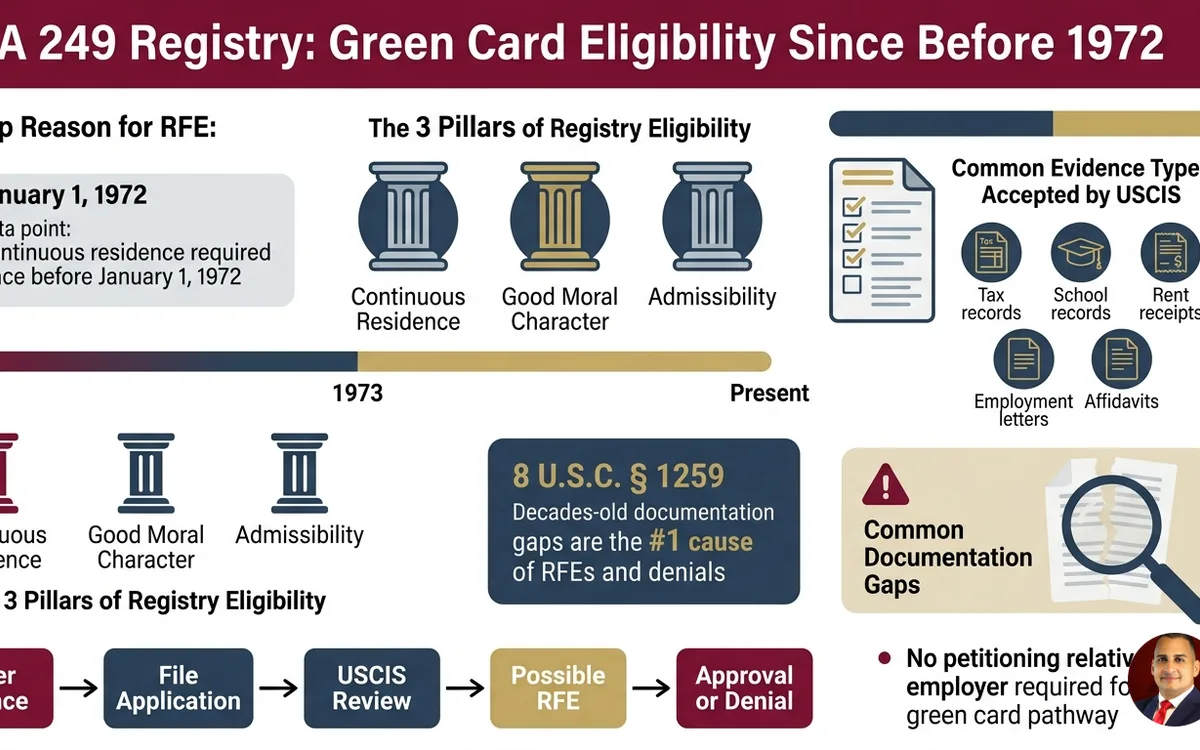
INA 249 registry lets certain long-term residents who have lived in the U.S. continuously since before January 1, 1972 (8 U.S.C. § 1259) apply for a green card without a petitioning relative or employer. You must prove continuous residence, good moral character, and admissibility. Decades-old documentation gaps are the most common reason USCIS issues an RFE or denial.
The Hard Truth
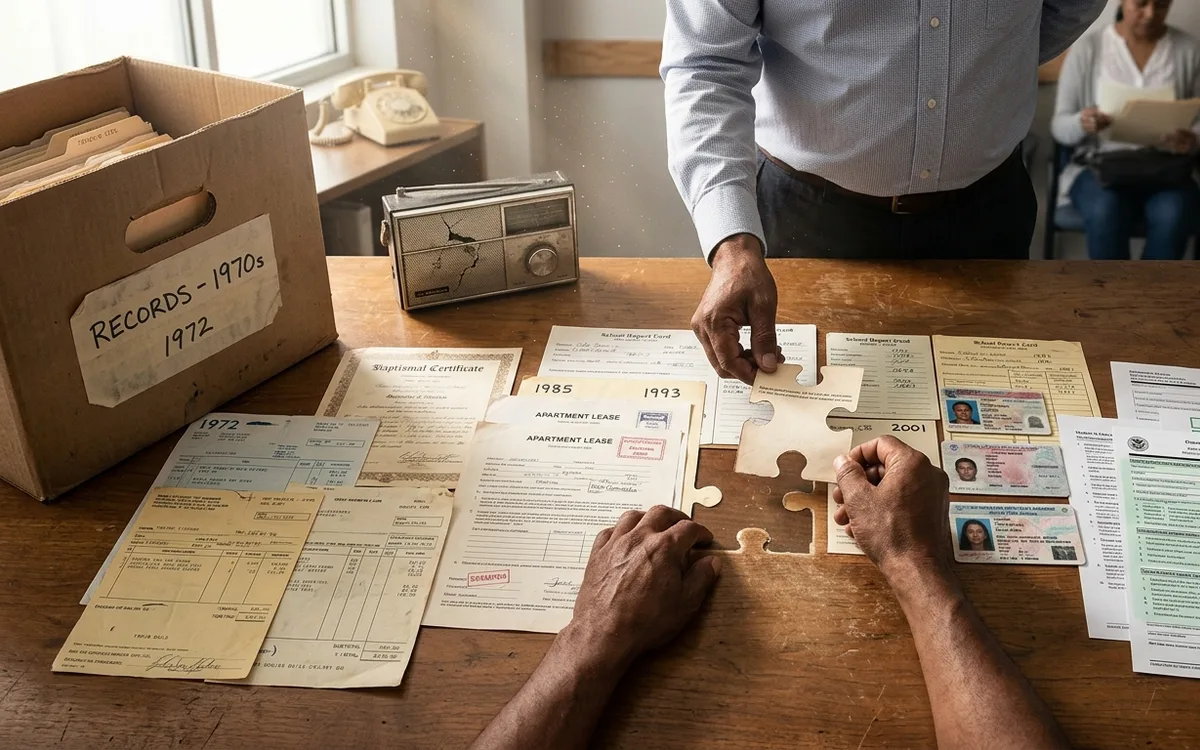
The INA 249 cutoff date has not moved since 1972 (8 U.S.C. § 1259), despite several bills introduced in Congress to advance it. That means registry only reaches people who can prove continuous U.S. residence since before January 1, 1972, over fifty years ago. If you arrived in 1975, 1985, or any year after, registry is not available to you, no matter how long you have lived here since. For the small group it does cover, the real obstacle is rarely the law itself. It is the paper trail: pay stubs, leases, and school records from the early 1970s that were never kept, or were lost decades ago in a move, a fire, or simply time.
What Happens If You Wait
Every year you wait, a piece of your proof disappears. A neighbor who could sign an affidavit about your 1971 apartment passes away. A church digitizes its baptismal records and discards the originals. A county office that issued your 1973 work permit switches record systems and loses the index card with your name on it.
If you are already in removal proceedings, registry can be raised as a form of relief before the immigration judge under 8 C.F.R. § 1240.11(f), but only if you raise it before the case concludes. Missing that window does not just delay an application. It closes off one of the few paths to a green card that does not depend on a relative's petition or an employer's sponsorship, leaving fewer options on the table for the rest of the case.
Step-by-Step Process
Step 1: Build a year-by-year chronology of every address, job, school, and event from 1972 forward, even where you have no document for a given year.
Step 2: Collect primary evidence first, anything with a date on it: old IDs, hospital or baptismal records, union cards, rent receipts, or county tax rolls.
Step 3: Where primary records do not exist, assemble secondary evidence recognized under USCIS Policy Manual, Volume 7, Part O, including affidavits from people with direct, personal knowledge of your presence, school enrollment letters, or employer statements reconstructed from memory and corroborating detail.
Step 4: File Form I-485, Application to Register Permanent Residence or Adjust Status, under the registry classification, with Form G-325A biographic information attached and a written explanation for any documentation gap.
Step 5: Attend biometrics, typically scheduled at the USCIS Application Support Center in Durham, NC.
Step 6: Attend the interview at the USCIS Charlotte Field Office, 6130 Tyvola Centre Drive, Charlotte, NC, where the officer evaluates continuous residence, good moral character, and admissibility together.
Step 7: If you are instead in removal proceedings, registry is raised as relief before the Charlotte Immigration Court, 5701 Executive Center Drive, Charlotte, NC, following the filing procedures in EOIR Immigration Court Practice Manual, Chapter 3, and the court's e-filing requirements.
A Real-World Example
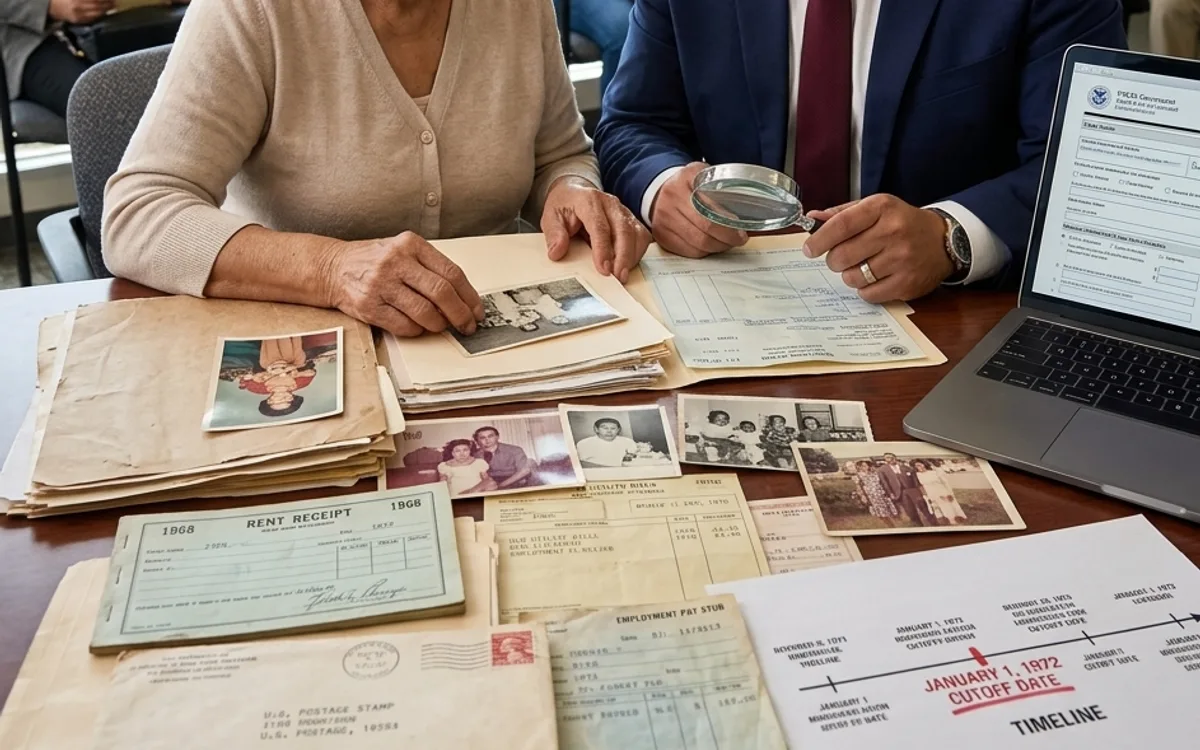
Consider a composite example: a woman we'll call Mrs. R, who has lived in Mecklenburg County since 1970. She has no pay stubs from the early 1970s, only a handful of photographs, a 1974 baptismal certificate for her oldest child, and three former neighbors who are still alive and willing to speak to her presence.
The process started with a chronology: every address, employer, and milestone she could recall, year by year, checked against whatever document existed for that year. Next came secondary evidence under USCIS Policy Manual, Volume 7, Part O, including affidavits from people with personal knowledge, church records, and an old utility bill a relative had kept in a storage box.
The filing included Form I-485 under the registry classification, Form G-325A, and a declaration explaining why no direct 1971 or 1972 records remain. Biometrics followed at the Durham Application Support Center, then an interview at the USCIS Charlotte Field Office. At every stage, the question was the same: does this piece of evidence make continuous residence since before January 1, 1972 more likely than not, the standard described in Matter of Villanueva, 19 I&N Dec. 101 (BIA 1984). That standard applies to every registry file, regardless of how the evidence comes together.
William J. Vasquez has spent years handling federal immigration matters, including registry applications that require piecing together decades of secondary evidence instead of a clean, document-by-document record. He is admitted to practice in North Carolina and focuses his federal immigration work on cases where the paper trail is incomplete, not just the straightforward ones. Our team has handled registry and other long-term-residence filings, and builds each application around the specific evidentiary gaps a given applicant actually has, rather than a generic checklist.
Key Terms Explained
Registry: the process under INA § 249 (8 U.S.C. § 1259) that lets certain noncitizens apply for a green card based on continuous U.S. residence since before January 1, 1972, without a petitioning relative or employer.
Continuous residence: ongoing physical presence in the U.S. without a meaningful break, evaluated for registry purposes under the standard set in Matter of Villanueva, 19 I&N Dec. 101 (BIA 1984).
Good moral character: a statutory requirement reviewed by USCIS under USCIS Policy Manual, Volume 7, Part O, looking at an applicant's conduct and record, including any criminal history, over the relevant period.
Form I-485: the Application to Register Permanent Residence or Adjust Status, the form used to file a registry-based green card application.
Form G-325A: the biographic information form filed alongside Form I-485, listing addresses, employment, and family history.
RFE (Request for Evidence): a written notice from USCIS asking an applicant to submit additional documentation before the agency decides the case.
8 C.F.R. § 1240.11(f): the regulation that allows registry to be raised as a form of relief before an immigration judge in pending removal proceedings.
EOIR: the Executive Office for Immigration Review, the Department of Justice agency that operates the immigration courts, including the Charlotte Immigration Court.
Frequently Asked Questions
Q: Can I apply for registry if I entered the U.S. without inspection before 1972? A: Yes. INA § 249 does not require a lawful entry. What matters is continuous residence in the U.S. since before January 1, 1972, proven through the standard applied in Matter of Villanueva, 19 I&N Dec. 101 (BIA 1984).
Q: Will an old DUI or minor conviction automatically disqualify me from registry? A: Not automatically. USCIS reviews good moral character under USCIS Policy Manual, Volume 7, Part O, looking at the nature of the offense, how long ago it occurred, and whether any statutory bar applies, so an old or minor conviction needs individual review rather than an assumption either way.
Q: What is the difference between registry and cancellation of removal for a long-term resident? A: Registry is an affirmative application filed with USCIS (or raised before an immigration judge under 8 C.F.R. § 1240.11(f)) based on residence since before January 1, 1972, with no sponsor required. Cancellation of removal under INA § 240A is relief available only inside removal proceedings, with a shorter 10-year continuous presence requirement but a much higher bar: the applicant must also show exceptional and extremely unusual hardship to a qualifying U.S. citizen or lawful permanent resident relative.
Q: What happens if there is a gap or an unexplained absence in my residence history? A: A gap does not automatically end a registry claim, but it has to be addressed directly, usually with an explanation and corroborating evidence for the period in question, since the adjudicator is weighing the whole record under the Villanueva standard rather than looking for a single missing year to deny the case.
Q: Can registry be raised if I am already in removal proceedings? A: Yes, under 8 C.F.R. § 1240.11(f), registry can be presented to the immigration judge as a form of relief in a pending case, including at the Charlotte Immigration Court, but it generally needs to be raised before the case concludes.
Clients who come to us for registry and other long-term-residence filings consistently describe the same experience: a methodical review of decades of scattered records, direct answers about what USCIS actually requires, and no promises about how an individual case will turn out. We report our work by volume, the number of federal immigration matters our team has handled, not by outcome statistics, because case results are not something a law firm can verify or guarantee.
Registry cases live or die on documentation you may not realize you still have, or that someone close to you is still able to provide. Before you decide whether this path applies to you, it helps to have someone who works with this statute walk through what you've kept and what else might exist.
If you believe you've lived in the U.S. continuously since before January 1, 1972, schedule a consultation with our immigration team to review your residence history and find out whether registry, or another form of relief, fits your situation. Call our North Carolina office or request a consultation online to start building your evidence file before more of it disappears.