A TPS Deadline Doesn't Wait for You to Feel Ready
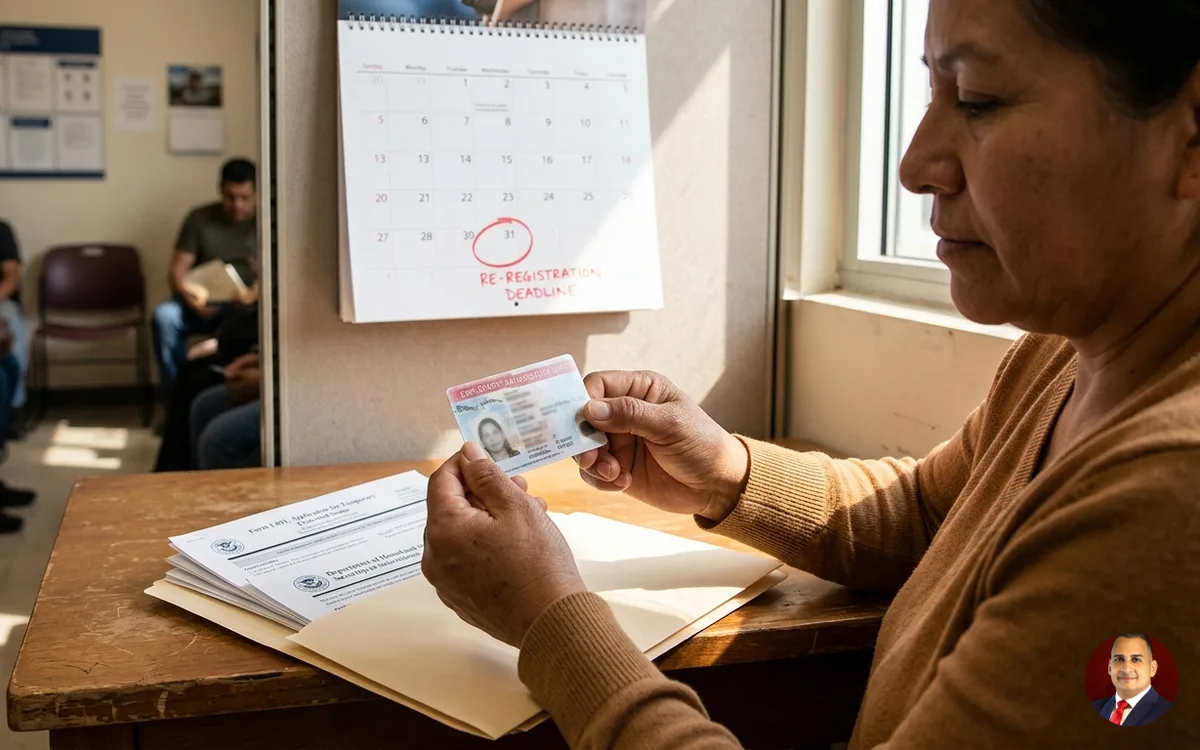
You read a notice, or a news story, saying Temporary Protected Status for your country is ending or up for renewal. Your work permit has an expiration date printed on it, and that date now feels like the only thing that matters. You are not sure if you still qualify, whether the government changed the rules again, or what happens to your job if the card expires before anything gets resolved.
That fear is specific, not vague. TPS was built as a temporary measure from the start, and every designation carries its own renewal window, its own paperwork, and its own risk of ending without much warning. Knowing the actual deadline, and what to file before it, is the difference between keeping your status intact and starting over from a much worse position.
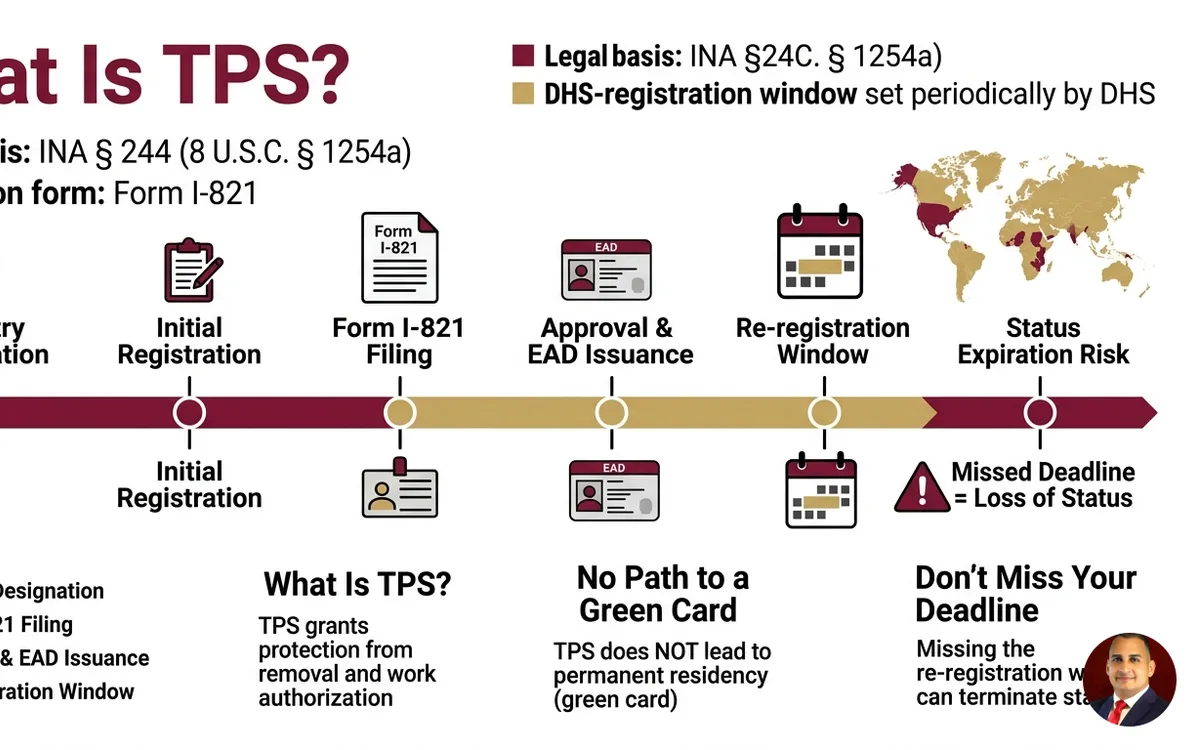
Temporary Protected Status (TPS) lets eligible nationals of designated countries remain and work in the United States without facing removal, under INA § 244 (8 U.S.C. § 1254a). You apply using Form I-821, generally during a re-registration window set by the Department of Homeland Security. TPS does not lead to a green card; missing the window can end your status.
The Hard Truth
The Hard Truth About TPS
TPS was never meant to be permanent, and Congress designed it that way. The Secretary of Homeland Security reviews each country's designation on a set schedule and can extend it, redesignate it to cover new arrivals, or terminate it, publishing that decision in the Federal Register. A termination does not require your agreement, and in recent years several terminations have ended up in federal court, including Ramos v. Nielsen, 336 F. Supp. 3d 1075 (N.D. Cal. 2018), which blocked terminations for some countries for a period of time. Litigation can pause a termination; it cannot guarantee that the designation continues indefinitely.
Re-registering on time does not by itself resolve your long-term immigration situation. TPS gives you protection from removal and permission to work while it is in effect, under 8 C.F.R. § 244.1-244.23, but it does not convert into a green card on its own. If you want a permanent path, that usually means a separate filing, such as adjustment of status through a qualifying relationship, and that filing has its own eligibility rules that TPS alone does not satisfy.
What Happens If You Wait
What Happens If You Miss the TPS Deadline
The re-registration window for most TPS designations runs 60 days, set by DHS and published in the Federal Register for each country, per 8 C.F.R. § 244.17. File after that window closes without a DHS-recognized exception, and USCIS can reject the application outright. Once that happens, your work authorization lapses when the current card expires, and your protection from removal lapses with it.
An expired Employment Authorization Document (EAD) is not just a paperwork problem. Under Form I-9 reverification requirements, 8 C.F.R. § 274a.2, an employer that sees an expired EAD without a valid Federal Register extension notice can lawfully stop you from working. Some employers misread an automatic extension and ask workers to stop immediately anyway; we see this often enough in client calls to flag it here, though we do not track it as a formal statistic.
If your TPS protection ends and you have no other status, you can begin accruing unlawful presence under INA § 212(a)(9)(B), which carries its own bars to future immigration benefits. At that point, DHS can place you in removal proceedings before the immigration court, and a case that started as a missed renewal form becomes a defense against deportation.
Step-by-Step Process
How TPS Re-Registration Works, Step by Step
Confirm your country's current designation. DHS publishes each TPS designation, extension, or redesignation in the Federal Register; check the specific dates for your country before doing anything else.
File Form I-821, Application for Temporary Protected Status, with USCIS. Re-registering applicants typically file at the Vermont or Nebraska Service Center, not a local office, per the form's current filing instructions.
Pay or request a fee waiver. The I-821 filing fee is set by USCIS (check the current fee schedule on uscis.gov, since it changes periodically); biometrics are processed separately.
File Form I-765 for your Employment Authorization Document if you want to keep working, usually submitted with the I-821. Processing times vary by service center; check the USCIS case processing times tool for the current estimate.
Attend biometrics. North Carolina applicants are typically scheduled at the USCIS Application Support Center (ASC) in Charlotte for fingerprints and photographs.
Respond to any Request for Evidence (RFE). USCIS sets a deadline on the RFE notice itself, usually 30 to 87 days depending on the request; missing it can result in a denial.
If TPS is terminated or your application is denied, and you are placed in removal proceedings, your case moves to the Charlotte Immigration Court (EOIR), 5701 Executive Center Dr, Suite 100, Charlotte, NC, where a judge reviews any remaining relief.
If you believe a denial was wrong, a motion to reopen or reconsider generally must be filed within 30 days of the decision; appeals of removal orders go to the Board of Immigration Appeals (BIA).
The USCIS Field Office in Charlotte, 6130 Tyvola Centre Dr, does not adjudicate TPS applications directly, but it can help with related inquiries, and organizations like El Centro Hispano in Durham assist community members in gathering documents before filing.
A Real-World Example
What a TPS Re-Registration Case Looks Like
A composite example: a Honduran national living in Mecklenburg County had held TPS for several years when DHS announced a redesignation extending eligibility to more recent arrivals. Her existing TPS was due to expire in four months, and she had also changed addresses and employers since her last filing.
The first step was confirming she fell inside the specific 60-day re-registration window published for Honduras in the Federal Register, since filing even a few days early or late outside that window can affect how USCIS processes it. Next came gathering updated evidence: proof of continuous residence since the relevant date, a government-issued photo ID, and a certified translation of a birth certificate that had never been submitted before.
Her I-821 and I-765 were filed together at the correct service center, with the required fee and a biometrics appointment scheduled at the Charlotte ASC. Roughly ten weeks later, USCIS issued a Request for Evidence asking for additional proof of her physical presence during a specific period, which required locating old utility bills and a notarized statement from a former landlord.
At the time of this writing in the composite scenario, her case remains in standard processing. That is the realistic shape of most TPS filings: a sequence of deadlines, document requests, and waiting periods, not a single dramatic hearing.
About Attorney William J. Vasquez
William J. Vasquez is admitted to the North Carolina State Bar and to practice before several federal appellate circuits, and focuses his federal immigration practice on removal defense, humanitarian relief, and status applications, including TPS matters, before USCIS and the Executive Office for Immigration Review (EOIR). He is a member of the American Immigration Lawyers Association (AILA).
His practice handles TPS filings alongside related issues that often come up in the same case: a terminated designation that leads to removal proceedings, a TPS holder exploring adjustment of status through marriage, or a denied I-821 that needs a motion to reopen. Our team tracks each eligible country's Federal Register designation and re-registration window so that renewal deadlines do not get missed.
Key Terms Explained
Glossary of TPS Terms
TPS (Temporary Protected Status): A temporary immigration status under INA § 244 that protects eligible nationals of designated countries from removal and allows work authorization, without granting permanent residence.
Designation: The Secretary of Homeland Security's formal decision, published in the Federal Register, naming a country as eligible for TPS, usually because of armed conflict, environmental disaster, or similarly extraordinary conditions.
Redesignation: An extension of TPS eligibility to a broader group of nationals from the same country, typically covering people who arrived in the U.S. after the original designation date.
Re-registration: The process of renewing TPS during a specific window set by DHS for each extension period, filed on Form I-821.
Form I-821: The USCIS application used for initial TPS registration and for each subsequent re-registration.
Form I-765: The application for an Employment Authorization Document (EAD), usually filed alongside the I-821.
EAD (Employment Authorization Document): The card that proves a noncitizen is authorized to work in the United States during a specific period.
Form I-131, Application for Travel Document: Used to request advance parole, which some TPS holders need before leaving and re-entering the U.S. without abandoning their status.
BIA (Board of Immigration Appeals): The administrative body within EOIR that reviews appeals from immigration judge decisions, including some TPS-related removal orders.
Motion to reopen/reconsider: A filing asking USCIS or an immigration judge to revisit a decision, generally due within 30 days of that decision under 8 C.F.R. § 1003.23.
Frequently Asked Questions
Frequently Asked Questions
Q: Can I apply for TPS if my country's designation was terminated by a court order? A: It depends on the specific litigation. Several TPS terminations have been challenged in federal court, including Ramos v. Nielsen, and some protections remained in effect during that litigation; check the current Federal Register notice for your country before assuming either way.
Q: Does TPS lead to a green card? A: Not by itself. TPS provides protection from removal and work authorization while it is in effect, but a separate filing, such as adjustment of status based on a qualifying marriage or family petition, is what actually leads to permanent residence.
Q: What happens if USCIS denies my I-821 TPS application? A: You can generally file a motion to reopen or reconsider with USCIS, often within 30 days of the decision, and if the denial leads to removal proceedings, the case moves to the immigration court for further review.
Q: Can I travel outside the U.S. while I hold TPS? A: Only with advance parole, requested on Form I-131, approved before you leave; traveling without it can be treated as abandoning your TPS application or status.
Q: How is TPS different from asylum? A: TPS is tied to a country-wide designation and does not require proving individual persecution, while asylum under INA § 208 requires showing a well-founded fear of persecution on a protected ground, and asylum can lead directly to a green card after one year.
Clients come to our team at a specific moment: a deadline on a government notice, a work permit about to expire, or a denial they do not understand. We describe our caseload honestly, in terms of the matters we have handled, not in terms of outcomes we cannot guarantee. People return to us, and refer family members, because we explain each filing requirement plainly and keep track of renewal windows so a client does not have to discover a missed deadline on their own.
TPS deadlines are fixed by federal notices, not by how ready you feel to deal with them. Checking your specific country's current window, and whether your situation calls for more than a simple renewal, is worth doing before that window closes.
If your TPS is up for renewal, was recently terminated, or was denied, schedule a consultation with our immigration team to review your specific filing deadline and options, including whether a path to adjustment of status may apply to your case.