
You have a conviction that closes most doors. Asylum is barred. Withholding of removal may be barred too. But you still believe, and the evidence may show, that going back means a government official will torture you, or stand aside while someone else does.
The Convention Against Torture is the one form of relief built without a criminal bar. It will not erase the conviction. It asks a narrower question: is it more likely than not that you will be tortured, and will a government have a hand in it.
That question has a very high bar to clear, and immigration judges deny far more of these claims than they grant. The rest of this page explains what the evidence actually needs to look like, and what happens at each step from here.
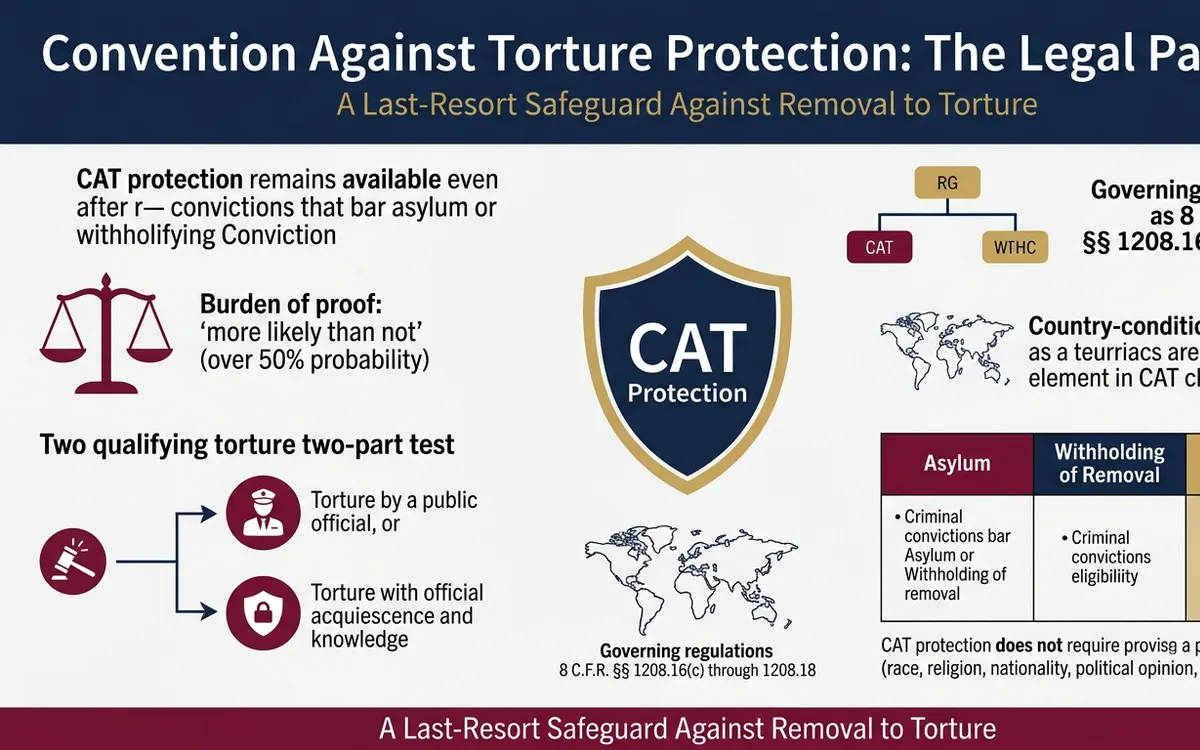
Convention Against Torture protection lets someone stay in the United States, even after a conviction that blocks asylum or withholding of removal, if they prove it is more likely than not that a public official would torture them or knowingly allow it, per 8 C.F.R. §§ 1208.16(c)-1208.18.
The Hard Truth
CAT protection has no criminal bar. It also has one of the hardest evidentiary standards in immigration law, and immigration judges deny far more CAT claims than they grant.
You must prove it is more likely than not, over 50 percent, that you will be tortured if removed. A fear that feels real to you is not enough if the record is general country-conditions evidence rather than evidence tied to you specifically: your name, your profile, your history with the particular officials or groups you fear.
General violence in a country, even documented police brutality, rarely satisfies this standard on its own. The Board of Immigration Appeals and the federal courts have repeatedly rejected CAT claims built on background country conditions alone, without a direct line from that country's documented practices to this applicant's individualized risk.
If your conviction also means you are detained, the time pressure to build that individualized record is real. Charlotte Immigration Court sets merits hearing dates that do not wait for a forensic medical evaluation to be scheduled.
What Happens If You Wait
Miss a deadline here, and part of your case is gone for good, not merely paused.
If an immigration judge denies CAT relief and you do not file a Notice of Appeal with the Board of Immigration Appeals within 30 days, 8 C.F.R. § 1003.38, the denial becomes a final, enforceable order of removal. A general motion to reopen after that must be filed within 90 days under 8 C.F.R. § 1003.23(b)(1), and only one is normally allowed.
There is a narrower exception. A motion to reopen based on changed country conditions material to a CAT claim has no fixed deadline, but it still must be filed without unreasonable delay once the new evidence exists. Waiting months after new country reports or new evidence of government acquiescence surfaces can itself be used against you.
Meanwhile, if you are detained, each continuance and each unfiled piece of evidence is time spent in custody without a decision. A CAT claim built after the fact, once documents are stale or witnesses are no longer reachable, is a weaker claim than one built before the merits hearing.
Step-by-Step Process
Confirm the bar. Counsel reviews the record of conviction against 8 U.S.C. § 1158(b)(2) (asylum bars) and § 1231(b)(3)(B) (withholding bars) to confirm which forms of relief the conviction actually closes, and which remain open.
File or amend the claim. CAT relief is raised on Form I-589, Part III, filed with the Charlotte Immigration Court (5701 Executive Center Drive, Charlotte, NC) and, where applicable, through the EOIR Courts & Appeals System (ECAS) electronic filing portal.
Build the record before the hearing. This includes a personal declaration, U.S. Department of State Bureau of Democracy, Human Rights, and Labor Country Reports on Human Rights Practices for the country of removal, and, where torture already occurred, a forensic medical evaluation conducted under the Istanbul Protocol standard.
Document acquiescence specifically. Under 8 C.F.R. § 1208.18(a)(7), acquiescence means a public official knew of the torture and breached a legal duty to intervene, or willfully turned away. General corruption or weak policing is not enough; the record needs the specific official, agency, or unit tied to your individualized risk.
Merits hearing. The immigration judge decides whether you qualify for withholding of removal under CAT, 8 C.F.R. § 1208.16(c), available in most cases without a serious-crime bar, or only deferral of removal under 8 C.F.R. § 1208.17, which applies when a bar such as an aggravated felony treated as a particularly serious crime blocks withholding.
Appeal if denied. A Notice of Appeal to the Board of Immigration Appeals is due within 30 days of the written decision, 8 C.F.R. § 1003.38, with the Board's review authority over CAT deferral orders set out at 8 C.F.R. § 1003.1(b)(3).
Petition for review. If the Board denies relief, the next step is a petition for review to the federal circuit court covering the removal proceedings. The Supreme Court held in Nasrallah v. Barr, 140 S. Ct. 1683 (2020), that factual findings underlying a CAT deferral order remain subject to that circuit's review even when the applicant's criminal history would otherwise limit review of the removal order itself.
After a grant. Deferral of removal is not permanent relief. It can be reopened and terminated under 8 C.F.R. § 1208.17(d) if conditions in the country change or new evidence undercuts the original finding, and the government can request that review at any time.
A Real-World Example
Consider a composite, non-client example. A man in his late thirties, convicted years earlier of a drug trafficking offense classified as an aggravated felony, is placed in removal proceedings after a state sentence ends. Asylum and withholding of removal are foreclosed by the conviction under 8 U.S.C. §§ 1158(b)(2) and 1231(b)(3)(B). He fears return to a country where he was once detained and beaten by local police investigating a relative's political activity.
Everything starts with the record, built long before the hearing. Counsel requests his medical and detention records from years earlier, arranges a forensic medical evaluation under the Istanbul Protocol standard to document scarring consistent with his account, and compiles the U.S. Department of State Country Report sections addressing police conduct toward people with his specific profile.
At the merits hearing in Charlotte Immigration Court, the government cross-examines him on inconsistencies between an earlier credible fear interview and his current testimony, a common line of attack in CAT cases. The immigration judge weighs the forensic evaluation, the country-conditions evidence tied to his specific profile, and his testimony against the particularly-serious-crime bar that forecloses withholding of removal.
The judge takes the case under advisement to issue a written decision addressing whether deferral of removal under 8 C.F.R. § 1208.17 applies. Whatever the outcome, the process illustrates what a CAT claim after a disqualifying conviction actually requires: individualized, document-backed evidence of torture and government acquiescence, not a general account of danger in the home country.
William J. Vasquez handles removal defense matters, including Convention Against Torture claims, for clients who have lost access to asylum and withholding because of a criminal record. He is admitted to the North Carolina State Bar and to practice before the U.S. Court of Appeals for the Fourth Circuit, the circuit that reviews petitions for review from immigration proceedings originating in North Carolina, including CAT deferral orders under the standard set out in Nasrallah v. Barr.
Before the Board of Immigration Appeals, representation is governed by 8 C.F.R. § 1292.1, which allows any attorney admitted to a state bar in good standing to appear nationwide; that authority covers BIA appeals in CAT cases regardless of where the client's removal proceedings began.
CAT claims built on a disqualifying conviction depend on the quality of the evidentiary record: forensic medical evaluations, country-conditions documentation tied to the individual, and a clear account of what the criminal bars do and do not foreclose. That is the specific work our team does in these cases, case by case, not a general removal-defense caseload.
Key Terms Explained
Convention Against Torture (CAT): A 1984 international treaty, implemented in U.S. law through the Foreign Affairs Reform and Restructuring Act of 1998 (FARRA) § 2242 and codified at 8 C.F.R. §§ 1208.16(c)-1208.18, that bars removing a person to a country where it is more likely than not they will be tortured by or with the acquiescence of a government official.
Withholding of removal under CAT: Protection under 8 C.F.R. § 1208.16(c) available to applicants who are not barred by an aggravated felony treated as a particularly serious crime or certain other bars; it prevents removal to the specific country of feared torture but does not grant lawful status.
Deferral of removal under CAT: Protection under 8 C.F.R. § 1208.17 for applicants who would otherwise qualify for CAT relief but are barred from withholding by a criminal or other disqualifying history. It has no criminal bar of its own, but it is narrower and more easily reopened than withholding.
Acquiescence: Under 8 C.F.R. § 1208.18(a)(7), a public official's awareness of torture combined with a breach of a legal duty to intervene, or a willful decision to look away. Acquiescence does not require government approval of the torture, only knowledge and inaction.
Particularly serious crime: A category of offense, including most aggravated felonies with a sentence of five years or more, that blocks withholding of removal under 8 U.S.C. § 1231(b)(3)(B) but does not block CAT deferral of removal.
Forensic medical evaluation: A physical and psychological examination documenting evidence of past torture, generally conducted to the Istanbul Protocol standard, the United Nations manual on investigating and documenting torture, and submitted as evidence in CAT proceedings.
Nasrallah v. Barr: A 2020 U.S. Supreme Court decision holding that factual findings underlying a CAT deferral-of-removal order remain subject to review by the federal circuit courts of appeals, even for applicants whose criminal history otherwise limits judicial review of their removal order.
Frequently Asked Questions
Q: Can I still get CAT protection if an aggravated felony bars my asylum and withholding claims? A: Yes. Deferral of removal under CAT, 8 C.F.R. § 1208.17, has no criminal bar, so an aggravated felony or particularly serious crime conviction that blocks asylum and withholding does not block CAT deferral.
Q: What is the difference between CAT withholding and CAT deferral of removal? A: Withholding of removal under 8 C.F.R. § 1208.16(c) is available to applicants without a disqualifying criminal record; deferral under 8 C.F.R. § 1208.17 covers applicants barred from withholding, carries no criminal bar, but is reviewed and can be terminated more easily under 8 C.F.R. § 1208.17(d).
Q: How do I prove a specific government official will acquiesce to torture? A: You need evidence tied to your individual profile, such as prior encounters with named officials or units, country reports documenting that agency's conduct toward people in your situation, and, where torture already occurred, a forensic medical evaluation connecting your injuries to that account. General country conditions alone are usually not enough.
Q: Can I reopen a case with a final order of removal to add a CAT claim? A: It is possible through a motion to reopen, but a general motion must be filed within 90 days of the final order under 8 C.F.R. § 1003.23(b)(1); a motion based on new country conditions material to CAT has no fixed deadline but must still be filed without unreasonable delay once the new evidence exists.
Q: Is deferral of removal under CAT permanent? A: No. It can be reopened and terminated under 8 C.F.R. § 1208.17(d) if the government shows that country conditions have changed or that the original torture finding is no longer supported, so the protection remains subject to ongoing review.
Clients who come to our team after losing access to asylum and withholding tend to describe the same starting point: a conviction they already served time for, and a fear that the system will not look past it. The feedback we hear is less about any particular result and more about the process, whether a forensic medical evaluation got scheduled early enough to matter, whether withholding versus deferral of removal was explained before the hearing, and whether the record reflected their specific history rather than a generic account of danger in the home country. That is the standard our team works toward on every CAT matter it accepts: whether the person understood their own case by the time the judge ruled, not a volume count or a percentage.
If your case involves a conviction that already cost you asylum and withholding, the CAT evidentiary record needs to start well before your next hearing date, not after. The earlier a forensic medical evaluation and an individualized country-conditions record exist, the more an immigration judge has to work with when it matters.
Our team handles Convention Against Torture claims, including deferral-of-removal cases for clients barred by a criminal conviction, as part of our broader removal defense practice. Call our office to schedule a consultation to review your record of conviction, your prior country history, and what evidence your CAT claim will need before your next Charlotte Immigration Court date.

- Asylum and Withholding of Removal
- Removal Defense in Immigration Court
- Criminal Convictions and Immigration Consequences
- BIA Appeals
- Immigration Bond Hearings