You're waiting on an immigrant visa interview overseas, and your family is waiting on the other side of it. The National Visa Center keeps asking for one more document. That embassy appointment letter sits in your email, and so does the worry that one overlooked form, one old visa overstay, or one hard question from the consular officer could end the case at the single interview you get.
That fear is not imagined. A denial at a U.S. embassy or consulate abroad is one of the hardest immigration decisions to undo, and you are the one who has to sit in the room and answer for it alone.
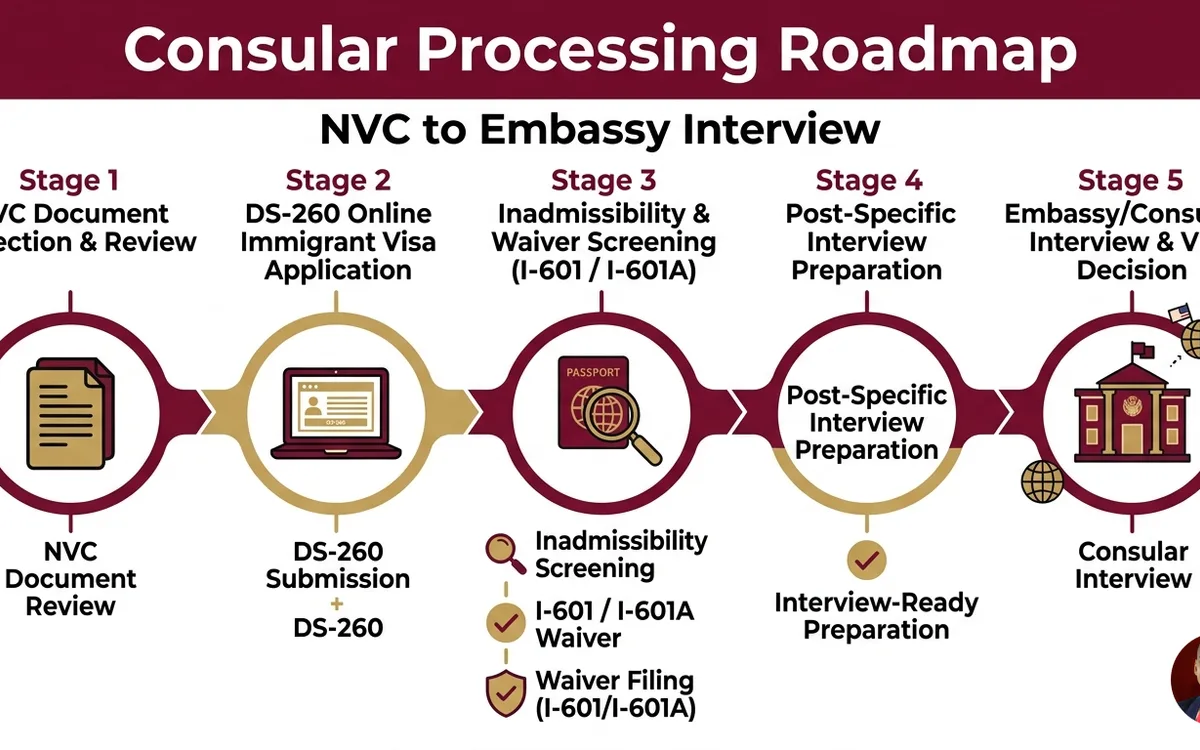
A consular processing attorney represents immigrant visa applicants completing their case at a U.S. embassy or consulate abroad, rather than through adjustment of status inside the country. The work includes NVC document review, DS-260 preparation, inadmissibility screening, interview preparation for a specific post, and waiver filings such as Form I-601 or I-601A when a bar applies.
The Hard Truth
Here is what most applicants do not learn until after a denial: a consular officer's decision is, in nearly every practical sense, final. The Supreme Court reaffirmed this rule, known as consular nonreviewability, in Department of State v. Muñoz, 602 U.S. 899 (2024), holding that U.S. courts generally cannot second-guess a consular officer's refusal of a visa, even when a U.S. citizen spouse is the one left waiting at home.
There is no immigration judge to appeal to and no board that reconsiders the merits of a visa refusal. If a ground of inadmissibility applies, such as a prior unlawful presence bar under INA § 212(a)(9)(B)(i)(II), the usual path forward is a waiver, and a waiver is not a formality. It requires proof of extreme hardship to a qualifying U.S. citizen or lawful permanent resident relative, decided by USCIS, not by the embassy that refused you.
What Happens If You Wait
Every month your case sits incomplete at the National Visa Center in Portsmouth, New Hampshire adds a month to a family separation that already has no fixed end date. Medical exams performed by an embassy-approved panel physician are valid for a limited window; let it lapse before your interview and you pay for the exam again before a new appointment is possible.
A case placed into administrative processing after a 221(g) refusal can sit for 60 days, a year, or longer, with no guaranteed resolution date published by the Department of State. If a prior unlawful presence bar already applies under INA § 212(a)(9)(B)(i)(II), waiting does not make the bar go away. It only delays the point where a waiver gets filed, and the review clock at the USCIS Nebraska Service Center does not start until that filing happens.
Step-by-Step Process
NVC case creation. Once USCIS approves the underlying petition (Form I-130 or I-140) and the National Visa Center in Portsmouth, New Hampshire opens the case, you select an agent and pay the immigrant visa and Affidavit of Support fees.
Form DS-260 and document collection. You file the online immigrant visa application, Form DS-260, and submit civil documents (birth certificate, police certificates, marriage certificate) along with Form I-864, Affidavit of Support, showing the sponsor meets the income requirement.
Documentarily complete and interview scheduling. Once the NVC confirms your file is documentarily complete, it forwards the case to the relevant post, such as the U.S. Embassy in Ciudad Juárez, the U.S. Consulate General in Guangzhou, or the U.S. Embassy in Manila, which schedules the interview.
Medical exam. Before the interview, a panel physician approved by that specific embassy or consulate performs the medical exam and vaccination review required under INA § 212(a)(1).
The interview. A consular officer reviews your file, asks questions under oath, and either approves the visa, issues a 221(g) refusal for administrative processing or missing documents, or identifies a ground of inadmissibility.
Waiver filing, if needed. If the officer identifies a bar, such as unlawful presence under INA § 212(a)(9)(B)(i)(II), the next step is a Form I-601 or I-601A waiver application, most of them adjudicated at the USCIS Nebraska Service Center under the extreme-hardship standard described at 9 FAM 302.9-3(B).
Visa issuance and entry. Once any required waiver is decided and the visa is issued, you enter the United States and become a lawful permanent resident at the port of entry.
A Real-World Example
Consider a composite case, not a real client: a spouse abroad whose U.S. citizen husband filed Form I-130, approved after about a year. The National Visa Center requested additional civil documents twice before marking the file documentarily complete. The case was sent to the U.S. Embassy in Manila for interview.
At the medical exam, the panel physician's intake paperwork surfaced a prior deportation order from years earlier, something the applicant had not mentioned to the petitioning spouse beforehand. At the interview, the consular officer issued a 221(g) notice for administrative processing rather than a decision on the spot.
That triggered a Form I-601 waiver filing, built around evidence of extreme hardship to the U.S. citizen spouse, submitted to the USCIS Nebraska Service Center. Months passed with no interview-day answer and no fixed decision date. This is the ordinary shape of a case once a bar surfaces: a second filing, a second review, and a wait measured in months. One interview rarely settles things in a single pass.
William J. Vasquez is admitted to the North Carolina State Bar and holds federal immigration-bar standing, which allows him to represent clients in EOIR, USCIS, and Board of Immigration Appeals matters nationwide, including consular processing and waiver cases for applicants completing their immigrant visa abroad. He has years of experience with family-based and employment-based immigrant visa cases, including I-601 and I-601A waivers built around the extreme-hardship standard at 9 FAM 302.9-3(B).
Our attorneys review NVC document requests, DS-260 submissions, and medical exam findings well ahead of the interview, while there's still room to fix a problem instead of reacting to it after a denial letter arrives. That early review is where a missed ground of inadmissibility gets caught, while there is still time to prepare a waiver application rather than react to a refusal at the embassy.
Key Terms Explained
DS-260: The online Immigrant Visa and Alien Registration Application filed through the Consular Electronic Application Center once the National Visa Center accepts a case for interview scheduling.
NVC (National Visa Center): The State Department office in Portsmouth, New Hampshire that collects fees, documents, and the DS-260 before forwarding an approved immigrant visa case to the interviewing embassy or consulate.
221(g) refusal: A temporary refusal issued at the interview when the consular officer needs more documents or time, commonly called administrative processing, rather than a final grant or denial.
Form I-601: The waiver application for most grounds of inadmissibility, including unlawful presence, filed with and adjudicated by USCIS, generally at the Nebraska Service Center.
Form I-601A: A provisional unlawful-presence waiver filed before leaving the United States for the interview, available only to applicants whose sole ground of inadmissibility is unlawful presence under INA § 212(a)(9)(B)(i)(II).
Consular nonreviewability: The doctrine, reaffirmed in Department of State v. Muñoz, 602 U.S. 899 (2024), that U.S. federal courts generally cannot review the merits of a consular officer's decision to deny a visa.
Panel physician: A doctor pre-approved by a specific U.S. embassy or consulate to perform the medical exam required for an immigrant visa; exam validity periods vary by post and vaccination status.
Affidavit of Support (Form I-864): The sponsor's enforceable contract to support the intending immigrant financially, requiring income at or above 125 percent of the federal poverty guideline, per 8 C.F.R. § 213a.2.
Mandamus action: A lawsuit filed under 28 U.S.C. § 1361, such as in the U.S. District Court for the Middle District of North Carolina, asking a federal court to compel an agency to act when a visa case has been stuck in administrative processing far longer than is reasonable.
Frequently Asked Questions
Q: My DS-260 interview ended with a 221(g) notice for administrative processing. What happens next? A: The consular officer needs more documents, a security check, or more time before deciding your case. The embassy will send instructions on what to submit, and per Department of State practice, processing can take 60 days or longer with no fixed timeline.
Q: What is the difference between a Form I-601 and a Form I-601A waiver? A: Form I-601A is a provisional waiver for unlawful presence only, filed from inside the United States before the interview. Form I-601 covers a broader range of inadmissibility grounds and is filed after a bar is identified at or after the interview; both are adjudicated by USCIS, generally at the Nebraska Service Center.
Q: My NVC case has said "documentarily complete" for months with no interview date. Is that normal? A: It depends on the assigned post's current backlog and visa category. Some embassies schedule interviews within weeks of completion, others take considerably longer, and the NVC's published processing time reports are the first place to check before assuming something is wrong.
Q: Can I sue if my immigrant visa has been stuck in administrative processing too long? A: Yes, a mandamus action under 28 U.S.C. § 1361 can be filed in federal district court, such as the U.S. District Court for the Middle District of North Carolina, to ask a judge to compel a decision. Courts generally will not order a specific outcome, only a decision within a reasonable time.
Q: What is the difference between adjustment of status and consular processing? A: Adjustment of status lets an eligible applicant already in the United States get a green card through USCIS without leaving the country. Consular processing is completed at a U.S. embassy or consulate abroad for applicants who are outside the United States or choose not to adjust status domestically.
Clients often reach out as soon as that first NVC letter feels confusing, long before any denial shows up. Feedback from people we have represented in family-based and employment-based immigrant visa cases points to clear explanations of what the National Visa Center is asking for and realistic timelines instead of guesses.
We do not publish success rates or outcome statistics for consular processing cases. A consular officer's decision is not something any firm can promise, so we describe our work in terms of what gets done: document review, waiver preparation, interview preparation, not a guaranteed result.
An embassy interview date is not something to walk into without knowing what the officer is likely to ask, or whether a ground of inadmissibility is already sitting in your file. A document review before that date costs far less, in time and money, than dealing with a 221(g) notice or filing an I-601 waiver once the problem has already surfaced.
If you have an NVC case open, a DS-260 pending, or an interview date already scheduled at a U.S. embassy or consulate, schedule a consultation with our immigration team to review your documents and flag inadmissibility risks before you sit across from the consular officer. Call our North Carolina office to get your case reviewed while there's still time to prepare, ahead of the interview.