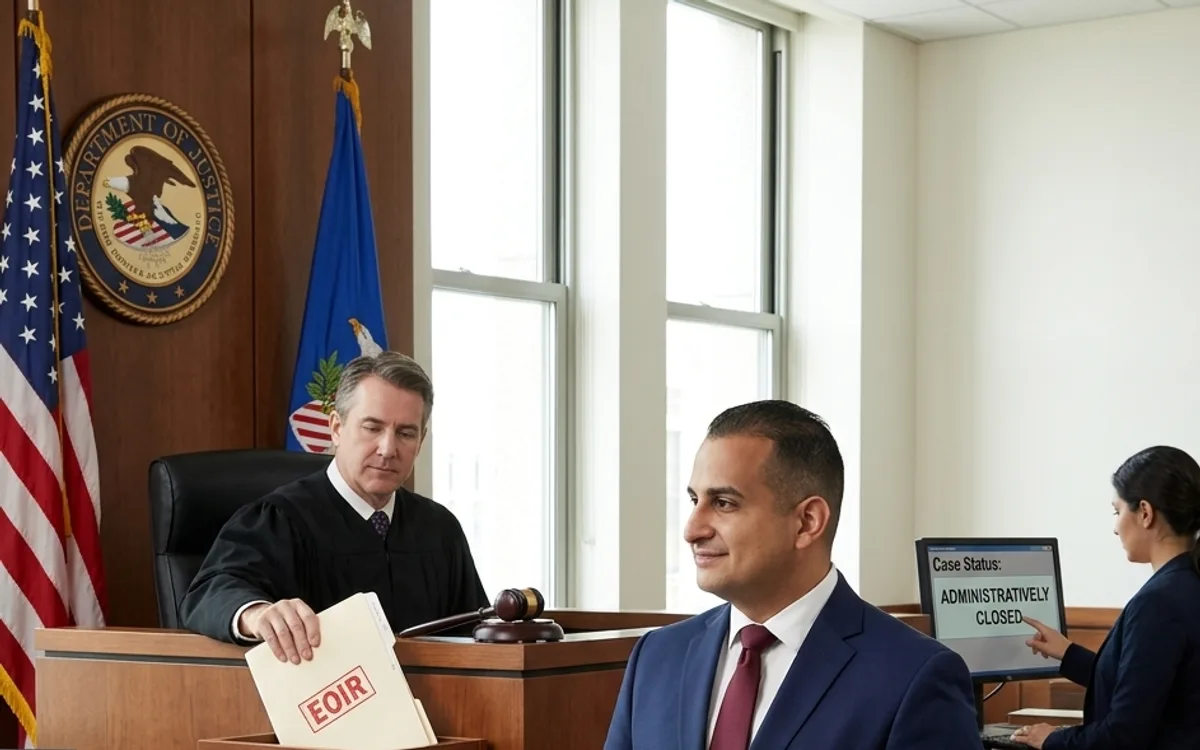
Your removal case is still open. Somewhere else, a separate government office is deciding something that could change everything: a U visa petition, a family-based I-130, an application that has nothing to do with the judge in front of you. You don't want a ruling yet. You want the clock to stop while that other process plays out.
That is what administrative closure is for. It takes your case off the active court calendar without deciding it, so you are not showing up for hearing after hearing while a separate matter moves forward at USCIS.
Closure is not automatic, and it is not permanent. An immigration judge decides whether to grant it, weighing factors the Board of Immigration Appeals laid out in a 2012 decision called Matter of Avetisyan, and either side can later ask to put the case back on the docket. If you are waiting on a pending benefit and want breathing room instead of a hearing date hanging over you, you need to know exactly how that request works, and what happens if the judge says no.
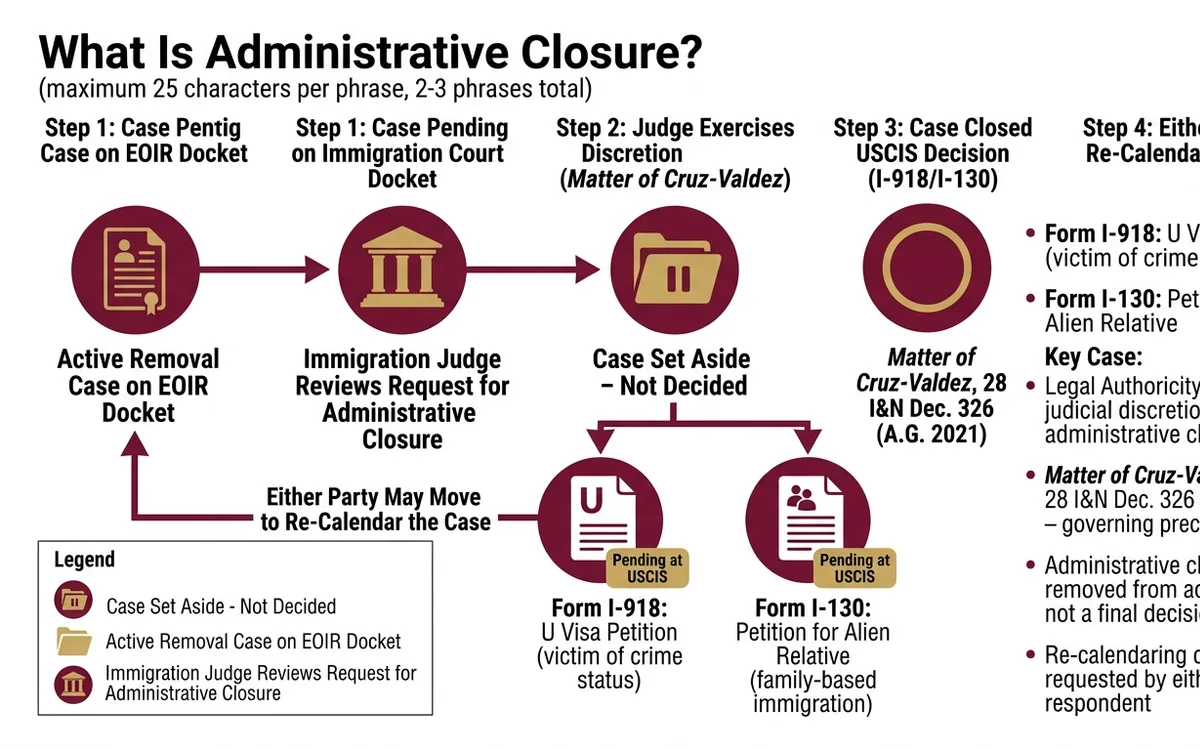
Administrative closure takes a removal case off an immigration judge's active calendar without deciding it, typically while a separate petition, like a U visa (Form I-918) or family petition (I-130), is pending at USCIS. Under Matter of Cruz-Valdez, 28 I&N Dec. 326 (A.G. 2021), judges have discretion to grant it, but either party can later ask to re-calendar.
The Hard Truth
Judges grant administrative closure at their own discretion, weighing the factors laid out in Matter of Avetisyan, 25 I&N Dec. 688 (BIA 2012): the government's position, the likelihood the other proceeding resolves the case, the anticipated length of closure, and whether both sides have cooperated, among others. No statute or regulation entitles a respondent to it.
DHS counsel can still object. Matter of Cruz-Valdez restored a judge's authority to close a case over an objection, so a judge can grant closure even when the government disagrees. But an objection still carries weight, and some judges deny closure when ICE opposes it, especially if the pending benefit looks speculative or the receipt notice is recent.
Closure also doesn't put the matter to rest for good. Either party, including DHS, can file a motion to re-calendar, and judges have granted those motions years after the original closure, sometimes on short notice. If you are not prepared for that possibility, administrative closure can feel like it solved nothing when the case reappears on the docket.
What Happens If You Wait
If you do nothing, your hearing date does not move on its own. The Charlotte Immigration Court keeps the case on its docket regardless of what USCIS is doing with your petition, and if you miss a scheduled hearing while waiting, the judge can order you removed in absentia under INA § 240(b)(5), 8 U.S.C. § 1229a(b)(5).
Waiting too long to file the motion also narrows what you can show the judge. The EOIR Immigration Court Practice Manual, Chapter 5, requires a motion to administratively close to identify the specific pending benefit and its procedural posture, including a receipt number or filing date. If your U visa petition has not been filed with the USCIS Vermont Service Center, or your I-130 has not been submitted, there is no pending benefit yet for the judge to weigh.
Separately, unlawful presence under INA § 212(a)(9)(B) keeps accruing regardless of what the immigration judge does. Administrative closure pauses the court case; it does not pause that clock, and it does not automatically preserve adjustment of status eligibility if a filing deadline elsewhere is missed. Confirm which deadlines stop and which keep running before you file, not after a hearing where you expected a pause and got a denial instead.
Step-by-Step Process
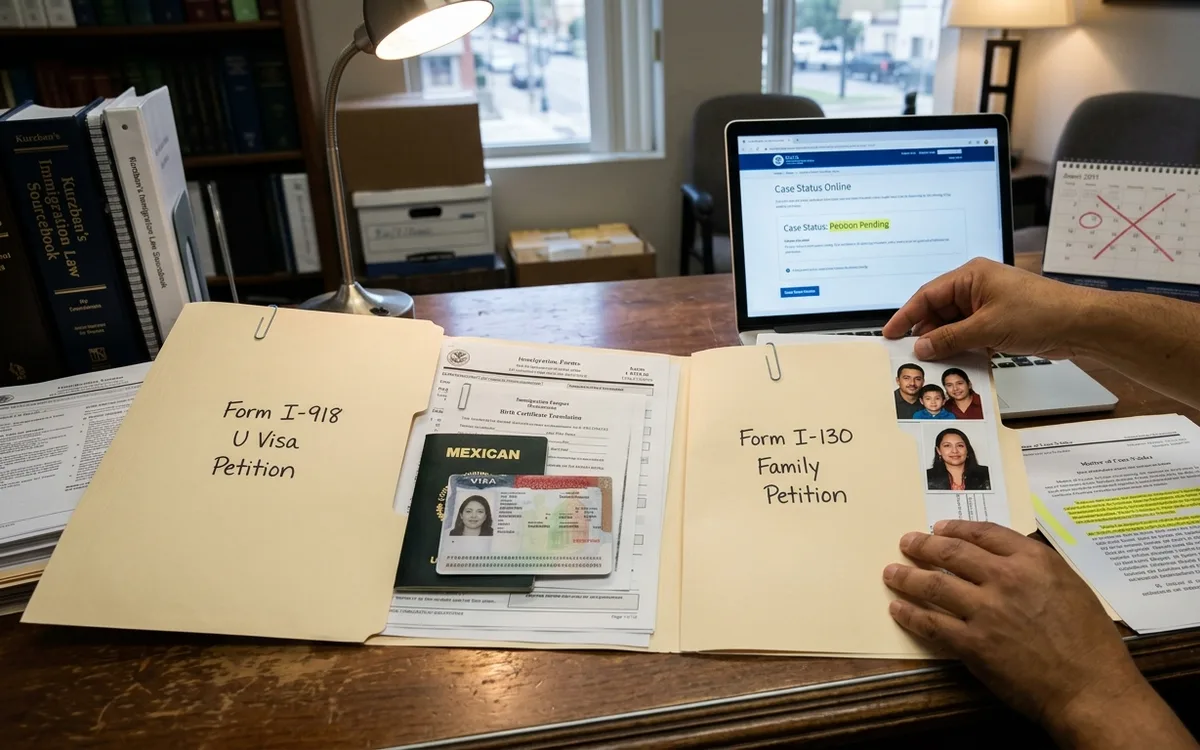
Confirm the pending benefit exists on paper. A motion to administratively close needs a filed petition to point to, such as a Form I-918 U nonimmigrant petition sent to the USCIS Vermont Service Center, or an I-130 filed on your behalf. A receipt notice (Form I-797C) is usually the proof the judge wants to see.
Draft the motion under EOIR Immigration Court Practice Manual, Chapter 5. The motion must state the legal basis, apply the Matter of Avetisyan factors, and explain why closure, not a continuance, fits the situation.
Serve the motion on the DHS Office of Chief Counsel and attempt to get their position in writing, unopposed, opposed, or no position, before filing with the court.
File the motion with the Charlotte Immigration Court, 5701 Executive Center Drive, Charlotte, NC, following local filing and service rules.
The judge rules, either in a written order or on the record at the next hearing. The judge can grant the motion, deny it and keep the case on calendar, or grant a continuance instead if the pending benefit isn't developed enough yet.
If granted, the case comes off the active calendar. You still have obligations, including notifying the court of any address change on Form EOIR-33.
Track the pending petition. If USCIS acts on it, file a follow-up motion to terminate, dismiss, or proceed, depending on the result. If the underlying petition stalls for years at USCIS, a mandamus action in the U.S. District Court for the Western District of North Carolina is sometimes the next step to force a decision.
If either side moves to re-calendar, be ready to prepare for a merits hearing on the original removal case.
A Real-World Example
Consider a composite respondent, referred to here as J.M., in removal proceedings before the Charlotte Immigration Court. J.M.'s attorney had filed a Form I-918 U nonimmigrant petition with the USCIS Vermont Service Center eight months earlier, based on cooperation in a police investigation, and had the I-797C receipt notice in hand.
At the next master calendar hearing, the attorney filed a written motion to administratively close, citing the Avetisyan factors and attaching the receipt notice and a declaration describing the pending petition. The motion had already been served on the DHS Office of Chief Counsel the week before, along with a request for their position.
DHS counsel responded with a written non-opposition, noting the petition appeared to be a genuine pending benefit. At the hearing, the immigration judge reviewed the filing, asked J.M.'s attorney several questions about the anticipated USCIS processing time, and took the matter under advisement, scheduling a status conference for several months later rather than ruling from the bench.
That is the typical shape of the process: a documented pending benefit, a motion built around specific factors, a DHS position on the record, and a judge who may rule immediately or hold the matter for further review. What the judge ultimately decides varies case by case, and nothing about this scenario should be read as predicting a particular ruling.
William J. Vasquez is admitted to the North Carolina State Bar and handles removal defense matters before the Executive Office for Immigration Review, including motions practice in individual immigration courts. Under 8 C.F.R. § 1292.1, an attorney licensed and in good standing in any U.S. state bar may represent clients before immigration courts and the Board of Immigration Appeals nationwide, which is why this kind of motion practice is not limited by state lines.
His work on administrative closure motions focuses on building the factual record a judge actually needs: documenting the pending petition, addressing the Avetisyan factors one by one, and anticipating how DHS counsel is likely to respond based on that office's recent practice. That groundwork is what separates a motion a judge can act on from one that gets a short denial for lack of detail.
Key Terms Explained
Administrative closure: a procedural step that removes a case from an immigration judge's active calendar without resolving it, typically pending an outcome in a related matter.
Continuance: a postponement of a scheduled hearing to a later date; unlike administrative closure, the case stays on the active docket and a new hearing date is set.
Termination: an order ending removal proceedings entirely, without a final order of removal, often because the Notice to Appear was defective or DHS exercises discretion.
Dismissal: a court order ending proceedings, sometimes at DHS's request, that leaves open the possibility of a new Notice to Appear later.
Re-calendar: the act of putting an administratively closed case back on the active docket, which either the respondent or DHS can request by motion.
Matter of Avetisyan, 25 I&N Dec. 688 (BIA 2012): the Board of Immigration Appeals decision listing the factors a judge weighs before granting administrative closure.
Matter of Cruz-Valdez, 28 I&N Dec. 326 (A.G. 2021): the Attorney General decision restoring immigration judges' discretion to administratively close cases, including over a party's objection.
Form I-918: the USCIS petition for U nonimmigrant status, filed with the USCIS Vermont Service Center, the sole service center that adjudicates U visa petitions.
In absentia order: a removal order entered when a respondent fails to appear at a scheduled hearing, authorized under INA § 240(b)(5).
Frequently Asked Questions
Q: What's the difference between administrative closure and a continuance? A: A continuance resets your hearing date but keeps the case active on the docket. Administrative closure removes the case from the active calendar entirely until someone moves to put it back on.
Q: Can ICE still object to administrative closure after Matter of Cruz-Valdez? A: Yes. DHS counsel can object, and the judge still has to weigh that objection, but Cruz-Valdez means the judge is no longer required to deny closure just because DHS opposes it.
Q: What happens if the immigration judge denies the motion to administratively close? A: The case stays on the active calendar and your next hearing proceeds as scheduled. You can usually ask for a continuance instead, or refile the closure motion later if the pending petition's posture changes.
Q: How long can a case stay administratively closed while USCIS decides a U visa petition? A: There's no fixed limit set by statute. Cases have stayed closed for years while a petition is pending, but either party can move to re-calendar at any point, and a long gap with no update can itself prompt DHS to ask for the case to be put back on calendar.
Q: Does administrative closure stop unlawful presence from accruing? A: No. Administrative closure pauses the court proceeding, not separately running clocks like unlawful presence under INA § 212(a)(9)(B). Those deadlines need to be tracked independently of the court case.
Clients come to our office mid-process, often after a hearing notice arrives and they aren't sure what it means for a petition they already filed elsewhere. What they describe afterward is less about outcomes and more about understanding: knowing what the judge can and can't do, what DHS is likely to argue, and what happens if the first motion doesn't go their way. We report case volume, not outcomes; describing a removal case as "won" or citing a success rate isn't something this firm does, because the results of contested immigration matters are not the kind of thing that can be guaranteed or verified in advance.
Every closure motion stands or falls on one concrete fact: a real pending benefit worth the wait, documented well enough for a judge to rely on it. If you're not sure your U visa or family petition is developed enough to support that request, the fastest way to find out is to have someone review your actual filing dates and receipt notices against the Avetisyan factors.
If you have a case on the Charlotte Immigration Court's calendar and a petition pending elsewhere, schedule a consultation with our immigration team to review whether a motion to administratively close fits your situation, and what to prepare before the next hearing date.
- Removal Defense Attorney North Carolina
- U Visa Petitions for Crime Victims
- Family-Based Immigration Petitions (I-130)
- What Happens at a Master Calendar Hearing
- Immigration Court Appeals and the BIA
- Responding to a Notice to Appear