You have built a life here for ten years or more: a mortgage payment, a school picture on the refrigerator, a spouse who depends on your income or your care. Now an immigration judge wants you to prove all of it in a single hearing, and to describe your family's pain in a legal phrase that sounds colder than anything you've lived. That phrase is 'exceptional and extremely unusual hardship,' and the fear that your family's suffering, however real, might not meet it on paper is not irrational. It is the actual standard, and it is set high on purpose.
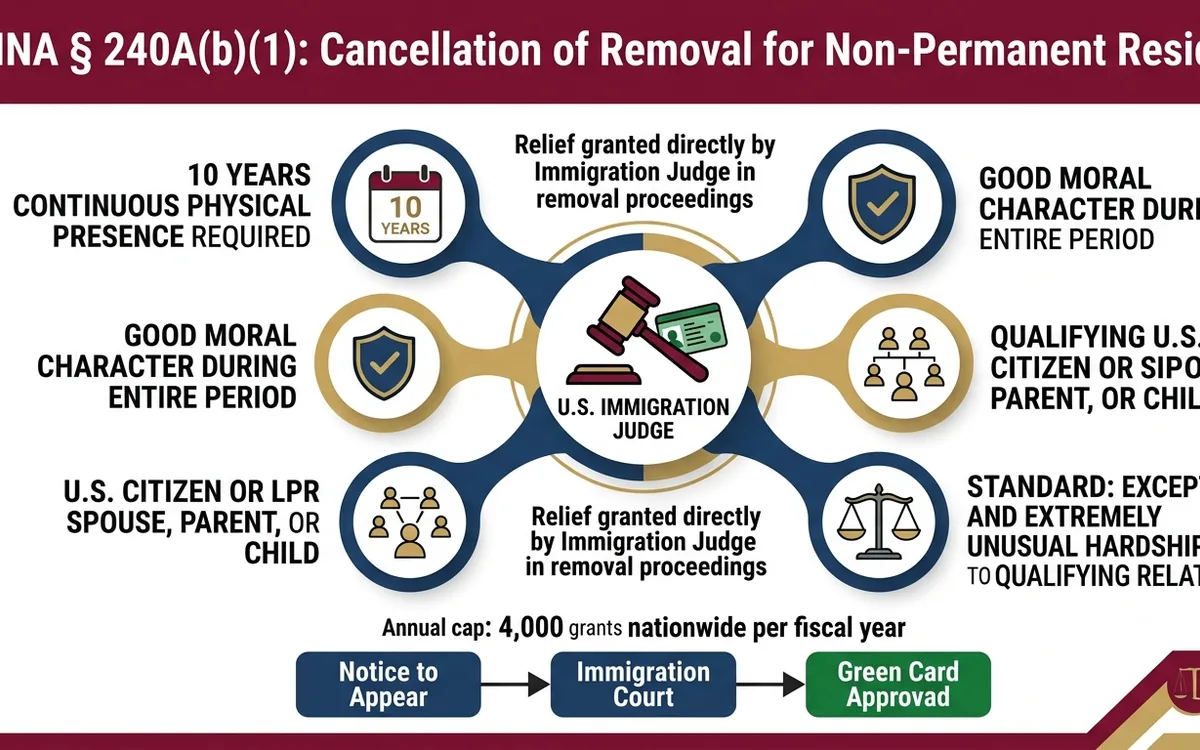
Cancellation of removal under INA § 240A(b)(1) lets an immigration judge grant a green card to an undocumented person with ten years of continuous physical presence, good moral character, and a U.S. citizen or lawful permanent resident spouse, parent, or child who would suffer exceptional and extremely unusual hardship if you were removed.
The Hard Truth
Exceptional and extremely unusual hardship is not the same as hardship. Under Matter of Monreal-Aguinaga, 23 I&N Dec. 56 (BIA 2001), the Board of Immigration Appeals treats lost income, family separation, and a child growing up without a parent in the home as ordinary consequences of removal, not enough on their own. You have to show something past that baseline: a documented medical condition that cannot be treated in your home country, a qualifying relative's serious dependency on your presence, or circumstances a judge can point to as genuinely unusual.
Even a strong record does not guarantee relief. INA § 240A(e)(1) caps 42B grants, shared with 42A cancellation for lawful permanent residents, at 4,000 nationwide per fiscal year. When that cap is reached, judges hold qualifying decisions over to the next fiscal year, so a case that meets every element can still wait, sometimes years, for a visa number to open up.
What Happens If You Wait
Evidence has a shelf life. A landlord sells the building and stops answering calls. A former employer closes and its payroll records disappear. A witness to your ten years of presence moves away, and school enrollment offices only keep records for a set retention period before they're purged. Waiting to start the hardship record does not pause the case; the court sets your filing deadline, and the Notice to Appear starts a clock you do not control.
If you are already in proceedings and miss a filing deadline set by the immigration judge, the judge can deem your EOIR-42B application abandoned and order removal without ever reaching the hardship question. Each continuance also forces your qualifying relative to relive the hardship narrative, and children old enough to understand the hearing often carry that anxiety for months. The earlier the record is built, document by document, the fewer gaps a trial attorney for DHS can use against you at the individual hearing.
Step-by-Step Process
The case starts when DHS files a Notice to Appear (NTA) with the Charlotte Immigration Court (EOIR), 5701 Executive Center Drive, Charlotte, NC, charging you as removable. At your first master calendar hearing, you or your attorney plead to the factual allegations, concede or contest removability, and tell the judge you intend to apply for cancellation of removal.
Next comes the written application: Form EOIR-42B, Application for Cancellation of Removal and Adjustment of Status for Certain Nonpermanent Residents, filed with supporting evidence under the filing and service rules in the EOIR Immigration Court Practice Manual, Chapter 5. That packet should include ten years of continuous-presence proof (tax transcripts, leases, utility bills, Mecklenburg County Register of Deeds property records where applicable), birth certificates from the NC Office of Vital Records establishing your qualifying relative, Charlotte-Mecklenburg Schools enrollment records where a child's hardship is at issue, and a hardship-specific record: medical documentation, school evaluations, and a detailed statement from your qualifying relative.
Before the judge can grant relief, you must complete biometrics and a background check at a USCIS Application Support Center, including the Charlotte Field Office, which has to clear before a decision is entered. The case concludes at an individual (merits) hearing, often set a year or more after the master calendar hearing given current docket volume, where you and your witnesses testify and the DHS attorney cross-examines. The judge then decides whether you meet each statutory element, and if so, whether a slot remains under the INA § 240A(e)(1) annual cap for that fiscal year.
A Real-World Example
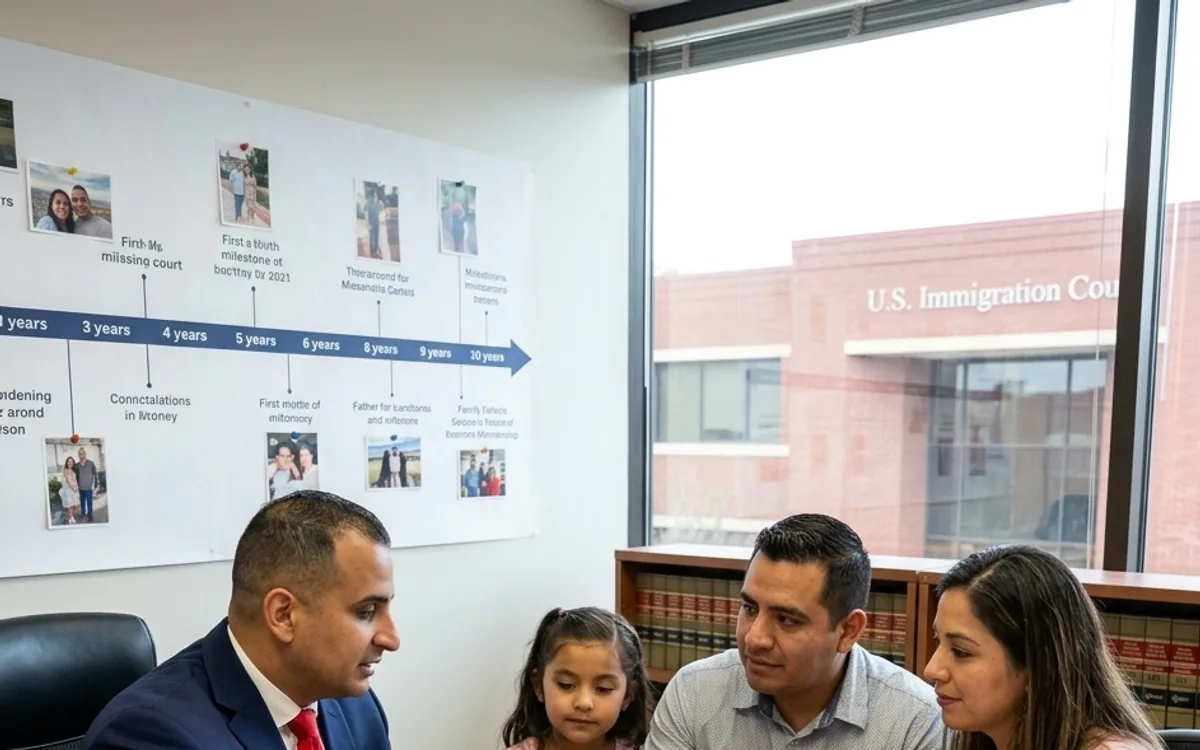
Consider a composite drawn from the kind of case our team prepares, not a real client: call her Elena, present in the U.S. without status for twelve years, married to a U.S. citizen whose teenage son has a documented seizure disorder. Preparation started with the paper trail: twelve years of tax transcripts, a chronological lease history, utility bills in her name, and her son's school enrollment records from Charlotte-Mecklenburg Schools going back to kindergarten.
The hardship record centered on her stepson's neurologist records, a letter from his treatment team describing the specialized care and medication access he needs, and a statement from the husband describing his own ability to work and care for his son without Elena present. At the master calendar hearing, the judge confirmed the charges, accepted the application for filing, and set an individual hearing date roughly fourteen months out. Biometrics at the USCIS Charlotte Field Office were scheduled in the interim, and the file was supplemented twice as new medical records came in before the merits hearing. What happens at that hearing, and whether a visa number is available under the fiscal-year cap, is decided case by case; this example describes the preparation process, not a result.
William J. Vasquez has spent years building cancellation-of-removal cases in the Charlotte Immigration Court and before the Board of Immigration Appeals, work that depends on assembling years of documentary proof rather than arguing sympathy alone. He is admitted to practice before the federal courts that handle immigration matters and focuses his caseload on removal defense, including both 42A cancellation for lawful permanent residents and 42B cancellation for non-permanent residents. His approach to a hardship case starts with the same question every time: what document proves this, and where do we get it.
Key Terms Explained
Cancellation of removal (non-LPR, 42B): relief under INA § 240A(b)(1) that lets an immigration judge grant lawful permanent residence to an undocumented person who meets four statutory elements, in place of ordering removal.
Continuous physical presence: ten years of physical presence in the U.S. without a single absence of more than 90 days, or combined absences exceeding 180 days, counted back from the date you were served with the Notice to Appear.
Exceptional and extremely unusual hardship: the legal standard from Matter of Monreal-Aguinaga, 23 I&N Dec. 56 (BIA 2001), requiring hardship to a qualifying relative substantially beyond what removal ordinarily causes a family.
Qualifying relative: a spouse, parent, or child who is a U.S. citizen or lawful permanent resident; hardship to the applicant personally does not count toward this element.
Good moral character: a statutory requirement that you have not committed certain disqualifying acts (such as specified crimes or false testimony) during the ten-year presence period.
Notice to Appear (NTA): the charging document DHS files with the immigration court that begins removal proceedings and lists the allegations and charges against you.
Master calendar hearing: a short, often 10-to-20-minute procedural hearing where the judge takes pleadings, confirms you intend to apply for relief, and sets deadlines; it is not the hearing where your case is decided.
Individual (merits) hearing: the full evidentiary hearing where you and your witnesses testify, the DHS attorney cross-examines, and the judge decides whether to grant or deny relief.
Annual cap: the limit of 4,000 total 42A and 42B grants nationwide per fiscal year under INA § 240A(e)(1), which can delay a decision even in a qualifying case.
Frequently Asked Questions
Q: How long does a 42B cancellation of removal case take from the Notice to Appear to a final decision? A: Current Charlotte Immigration Court docket volume typically means 12 to 36 months between the master calendar hearing and the individual merits hearing, and a case that qualifies can wait further if the fiscal-year cap under INA § 240A(e)(1) has already been reached.
Q: What if I'm missing some records from the ten-year presence period? A: Gaps are common and not automatically fatal; school records, tax transcripts, medical bills, church records, and sworn statements from people who knew you during that period can fill in a missing year, and a judge weighs the totality of the record rather than requiring a document for every single month.
Q: Can I work legally while my cancellation of removal case is pending? A: You may be eligible to apply for employment authorization while your case is pending before the immigration court; eligibility and category depend on your specific procedural posture, so this should be evaluated with your immigration attorney rather than assumed.
Q: What's the difference between 42A and 42B cancellation of removal? A: 42A applies to lawful permanent residents facing removal and does not require proof of hardship, while 42B applies to people without status, requires ten years of continuous presence, and requires proof that a qualifying U.S. citizen or LPR relative would suffer exceptional and extremely unusual hardship.
Q: Does the 4,000-grant annual cap mean most 42B cases get denied? A: The cap under INA § 240A(e)(1) limits how many grants can be finalized in a given fiscal year, which can delay a decision in a qualifying case, but it is a separate limit from whether the judge finds you meet the legal standard in the first place.
Clients describe our immigration team as thorough about paperwork and direct about what the law actually requires, rather than making promises about how a judge will rule. Reviews on Google and Avvo consistently mention clear explanations of each hearing before it happens and responsiveness when new documents or deadlines come up. We do not publish case outcome statistics; removal cases are decided by an immigration judge based on the individual record, not by any law firm.
If you already have a hearing date on your Notice to Appear, your filing deadline for Form EOIR-42B is set by the judge, not by you, and missing it can end the case before the hardship evidence is ever heard. The sooner we start the document search, tax transcripts, school records, medical letters, the more complete the record will be by the time the individual hearing arrives.
If you are in removal proceedings or have received a Notice to Appear and believe you may qualify for cancellation of removal, call our office to schedule a consultation with our immigration team. Bring whatever presence records you already have, leases, tax returns, pay stubs, school paperwork, so we can start identifying what the record still needs.