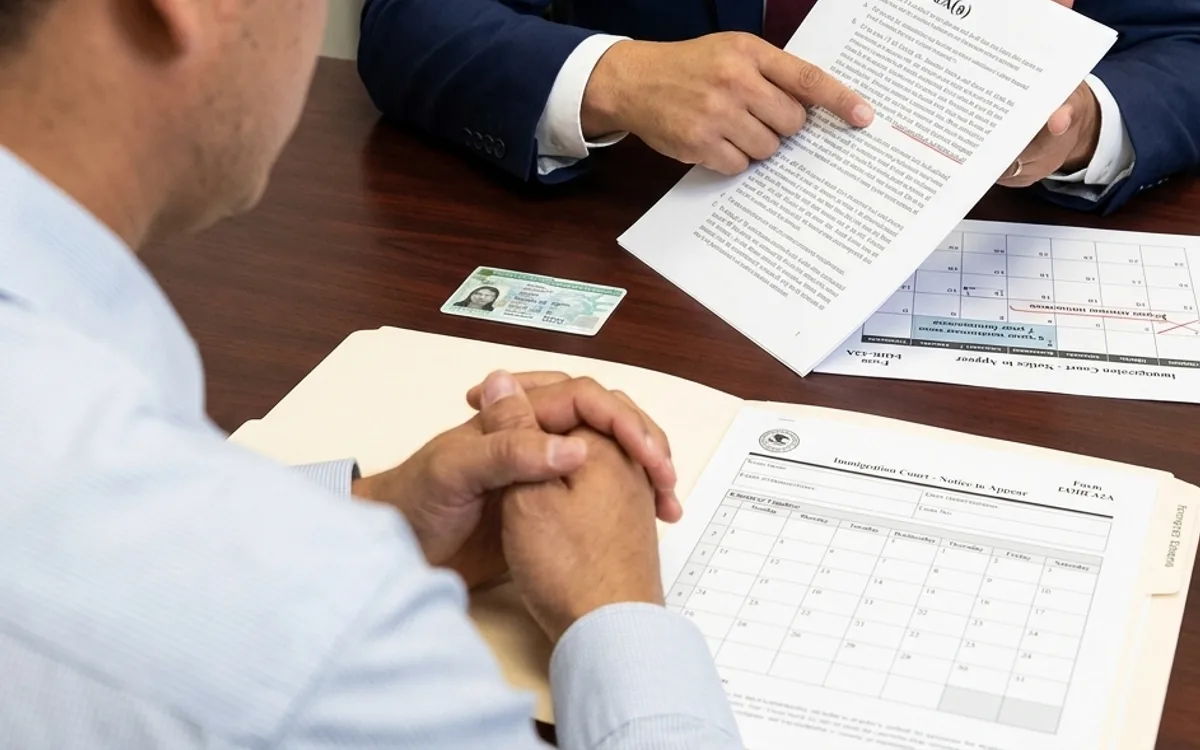
You have held a green card for years, maybe decades. Then a criminal conviction turned into a Notice to Appear, and now the government is asking an immigration judge to take your permanent resident status away.
Your job, your family, the home you've built here — none of that disappears because of the conviction. What changes is that the conviction now sits at the center of your case. An immigration judge will decide whether that single record outweighs everything else you can show the court.
You already have a green card. This case is about keeping it, and that shapes how the case gets built, starting at the first hearing.
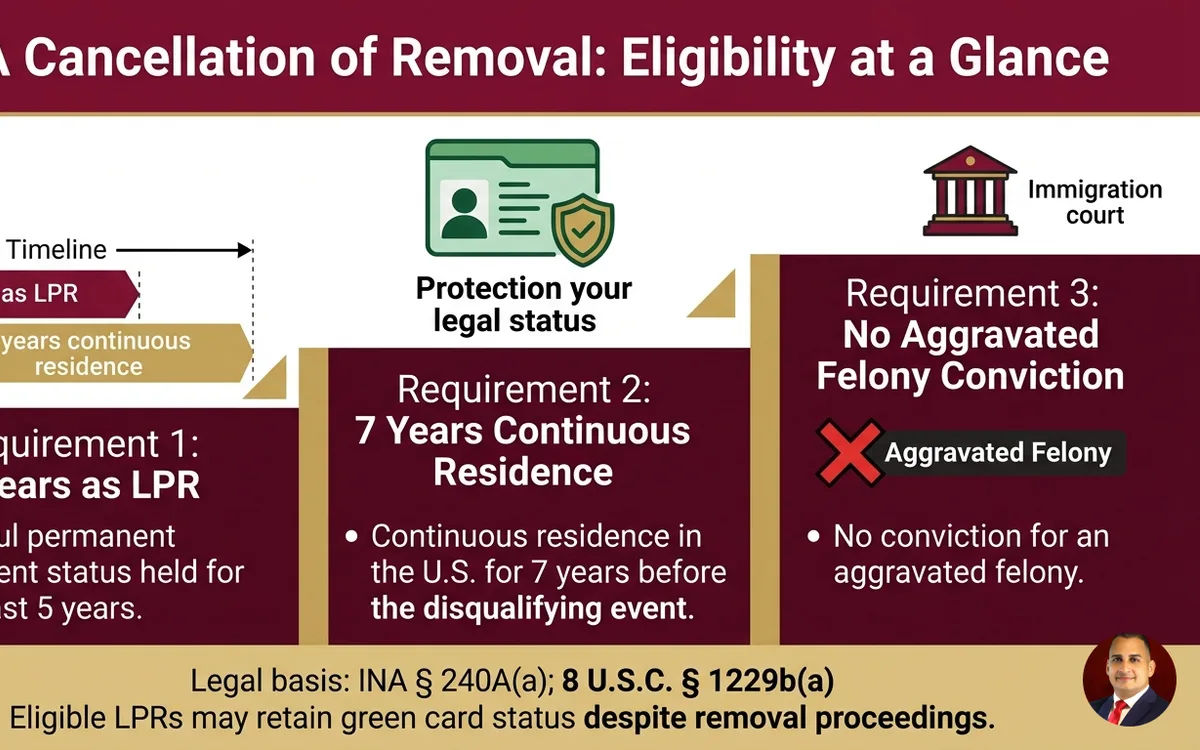
42A cancellation of removal lets a lawful permanent resident keep a green card despite a removal case, if they have held LPR status at least 5 years, lived continuously in the U.S. for 7 years before any disqualifying event, and were not convicted of an aggravated felony, per INA § 240A(a), 8 U.S.C. § 1229b(a).
The Hard Truth
The Three-Part Test Has No Exceptions
INA § 240A(a) (8 U.S.C. § 1229b(a)) sets three requirements, and an immigration judge cannot waive any of them: at least 5 years as a lawful permanent resident, 7 years of continuous residence in the United States after a lawful admission, and no conviction for an aggravated felony, defined at INA § 101(a)(43). Miss one requirement and the case is over before the judge ever reaches your family ties, your work history, or your rehabilitation. Discretion only matters once all three boxes are checked.
The Stop-Time Rule Can Cut Your Clock Short
Your 7 years of continuous residence does not necessarily run until today. Under the stop-time rule at INA § 240A(d)(1), residence stops counting the day you commit certain offenses, not the day a court convicts you of them. If you committed a qualifying offense in year 6, the clock stopped in year 6, even if the conviction came three years later. Pereira v. Sessions, 138 S. Ct. 2105 (2018), addressed a related stop-time question: whether a Notice to Appear missing a hearing date or location can stop the clock at all. If your NTA has that defect, it may not trigger stop-time, which can be the difference between qualifying and not.
Not Every Felony Is an Aggravated Felony
The word "felony" on a state judgment does not decide the immigration question. Courts use the categorical approach from Taylor v. United States and Mathis v. United States to compare the elements of your specific state statute against the federal generic definition of the offense. A conviction under an overbroad state statute, one that criminalizes more conduct than the federal definition covers, sometimes does not count as an aggravated felony at all, even if the state calls it one. This analysis depends on your exact statute, plea record, and judgment, not on the label the state used.
Nationally, immigration courts decide thousands of 240A(a) applications each year, and outcomes vary case by case based on the conviction, the judge, and the record presented. EOIR publishes these figures in its own Adjudication Statistics reports (justice.gov/eoir/statistics). No attorney can tell you in advance how a specific judge will weigh your equities.
What Happens If You Wait
What Delay Actually Costs You
Every day you wait to retain counsel or file is a day closer to a master calendar hearing you are not ready for. Charlotte Immigration Court, at 5701 Westpark Drive, is currently setting many removal cases for individual (merits) hearings 12 to 18 months out, based on EOIR's own court-by-court caseload reporting as of its October 2024 statistics update. That may sound like a long runway to prepare, but it isn't a reason to put off starting now.
If you are detained, the math changes. ICE transfers many North Carolina detainees to Alamance County Detention Center, an ICE-contracted facility, while removal proceedings are pending. A detained case moves on a faster docket, often with an individual hearing set in weeks rather than months, and you will not have the same opportunity to gather rehabilitation evidence, character letters, or tax records from inside a detention facility.
Missing the Form EOIR-42A filing deadline a judge sets at a hearing, or missing the required USCIS Application Support Center biometrics appointment, can result in the application being deemed abandoned under 8 C.F.R. § 1003.31(c). An abandoned application is not something you can simply refile. You can ask the court to reopen, but a motion to reopen carries its own strict deadlines and a higher burden than filing correctly the first time.
A pending conviction appeal in state court does not pause your immigration case automatically. If you are relying on a vacated or reduced conviction to change your eligibility, that state court action needs to be final, and the immigration judge needs documentation of it, before your individual hearing, not after.
Step-by-Step Process
Step 1: The Notice to Appear and First Master Calendar Hearing
Your case starts when the Department of Homeland Security files a Notice to Appear with Charlotte Immigration Court. At your first master calendar hearing, a short procedural hearing lasting 5 to 15 minutes, the judge confirms your identity and address, reads the government's allegations, and asks you to admit or deny them. This is also where you tell the court you intend to apply for 240A(a) cancellation of removal.
Step 2: Pleadings and the Criminal Record Analysis
Before you can plead to the NTA's allegations, your attorney needs the full certified record of conviction: charging document, plea colloquy, judgment, and sentencing order, not just an arrest report. This record is what gets run through the categorical approach analysis described above. Charlotte Immigration Court judges routinely grant continuances for this document gathering; expect your case to span several master calendar hearings before pleadings close.
Step 3: Filing Form EOIR-42A
Once the judge sets an individual hearing, your attorney files Form EOIR-42A, Application for Cancellation of Removal for Certain Permanent Residents, directly with the court under the filing procedures in the EOIR Immigration Court Practice Manual, Chapter 3. There is a filing fee, currently $100 payable to DHS per the form instructions, with a fee waiver available through Form EOIR-26A for those who cannot pay.
Step 4: Biometrics at the USCIS Application Support Center
After filing, you must complete biometrics, fingerprints and a photograph, at a USCIS Application Support Center. In the Charlotte area, this is scheduled through a government-issued appointment notice. Missing it without rescheduling in advance can result in your application being deemed abandoned under 8 C.F.R. § 1003.31(c).
Step 5: Building the Equities Record
Between filing and your individual hearing, the case shifts from the legal question (are you eligible) to the discretionary question (should the judge grant relief). This means assembling tax returns, letters from employers and family, proof of community ties, certificates from rehabilitation or treatment programs, and evidence of what has changed since the offense.
Step 6: The Individual Hearing
This is the actual trial. You testify, your witnesses testify, and government counsel cross-examines on the conviction and any other negative factors in your record. The judge weighs the statutory eligibility finding against the discretionary equities and issues a decision, sometimes the same day, sometimes weeks later.
Step 7: Appeal, If Necessary
Either side can appeal an adverse decision to the Board of Immigration Appeals within 30 days under 8 C.F.R. § 1003.38. A BIA appeal is a paper appeal, briefs and the existing record, not a new hearing. From there, a further appeal goes to the federal circuit court of appeals with jurisdiction over Charlotte Immigration Court, by petition for review.
A Real-World Example
A Composite Example: How a 240A(a) Case Actually Moves
Consider a composite, not a real client: a lawful permanent resident of 15 years, convicted eight years ago of a felony drug possession offense in a North Carolina county, now in removal proceedings after a later, unrelated traffic stop led ICE to flag his record.
At the first master calendar hearing in Charlotte Immigration Court, his attorney requests a continuance to obtain the certified record of conviction, the plea transcript, and the judgment. That record matters because North Carolina's possession statute criminalizes a broader range of substances than the federal controlled substances schedule, which raises a categorical approach argument about whether the conviction counts as a removable offense in the first place.
After pleadings close and the court sets an individual hearing, the attorney files Form EOIR-42A and schedules the required biometrics appointment at the Charlotte Application Support Center. Over the following months, the client gathers W-2s, a letter from his employer of nine years, letters from his U.S. citizen children, and a certificate from a substance abuse treatment program he completed on his own, years before removal proceedings began.
At the individual hearing, the client testifies about the offense, what has changed since, and his family and work ties. Government counsel cross-examines on the conviction and asks about any other arrests. The immigration judge takes the case under advisement and issues a written decision weeks later. Whatever the result, the case illustrates the sequence every 240A(a) applicant goes through: record analysis first, filing and biometrics second, equities-building third, testimony last.
William J. Vasquez is admitted to the North Carolina State Bar and to the Fourth, Fifth, and Eleventh Circuit Courts of Appeals. Because the Board of Immigration Appeals is a federal administrative body, any attorney licensed in good standing in one U.S. state bar can represent clients before it nationwide, including at Charlotte Immigration Court, under 8 C.F.R. § 1292.1.
His practice focuses on crimmigration analysis, the question of whether a specific state conviction triggers an aggravated felony bar or another ground of removability, and on building the discretionary equities record that 240A(a) cases require once eligibility is established. That dual focus matters here: a cancellation of removal case usually turns on both a close statutory reading of the conviction and a credible, well-documented presentation of a client's ties to the United States.
He has represented clients in Board of Immigration Appeals proceedings and in federal circuit court petitions for review following adverse immigration court decisions. Our team at Vasquez Law Firm works directly with clients and their families to gather the certified conviction records, treatment and rehabilitation documentation, and witness testimony a 240A(a) application requires, case by case.
Key Terms Explained
Cancellation of Removal for Permanent Residents (240A(a)): Discretionary relief under INA § 240A(a), 8 U.S.C. § 1229b(a) that lets an immigration judge cancel removal and restore lawful permanent resident status for an LPR who meets three statutory requirements and merits a favorable exercise of discretion.
Notice to Appear (NTA): The charging document DHS files with the immigration court to begin removal proceedings. It lists the factual allegations and the legal grounds of removability the government relies on.
Stop-Time Rule: Under INA § 240A(d)(1), the rule that stops the 7-year continuous residence clock (and the 10-year clock for non-LPR cancellation under 240A(b)) on the date a qualifying offense was committed, not the date of conviction or the date the NTA was served.
Aggravated Felony: A category of offenses defined at INA § 101(a)(43) that bars eligibility for 240A(a) cancellation regardless of how long ago it occurred or how much has changed since. The label covers many offenses that are not classified as felonies under the law of the state where they were charged.
Categorical Approach: The method courts use, from Taylor v. United States and Mathis v. United States, to compare the elements of a state criminal statute against a federal generic offense definition, without looking at the specific facts of what you actually did, to decide whether a conviction triggers an immigration consequence.
Modified Categorical Approach: Used when a statute lists multiple, separate offenses with different elements. The court may then review a limited set of record documents, the charging document, plea agreement, and judgment, to determine which specific offense was the basis of conviction.
Form EOIR-42A: The application for cancellation of removal filed with the immigration court by lawful permanent residents in removal proceedings, distinct from Form EOIR-42B, filed by non-permanent residents applying under 240A(b).
Master Calendar Hearing: A short procedural hearing, typically 5 to 15 minutes, where the judge handles identity, pleadings, and scheduling. It is not the hearing where evidence or testimony is presented.
Individual Hearing: The merits hearing where testimony and evidence are presented and the judge decides the application.
Board of Immigration Appeals (BIA): The administrative appellate body that reviews immigration judge decisions. Appeals must generally be filed within 30 days under 8 C.F.R. § 1003.38.
212(h) Waiver: A separate form of relief, under INA § 212(h), that waives certain criminal grounds of inadmissibility, often used when an applicant is adjusting status rather than already holding LPR status at the time of the conviction.
Frequently Asked Questions
Q: Does a DUI conviction count as an aggravated felony for 240A(a) cancellation? A: A standard DUI conviction, without more, is generally not an aggravated felony under INA § 101(a)(43), but a DUI involving serious injury, a death, or certain aggravating state-law elements can be analyzed differently. The categorical approach is applied to your specific state statute to answer this, not to the label "DUI" itself.
Q: How many years of continuous residence do I need before the stop-time rule can cut off my eligibility? A: You need 7 years of continuous residence after a lawful admission under INA § 240A(a)(2), and the stop-time rule under INA § 240A(d)(1) can end that count on the date you committed a qualifying offense, years before any conviction. If the offense happened before you reached 7 years, eligibility can be cut off entirely.
Q: Can a green card holder still qualify for cancellation after a drug possession conviction? A: It depends on the specific state statute of conviction. Some state possession statutes cover substances not on the federal controlled substances schedule, which can mean the conviction does not trigger the aggravated felony or controlled substance bar under the categorical approach, and a single qualifying conviction for simple possession is sometimes treated differently than a distribution offense.
Q: What equities do immigration judges weigh at an LPR cancellation of removal hearing? A: Judges consider factors including family ties in the United States, length of residence, employment history, community ties, evidence of rehabilitation, and the nature and recency of the conviction, balanced against the seriousness of the conduct and any other negative factors in the record.
Q: Can cancellation of removal be granted a second time after a prior grant? A: No. INA § 240A(c)(6) bars a second grant of cancellation of removal, under either 240A(a) or 240A(b), to anyone previously granted cancellation, suspension of deportation, or relief under former INA § 212(c).
Q: What is the difference between 240A(a) cancellation and a 212(h) waiver? A: 240A(a) cancellation is relief for someone already in removal proceedings who already holds LPR status. A 212(h) waiver forgives certain criminal inadmissibility grounds and is typically used when someone is applying for a green card or adjusting status rather than already holding one; see the comparison table on this page for the forum and evidentiary differences.
Clients come to us after a conviction from years in the past resurfaces in a Notice to Appear, often confused about how a closed criminal case can reopen an immigration case. Reviews of our immigration practice consistently mention direct communication about the realistic legal standard, not just reassurance, and clear explanations of what the categorical approach does and does not change about a specific conviction. We do not publish case outcomes or success statistics; removal defense results depend on the conviction, the judge, and the individual record, not on any firm's track record claim.
Reading about the stop-time rule or the categorical approach does not tell you how either one applies to your specific conviction and your specific years of residence. That takes a review of your actual record of conviction, your A-file history, and the dates involved.
If you are a lawful permanent resident with a pending Notice to Appear, or a conviction you are worried could trigger one, schedule a consultation with our immigration defense team to review your record of conviction, your continuous residence timeline, and your options for 240A(a) cancellation of removal before your next Charlotte Immigration Court hearing date.
- 212(h) Waiver of Inadmissibility Attorney
- BIA Appeals Attorney
- Crimmigration: How a Criminal Conviction Affects Immigration Status
- ICE Detention and Bond in North Carolina
- Charlotte Immigration Court Removal Defense