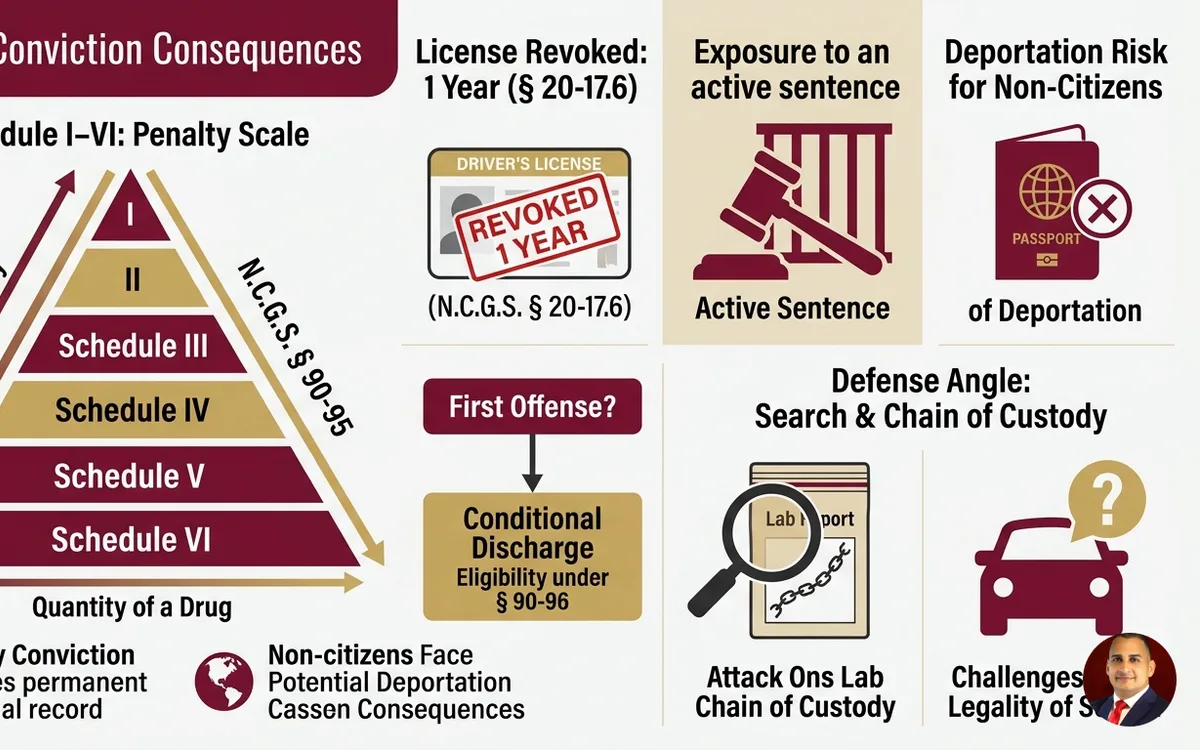
A North Carolina drug conviction can mean active prison time, a felony record, a one-year driver's license revocation under N.C. Gen. Stat. § 20-17.6, and, for non-citizens, deportation. The exact penalty depends on the drug schedule and quantity under § 90-95. Defense options include challenging the stop or search, attacking the lab's chain of custody, and seeking conditional discharge under § 90-96 for a first offense.
How North Carolina Classifies a Drug Charge
Every drug case starts with two questions: what schedule is the substance, and how much was found. § 90-87 sets out six schedules, from Schedule I (heroin, LSD, MDMA, no accepted medical use) down to Schedule VI (marijuana and a handful of low-abuse substances). § 90-95 then sets the penalty based on schedule, quantity, and whether the charge is possession, sale, delivery, or manufacture.
| Schedule | Example Drugs | Simple Possession | Possession With Intent to Sell/Deliver |
|---|---|---|---|
| Schedule I | Heroin, LSD, MDMA | Class I felony | Class H felony |
| Schedule II | Cocaine, methamphetamine, oxycodone, fentanyl | Class I felony | Class H felony |
| Schedule III | Certain narcotics, anabolic steroids | Class 1 misdemeanor | Class H felony |
| Schedule IV | Xanax, Valium, Ambien | Class 1 misdemeanor | Class I felony |
| Marijuana | Under 0.5 oz: Class 3 misdemeanor; 0.5 to 1.5 oz: Class 1 misdemeanor; over 1.5 oz: Class I felony | Class H or I felony depending on weight |
A pipe, scale, or baggie used to hold or use a controlled substance is its own charge, drug paraphernalia under § 90-113.22, usually a standalone Class 1 misdemeanor.
Trafficking Is a Mandatory Minimum, Not a Range
Trafficking is not a possession charge with extra time tacked on. It is a quantity threshold that takes sentencing discretion away from the judge entirely. Under § 90-95(h), trafficking 28 to 200 grams of cocaine is a Class G felony carrying a mandatory minimum of 35 months and a $50,000 fine, regardless of the defendant's record. Trafficking 4 to 14 grams of heroin, or 28 to 200 grams of methamphetamine, is a Class F felony with a mandatory minimum of 70 months. A judge cannot suspend that sentence or substitute probation. The only way around a trafficking mandatory minimum is a reduced charge negotiated with the district attorney, or a successful suppression motion that removes the evidence establishing the quantity in the first place. Our drug trafficking defense page goes through these thresholds drug by drug.
The Structured Sentencing Grid
For non-trafficking felonies, North Carolina uses the Structured Sentencing Act, § 15A-1340.17. Two numbers set your exposure: offense class (A through I) and prior record level (I through VI, calculated from points assigned to past convictions). The table below shows approximate presumptive ranges, in months, for the felony classes most common in drug cases. These are approximate; the exact range for your prior record level should be checked against the current chart and your own worksheet before any plea.
A presumptive range does not automatically mean prison. Depending on class and prior record level, a judge can impose community punishment (probation, no active time), intermediate punishment (probation with conditions like electronic monitoring), or active punishment. Misdemeanor sentencing runs on a separate, shorter chart under the same framework, and most first-offense misdemeanor drug cases end in probation rather than jail.
License Revocation Happens Even Without a Car Involved
This catches most clients off guard. Under § 20-17.6, a conviction for almost any drug offense under Chapter 90, including simple possession, triggers a mandatory one-year revocation of your driver's license. It makes no difference whether a vehicle was anywhere near the offense. The revocation is civil, separate from the sentence, and the DMV processes it automatically once the clerk of court reports the conviction. A limited driving privilege is sometimes available but has to be requested; it is not automatic. Our DWI and license restoration page covers how that request works.
Defense Strategies That Actually Move a Case
The strongest defenses attack the stop, the search, or the lab result, not the quantity math.
A motion to suppress under § 15A-974 asks the court to exclude evidence from an unlawful stop or search. If the traffic stop lacked reasonable suspicion, or officers searched a car or person without a warrant, consent, or a recognized exception, the drugs recovered in that search can be excluded. Without the physical evidence, the State usually cannot proceed on the charge.
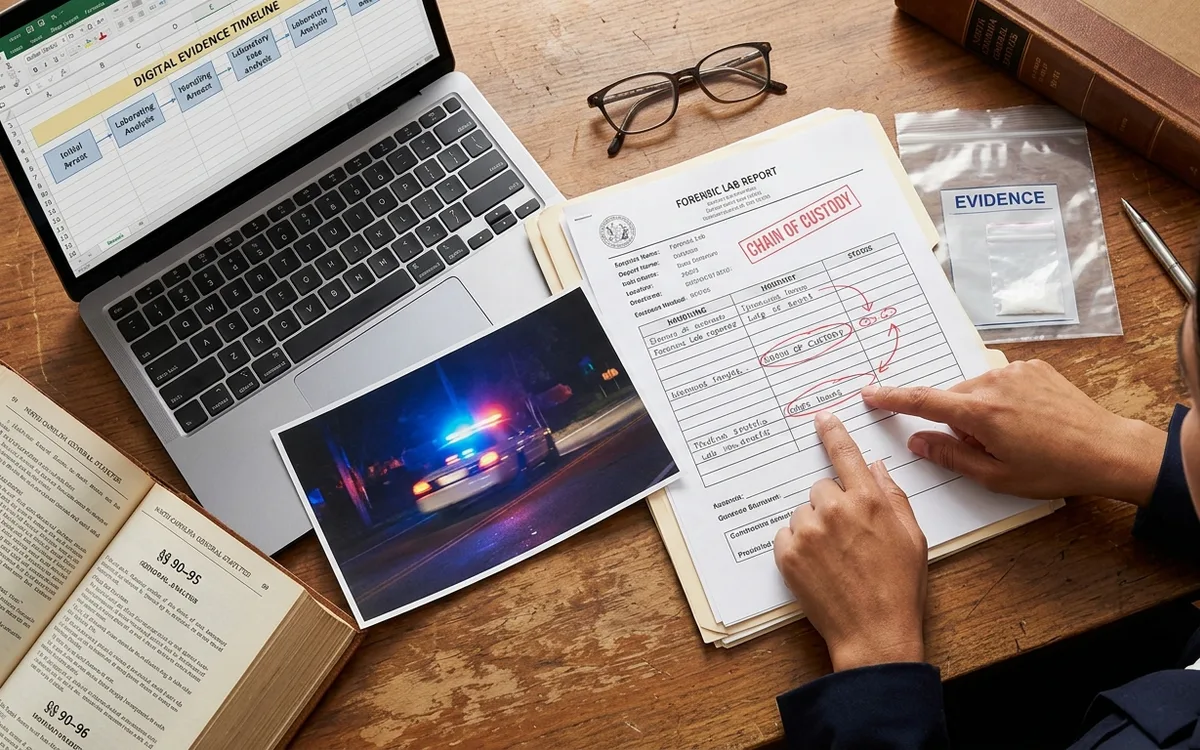
Chain of custody is the second front. Every controlled substance case depends on a lab report, typically from the North Carolina State Crime Laboratory, confirming what the substance actually is. The lab has acknowledged turnaround delays in its own published quality assurance reports, and cases routinely sit for months waiting on results. That delay can work for a defendant, buying time to negotiate, but it also means charges are sometimes filed before the substance is confirmed. A gap in the chain of custody between the stop and the lab bench is a legitimate basis to challenge the report at trial.
Intent is the third front in possession-with-intent-to-sell cases, where the State often relies on quantity, packaging, digital scales, or cash rather than direct proof of a sale.
Conditional Discharge and Drug Treatment Court
For a first-offense simple possession charge, § 90-96 lets a defendant plead guilty or no contest while the court withholds entering a conviction and places the person on probation instead. Complete probation without a new violation, and the charge is dismissed, never becoming a conviction. This option is generally available once, to defendants with no prior felony drug conviction and no earlier use of the same provision.
Some counties also run drug treatment court under § 7A-791, a supervised program combining substance abuse treatment with court oversight. It is longer and more demanding than ordinary probation, often a year or more of regular court dates, drug testing, and treatment compliance, but it can end the same way: dismissal instead of a permanent record.
Expunging a Drug Conviction Later
A first-offense misdemeanor can be expunged under § 15A-145 once the full sentence, including probation, is served. A single nonviolent felony can be expunged under § 15A-145.5, but only after a waiting period of at least 10 years from completion of the sentence, and only with no other felony convictions on record. Trafficking convictions and most Class A through D felonies are not eligible under either statute. Our expungement services page walks through current eligibility rules and the petition process at the clerk of court.
Immigration Consequences for Non-Citizens
For a non-citizen, almost any drug conviction other than a single offense involving 30 grams or less of marijuana for personal use is a deportable offense under federal immigration law, regardless of how light the North Carolina sentence looks on paper. A conditional discharge under § 90-96 can sometimes avoid that consequence because no formal judgment of conviction is entered, but this depends entirely on the exact plea language and which immigration consequence is at issue. Our immigration consequences of a criminal conviction page explains how a pending charge interacts with removal proceedings, and anyone who is not a U.S. citizen should get that advice before entering a plea, not after.
Frequently Asked Questions
Will I go to jail for a first-offense possession charge? Most first-time misdemeanor possession cases end in probation, not active jail time. Felony possession can still result in community or intermediate punishment rather than prison, depending on your prior record level.
How much does a criminal defense attorney cost for a drug case in North Carolina? Fees are billed flat or hourly, never as a contingency arrangement. North Carolina ethics rules do not permit contingency fees in criminal defense. Cost scales with charge severity: a Class I felony plea negotiation costs less than a Class G or F felony jury trial.
Am I eligible for conditional discharge under § 90-96? Generally yes, if this is a first-offense simple possession charge, you have no prior felony drug conviction, and you have never used this provision before. It is not available for sale, delivery, or trafficking charges.
How long does the SBI lab take to test evidence? There is no fixed number. The State Crime Laboratory has publicly acknowledged backlog issues in its own quality assurance reporting, and it is common for a case to sit for months before results come back, sometimes longer in rural counties.
Can a felony drug conviction be expunged? One nonviolent felony conviction can be expunged under § 15A-145.5, but only after at least 10 years from completing the sentence and only if you have no other felony convictions. Trafficking and most violent or high-class felonies are not eligible.
Does a drug conviction affect my immigration status? For most non-citizens, yes. Nearly any drug conviction beyond a single minor marijuana possession offense is a deportable offense under federal law, separate from whatever sentence the state court imposes.
What's the difference between possession and possession with intent to sell? Possession requires only that you knowingly had the substance. Intent to sell or deliver requires the State to also prove an intent to distribute, usually inferred from quantity, packaging, scales, or cash, which raises the offense class.
Can my license be revoked if I wasn't driving? Yes. § 20-17.6 triggers a mandatory one-year revocation for almost any Chapter 90 drug conviction, with no requirement that a vehicle was involved.
What happens if I violate probation on a drug case? The court can hold a violation hearing and, if it finds a willful violation, activate the suspended sentence, meaning the time you avoided at sentencing can still be imposed.
Is marijuana legal in North Carolina? No. Marijuana possession above half an ounce remains a criminal offense under § 90-95, regardless of legal status in neighboring states.
This page was reviewed by William J. Vasquez, a North Carolina State Bar member who represents clients in criminal matters in district and superior courts across North Carolina, including filing motions to suppress in vehicle stop and search cases, a frequent point of attack in possession charges. Last updated November 2025. The Structured Sentencing Act grid is periodically revised by the General Assembly; always confirm you are looking at the version in effect for your offense date before relying on a specific range.
If you've been charged with a drug offense in North Carolina, the practical first step is getting a copy of the lab report and your prior record level worksheet before you talk to a prosecutor. Our Criminal Defense team, including attorney William J. Vasquez, reviews the stop, the search, and the lab paperwork before advising on a plea. Contact the firm to have your charge and record level reviewed before your next court date.