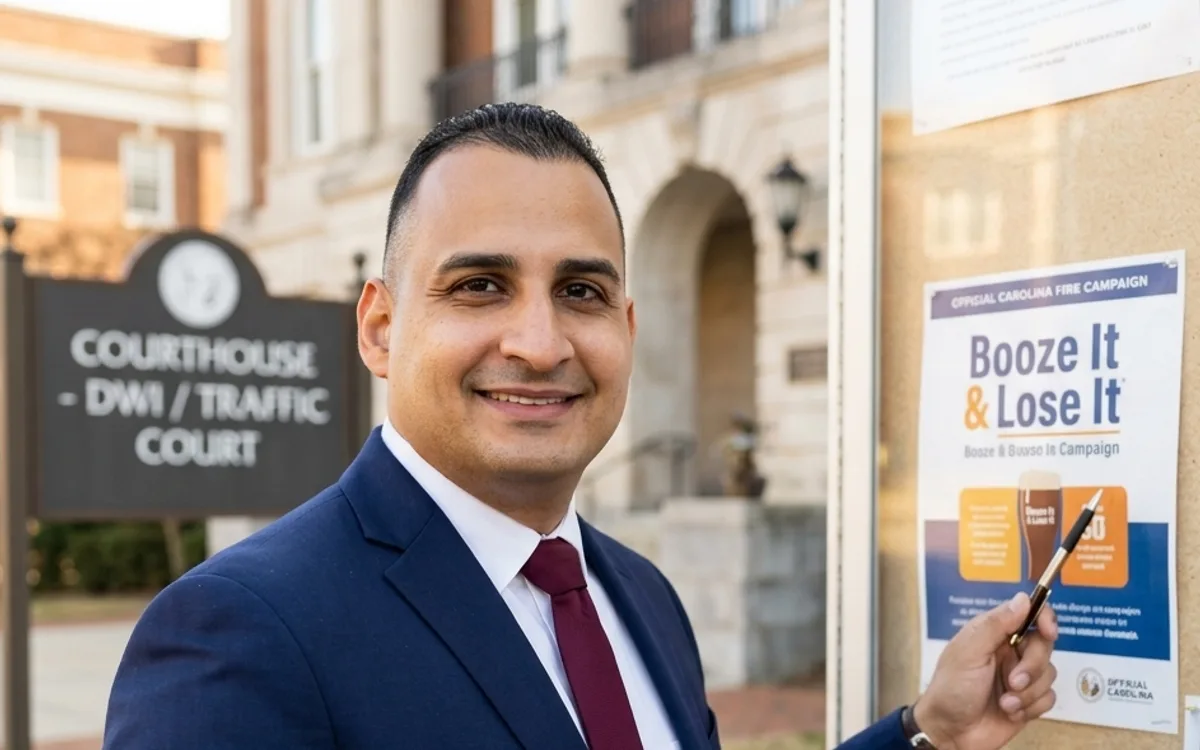
Booze It & Lose It is North Carolina's periodic increase in DWI checkpoints and patrols, coordinated by the NC Governor's Highway Safety Program and State Highway Patrol around holiday weekends. It doesn't change the law. The BAC limit stays 0.08% for most drivers, and refusing the breath test still triggers a 12-month license revocation under North Carolina's implied consent law.
Last updated November 2025. This page covers the North Carolina law behind Booze It & Lose It, not just the current campaign's dates, because the underlying statutes apply year-round.
What Booze It & Lose It Actually Is
Booze It & Lose It isn't a statute. It's a grant-funded enforcement push, coordinated by the North Carolina Governor's Highway Safety Program (GHSP) and the State Highway Patrol, that pays local and state agencies for extra checkpoints and patrol shifts around Labor Day, July 4th, and the December holidays. DWI arrests are still prosecuted as criminal cases, which is why this page sits inside our criminal defense resources even though half of what happens next runs through NCDMV's civil license process, not the courtroom.
GHSP and NCDMV publish after-action numbers, checkpoints run, arrests made, crashes avoided, for each cycle, but those figures come out months after the campaign ends. If you want the count for the most recent cycle, check NCDMV's newsroom directly rather than a news estimate published mid-campaign.
Are the Checkpoints Legal?
Yes, if the agency follows the rules. N.C. Gen. Stat. § 20-16.3A authorizes checking stations, but the North Carolina Court of Appeals set the constitutional floor in State v. Veazey (2008), later affirmed by the state Supreme Court in 2009. A checkpoint needs a primary purpose other than general crime control, a written plan approved by a supervisor before it goes up, and a neutral pattern for which cars get stopped, every car, every third car, not an officer's discretion in the moment.
A checkpoint that skips the written plan, or lets individual troopers pick which cars to pull over, can be challenged as an unconstitutional seizure. If that challenge succeeds, everything found after the stop, including the breath test result, can be suppressed.
Implied Consent and What Refusal Actually Costs You
By holding a North Carolina driver's license, you've already agreed to a breath or blood test if arrested for DWI. That's what N.C. Gen. Stat. § 20-16.2 means by implied consent. You can still refuse in the moment, but the refusal carries its own separate consequence.
Refuse, and NCDMV revokes your license for 12 months. That revocation is civil, not criminal, and it happens whether the DWI charge is later dismissed, reduced, or the driver is acquitted at trial. The refusal can also be introduced against you at trial as evidence of guilt.
BAC Limits Aren't the Same for Every Driver
| Driver category | Legal BAC limit | Governing statute |
|---|---|---|
| Standard licensed driver, 21 or older | 0.08% | N.C. Gen. Stat. § 20-138.1 |
| Commercial driver (CDL), operating a commercial vehicle | 0.04% | N.C. Gen. Stat. § 20-138.2 |
| Driver under 21 | 0.00%, any measurable alcohol | N.C. Gen. Stat. § 20-138.3 |
A driver under 21 with a 0.02% reading is over the limit for their category, even though the same reading wouldn't support a charge for a driver over 21.
The 30-Day Civil Revocation and the 10-Day Hearing Deadline
Two clocks start the moment you're charged. The criminal DWI case moves through district court on its own schedule, often months. Separately, NCDMV issues an immediate 30-day civil revocation under N.C. Gen. Stat. § 20-16.5 if you tested at 0.08% or above, or refused testing, taking your physical license before you've been convicted of anything.
For a refusal-based revocation, you have 10 calendar days from the date on the revocation notice to request an administrative hearing before NCDMV, under N.C. Gen. Stat. § 20-16.2(d). Miss that window and the 12-month revocation stands regardless of what happens later in criminal court. This deadline runs whether or not you've hired a lawyer yet.
DWI Sentencing Levels If You're Convicted
N.C. Gen. Stat. § 20-179 sentences DWI using six levels, driven by grossly aggravating, aggravating, and mitigating factors: prior DWI convictions, a child in the vehicle, driving on a revoked license, and injury to another person, among others.
| Level | What generally triggers it | Minimum active sentence if imposed |
|---|---|---|
| Aggravated Level One | Three or more grossly aggravating factors | 12 months, generally not suspendable |
| Level One | Two grossly aggravating factors | 30 days |
| Level Two | One grossly aggravating factor | 7 days |
| Level Three | Aggravating factors outweigh mitigating | 72 hours |
| Level Four | Aggravating and mitigating roughly balanced | 48 hours |
| Level Five | Mitigating factors outweigh aggravating | 24 hours |
Even a Level Five conviction, the lowest tier, carries a mandatory minimum jail term unless the judge suspends it in favor of probation. No version of a DWI conviction in North Carolina carries a zero minimum penalty.
What To Do If You're Stopped
Have your license, registration, and insurance ready before the officer reaches your window. Field sobriety tests, the walk-and-turn, one-leg stand, and similar exercises, are voluntary in North Carolina. Declining them doesn't carry the automatic license consequence that refusing the post-arrest chemical test does.
Once arrested and asked to submit to a breath or blood test, that's implied consent territory, and the 12-month refusal revocation is on the table. Say little beyond identifying yourself. Anything said at the checkpoint becomes part of the officer's report and, later, part of the state's evidence.
William J. Vasquez, founding attorney of Vasquez Law Firm and licensed to practice in North Carolina, has handled checkpoint-arrest cases where the checkpoint itself became the issue, no written plan on file, no supervisor sign-off, or a stopping pattern that broke down into officer discretion halfway through the night. In those cases, the fight isn't about the breath test number. It's about whether the stop should have happened at all.
Frequently Asked Questions
Is Booze It & Lose It a new law? No. It's a seasonal enforcement campaign, not a change to the DWI statute. BAC limits, implied consent rules, and revocation periods are identical in October and during the campaign windows around Labor Day and the December holidays.
Can I refuse field sobriety tests in North Carolina? Yes. FSTs are voluntary. Refusing them doesn't trigger an automatic revocation the way refusing the post-arrest chemical test does, though an officer can still arrest you based on other observations.
What happens if I refuse the breath test? NCDMV revokes your license for 12 months under the implied consent law, separate from the criminal case. You have 10 days from the notice date to request a hearing challenging that revocation.
How long will my license actually be revoked? It depends on the track. A 0.08%+ result or a refusal triggers a 30-day civil revocation under § 20-16.5 immediately. A refusal separately triggers the 12-month implied consent revocation. A later conviction can add further revocation under § 20-19. These periods can overlap or run separately depending on the facts.
What's the mandatory minimum for a first DWI? If charged as a Level Five, the lowest tier, the mandatory minimum is 24 hours, which a judge can suspend in favor of probation. Prior convictions, a child passenger, or a high BAC reading push the case into a higher level with a longer mandatory minimum.
Do I need a lawyer for a checkpoint stop, or only after an arrest? Call one after an arrest, or after release with a court date, whichever comes first. If you were stopped and let go with no charge, there's usually nothing yet to challenge.
Can I get a limited driving privilege during a revocation? Sometimes, depending on the type of revocation, your driving record, and whether you meet the waiting-period and insurance requirements. Our guide to limited driving privileges in North Carolina covers the eligibility rules in detail.
Is the civil license revocation the same thing as the criminal DWI case? No. They're two separate proceedings running at the same time. Winning the DMV hearing on the civil revocation doesn't resolve the criminal charge, and a not-guilty verdict in criminal court doesn't undo a civil revocation you didn't challenge within the 10-day window.
Can I challenge the checkpoint itself instead of just the breath test result? Yes. If the checkpoint didn't follow a written, supervisor-approved plan with a neutral stopping pattern, as required under State v. Veazey, that's a basis to move to suppress everything that followed the stop.
What does a DWI conviction cost beyond the fine and jail time? Higher insurance premiums for years, a license revocation period under § 20-19, and, for CDL holders, potential loss of the commercial endorsement even for a first offense. The cost usually outlasts the criminal case itself.
For the mechanics of building a defense after arrest, our North Carolina DWI defense overview walks through what happens between the arrest and the first court date. If your license has already been revoked, our license restoration page covers the process for getting it back once the revocation period ends. Both sit under the same criminal defense umbrella as this page.
Because North Carolina bars contingency fees in criminal cases, we quote a flat or hourly fee before taking a checkpoint or DWI case, and we'll tell you directly whether your 10-day hearing deadline has already passed. If you were stopped during this campaign or any other weekend, call Vasquez Law Firm and bring the arrest report and revocation notice so we can check the checkpoint paperwork and the hearing clock before either one runs out.