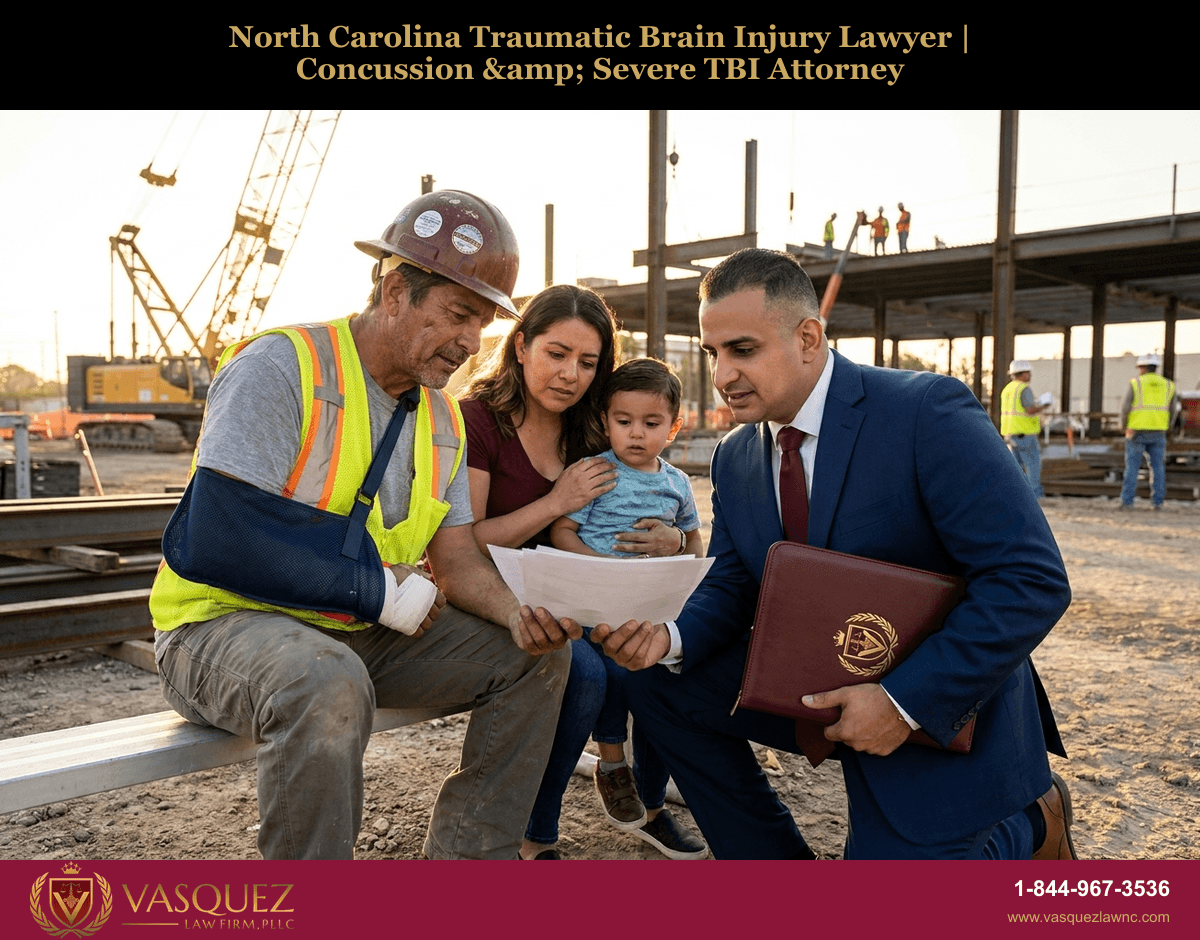
North Carolina Traumatic Brain Injury Lawyer | Concussion & Severe TBI Attorney
Fighting for families facing a lifetime of change after a brain injury
Compassionate Legal Support for Life-Changing Injuries
A brain injury changes everything - for the person injured and for the family supporting them. Our goal is to secure the resources your family needs for a lifetime of care while holding negligent parties accountable.
Traumatic Brain Injury Claims in North Carolina
A traumatic brain injury occurs when an external force - a blow, jolt, or penetrating injury - disrupts normal brain function. In North Carolina, TBI claims commonly arise from car, truck, and motorcycle collisions, falls (especially in premises liability cases), workplace accidents on construction sites and in industrial settings, sports and recreational injuries, and assaults or other intentional acts. At Vasquez Law Firm, we help people injured by another party's negligence pursue compensation for a category of injury that is uniquely difficult to prove, value, and live with.
TBIs exist on a wide spectrum, and that spectrum drives nearly every legal and medical decision in these cases. A mild TBI, commonly called a concussion, may involve a brief loss of consciousness or none at all, with symptoms including headaches, dizziness, difficulty concentrating, memory problems, light and noise sensitivity, and mood changes. Many people with mild TBI recover within weeks to months, but a meaningful subset develop persistent post-concussive symptoms that last far longer and can be genuinely disabling. Moderate and severe TBIs involve longer loss of consciousness, more pronounced structural brain damage often visible on CT or MRI imaging, and a much higher likelihood of permanent cognitive, physical, and behavioral impairment - including problems with memory, executive function, impulse control, personality, speech, and motor skills that can require lifelong care. Because mild TBI frequently produces normal-looking imaging despite real and disabling symptoms, insurance companies routinely argue these injuries are minor or fabricated - one of the most important reasons to have an attorney build the medical record correctly from the start.
Under North Carolina's general personal injury statute of limitations, N.C.G.S. § 1-52(16), you generally have three years from the date of injury to file a lawsuit for a traumatic brain injury claim - this is a different, longer deadline than the two-year window that applies specifically to wrongful death claims, and the two should not be confused. Missing this deadline generally bars recovery permanently, though certain circumstances can affect how the deadline is calculated, which is why it's important to consult an attorney about how the statute applies to your specific situation rather than assuming a specific date.
The TBI Severity Spectrum
Mild TBI / Concussion
Brief or no loss of consciousness, headaches, dizziness, memory and concentration problems, often normal imaging
Persistent Post-Concussive Symptoms
Symptoms that continue or worsen for months, sometimes disabling despite a "mild" initial diagnosis
Moderate TBI
Longer loss of consciousness, visible imaging findings, meaningful risk of lasting cognitive or physical impairment
Severe TBI
Extended unconsciousness, significant structural damage, high likelihood of permanent, lifelong impairment and care needs
Types of Damages in Traumatic Brain Injury Cases
Economic Damages
- • Past and future medical expenses
- • Emergency care, neurosurgery, hospitalization
- • Inpatient rehabilitation and decades of follow-up care
- • Lost income and diminished future earning capacity
- • Life care plan costs: therapies, home modifications, assistive technology, attendant care
- • Cognitive rehabilitation and vocational retraining
Non-Economic Damages
- • Pain and suffering
- • Loss of enjoyment of life
- • Personality and cognitive changes affecting relationships
- • Loss of independence
There is no fixed formula or guaranteed outcome in any TBI case - value depends on the severity and permanence of the injury as documented by neuropsychological testing and imaging, the strength of the liability evidence, the injured person's age and pre-injury earning trajectory, available insurance coverage or defendant assets, and whether contributory negligence is a factor. A properly built life care plan, prepared by a certified life care planner working from a treating physician's and neuropsychologist's findings, is often the single most important document in valuing a moderate-to-severe TBI claim, since it translates a lifetime of projected medical, therapeutic, and support needs into a present-day dollar figure that a jury or insurer can evaluate.
Vasquez Law Firm handles traumatic brain injury cases on a contingency fee basis - there is no upfront cost to have us review your case, and we only get paid if we recover compensation for you. We advance the costs of investigation, medical record retrieval, and expert retention, which matters especially in TBI cases where neuropsychological evaluation and life care planning are essential but not inexpensive.
Contributory Negligence: What NC TBI Clients Need to Understand
North Carolina is one of only a small number of states, along with the District of Columbia, that still follows pure contributory negligence rather than a comparative fault system. Under this doctrine, if you are found to have contributed to the accident that caused your brain injury - even to a small degree - that finding can, under a strict application of the rule, bar recovery entirely, regardless of how much more at fault the other party was. There are recognized limits and exceptions, including the "last clear chance" doctrine, and whether an exception applies depends heavily on the specific facts. Because insurers frequently contest whether a concussion or mild TBI is "real" or exaggerated on top of any fault dispute, having an attorney investigate and document a case from the earliest possible point is critical.
The TBI Claims Process and Realistic Timeline
Medical Stabilization & Diagnosis (typically the first 2-12 weeks)
Emergency treatment, imaging, and initial diagnosis come first. For moderate and severe TBI, this phase includes hospitalization and the start of inpatient or outpatient rehabilitation.
Investigation & Expert Evaluation (roughly 8-26 weeks)
We secure accident evidence while it is still available, and coordinate neuropsychological testing and, in serious cases, life care planning to fully document the injury's impact.
Demand and Negotiation (roughly 12-30 weeks)
Once liability and damages, including any life care plan, are reasonably well documented, we present a demand package to the responsible party's insurer. Some cases resolve at this stage.
Litigation, If Needed (often 52-104 weeks)
If pre-suit negotiation doesn't produce a fair resolution, we file in North Carolina Superior Court. Disputed liability, especially in mild TBI cases with limited imaging findings, can extend this timeline.
Most TBI cases resolve somewhere between 12 and 30 months from the time an attorney is retained through settlement, though cases involving disputed liability, multiple insurance carriers, or litigation can take significantly longer. No timeline can be guaranteed for any individual case, and settling before the full extent of cognitive and physical recovery is understood can significantly undervalue a claim.
Realistic Traumatic Brain Injury Claims Timeline (Weeks)
| Phase | Minimum (weeks) | Maximum (weeks) |
|---|---|---|
| Medical Stabilization & Diagnosis | 2 | 12 |
| Investigation & Expert Evaluation | 8 | 26 |
| Demand & Negotiation | 12 | 30 |
| Litigation (if needed) | 52 | 104 |
Ranges shown are typical, not guaranteed - phases can run concurrently in some cases (for example, investigation continues while medical treatment is ongoing), and litigation only occurs when pre-suit negotiation doesn't resolve the claim.
Time Limits for Traumatic Brain Injury Claims
Three-Year Statute of Limitations
In North Carolina, traumatic brain injury claims generally must be filed within three years of the date of injury under N.C.G.S. § 1-52(16). Don't wait - evidence disappears and witnesses' memories fade over time.
Why Local NC Experience Matters
Traumatic brain injury claims move through a specific North Carolina county's court system, and the strength of a case often depends on how quickly liability evidence is preserved and how credibly the injury is documented from the earliest days after the incident. Handling these cases throughout central North Carolina - not as one state among fifty - means familiarity with the region's trauma centers and rehabilitation hospitals where TBI patients are typically treated, working relationships with the neurologists, neuropsychologists, and life care planners whose testimony often decides these cases, and firsthand experience with how North Carolina Superior Court judges and defense counsel in these districts approach mild TBI cases where objective imaging findings may be limited. Because North Carolina's pure contributory negligence rule is unusual compared to most other states, and because insurers frequently contest whether a concussion or mild TBI is "real" or exaggerated, handling these cases day in and day out under North Carolina law means that doctrine and its evidentiary challenges inform every stage of how we investigate, negotiate, and, if necessary, litigate a case.
Frequently Asked Questions About Traumatic Brain Injury Claims
What is the statute of limitations for a traumatic brain injury claim in North Carolina?
Generally three years from the date of injury under N.C.G.S. § 1-52(16). This is different from the two-year deadline that applies to wrongful death claims, so it's important not to confuse the two. Certain circumstances can affect how the deadline is calculated, so it's best to consult an attorney about your specific situation as soon as possible rather than waiting.
Can I still recover compensation for a mild TBI or concussion, even if my brain scan came back normal?
Yes, though these cases require careful documentation. Many mild traumatic brain injuries and concussions don't show up clearly on standard CT or MRI imaging, even when symptoms are real and disabling. We work with treating physicians and neuropsychologists who use cognitive testing, symptom tracking, and clinical evaluation - not just imaging - to document the injury. Insurance companies frequently argue that a normal scan means there's no real injury, which is one of the most common disputes in these cases.
What if I was partly at fault for the accident that caused my brain injury?
North Carolina follows the pure contributory negligence rule, which means that if you contributed even minimally to causing the accident, a strict application of that rule can bar recovery entirely. There are limited exceptions, including the "last clear chance" doctrine, which may apply depending on the specific facts. It's important to have an attorney review the details before assuming a claim is barred.
How is the value of a traumatic brain injury settlement calculated?
There is no fixed formula, and no outcome can be guaranteed in advance. Value is shaped by the severity and permanence of the injury as documented by medical and neuropsychological evidence, past and projected future medical and rehabilitation costs, lost earning capacity, the strength of the liability evidence, available insurance coverage or defendant assets, and whether contributory negligence is a factor. Two cases with similar-sounding injuries can result in very different outcomes depending on this full picture.
What is a life care plan, and why does it matter in a TBI case?
A life care plan is a detailed, medically grounded projection of a person's future care needs - therapy, medical treatment, home modifications, assistive equipment, and attendant care - prepared by a certified life care planner working from treating physicians' and neuropsychologists' findings. In moderate and severe TBI cases, the life care plan is often the central document used to calculate the true lifetime cost of the injury, since these costs can extend for decades and are easy to undervalue without expert analysis.
Why do I need a neuropsychologist involved in my case, not just my treating doctor?
A neuropsychologist performs standardized cognitive testing that can objectively measure deficits in memory, attention, processing speed, and executive function - deficits that may not show up on imaging but significantly affect a person's daily life and ability to work. This testing is often critical evidence, especially in mild-to-moderate TBI cases where insurers argue the injury isn't serious because a scan looked normal.
What kinds of accidents most commonly cause traumatic brain injuries in North Carolina?
Common causes include car, truck, and motorcycle accidents, falls (including on unsafe premises), workplace accidents such as falls from height or being struck by equipment, and sports or recreational injuries. Each type of case involves different liable parties and evidence, and some, like workplace injuries, may involve workers' compensation alongside or instead of a third-party claim.
How long does a traumatic brain injury lawsuit typically take?
Most TBI cases resolve somewhere between 12 and 30 months from the time an attorney is retained through settlement, though cases involving disputed liability, multiple insurance carriers, or litigation can take significantly longer. Moderate and severe TBI cases often take longer to resolve than mild TBI cases because treatment, recovery, and prognosis take longer to stabilize enough to accurately value the claim. No timeline can be guaranteed for any individual case, and settling before the full extent of cognitive and physical recovery is understood can significantly undervalue a claim.
Can behavioral or personality changes after a brain injury be part of my compensation?
Yes. Changes in mood, impulse control, personality, and behavior are well-recognized consequences of traumatic brain injury and can be included in a claim for non-economic damages, as well as factored into life care planning if they affect a person's ability to live independently or maintain relationships and employment. These changes are typically documented through neuropsychological evaluation and input from family members and treating providers.
What if the injury seemed mild at first but symptoms got worse over time?
This is common with traumatic brain injuries - post-concussive symptoms can persist or worsen for months after the initial event, and some effects, particularly cognitive ones, may not become fully apparent until a person returns to work, school, or complex daily tasks. This is one reason it's important not to settle a claim too early, and to continue documenting symptoms with treating providers even after initial emergency care.
Do I need to pay anything upfront to hire a traumatic brain injury attorney?
No. We handle traumatic brain injury cases on a contingency fee basis, meaning our firm advances the costs of investigation, medical record retrieval, and expert evaluation, and we only get paid if we recover compensation for you. There is no upfront cost to have us review your case.
What happens if the at-fault party doesn't have enough insurance to cover a serious brain injury?
This is a real concern given how costly lifetime TBI care can be. Our attorneys investigate every available source of coverage, including underinsured motorist coverage on your own auto policy, umbrella policies, commercial coverage if a company vehicle or workplace was involved, and any other liable parties who may carry separate insurance. A defendant's personal assets may also be pursued in some cases, though collectability varies and is never guaranteed.
Can I meet with a Raleigh brain injury lawyer?
The firm helps people with brain and head injuries across North Carolina. Consultations are by phone and video from anywhere in the state. Call 1-844-967-3536 weekdays 8am to 7pm or Saturday 9am to 2pm.
What should I bring when I call about a head injury claim?
Bring medical records and imaging if you have them, the accident or police report, and the names of any insurers. Because North Carolina follows contributory negligence, which can bar recovery if a person is found even partly at fault (with some exceptions), and deadlines can be short, a traumatic brain injury lawyer can help you sort out next steps early.
People also search for: raleigh brain injury lawyer; brain injury attorney raleigh; raleigh traumatic brain injury attorney; nc brain injury lawyer; traumatic brain injury lawyer north carolina; traumatic brain injury attorneys north carolina; north carolina traumatic brain injury lawyer; brain injury lawyer north carolina; head injury lawyer north carolina.
Let Us Handle the Legal Fight While You Focus on Recovery
A brain injury can mean a lifetime of change. You shouldn't have to navigate legal complexities while managing medical care and rehabilitation. We'll handle every aspect of your traumatic brain injury case with compassion and determination.
Get Compassionate Legal HelpLegal Services We Offer
Popular Services
Our Office Locations
Additional Resources
Important Deadlines
3 Years
To file TBI claim (N.C.G.S. § 1-52(16))
ASAP
Evidence preservation critical
No Fee
Unless we recover for you
Traumatic Brain Injury Claims in North Carolina: Proving the Injury and Valuing the Claim
What Makes TBI Claims Different
Traumatic brain injuries are uniquely difficult to prove, value, and live with. Unlike a broken bone visible on an X-ray, many TBIs - especially concussions and mild TBI - produce normal-looking imaging despite real and disabling symptoms. That gap between what a scan shows and what a person actually experiences is exactly where insurance companies challenge these claims hardest, which is why building a thorough medical record from the earliest days after the injury matters so much.
North Carolina Traumatic Brain Injury Law
In North Carolina, traumatic brain injury claims are governed by the state's general personal injury statute of limitations, N.C.G.S. § 1-52(16), giving injured people generally three years from the date of injury to file suit - a longer window than the two-year wrongful death deadline. North Carolina's pure contributory negligence rule means even minor fault attributed to the injured person can bar recovery entirely, subject to limited exceptions like the "last clear chance" doctrine. Recoverable damages can include past and future medical expenses, lost earning capacity, life care plan costs, and pain and suffering.
Common Causes of Traumatic Brain Injury
Common causes of TBI handled by Vasquez Law Firm include car, truck, and motorcycle collisions, falls on unsafe premises, workplace accidents such as falls from height or being struck by equipment, and sports or recreational injuries. Each type of case involves different liable parties and evidence, and workplace injuries may involve workers' compensation alongside or instead of a third-party claim. Our attorneys have the resources to retain neuropsychologists, life care planners, and accident reconstruction experts needed to build a comprehensive case.
Compassionate and Determined Representation
A traumatic brain injury changes daily life for the person injured and often reshapes the entire family's routine. We approach TBI representation with the sensitivity these cases demand while fighting aggressively to secure the resources a family needs. Vasquez Law Firm serves clients throughout North Carolina. Contact us for a free, confidential consultation. There is no obligation, and we handle traumatic brain injury cases on a contingency fee basis.
Calculating the Full Lifetime Value
Calculating the full value of a moderate-to-severe TBI claim requires a certified life care planner working from treating physicians' and neuropsychologists' findings to project decades of therapy, medical treatment, home modifications, assistive technology, and attendant care into a present-day dollar figure. Our attorneys work with these experts to build comprehensive damage models so that no element of recoverable economic loss is overlooked or undervalued in settlement negotiations or at trial.
Act Quickly to Preserve Your Rights
North Carolina generally applies a three-year statute of limitations to traumatic brain injury claims from the date of injury. This deadline is strict, and courts rarely grant exceptions. If you or a loved one has suffered a brain injury due to another party's negligence, do not wait to consult with an attorney. Critical evidence, including surveillance footage, incident reports, and witness availability, begins to disappear almost immediately. Call Vasquez Law Firm at 1-844-967-3536 for a compassionate, confidential consultation at no cost to you.