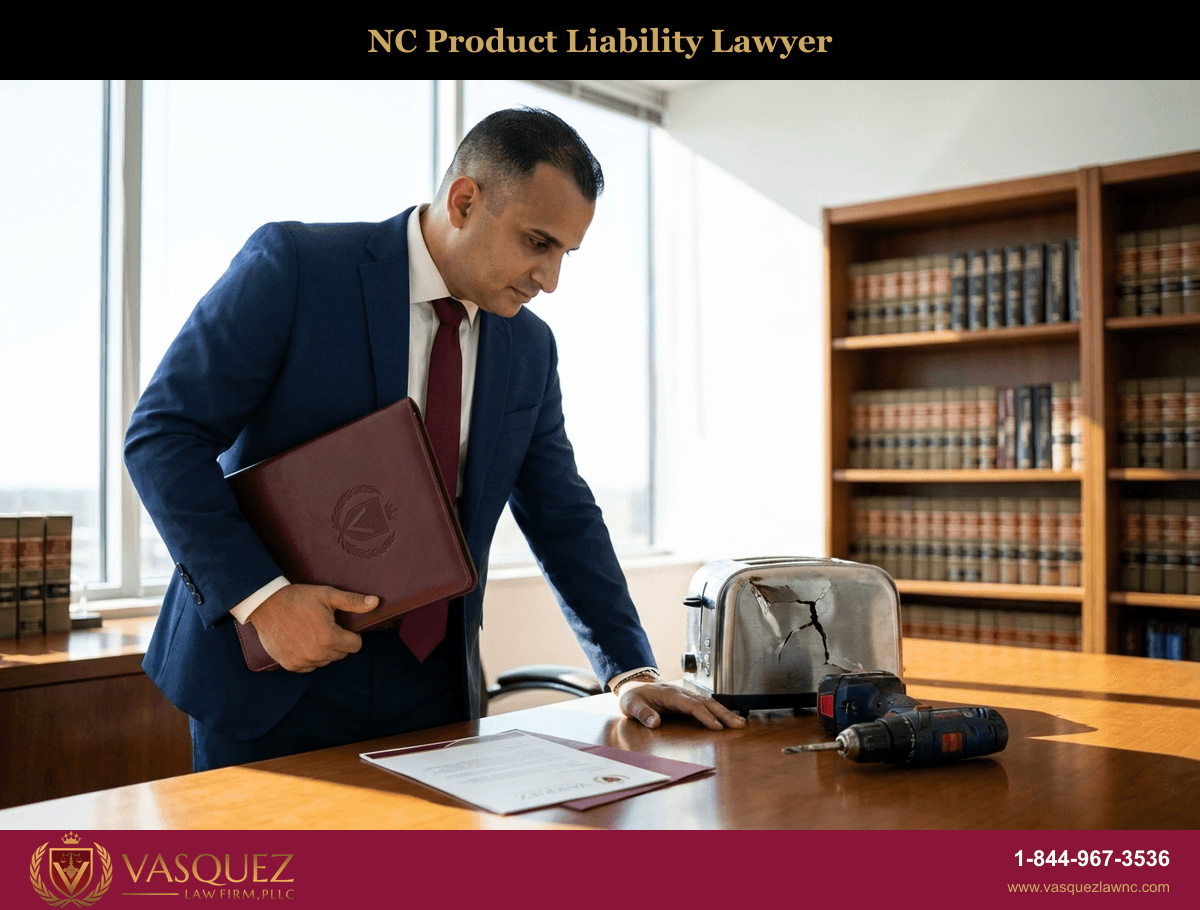
Quick Answer
A product liability lawyer in North Carolina helps an injured person look at whether a defective product caused the harm and who may be responsible. Vasquez Law Firm handles individual personal injury cases in North Carolina only. The firm meets clients by phone and video, in English and Spanish.
- Keep the product, its packaging and your receipts. Ask a lawyer before you repair or return it. If it is unsafe to keep, call and ask how to store it safely.
- Photograph the product, the injury and the place where it happened.
- North Carolina deadlines can be short, so ask early which one applies.
- Call 1-844-967-3536 to describe what happened.
Introduction
A space heater tips over and scorches a hallway. A child car seat buckle will not release. A power tool throws a blade during ordinary use. In each case, the person hurt wants to know if the product itself was the problem.
That question is what a product liability lawyer in North Carolina examines. The answer is rarely clear on the first day, and it often depends on what happens to the product afterward. This page explains what to keep, how the investigation works and where the firm fits.
It is written for people across the state who are looking for help after a product injury, whether in Charlotte, Raleigh or Durham. It is general information, not advice about your case. William J. Vásquez and the firm's bilingual staff speak with callers in English and Spanish.
What a Product Liability Claim Looks Like
A product liability claim starts with an injury and a product. The question is whether something about the product made it unsafe, and whether that is what hurt you. The product might be a tool, an appliance, a toy, a piece of furniture, a tire, a ladder or a vehicle part.
Lawyers often group the possible problems into three kinds. The first is a design problem, where the product was unsafe as planned. The second is a manufacturing problem, where one unit came out wrong. The third is a warning problem, where a danger was not explained clearly.
These labels are tools for thinking. They are not a form you fill out. A single injury can raise more than one of them, and the facts decide which ones matter.
Many people who look for a firm in Raleigh after a product injury expect a quick yes or no. The honest first step is a conversation about what happened and what you still have.
The firm already has a background article on products liability claims. This page does not repeat all of it. It focuses on evidence and on the questions people ask first.
In most injury cases the key evidence is a report, a photo or a medical record. In a product case, the key evidence is often the object. If it is gone, changed or thrown away, it can be very hard to show what was wrong with it.
A product can be examined by a technical reviewer, such as an engineer, who may be able to see how it was made, how it wore and how it failed. That review depends on the product being in the condition it was in when it hurt you. Even a well-meant repair can erase the clue.
That is why this page keeps returning to one idea. Keep the product. Do not clean it up, fix it, test it or send it back before you speak with a lawyer.
The same is true for the broken pieces. If part of the product snapped, melted or fell off, put the parts in a bag or box and keep them together. Write down where each one was found.
If the product is large, damaged by fire or unsafe to keep in the house, say so when you call. The firm can talk through how to store it safely and when to bring in a reviewer.
What to Keep and What Not to Do
The first hours and days after an injury matter for evidence. You do not need to be an investigator. A few simple habits protect a lot.
- Keep the product in the state it was in after the injury.
- Keep the box, bag, manual, labels and any inserts.
- Keep receipts, order confirmations, emails and card statements that show where and when you bought it.
- Do not repair, clean, modify or throw away the product.
- Do not return it to the store or ship it back to the maker, even if they offer a refund.
- Do not let anyone from the company or its insurer take it, test it or "look at it" without advice.
A refund can feel like a fair end to the problem. It is not, if it means giving up the object you may need later. Ask a lawyer before you accept one.
If a store or a company asks for the product back, you can say you are not ready to release it yet. You can also ask them to put the request in writing.
Photograph the product from every side before anyone touches it. Take close-ups of the damage, the labels and any model or serial numbers. Photograph the place where it happened, and your injuries as they change.
In our experience, the item people most often no longer have is the product itself, because a repair, a refund or a cleanup happened before they thought of a claim.
How Fault and Defect Questions Are Investigated
An investigation tries to answer two linked questions. Was the product defective, and was that defect the reason you were hurt? Neither one is assumed. Both have to be supported by facts.
The firm usually starts by listening. It asks how you used the product, how old it was and how it was stored or cared for. It asks what happened just before and just after the injury.
Next, a lawyer looks at the records. Medical records show the injury. Photographs and the product show the failure. Purchase records show who sold it. The manual and labels show what warnings and instructions came with it.
A technical reviewer may then look at the product. That person can explain how it was built and why it may have failed. Which kind of reviewer is needed depends on the product.
The investigation also asks who was involved in getting the product to you. Makers, parts suppliers, distributors and sellers can all be part of the chain. A lawyer helps sort out which of them may be responsible.
Your own use of the product will be examined too. North Carolina follows contributory negligence, which bars a person from collecting damages if found even partially at fault (there are some exceptions). Talk to a lawyer before you discuss fault with anyone.
That matters in product cases, because a company may argue that the product was misused or that a warning was ignored. Do not guess aloud about what you did wrong. Describe the facts when you speak with a lawyer.
Charlotte, Raleigh, Durham and Statewide Clients
Product injuries happen in homes, workplaces, stores and driveways everywhere. The firm reviews individual product injury cases that happened in North Carolina, wherever in the state you live.
Personal injury consultations are held by phone and video for people anywhere in North Carolina, including Raleigh and Durham. The firm explains its work in Raleigh on its Raleigh personal injury page.
Charlotte clients meet with the firm by phone and video, because the firm's office there does not hold consultations. You can read about the firm's work in that area on the Charlotte personal injury page. Personal injury consultations are by phone and video only, not in person.
People sometimes search by ZIP code or by a nearby town such as Matthews, Fayetteville or downtown Durham. The firm does not need you to live in a particular ZIP code. What matters is that the injury happened in North Carolina.
If you cannot travel because of your injuries, say so. A phone or video meeting can work well for a first conversation, and the firm can tell you what else it needs from you.
Recalls and Where to Look Them Up
A recall means the maker or a safety agency has said a product has a safety problem. A recall can be helpful information, but it is not required for a claim, and the lack of a recall does not mean a product was safe.
For many household and consumer products, the U.S. Consumer Product Safety Commission keeps a searchable recall list at cpsc.gov/Recalls. Its search tool lets you filter by date, hazard and product category, and the agency says the data updates weekly.
If you find a recall that matches your product, take a screenshot and note the date you found it. Do not treat the recall notice as the final word on your rights. A recall remedy, such as a repair kit or a refund, may involve giving up the product, so ask a lawyer first.
Recalls may also not cover your exact model, date or lot. If you are not sure, bring the model and serial numbers when you call.
What the Firm Does Not Handle
The firm limits its personal injury work so it can say clearly what it does. A product liability case for this page means an individual injury caused by a defective product in North Carolina.
The firm does not handle drug, medical device or chemical mass torts. It does not handle medical malpractice or nursing home cases. It does not take personal injury cases outside North Carolina, and it does not handle Florida cases.
Injuries at work usually go through workers' compensation, which the firm handles separately in North Carolina. If someone other than your employer, such as the maker of a machine, caused the injury, there may also be a separate claim. Ask about both. You can read about that side of the firm's work on its workers' compensation page.
If your question is about a recall, a refund or a store return only, the manufacturer or the agency listed in the recall notice is usually the place to start. A lawyer is needed when someone has been hurt.
Checklist: What You Need
You do not have to gather everything before you call. This list shows what is useful, and the firm will tell you which items matter for your situation.
- The product and any broken pieces, kept as they were after the injury.
- Packaging, manuals, labels and inserts.
- Receipts, order confirmations, emails and card statements.
- Model, lot and serial numbers, if you can find them.
- Photographs of the product, the place and your injuries.
- Medical records, bills and a list of the doctors you have seen.
- Names of anyone who saw what happened.
- Any letters, emails or messages from the seller, the maker or an insurer.
- A short written note of what happened, written while you still remember it.
If something on the list is missing, do not worry. Tell the firm what you have and what you do not. Many people find the receipt or the box later.
Timeline and Process
Every case moves at its own pace. The table below shows the usual stages, not a schedule. The firm does not give exact times, because they depend on the injury, the product and the other side.
| Stage | What happens | Who acts |
|---|---|---|
| First call | You describe the injury, the product and where it happened. | You and the firm |
| Preserve evidence | The product, packaging and records are kept. Photos are taken. | You, with guidance from the firm |
| Investigation | Records are gathered and the product may be reviewed by a technical reviewer. | The firm |
| Claim to insurers or companies | A written claim is made against the parties who may be responsible. | The firm |
| Negotiation | The parties discuss whether the claim can be resolved. | The firm, the other side and their insurers |
| Lawsuit, if needed | A case is filed in court and goes through the court process. | The firm and the court |
North Carolina law sets deadlines to file a claim, and some are short. Missing one can end the claim, so ask a lawyer early which one applies. The firm does not list the deadlines here, because the right one depends on your facts.
While a case is open, expect quiet stretches. Records take time to arrive, and companies and insurers answer slowly. Silence does not mean that nothing is happening.
Cost Factors
Medical bills and missed work create real pressure. The firm explains how fees work during the consultation, and a free consultation is available when the case qualifies. The table below lists the kinds of costs that can come up.
| Item | Amount | Notes |
|---|---|---|
| Attorney fee | Ask during your consultation | Ask how the fee is set and whether it is in writing. |
| Court filing costs | Ask during your consultation | Only applies if a lawsuit is filed. |
| Records and reports | Ask during your consultation | Medical, purchase and company records can carry fees. |
| Technical review of the product | Ask during your consultation | Some product cases need an engineer or similar reviewer to examine the item. |
| Safe storage of the product | Ask during your consultation | Large or damaged items may need special storage. |
Ask who pays each cost and when. Ask what happens to those costs if the case ends without a recovery. Get the answers in writing.
Money questions can feel awkward to raise. They are still important, and the firm expects them.
Common Mistakes to Avoid
- Repairing, cleaning, testing or throwing away the product.
- Returning the product for a refund or mailing it to the maker.
- Giving a recorded statement to the other side's insurer without advice. Your own policy may require you to cooperate with your own insurer.
- Accepting a quick payment or signing a release before you know the full extent of your injuries.
- Throwing away packaging, labels and receipts.
- Posting about the injury, the product or the company on social media.
- Skipping medical visits or leaving gaps in your treatment.
- Waiting too long and missing a deadline.
None of these mistakes means you have no claim. They can make the claim harder to prove, though, so tell the firm about any that already happened.
When to Contact Vasquez Law Firm
Call as soon as you can after a product injury, ideally before the product leaves your hands. Early contact lets a lawyer tell you what to keep and how to store it.
Call if you are being asked to return the product, sign a release or give a statement. Call if you are not sure whether the injury has anything to do with the product at all. The firm can help you sort that out.
Phones are answered weekdays 8am to 7pm and Saturday 9am to 2pm. You can call 1-844-967-3536 and speak in English or Spanish. Take the time you need, and bring what you have.
About Vasquez Law Firm
Vasquez Law Firm is led by attorney William J. Vásquez. The firm has offices at 4426 Louisburg Road, Suite 206, Raleigh, NC 27616 and 612 South Brightleaf Boulevard, Smithfield, NC 27577.
The firm helps people throughout North Carolina by phone and video. Charlotte clients meet with the firm by phone and video, because the firm's office there does not hold consultations. Personal injury work is limited to North Carolina. You can see the full range on the firm's personal injury page.
The phone number is 1-844-967-3536. Consultations are in English and Spanish. A free consultation is available when the case qualifies.
Frequently Asked Questions
What is a product liability lawyer?
A product liability lawyer helps people hurt by a defective product look at whether the product caused the injury and who may be responsible. The firm handles individual injury cases in North Carolina.
Should I keep the product that hurt me?
Yes. Keep the product, any broken pieces, the packaging and your receipts. Do not repair, clean or throw it away, and ask a lawyer before you return it.
Can I return the product for a refund?
Ask a lawyer first. A refund or return can mean giving up the object that may be needed to show what went wrong.
How is a product defect investigated?
A lawyer reviews your account, medical records, photos, purchase records, manuals and labels. A technical reviewer, such as an engineer, may examine the product itself.
What if I used the product the wrong way?
Do not guess about fault with anyone. North Carolina follows contributory negligence, which bars a person from collecting damages if found even partially at fault (there are some exceptions). Talk to a lawyer before you discuss fault with anyone.
Is there a deadline to file a product claim?
North Carolina law sets deadlines to file a claim, and some are short. Missing one can end the claim, so ask a lawyer early which one applies.
Does the product need to have been recalled?
No. A recall can be useful information, but it is not required, and the lack of a recall does not mean a product was safe. The CPSC keeps a searchable recall list at cpsc.gov/Recalls.
Does the firm handle drug or medical device cases?
No. The firm does not handle drug, medical device or chemical mass torts, and it does not take personal injury cases outside North Carolina.
What if the product injured me at work?
Injuries at work usually go through workers' compensation, which the firm handles separately in North Carolina. If someone other than your employer, such as the maker of a machine, caused the injury, there may also be a separate claim. Ask about both.
Can I meet with the firm if I live in Charlotte or Durham?
Yes. Charlotte clients meet with the firm by phone and video, because the firm's office there does not hold consultations. Durham clients can also meet by phone and video. Call 1-844-967-3536.
Sources and References
U.S. Consumer Product Safety Commission: Recalls
Other ways people search for this
Other searches: product liability attorney Charlotte NC, product liability lawyer Raleigh, Durham product liability attorney, product liability attorney Durham NC, product liability attorney 28273, product liability attorney Durham, product liability attorney 28301, product liability attorney 28210, Raleigh product liability attorney, product liability law firm Raleigh, Raleigh product liability law firm, product liability attorney 28105, product liability attorney Raleigh, product liability attorney 27701, product liability attorney Matthews.