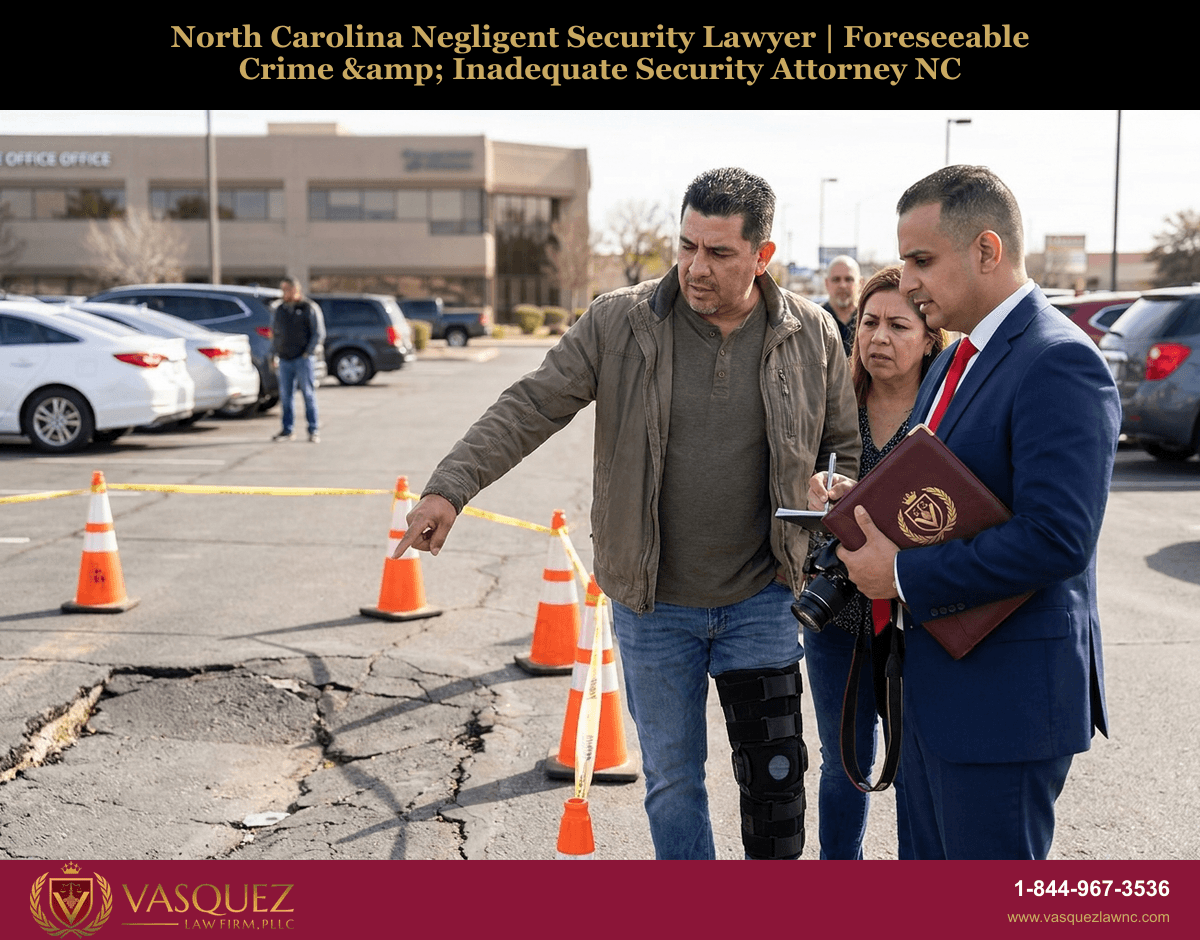
North Carolina Negligent Security Lawyer | Foreseeable Crime & Inadequate Security Attorney NC
Holding property owners accountable when a preventable crime happened because security was ignored
Holding Property Owners Accountable for Preventable Crime
A crime that could have been prevented with basic security measures deserves a thorough investigation - and a property owner who deserves to be held responsible.
Negligent Security Claims in North Carolina
Negligent security claims are a distinct category of premises liability - not about a wet floor or a broken step, but about a property owner or manager who knew (or reasonably should have known) that criminal activity was likely on their property and failed to take reasonable precautions to prevent it. When a tenant is assaulted in a poorly lit apartment complex parking lot with a known history of break-ins, when a hotel guest is robbed because an entry gate lock was broken for weeks, or when a nightclub patron is shot because management removed security staff despite prior violent incidents on the premises, the property owner can be held civilly liable for the resulting harm - even though the crime itself was committed by a third party who is often unidentified, uninsured, or otherwise unable to pay a judgment.
At Vasquez Law Firm, we pursue negligent security claims against apartment complexes, hotels, shopping centers, bars and nightclubs, parking garages, and other commercial property owners across North Carolina. These cases turn on foreseeability: was there a documented history of crime on or near the property (prior police calls, prior similar incidents, crime statistics for the area) that should have put the owner on notice that additional security measures - working locks and gates, adequate lighting, security cameras, on-site security personnel, controlled access - were necessary? Establishing that notice, and then showing the owner's security measures fell below what a reasonably careful property owner would have provided under the circumstances, is the core of every negligent security case.
These claims are legally and factually more complex than a typical trip-and-fall because they require proving both the property owner's negligence and that the criminal act was a foreseeable consequence of that negligence - not an unpredictable, intervening event that breaks the chain of liability. North Carolina courts look at factors including prior criminal incidents on the property, the nature of the neighborhood, whether the owner had actual knowledge of specific threats, and industry or safety standards for similar properties. Insurance companies and defense attorneys aggressively contest foreseeability in these cases, which makes early investigation, police-report gathering, and preservation of security footage and maintenance records critical.
Common Security Failures That Lead to Claims
Broken Locks and Gates
Malfunctioning locks on exterior doors and entry gates left unrepaired
Inadequate Lighting
Poorly lit parking lots, stairwells, and common areas
Missing Security Cameras
Non-functioning or absent camera coverage in high-risk areas
Insufficient Security Staffing
Failure to maintain security personnel despite a known history of crime
Uncontrolled Access
Failure to control building or complex access, or ignored prior safety complaints
Compensation in Negligent Security Cases
Compensation in a negligent security case covers the same broad categories available in other North Carolina personal injury claims, but the mix often skews heavily toward the psychological and non-economic side because these injuries stem from a violent crime rather than an accident. Economic damages typically include emergency and hospital treatment, surgery for gunshot or stabbing wounds, ongoing physical rehabilitation, and lost wages during recovery. Non-economic damages frequently include post-traumatic stress disorder and other psychological trauma, pain and suffering, and, in the most severe cases involving permanent injury or wrongful death, loss of enjoyment of life or loss of consortium. Because the criminal who committed the assault is often unidentified, uninsured, or judgment-proof, pursuing the civil claim against the property owner (and their commercial liability insurance) is frequently the only realistic path to meaningful compensation - there is no fixed formula, and no outcome can be guaranteed, but courts and insurers do recognize psychological trauma from a violent crime as compensable in its own right, not merely as an add-on to physical injury. Vasquez Law Firm handles negligent security cases on a contingency fee basis: there is no upfront cost to have your case reviewed, and our firm is paid only if we recover compensation on your behalf. We advance the costs of investigation, including obtaining police incident histories, subpoenaing prior crime records for the property, and retaining security industry experts where needed to establish what precautions a reasonably careful property owner should have had in place.
Economic Damages
- • Emergency and hospital treatment
- • Surgery for gunshot or stabbing wounds
- • Ongoing physical rehabilitation
- • Lost wages during recovery
Non-Economic Damages
- • PTSD and other psychological trauma
- • Pain and suffering
- • Loss of enjoyment of life
- • Loss of consortium (severe cases)
Who Can Be Held Liable?
Property Owners
Who failed to provide reasonable security measures despite a foreseeable risk of crime
Property Management Companies
Responsible for day-to-day operations and maintenance of the property
Contracted Security Companies
When a hired security provider failed to perform its duties reasonably
Contributory Negligence: What NC Crime Victims Need to Understand
North Carolina follows the pure contributory negligence rule, one of the strictest in the country. If you are found to have contributed even minimally to the circumstances of the incident, a strict application of that rule can bar recovery entirely, regardless of how negligent the property owner was. There are limited exceptions, including the last clear chance doctrine, which may apply depending on the specific facts. Property owners and their insurers in negligent security cases frequently argue that a victim was in an area they shouldn't have been, ignored a posted warning, or otherwise contributed to the incident, so it's important to have an attorney review the full facts before assuming a claim is weakened.
The Negligent Security Legal Process and Realistic Timeline
Emergency & Medical Stabilization (typically the first 1-6 weeks)
Immediate medical treatment takes priority. Legal strategy begins alongside treatment, not after it.
Investigation & Evidence Preservation (roughly 4-20 weeks)
We move quickly to obtain police reports, prior-incident history, and camera footage before it is lost, overwritten, or destroyed.
Ongoing Medical & Psychological Treatment (often 8-52 weeks)
Many survivors need ongoing physical recovery and psychological treatment before the full extent of harm can be assessed.
Demand and Negotiation (roughly 8-26 weeks after treatment stabilizes)
Once liability and damages are well documented, we present a demand package to the responsible property owner's insurer.
Litigation, If Needed (often 52-130 weeks from filing to trial)
Disputed foreseeability, multiple defendants, or serious permanent injury cases can extend the litigation timeline.
Many negligent security cases take roughly 12 to 24 months from initial investigation through settlement. No timeline can be guaranteed for any individual case, and rushing to settle before the full extent of physical and psychological harm is understood can undervalue a claim.
Realistic Negligent Security Claims Timeline (Weeks)
| Phase | Minimum (weeks) | Maximum (weeks) |
|---|---|---|
| Emergency & Medical Stabilization | 1 | 6 |
| Investigation & Evidence Preservation (police reports, prior-incident history, camera footage) | 4 | 20 |
| Ongoing Medical & Psychological Treatment | 8 | 52 |
| Demand & Negotiation | 8 | 26 |
| Litigation, If Needed | 52 | 130 |
Ranges shown are typical, not guaranteed - phases can run concurrently in some cases, and litigation only occurs when pre-suit negotiation doesn't resolve the claim.
Time Limits for Negligent Security Claims
Three-Year Statute of Limitations
In North Carolina, negligent security claims must generally be filed within three years of the date of injury under N.C.G.S. § 1-52(16). Don't wait - evidence, including security footage, can disappear quickly.
Why Local NC Experience Matters
Negligent security cases depend heavily on local knowledge, including the specific crime history of a neighborhood, the police department that responded to the incident, and how North Carolina Superior Court districts in the area have historically evaluated foreseeability in premises cases. Handling these claims throughout central North Carolina means familiarity with local law enforcement records requests, the property management companies and their insurers who operate apartment complexes and commercial properties in the region, and the security industry standards applicable to similar properties nearby. Because foreseeability is contested in nearly every negligent security case, and because prior-incident evidence can be scattered across multiple police jurisdictions or lost if not requested promptly, moving quickly with attorneys who understand the local landscape can make a meaningful difference in building the case.
Frequently Asked Questions About Negligent Security Claims
What is a negligent security claim, and how is it different from a typical premises liability case?
A negligent security claim is a specific type of premises liability claim involving harm caused by a third party's criminal act - an assault, robbery, shooting, or similar crime - that occurred because a property owner failed to provide reasonable security measures despite a foreseeable risk of crime on the property. This is different from a typical premises liability case involving a physical hazard like a wet floor or broken stair, which involves accidental injury rather than a criminal act. Negligent security cases require proving both that the property owner was negligent in its security measures and that the crime was a foreseeable result of that negligence, which makes them more legally complex than a standard slip-and-fall claim.
What is the deadline to file a negligent security lawsuit in North Carolina?
North Carolina's general statute of limitations for personal injury claims, including negligent security claims, is generally three years from the date of the injury under N.C.G.S. Section 1-52(16). This is different from the two-year deadline that applies specifically to wrongful death claims. Because these cases often involve a criminal investigation running in parallel with the civil claim, and because evidence like security footage is frequently overwritten or deleted within days or weeks, it's important to consult an attorney promptly rather than wait, even though the statute of limitations itself may allow more time.
How do I prove a property owner should have known a crime was likely?
Foreseeability is typically established through evidence such as prior criminal incidents on the same property, documented through police call logs and incident reports, similar crimes in the immediate surrounding area, complaints from tenants or patrons about safety concerns, industry or safety standards for similar properties, and any specific threats the owner was aware of before the incident. Police departments maintain records of calls for service at specific addresses, which are often the single most important source of evidence in establishing a documented pattern the property owner knew or should have known about. An attorney can request these records and other supporting evidence promptly, since some records systems only retain data for a limited period.
What security failures typically lead to a negligent security claim?
Common security failures include broken or malfunctioning locks on exterior doors and gates, inadequate lighting in parking lots, stairwells, or common areas, non-functioning or absent security cameras, failure to maintain security personnel despite a known history of crime, failure to control access to a building or complex, and ignoring prior complaints or incident reports about safety concerns. The specific failure alleged depends heavily on the type of property - an apartment complex case often centers on broken gates or lighting, while a bar or nightclub case may center on inadequate staffing or failure to remove a known troublemaker before an assault occurred.
Who can be held liable in a negligent security case?
Potential defendants typically include the property owner, the property management company responsible for day-to-day operations and maintenance, and, in some cases, a security company contracted to provide protection if that company failed to perform its duties reasonably. Multiple parties are often involved because ownership, management, and security services are frequently handled by separate entities under different contracts, each with potential insurance coverage. Identifying every liable party and the applicable insurance policies is a key part of the early investigation in these cases.
Will it matter that the criminal who attacked me was never caught or is judgment-proof?
No, a negligent security claim is a civil claim against the property owner, and any property management or security company involved, not against the criminal who committed the assault. In many negligent security cases, the perpetrator is never identified, is a minor or otherwise judgment-proof, or has no meaningful assets or insurance to pay a civil judgment even if they are convicted criminally. The property owner's commercial general liability insurance is often the actual source of any recovery, which is why pursuing the civil claim against the property owner is frequently the only realistic path to compensation for a victim's medical bills and other losses.
Does North Carolina's contributory negligence rule apply to negligent security cases?
Yes. North Carolina follows the pure contributory negligence rule, one of the strictest in the country. If you are found to have contributed even minimally to the circumstances of the incident, a strict application of that rule can bar recovery entirely, regardless of how negligent the property owner was. There are limited exceptions, including the last clear chance doctrine, which may apply depending on the specific facts. Property owners and their insurers in negligent security cases frequently argue that a victim was in an area they shouldn't have been, ignored a posted warning, or otherwise contributed to the incident, so it's important to have an attorney review the full facts before assuming a claim is weakened.
How much does it cost to hire a negligent security attorney?
Vasquez Law Firm handles negligent security cases on a contingency fee basis, meaning there is no upfront cost to have your case reviewed, and our firm only gets paid if we recover compensation on your behalf. We advance the costs of investigation, including obtaining police records, prior-incident histories for the property, and retaining security industry experts where needed. This arrangement allows crime victims to pursue full and fair compensation regardless of their financial situation after the incident.
How long does a negligent security case typically take to resolve?
Timelines vary significantly based on the severity of the injury, whether a criminal case is proceeding in parallel, and how many parties and insurance policies are involved. Many negligent security cases take roughly 12 to 24 months from initial investigation through settlement, though cases involving disputed foreseeability, multiple defendants, or serious permanent injury or wrongful death often take longer and may require litigation. No timeline can be guaranteed for any individual case, and rushing to settle before the full extent of physical and psychological harm is understood can undervalue a claim.
What should I do immediately after being the victim of a crime due to inadequate security?
Seek immediate medical attention for any physical injuries, and don't dismiss the value of documenting psychological trauma as well, since PTSD and related conditions are compensable and require their own diagnosis and treatment record. Report the incident to police and get a copy of the incident report. If possible, take photographs of the security failures involved, such as broken locks, non-functioning lights, or absent cameras, before the property owner has an opportunity to repair them. Avoid giving a recorded statement to the property owner's insurance company before speaking with an attorney. Contact a negligent security attorney as early as possible, since security footage is frequently overwritten within days and prior-incident police records can be harder to obtain the longer you wait.
Can I still have a claim if the crime happened in a parking lot or common area, not inside a building?
Yes. Negligent security claims commonly arise from incidents in parking lots, parking garages, stairwells, breezeways, and other common areas that a property owner controls and is responsible for maintaining safely, not just the interior of a building. In fact, poorly lit parking areas and garages are among the most frequent locations for these claims, particularly at apartment complexes, hotels, and shopping centers, because they often receive less attention for lighting and camera coverage than building interiors despite being where much of the foreseeable risk exists.
Can I get help with a negligent security claim if I am in Raleigh or Greensboro?
Yes. If you are looking for a Raleigh negligent security lawyer, the firm has offices in Raleigh at 4426 Louisburg Road, Suite 206, and in Smithfield at 612 South Brightleaf Boulevard, and helps injured people by phone and video. The firm does not have an office in Greensboro, so Greensboro clients meet with the firm by phone and video. Call 1-844-967-3536 and bring any police report, photos of the security problem, and medical records.
People also search for: greensboro inadequate security claims lawyer; greensboro inadequate security claims attorneys.
Let Us Investigate While You Focus on Recovery
Being the victim of a preventable crime is traumatic enough. You shouldn't have to navigate insurance companies and legal complexities on top of it. We'll handle every aspect of your negligent security case with compassion and determination.
Get Compassionate Legal HelpLegal Services We Offer
Popular Services
Our Office Locations
Additional Resources
Important Deadlines
3 Years
To file negligent security claim
ASAP
Security footage preservation critical
No Fee
Unless we recover for you
Negligent Security Claims in North Carolina: Foreseeability, Liability, and Recovery
What Makes Negligent Security Claims Different
Negligent security claims are a distinct category of premises liability - not about a wet floor or a broken step, but about a property owner or manager who knew (or reasonably should have known) that criminal activity was likely on their property and failed to take reasonable precautions to prevent it. These claims require proving both the property owner's negligence and that the criminal act was a foreseeable consequence of that negligence.
North Carolina Negligent Security Law
North Carolina negligent security claims generally must be filed within three years of the injury under N.C.G.S. § 1-52(16). North Carolina courts look at factors including prior criminal incidents on the property, the nature of the neighborhood, whether the owner had actual knowledge of specific threats, and industry or safety standards for similar properties when evaluating foreseeability.
Common Security Failures
Common security failures include broken or malfunctioning locks on exterior doors and gates, inadequate lighting in parking lots and common areas, non-functioning or absent security cameras, failure to maintain security personnel despite a known history of crime, and failure to control access to a building or complex.
Compassionate and Determined Representation
Recovering from a violent crime is a difficult process. We approach negligent security representation with the sensitivity these cases demand while working with police records, prior-incident histories, and security industry experts as needed to build a complete case. Vasquez Law Firm serves clients throughout North Carolina. Contact us for a free, confidential consultation. There is no obligation, and we handle negligent security cases on a contingency fee basis.
Calculating Full Value
Compensation often skews heavily toward the psychological and non-economic side because these injuries stem from a violent crime rather than an accident. Economic damages can include emergency and hospital treatment, surgery, and lost wages. Non-economic damages frequently include PTSD, pain and suffering, and, in severe cases, loss of enjoyment of life or loss of consortium.
Act Quickly to Preserve Your Rights
North Carolina applies a three-year statute of limitations to negligent security claims from the date of injury. Security footage is frequently overwritten within days and prior-incident police records can be harder to obtain the longer you wait. If you have been the victim of a crime due to inadequate property security, call Vasquez Law Firm at 1-844-967-3536 for a compassionate, confidential consultation at no cost.